An ancient Chinese statue contains several acupuncture needles that, when placed correctly, can grant a man unstoppable vim and vigor. It can also grant amazing sexual prowess, which is why every elderly crime boss in the world wants it. In Hong Kong, a group of flamethrower-toting thugs steal the statue so that their boss, Lin Tao (Roy Chiao), can sell the statue to a Los Angeles mobster named Winters (Burgess Meredith!). Winters’s agent in Hong Kong, Felicity (Elizabeth Ashley), decides to hire Vietnam vet Dan Mason (Joe Don Baker) to steal the statue from her so that she can not only take Winters’s money but also sell the statue herself. Mason agrees, in return for money and sex.
Eventually, the action does move from Hong Kong to Los Angeles. That allows Jim Kelly to make an appearance as Jeff, a buddy of Mason’s who helps him look for the statue and who takes part in one lousy fight scene. It’s really a glorified cameo. Robert Clouse previous directed EnterTheDragon, in which Kelly played the member of the heroic trio who didn’t survive. There are actually a handful of EntertheDragon cast members scattered throughout GoldenNeedles but, unfortunately, Bruce Lee was dead and John Saxon was apparently unavailable.
There are a few good action sequences in this film, though if you’re hoping to see Joe Don Baker lay down some sweet kung fu moves, you’re going to be disappointed. Baker’s character throws people through windows but there’s not much finesse in his fighting style. I still appreciated Baker’s performance in GoldenNeedles. Clouse makes good use of Baker’s lumbering form, showing how out of place he is in Hong Kong. Baker and Elizabeth Ashley make a good team and Burgess Meredith gives a performance that’s only slightly less subtle than his turn as the Penguin on Batman. The film’s PG-rating keeps the violence from getting too extreme but it also probably made GoldenNeedles perfect for a Saturday matinee.
Golden Needles is an enjoyable oddity. See it if you’re a Joe Don Baker fan.
Welcome to Retro Television Reviews, a feature where we review some of our favorite and least favorite shows of the past! On Sundays, I will be reviewing the made-for-television movies that used to be a primetime mainstay. Today’s film is 1972’s The Weekend Nun! It can be viewed on YouTube!
By day, Marjorie Walker (Joanna Pettet) is a probation officer who, some might say, cares just a little too much.
By night and on the weekends, she’s Sister Mary Damian, a nun who has taken the three vows of poverty, chastity, and obedience.
Mother Bonaventure (Ann Sothern) isn’t sure that she’s happy about Sister Damian working as a probation officer. And the tough and cynical Detective Chuck Jardine (Vic Morrow) certainly isn’t happy when he discovers that the reason why Marjorie has never invited him into her home for a drink is because she lives at a convent. But Marjorie is determined to make a difference, especially in the life of a troubled teen runaway named Audree (Kay Lenz).
Now, this may sound like the premise of a socially relevant sitcom and, indeed, The Weekend Nun is one of those titles that might lead some to expect wacky hijinks and an intrusive laugh track. However, The Weekend Nun is not only loosely based on a true story but the film also takes itself very seriously. From the minute that Sister Damian agrees to take part in a program that would allow her to work a real job during the day while returning to the convent at night, she’s exposed to the harsh realities of the world. She goes from being sheltered to dealing with distraught parents, drug addicts, teen prostitutes, and violent criminals. Because Captain Richardson (James Gregory) doesn’t want anyone to feel uncomfortable, he hides the fact that she’s a nun. Of course, this leads to be people like Chuck Jardine wondering why Marjorie is so shocked when she witnesses the thing that he has to deal with a day-to-day basis.
And, indeed, the film’s biggest flaw is that Marjorie is often portrayed as being ridiculously naïve. The film acts as if spending time in a convent is somehow the equivalent of spending a decade hiding out in a bomb shelter or something. (Speaking as a Catholic school survivor, nuns are usually some of the least naïve people around.) Marjorie is portrayed as being such a wide-eyed innocent that it’s hard not to wonder why she was hired to work as a probation officer in the first place. Of course, Marjorie quickly gets an education on just how dangerous and unforgiving life on the streets can be and she soon has to make a choice between being a nun or being a probation officer. Will she give her life to God or will she potentially give it to Vic Morrow?
Joanna Pettet overplays Marjorie’s innocence but that’s more the fault of the script than anything else. James Gregory, Vic Morrow, and Ann Sothern are all believable as the authority figures in Marjorie’s life and Kay Lenz has a few good scenes as the teenage runaway who Marjorie tries to save. Beverly Garland has a small but brief role as Lenz’s horrifically unconcerned mother. It’s a well-acted film, regardless of any other flaws.
The Weekend Nun is not perfect but it’s still preferable to The Flying Nun. It’s a sincerely heartfelt film, one that’s earnest in a way that can seem a bit quaint but which is still likable when watched today. For better or worse, there’s not a hint of snark to be found.
Last week, I started a little series that I call Embracing The Melodrama, Part II. Over the next three weeks, I will be reviewing, in chronological order, 128 cinematic melodramas. I started this series with the 1927 silent film Sunriseand now, we have reached our 18th film, the 1949 best picture nominee, A Letter To Three Wives!
Now, I’m going to start this review by pointing out something that will probably scare off some of our readers. So, before you read the next paragraph, understand that A Letter To Three Wives is a great film that’s full of great performances and witty dialogue and you really should watch it the next time that it’s on TCM. Got all that? Okay. Good. Moving on…
A Letter To Three Wives feels a lot like a 1949 version of Desperate Housewives. Now, before you freak out, I’m talking about early Desperate Housewives as opposed to later Desperate Housewives. The similarities are actually pretty striking. Both A Letter To Three Wives and Desperate Housewives take place in an upper class suburb. Both of them deal with women who appear to have happy marriages but who are all actually dissatisfied with how their lives have turned out. Both of them are satires disguised as mystery stories. (The mystery in Desperate Housewives involved murder. The one in A Letter To Three Wives involves adultery.) Perhaps most significantly, both Desperate Housewives and A Letter To Three Wives are narrated by a snarky woman who exists largely off screen.
The narrator in A Letter To Three Wives is named Addie Ross and voiced by Celeste Holm. We never actually see Addie but we hear a lot from her and a lot about her. Apparently, every man in town has, at some point, been in love with Addie. Every woman is jealous of her. And Addie, amazingly enough, seems to have the power to know exactly what’s happening in everyone else’s marriage. At the start of A Letter To Three Wives, Addie has sent … well, a letter to three wives. In the letter, Addie explains that she’s run off with one of their husbands but she declines to reveal which husband. Each one of the wives thinks back on her marriage and wonders if her husband is the one.
Deborah (Jeanne Crain), for instance, is a country girl who met and married Bradford “Brad” Bishop (Jeffrey Lynn) during World War II. Deborah is insecure about the fact that Brad comes from an upper class background and that he was apparently engaged to marry Addie before he met Deborah.
(Here’s an interesting piece of trivia for those of you who, like me, are into true crime stories. Along with the movie character, there’s also a real-life murderer named Bradford “Brad” Bishop. Like the character in the movie, he came from an upper class background. Unlike the film character, the real Brad Bishop ended up murdering his wife, his children, and his mother and then fled to Europe. He’s been a fugitive for close to 40 years and is believed to still be alive. He’s currently on the FBI’s most wanted list.)
And then there’s Rita (Ann Sothern), who is an old friend of Brad’s. Rita is married to George. George is a quiet and intellectual English professor who is insecure over the fact that Rita, working as a soap opera writer, makes more money than he does. George is played by Kirk Douglas and, admittedly, it does take a while to get used to the idea of Kirk Douglas playing an introverted intellectual. But, once you get over the initial shock, Kirk Douglas gives a pretty good performance. Kirk may be miscast but that actually works to the film’s advantage. In a world where surface appearances hide the unexpected truth, it only makes sense that a mild college professor would look like Kirk Douglas.
My favorite wife was Lorna Mae (Linda Darnell), who grew up next to the train tracks and who pursues and eventually married a wealthy, older man (Paul Douglas). It was impossible for me not to relate to and even admire Lorna Mae. Much like me, Lorna Mae was determined to get what she wanted. Perhaps my favorite scene with Lorna Mae was when she blatantly did everything possible to get stuffy old Paul Douglas to look at her legs, largely because I’ve done the exact same thing on occasion.
A Letter To Three Wives is an entertaining and witty film that still holds up today. Director Joseph L. Mankiewicz deservedly won the Best Director Oscar for his work here. The film itself was nominated for best picture but lost to All The King’s Men. I actually happen to like All The King’s Men but, if I had been an Academy voter in 1949, my vote would have totally gone to A Letter To Three Wives.
“Does The Best Man Always Get To The White House?” asks the poster for the 1964 film, The Best Man.
Of course, nowadays, that question seems incredibly naive. Of course the best man doesn’t always get to the White House! Some of my friends are Republicans and some of my friends are Democrats and a lot of my friends are Libertarians but they all have one thing in common: the belief that at least half of the past 4 elections were won by the wrong man.
But, as anyone who has done their research can tell you, 1964 was a far different time from 2015. In general, people had greater faith in both government and their elected leaders. Ineffective leaders and corrupt authority figures were viewed as being the exception as opposed to the rule. We’re a lot more cynical now and, when we see political movies from the early 60s, all of that optimism and idealism often make them feel very dated.
Another big difference between the middle of the 20th Century and today is that, when it came to presidential nominating conventions, there was actually the potential for some suspense regarding who would win the nomination. Occasionally, it took more than one ballot for a candidate to be nominated. Last minute deals often had to be made and convention delegates were actually selecting an ideology along with a candidate. Political conventions were contests and not coronations.
Again, it’s obvious that times have changed and, as a result, a film like The Best Man, which may have seemed very provocative and shocking in 1964, feels a bit like an antique today. That doesn’t mean that it’s a bad film. In fact, The Best Man is an interesting time capsule of the way things used to be.
The Best Man takes place at a presidential nominating convention. The party is not specified but it feels like a Democratic convention. There are several candidates competing for the nomination but the two front-runners are former Secretary of State William Russell (Henry Fonda) and Senator Joe Cantwell (Cliff Robertson).
Much like the character that Fonda played in Advise & Consent, Russell is an intellectual, a calm and rational liberal. Much like Spencer Tracy in State of the Union, Russell is separated from his wife (Margaret Leighton) but the two of them are pretending to be a happy couple for the sake of the campaign.
Meanwhile, Joe Cantwell is a paranoid and ruthless opportunist, a former war hero who will do anything to win. The only person more ruthless than Joe Cantwell is his brother and campaign manager, Don (Gene Raymond).
(For those who enjoy history, it’s interesting to note that John F. Kennedy was a war hero-turned-senator who had a ruthless brother who doubled as his campaign manager.)
Both Cantwell and Russell come to the convention hoping to get the endorsement of former President Art Hockstader (Lee Tracy). While the pragmatic Hockstader cannot stand Cantwell personally, he also views Russell as being weak and indecisive.
However, both Russell and Cantwell have secrets of their own. When Cantwell discovers Russell’s secret and threatens to leak it, Russell has to decide whether or not to reveal Cantwell’s secret.
The Best Man was based on a stage play by Gore Vidal and the actual film never quite escapes its theatrical origins. And, in many ways, it feels undeniably dated. But it’s still a well-acted film, one that will probably be best enjoyed by political junkies and students of history. Before watching the movie, be sure to read up on the 1960 presidential election and then see if you can guess who everyone is supposed to be.
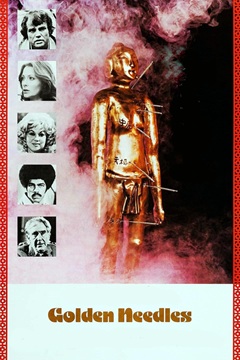 An ancient Chinese statue contains several acupuncture needles that, when placed correctly, can grant a man unstoppable vim and vigor. It can also grant amazing sexual prowess, which is why every elderly crime boss in the world wants it. In Hong Kong, a group of flamethrower-toting thugs steal the statue so that their boss, Lin Tao (Roy Chiao), can sell the statue to a Los Angeles mobster named Winters (Burgess Meredith!). Winters’s agent in Hong Kong, Felicity (Elizabeth Ashley), decides to hire Vietnam vet Dan Mason (Joe Don Baker) to steal the statue from her so that she can not only take Winters’s money but also sell the statue herself. Mason agrees, in return for money and sex.


 Through the Shattered Lens