It’s not Christmas without the story of Ebenezer Scrooge and his visit with three ghosts. There have been numerous film versions of this story. The one below comes to us from 1938 and stars Reginald Owen in the role of Scrooge.
This version is surprisingly good, considering that it was apparently shot in a hurry. (The movie hit theaters just a few weeks after filming stopped.) Originally, Lionel Barrymore was going to play Scrooge but he had to drop out due to ill-health. Reginald Owen stepped in and gave a good performance as the famous miser.
(Barrymore himself would more or less play Scrooge a little less than ten years later in Frank Capra’s It’s A Wonderful Life.)
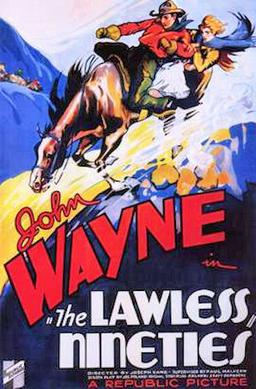
The year is 1890 and Wyoming is on the verge of voting for statehood. Newspaperman Major Carter (George “Gabby” Hayes) believes that it’s time for Wyoming to become a state and most of the locals agree with him. Businessman Charles Plummer (Harry Woods) does not want Wyoming to become a state and he’s willing to send out his main henchman, Steele (Al Bridge), to intimidate the voters and to silence Carter. Plummer has a profitable racket going and the last thing he wants is for the U.S. government to get involved in his activities. It falls to two federal agents, John Tipton (John Wayne) and Bridger (Lane Chandler), to supervise the voting and protect the citizen. When Major Carter is shot by a drunk anti-statehood activist, the mission to make Wyoming a part of the Union becomes personal.
The Lawless Nineties is typical of the B-movies that John Wayne made for Republic Pictures before John Ford resurrected his struggling career by casting him as The Ringo Kid in Stagecoach. There are plenty of gunfights and horse chases and explosions as the bad guys try to keep the townspeople from voting and the federal agents set up their own sting operation to expose Plummer’s gang. Wayne seems more relaxed here than he did in some of his other B-movies. He was obviously getting more comfortable with being on camera and playing the hero. Probably the most interesting thing about this film is that Gabby Hayes (credited as George Hayes, without his famous nickname) plays the renowned and intelligent Major Carter. Hayes was just a year away from establishing himself as a perennial B-movie sidekick and supplier comedy relief. He would soon be best-known for playing characters who had little in common with the intelligent and well-spoken Major Carter. In The Lawless Nineties, Hayes gets a chance to play something other than the comedic relief and turns out to be petty good at it.
This is another one of those westerns that will be enjoyed by fans of the genre. It’s nothing special but it does allow Wayne to show hints of his future stardom and it also gives Gabby Hayes a chance to show what he was actually capable of.
This B-western takes place in the legendry frontier town of Deadwood. It’s a town that’s patrolled by General George Custer (Addison Richards) and which is home to Wild Bill Hickok (Richard Dix) and Calamity Jane (Frances Farmer). When outlaw Jack McCall (Lon Chaney, Jr.) and his gang start disguising themselves as Sioux and start robbing stagecoaches, young homesteader Jim Holliday (Robert Stack) is appointed town marshal. Unfortunately, Jim’s older brother, Bob (Broderick Crawford), has gotten involved with McCall and his gang. Bob has also never forgiven Jim for marrying Anne (Ann Rutherford), the woman that Bob loved. Jim struggles to get the town to take him seriously. When Jim tries to put out a fire that’s threatening to burn down several businesses, the citizens laugh at him and shoot a hole in the water hose. No one said that the people of Deadwood were smart. Ann wants to leave town but McCall and his gang are growing more brazen in their attacks and when one of Jim’ mentors is murdered, Jim has no choice but to get justice and revenge. Meanwhile, the real Sioux grow tired of being blamed every time a stagecoach is robbed and they launch their own attack on the town.
Though the plot may be predictable, Badlands of Dakota is memorable for the cast that was assembled to bring its familiar story to life. Along with those already mentioned, the cast also includes Andy Devine as a saloon owner, Hugh Hubert as the town drunk, Fuzzy Knight as the town’s stagecoach driver, and the folk band, The Jesters, as the town’s entertainment. They all do their part to bring the town of Deadwood to life. Frances Farmer steals the film with her tough and unsentimental portrayal of Calamity Jane and Lon Chaney, Jr. is an effectively hard-edged villain. This was one of Robert Stack’s first films and he’s appropriately stiff and upright as Jim. Jim is the only honest man in Deadwood, which also means that Jim is fairly boring when compared to everyone else around him. It’s also difficult to accept him as being Broderick Crawford’s younger brother, though Crawford does a good job of portraying the personal betrayal that Bob feels when he discovers that Jim has married Anne.
Not surprisingly, Badlands of Dakota plays havoc with history. This is especially true when it comes to Addison Richards’s sober and reasonable portrayal of a middle-aged General Custer. (The real-life General Custer died when he was only 36 and could reportedly be slightly erratic. Not to mention, Custer died the same year that Deadwood was founded so it’s doubtful that he ever visited the city, much less had a personal friendship with Wild Bill Hickok and Calamity Jane.) Still, there’s a lot here to entertain fans of B-westerns. Along with all of the familiar faces in the cast, there’s also a sequence with an out-of-control stage coach that makes good use of rear projection and the film’s final gun battle is exciting and well-directed. It’s a quick 76 minutes, full of all the action and bad history that a western fan could hope for.
On this date, in 1813, Jane Austen’s Pride and Prejudice was first published. The book was published Thomas Egerton, who bought the rights for £110. Apparently, Austen didn’t expect the book to become the success that it did. As a result, she ultimately only made £140 off of the book. (Egerton made considerably more.) When the book was originally published, Austen’s name was nowhere to be found on the manuscript. Instead, it was credited to “the author of Sense and Sensibility.”
(When Sense and Sensibility was originally released, it was simply credited to “A Lady.”)
The rest, of course, is history. 205 years after it was first published, Pride and Prejudice remains one of the most popular and influential novels ever written. Every year, new readers discover and fall in love with the story of outspoken Elizabeth Bennet, the proud Mr. Darcy, the pompous Mr. Collins, and the rather sleazy George Wickham. There have been countless film and television adaptations. My personal favorite is Joe Wright’s 2005 version, with Keira Knightley as Elizabeth. My least favorite would have to be Pride and Prejudice and Zombies.
The very first film adaptation of Pride and Prejudice was released in 1940. Originally, the movie was envisioned as being a George Cukor film that would star Norma Shearer and Clark Gable. However, the film’s production was put on hold after the death of Shearer’s husband, the legendary Irving Thalberg. When the film finally resumed pre-production in 1939, Gable was now busy with Gone With The Wind. Cast in his place was Robert Donat (who, interestingly enough, would have played Rhett Butler if Gable had refused the role). With the film originally meant to be filmed in Europe, the outbreak of World War II led to yet another delay. By the time production resumed, Cukor had been replaced by Robert Z. Leonard and Norma Shearer had also left the project. With Gone With The Wind breaking box office records, MGM came up with the idea of once again casting Vivien Leigh opposite of Clark Gable. However, Gable eventually left the film and Laurence Olivier, looking for a chance to act opposite Leigh, agreed to play Darcy. However, the studio worried that casting Olivier and Leigh opposite each other would lead to negative stories about the two of them having an affair despite both being married to other people. So, Leigh was removed from the project and Greer Garson was cast. Olivier was so annoyed with the decision that, after Pride and Prejudice, it would be eleven years before he would work with another American studio.
Despite all of the drama behind-the-scenes, MGM’s version of Pride and Prejudice is a thoroughly delightful film, one full of charming performances and witty lines. Though she was 36 when she made Pride and Prejudice, Garson is still the perfect Elizabeth, giving a lively and intelligent performance that stands in stark contrast to the somewhat staid films that she was making at the same time with Walter Pidgeon. As for Olivier, from the first minute he appears, he simply is Darcy. That said, my favorite performance in the film was Edmund Gwenn’s. Cast as Mr. Bennet, Gwenn brought the same warmth and gentle humor to the role that he would later bring to Kris Kringle in Miracle on 34th Street. I also liked the performances of Maureen O’Sullivan as Jane and Edward Ashley as disreputable Mr. Wickham.
Pride and Prejudice is not an exact adaptation. For one thing, the movie takes place in the early Victoria era, supposedly because MGM wanted to cut costs by reusing some of the same costumes that were previously used in Gone With The Wind. As well, Lady Catherine (Edna May Oliver) is no longer as evil as she was in the novel. Finally, because the production code forbid ridicule of religion, the theological career of Mr. Collins (Melville Cooper) was considerably downplayed. Not even Jane Austen (or, more specifically, the film’s screenwriter, Aldous Huxley) could defy the Code.
Seventy-eight years after it was first released, the 1940 version of Pride and Prejudice holds up surprisingly well. It’s an enjoyable film and one that, despite a few plot changes, remains true to the spirit of Austen.


 Through the Shattered Lens