I can still remember the first time that I saw the 1973 film, Messiah of Evil.
It was on a Monday night, many years ago. I had recently picked up a 10-movie DVD box set called Tales of Terror and I was using the movies inside to try to deal with a bout of insomnia. I had already watched The Hatchet Murders (a.k,a. Deep Red) and The House At The Edge of the Park and, at two in the morning, I was faced with a decision. Should I try to sleep or should I watch one more movie?
Naturally, I chose to watch one more movie and the movie I picked was Messiah of Evil. So, there I was at two in the morning, sitting at the edge of my bed in my underwear and watching an obscure horror movie while rain fell outside.
And, seriously — this movie totally FREAKED me out!
Messiah of Evil opens with a man (played by future director Walter Hill) stumbling through the night, obviously trying to escape from something. A mysterious woman appears and kills him. We’re left to wonder who the man was supposed to be as the film doesn’t ever really return to his murder. In most films this would be a weakness but it feels appropriate for Messiah of Evil, a film that plays out with the visual style and fragmented logic of a particularly intense nightmare.
The rest of the story tells the story of Arletty (Marianna Hill), a neurotic woman who drives to an isolated California town in order to visit her father. Her father is an artist who specializes in painting eerie pictures of large groups of black-clad people. However, once she arrives at his home, Arletty discovers that her father has vanished and left behind a diary where he claims that a darkness has overtaken the town. Meanwhile, it sometimes appear as if the people in the paintings are moving or threatening to come out of the walls.
Meanwhile, one crazed man (Elisha Cook, Jr.) explains that “the dark stranger” is returning. An albino (Bennie Robinson) drives a truck up and down the street and talks about how he likes to listen to “Wagner.” The back of the truck is full of blank-faced people staring at the sky and the Albino eats a rat. Finally, a mysterious man named Thom (Michael Greer) is wandering about town with two groupies (played by Anitaa Ford and Joy Bang) and interviewing random townspeople. After meeting Arletty, they all end up moving into her father’s house.
Messiah of Evil is literally one of the strangest films that I’ve ever seen. It’s shot in a dream-like fashion and the much of the film is left open to the viewer’s interpretation. Joy Bang goes to see a Sammy Davis, Jr. western and doesn’t notice as the theater slowly fills up with pale, red-eyed townspeople. Anitra Ford goes to a grocery store late at night and discovers the townspeople indulging in their appetites. If the film was only distinguished by those two scenes, it would still be worth saying. However, Messiah of Evil is a total and complete experience, a film where every scene matters and the audience is tasked with putting the puzzle together.
This film was directed by Gloria Katz and Willard Huyck, two longtime associates of George Lucas. (They wrote the screenplay for American Graffiti and Huyck directed Howard The Duck.) There’s absolutely nothing else in their filmography that is as surreal as Messiah of Evil, leading me to suspect that the film itself might be a very fortunate accident. Apparently, the production ran out of money before Katz and Huyck finished principal photography, which is what led to the film’s disjointed nature. Accident or not, Messiah of Evil is a masterpiece of surreal horror.
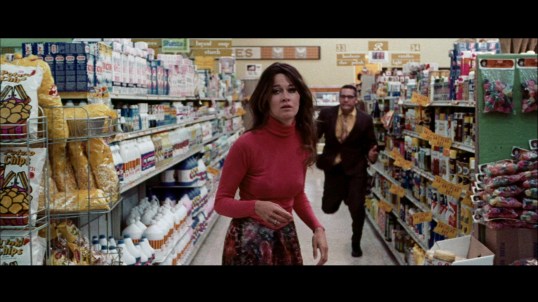
Messiah of Evil (1973, directed by Willard Huyck and Gloria Katz)


 Through the Shattered Lens