
“She said that people tried to be good. But they were really sick and rotten on the inside, her most of all. And every time she tried to make the world a better place, something terrible came up inside her and pulled her back down into hell, and took her deeper and deeper into the blackest nightmare. Each time it got harder to go back up to the light.”
— Bobby Briggs (Dana Ashbrook) in Twin Peaks 1.6 “Cooper’s Dreams”
Hi, everyone! Well, though it wasn’t specifically planned, we’ve got a bit of David Lynch festival going on here at the site. Not only are Leonard, Jeff, and I reviewing every single episode of Twin Peaks (in anticipation of next month’s Showtime revival) but right now, Jeff is focusing on movies with a Twin Peaks connection for his Movie A Day feature and Val is currently highlighting the various music videos that Lynch has directed over his career. And, while we’re on the topic, Erin put together an artist profile for David Lynch a few years back. Be sure to check them all out if you haven’t already!
As for the sixth episode of Twin Peaks, I have to admit that I was really excited when I saw that it was called “Cooper’s Dreams.” OH MY GOD, I thought, MORE DREAMS! YAY! So, you can imagine my surprise when I watched the episode and Cooper did not have a dream. Apparently, David Lynch and Mark Frost made the specific decision not to title any of their episodes. Instead, they just called them “Episode 5,” “Episode 6,” and so on. It was ABC that assigned and came up with the title for each episode. Some the titles they came up with were pretty good. (I will always love the sound of Zen, Or the Skill To Catch a Killer.) Other titles, like “Cooper’s Dreams,” were just kind of there.
(That said, the title isn’t totally random. It does ultimately work for this episode.)
With all that in mind, let’s take a look at Cooper’s Dreams!

We open with the opening credits. Yes, I know that’s redundant but I will always mention the opening credits because I love them so much. After watching the opening credits, you literally feel like you could step outside and find yourself in the town of Twin Peaks. They are quite simply amazing.
The show begins with a shot of a blood-red full moon, the same moon that hung over the end of the previous episode. On the soundtrack, we hear singing. Lots and lots of singing. It turns out that there’s a bunch of drunk businessmen from Iceland at the Great Northern and they’re currently celebrating some sort of beer holiday. They’ve managed to wake up Dale Cooper (Kyle MacLachlan). For the first time since the series began, we get to see Dale actually peeved about something and it’s a wonderfully funny moment, even though it is also used to highlight one of the key themes in the series. Grabbing his tape recorder, Cooper announces that this proves that “once a traveler leaves home, he has lost 100% of his ability to control his environment.” The inability to control a previously undiscovered and unknown environment is, in many ways, the engine that keeps this show moving.
Why are the Icelandic businessmen at the hotel? Again, it has to do with the Horne Brothers and their attempts to try to attract developers to the town. Since their deal with the Norwegians fell through, Ben (Richard Beymer) and Jerry (David Patrick Kelly) have moved on to Iceland. When I reviewed the pilot, I speculated that the Norwegians were meant to be a reference to Henrik Ibsen, who was the David Lynch of his day. However, after doing hours of research, I honestly can’t come up with any subtext to the use of Iceland in this episode. My best guess, quite frankly, is that no one ever expects a bunch of Icelandic businessmen to show up at a hotel in upstate Washington.
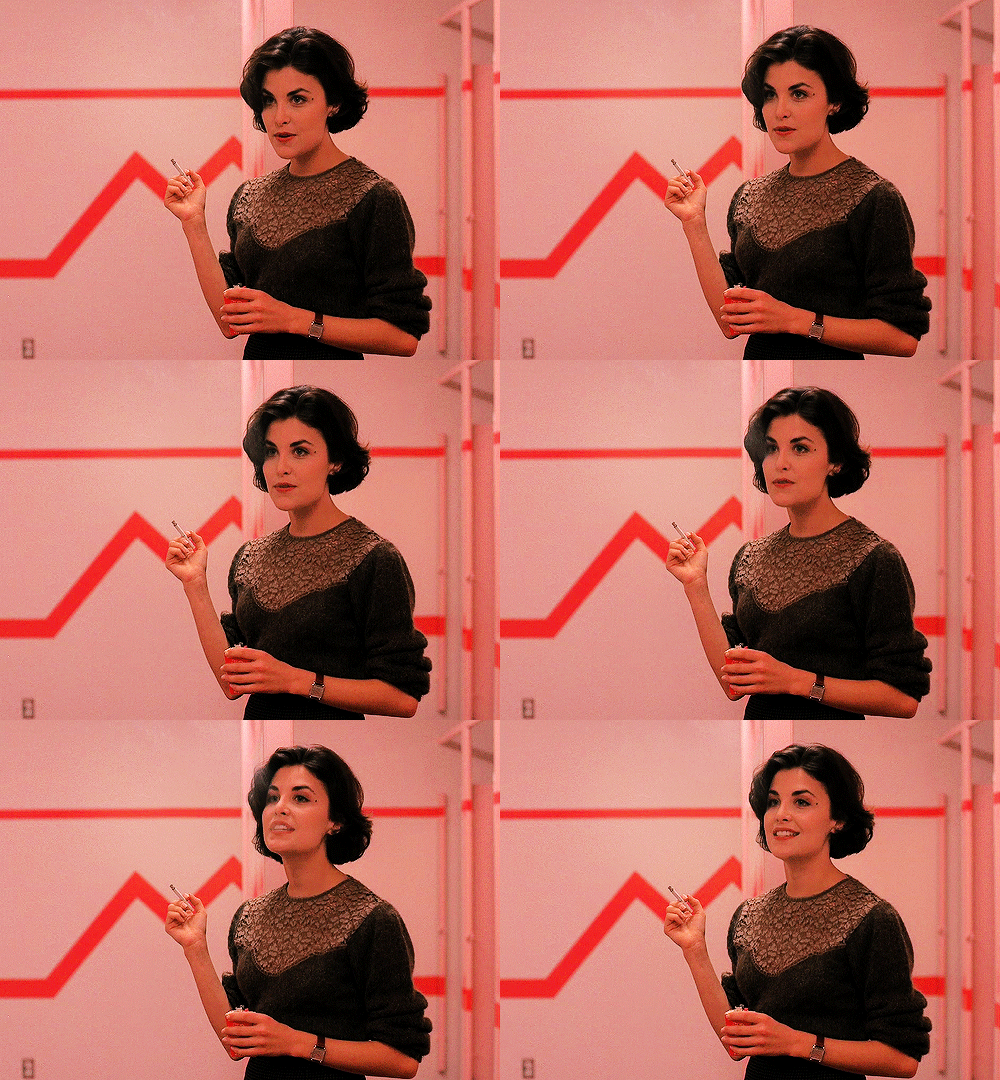
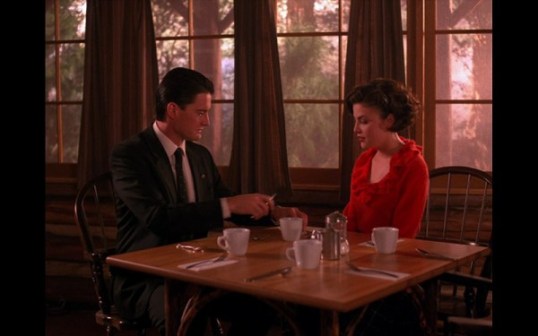
The next morning, a grouchy Agent Cooper drinks coffee and complains to his waitress about his lack of sleep. Audrey (Sherilyn Fenn) sits down at his table and tells him that she’s gotten a job at her father’s store and wonders if she could help Cooper investigate Laura’s death.
“When I was your age, Wednesday was traditionally a school day,” Cooper says, reminding us all that he’s essentially a man out of time.
Audrey picks up on this, telling him that she finds it hard to believe that Cooper was ever her age. She then mentions that she’s 18. In other words, perfectly legal.

In his office, Ben talks to Jerry. Jerry is super excited, as usual. Ben is worried about business, as usual. Jerry announces that the Icelanders are “insane for the Ghostwood Estate projects!” (The name Ghostwood is interesting, considering that the woods around Twin Peaks appear to be literally haunted.) Ben and Jerry’s celebration is interrupted by the arrival of Leland Palmer (Ray Wise). As usual, Leland is distraught. He says that, as Ben’s attorney, he needs to be a part of the Iceland deal. Obviously, neither Ben nor Jerry want him freaking out the Icelandic businessmen with talk of his dead daughter and they both try to convince him to go on a trip somewhere. While Leland sobs, another Icelandic drinking song begins in the background. Of all the characters on Twin Peaks, Leland’s grief is always the most raw. While we’re not surprised by the venality of the Horne brothers, even sympathetic characters rarely seem to know how to respond to Leland.
(Of course, there’s a deeper and more disturbing reason behind Leland’s breakdown but that will have to wait for a later review.)
As I watched this scene unfold, I once again found myself thinking about how impressive the production design of Twin Peaks was. I really love Ben’s all-wood office. Even Ben’s nameplate is carved out of wood.
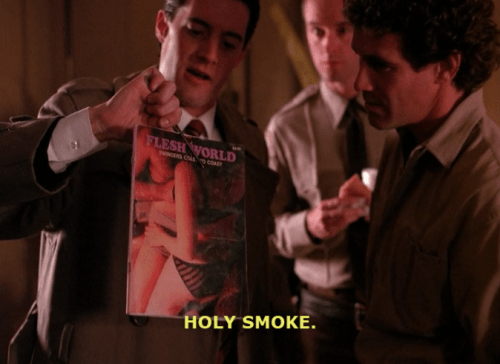
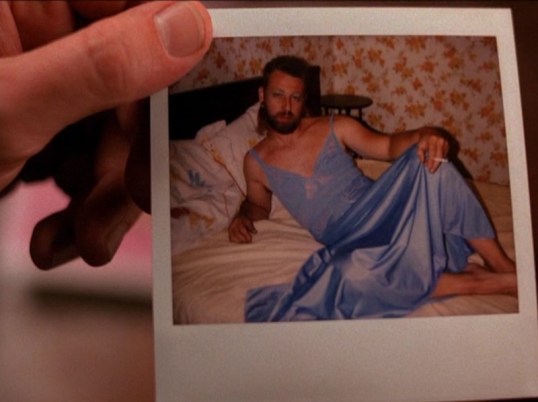
Meanwhile, at Jacques Renault’s apartment, the investigation continues. Harry (Michael Ontkean) tells Dale that Renault can’t be found and neither can his brother, Bernie. Doc Hayward (Warren Frost) confirms that the blood found on Leo’s shirt was not Laura Palmer’s. Instead, it was Jacques Renault’s. Dale isn’t surprised by any of this. Instead, he’s more interested in the copy of Flesh World that Jacques had hidden up in his ceiling. Flesh World was the magazine that featured both a “personal ad” from Ronette Pulaski and a picture of Leo Johnson’s truck. This copy of Flesh World contains a letter that was mailed to Ronette from Georgia. The letter comes with a picture of a bearded man wearing a blue night gown. “That’s no Georgia peach,” Harry says.
Oh, Harry. Never change.
 Back the Johnson House, Shelly (Madchen Amick) and Bobby Briggs (Dana Ashbrook) are playing with her pistol and role playing various scenarios that involve forcing Leo to cook before shooting him. At the risk of being unpopular, I have to admit that I really like Shelly and Bobby as a couple. Yes, they’re both unlikable and sleazy and they’re both trying way too hard to frame Leo for Laura’s murder. But, even with all that in mind, they just seem like they belong together. Maybe it’s just because they’re both so pretty. Who knows?
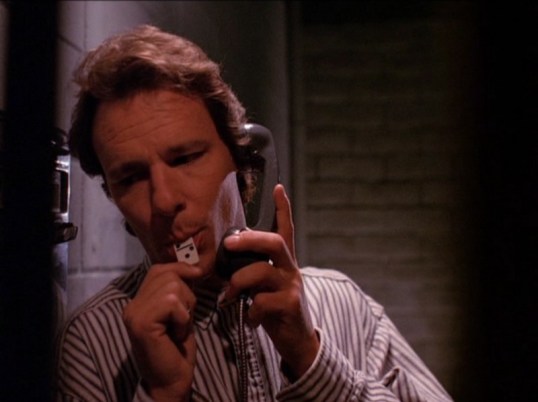
Shelly and Bobby’s fun gets interrupted twice. First, Andy (Harry Goaz) drops by and, while Bobby hides, Shelly says that she overheard Leo having an argument with Jacques. Immediately after Andy leaves, Leo calls. Leo wants to know if anyone’s looking for him. Shelly assures him that no one is and begs him to hurry on home, all the while staring down at the gun in her hand.
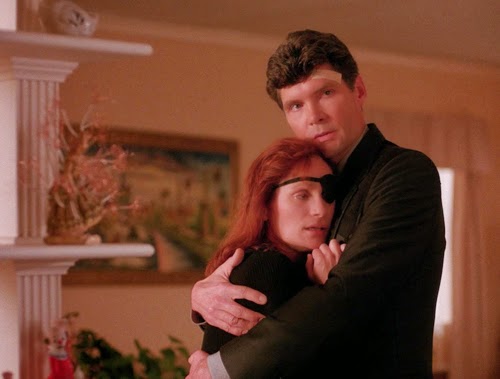
Meanwhile, Norma (Peggy Lipton) and Ed (Everett McGill) are having relationship drama of their own. Norma stops by the auto yard to tell Ed that Hank’s (Chris Mulkey) gotten parole and is coming home. Ed mentions that Nadine (Wendy Robie) is meeting with a patent lawyer. “The silent drape runners?” Norma asks. I don’t know what Norma’s being so snarky about. Silent drape runners sound like a great invention to me! Anyway, Ed and Norma decide to give up on their relationship. The scene veers a bit too close to getting a bit too mawkish but Angelo Badalamenti’s theme music saves it.
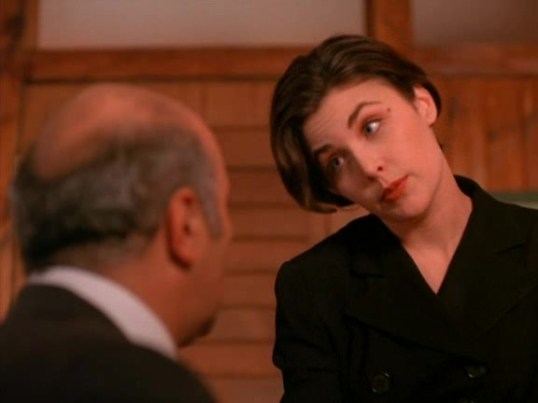
At Horne’s Department Store, the manager makes the mistake of trying to assign Audey to a position other than the perfume counter. Audrey replies that if she doesn’t get to work where she wants to work, she’s going to rip her dress, scream, and tell everyone that he made a pass at her. Perfume counter it is!
Meanwhile, Donna Hayward (Lara Flynn Boyle) meets James Hurley (James Marshall) at a lakeside gazebo and, as I watched them talk, I found myself wondering if maybe Cooper didn’t have a point earlier. Audrey’s at the department store, blackmailing her way to a sales job. Bobby is playing with Shelley. James and Donna are at the gazebo. Does anyone in this town go to school!? I guess Mike (Gary Hershberger) is probably there, pushing freshmen into lockers and leering at cheerleaders. But otherwise, Twin Peaks High School is probably close to being deserted by this point.
Anyway, James tells Donna that his father was a musician and his mother was a writer and that neither one of them was a good parent. He wants his relationship with Donna to be an honest relationship. In my research of this show, I’ve seen a lot of criticism of James Marshall’s performance in the role of James Hurley. Personally, I think Marshall did the best that he could do with a character who tended to be a bit of a drag. All things considered, James Hurley could be a little bit whiny. I mean, yes, his parents sucked. But his uncle is willing to do anything for him. His beautiful girlfriend may have been murdered but now he has a new beautiful girlfriend. Nobody thinks that he murdered Laura. And he apparently never has to actually go to school. Cheer up, James!
(I read an interesting interview with James Marshall where he said that James Hurley started out as the cool James Dean of Rebel Without A Cause, just to become the weepy James Dean of East of Eden. That’s the perfect way to put it so give Marshall some credit for that.)
Back at Jacques’s apartment, we’re reminded why the police are too busy to enforce the truancy laws. They’ve got a murder to solve! Searching the apartment, Dale finds pictures of a cabin that has red curtains (just like the curtains from his dream). He realizes that the curtains are also visible in one of the personal ads in Flesh World, an ad that, like Ronette’s, was apparently placed by Jacques Renault. Though her face isn’t visible, Dale deduces that the picture with the red curtains features Laura Palmer. Hawk (Michael Horse) mentions that the Renault brothers have a cabin on the border. Dale suggests that everyone pack a lunch and prepare for a walk around the woods.
(I have to admit that, during this scene, I kept getting distracted by the painting of a sad clown hanging on the wall. I found myself wondering it was the same sad clown who used to show up whenever I would play The Sims. I hated that clown and, whenever he would show up, I would always lead him into a room with a fireplace, delete the door, place a dozen rubber trees in front of the fireplace, and then light a fire. You do what you have to do when it comes to sad clowns.)
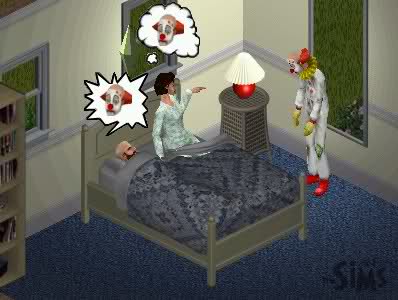
Go to Hell, Sad Clown!
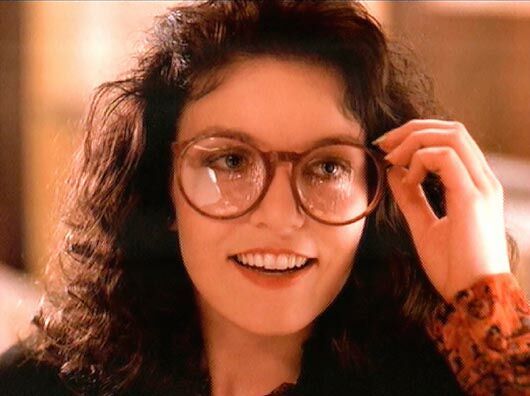
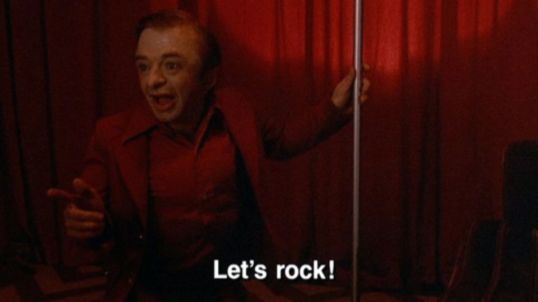
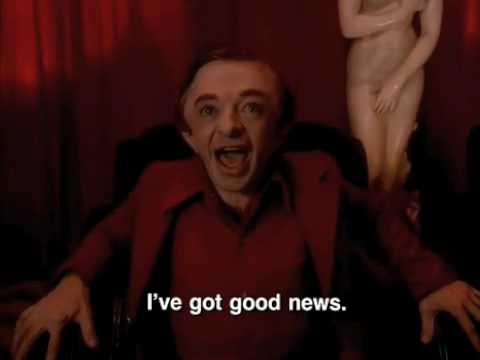
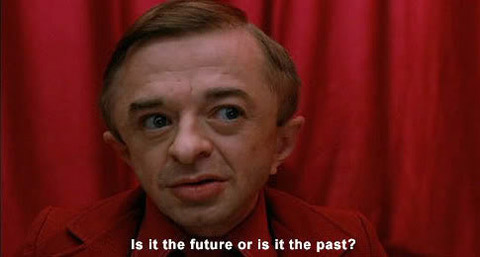
At the Double R Diner, James and Donna have a meeting with Maddy (Sheryl Lee) and her oversized red glasses. Maddy is one of those characters who I always struggle with. She is way too cheerful for own good but I think that may have been intentional. Whenever she smiles and innocently says that everyone says that she and Laura were exactly alike, it’s a reminder that Laura Palmer was not at all who people thought she was. Laura was, to quote the Man From Another Place, full of secrets. Cheerful, happy Maddy is who everyone assumed Laura was but Maddy is also never as interesting a character as Laura was. Maddy’s fatal flaw will ultimately prove to be that she has no secrets and therefore, no understanding of just how dangerous the world can be. Anyway, Donna and James tells Maddy that they want to solve Laura’s murder. Maddy agrees to help.
Far more interesting is the interaction between Hank and Norma. Having just gotten out of jail, Hank is hanging out at the diner when Norma and Shelly come in. Both Norma and Shelly have gotten makeovers and now look like they should be posing for Diane Arbus. Hank tells Norma that he won’t try to kiss her. He wants to earn his place back in her heart. Even though I know Hank’s a bad guy, Chris Mulkey gives such a charming performance that I can’t help but like him.
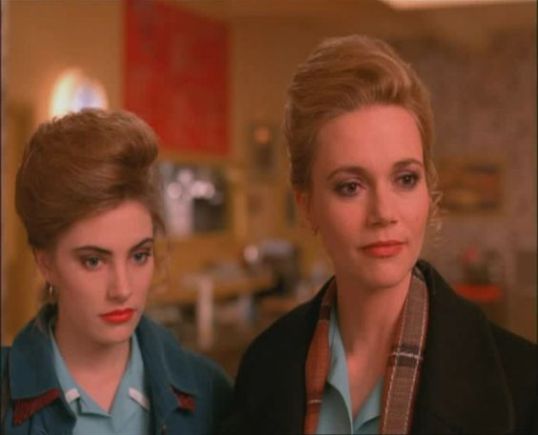
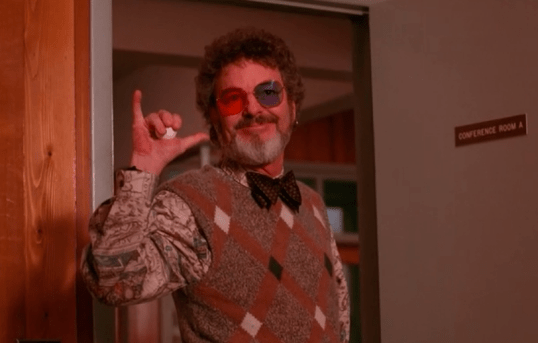
Meanwhile, it’s family counseling with the Briggs family! Bobby, his military father (Don S. Davis), and his cross-wearing mother (Charlotte Stewart) are meeting with Dr. Jacoby (Russ Tamblyn). Jacoby is wearing a tie with a turtle neck sweater. Let that sink in.

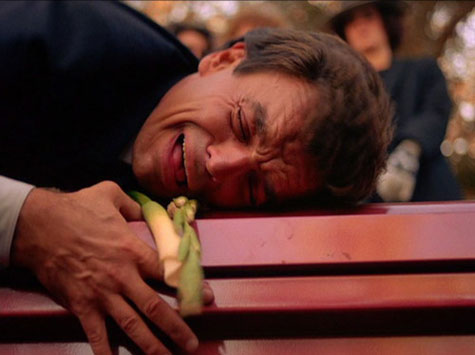
Despite Jacoby’s sartorial missteps, this is one of the best scenes in the entire episode. Jacoby sends Maj. and Mrs. Briggs out of the office and has a one-on-one discussing with Bobby. As they talk, it becomes apparent that Jacoby’s main interest is in finding out about Bobby’s relationship with Laura. Because Jacoby was secretly treating Laura, he knows exactly what to ask Bobby to get a reaction. Jacoby is not only investigating Laura’s death but he’s also taunting a romantic rival and, ultimately, actually helping Bobby have a breakthrough. For the first time, Bobby cries and shows some sign that he actually has human feelings. Both Tamblyn and Ashbrook give amazing performances in this scene.
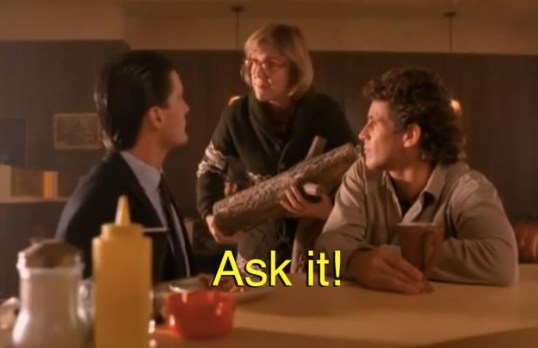
In the woods, Cooper, Harry, Hawk, and Doc Hayward (who I guess is some sort of cop now) search for the cabin. They find a cabin but it’s not the cabin that they’re looking for. Instead, it belongs to … THE LOG LADY (Catherine E. Coulson). YAY! The Log Lady will explain everything.
“Come on in,” The Log Lady says, “My log does not judge.”
Inside the cabin, the Log Lady adds, “Shut your eyes and you’ll burst into flame.”
“Thanks, Margaret,” Harry replies.

The Log Lady, who wears the same oversized red glasses as Maddy, says that 1) they’re two days late and 2) that her log saw something significant. The Log Lady assures her log that she’ll do the talking and then says that, the night Laura Palmer was murdered, the log was aware of many things. The owls were flying. There were two men. There was much laughing. Two girls. A flashlight passing the bridge. “The owls were near,” the Log Lady says, “the dark was pressing in on her.” Eventually, the owls were silent.
After leaving the Log Lady, Dale says that the two girls were Ronette and Laura. And the two men? Jacques and Leo? Or could it be that the two men are symbols of something far more disturbing?
The group finally comes across the cabin with red curtains. Inside,a record player plays the haunting sound of Julie Cruise singing about the night and Dale remembers the Man from Another Place saying that, where he and Laura are from, there’s always music in the air. There’s no sign of Jacques but there is a camera. And a myna bird named Waldo.
According to the Netflix subtitles, the next scene begins with people “Singing Home On The Range In Icelandic.” We’re back at the Great Northern Hotel. Like a femme fatale in a film noir, Josie (Joan Chen) sits in the shadows of an office and smokes a cigarette.

Jerry Horne announces that they are all Icelanders.
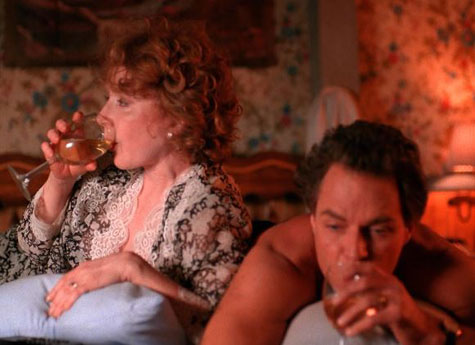
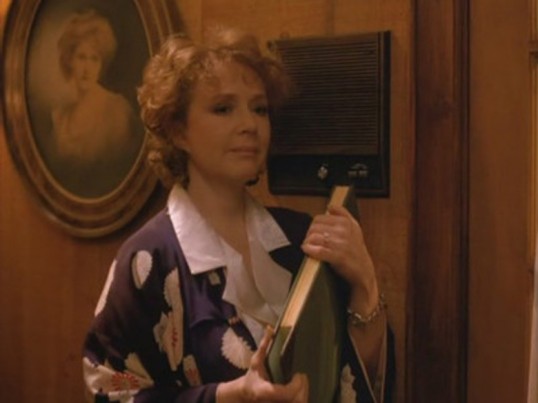
Meanwhile, in the Great Timber Room (everything’s about wood), a reception is being held for the Icelandic businessmen. The Horne Brothers have invited the best and brightest of Twin Peaks. Catherine (Piper Laurie) and Pete (Jack Nance) show up. Jack tells Catherine to go easy on the alcohol so Catherine immediately orders a drink.
Ben talks to the businessmen. He says, “What do you get when you cross a Norwegian with a Swede? A socialist who wants to be king!” I’ll be sure to remember that joke in case I ever find myself trapped in an elevator with a Bernie Sanders supporter.
Catherine and Ben meet in Ben’s office, little realizing that they’re being watched by Audrey. Apparently, the Great Northern is full of secret passages and Audrey, being a badass, knows about every single one of them. But even beyond the fun of a secret passage, this gets back to something that I’ve been saying since my very first review of Twin Peaks. This show is about the unknown that lies underneath the facade of normalcy. Just as it’s inevitable that Laura Palmer would be full of secrets, it’s inevitable that the all-wood Great Northern would be full of secret passages.
(The scene of Audrey crouches in front of a peephole also is a nice visual shout out to Psycho.)
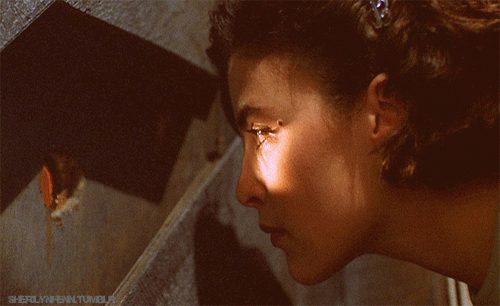
Audrey discovers that Catherine is upset because Ben had a poker chip from One-Eyed Jacks in his suit. Audrey’s smile as she watches Catherine slap Ben is one of the main reasons why I relate so much to Audrey. Like me, she loves to observe the melodrama while, at the same time, remaining slightly detached from what’s actually happening. By observing through a peephole, she mimics what every viewer is doing while they watch Twin Peaks unfold on a screen, regardless of whether that screen belongs to a TV, a laptop, or a phone. Audrey is the audience. She loves Cooper because, in the tradition of Gary Cooper, he’s the perfect cinematic hero and the audience always loves the hero. She wants to know who killed Laura less out of a sense of justice more out of a need for the story she’s watching to have a proper conclusion. Audiences always demand a perfect and proper conclusion.
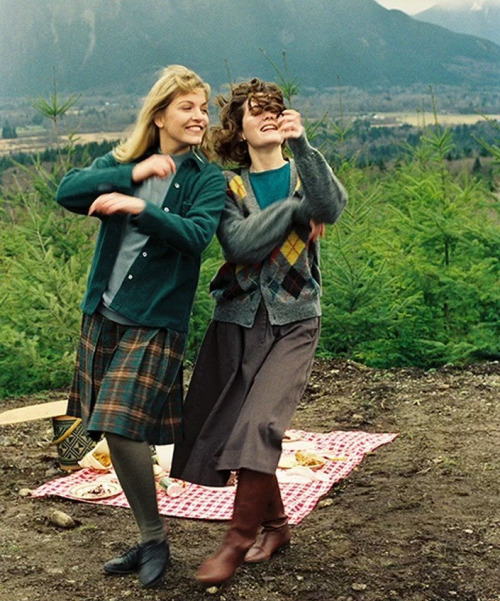
Uh-oh, Leland’s shown up at the party! And he’s dancing! And sobbing! Catherine runs out onto the dance floor and starts to dance with him, a big smile plastered across her face. When Leland starts to pound his fists against his head, Catherine mimics him but she does it with a smile. The Icelandic visitors start to dance as well. Soon everyone is beating their head and laughing, except for Leland who is still sobbing. It’s a whole new party and again, as always, Leland is pushed to the side. Significantly, it is Audrey — who was so detached just a few minutes ago — who watches Leland and starts to cry. Again, she is the audience, suddenly touched by Leland’s plight. She alone understands the scene that she’s watching. This scene is Twin Peaks at its absolute best, a combination of raw emotion and painfully dark comedy.

At the Palmer House, Maddy calls Donna that she found an audio tape in Laura’s bedroom. They agree to meet tomorrow and listen to it. Sure, why not? What else are they going to do? Go to school?
Back at the Great Northern, Ben is having a secret meeting with … JOSIE PACKARD! OH MY GOD, COULD IT BE JOSIE IS NOT AN INNOCENT AS WE ALL THOUGHT? Well, yeah. It’s Twin Peaks after all.
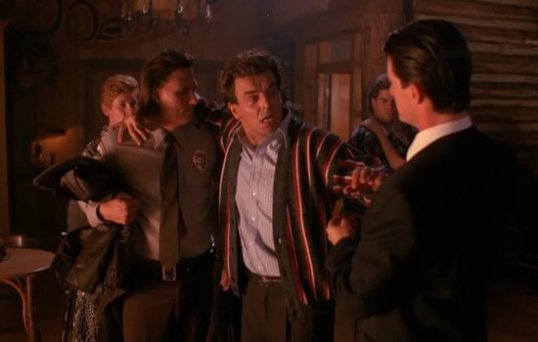
At the Johnson House, Leo finally returns. First Hank shows up and beat him up, yelling at him for mismanaging their drug business. When Leo tries to take it out on Shelly, she shoots him. Good for Shelly.
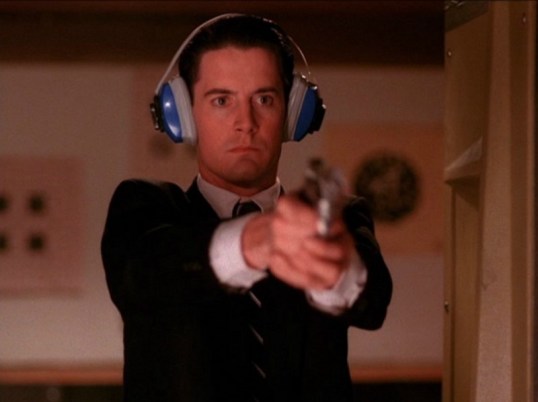
Dale finally arrives back at his room. He’s annoyed to hear that the Icelandic singing is still continuing. He’s even more annoyed when he realizes that someone is waiting for him in his dark room. He draws his gun. “Turn on the light!” he announces.
The light comes on and … there’s a naked Audrey in his bed! “Please, don’t make me leave,” she says.

With that, the episode ends. This is one of those episodes that starts out a little bit slow but, by the end, it actually becomes a classic. Between the Jacoby therapy session, the meeting with the Log Lady, and Leland’s dance, this was ultimately Twin Peaks at its best.
Up next: “Realization Time”
Previous Entries in The TSL’s Look At Twin Peaks:
- Twin Peaks: In the Beginning by Jedadiah Leland
- TV Review: Twin Peaks 1.1 — The Pilot (dir by David Lynch) by Lisa Marie Bowman
- TV Review: Twin Peaks 1.2 — Traces To Nowhere (directed by Duwayne Dunham) by Jedadiah Leland
- TV Review: Twin Peaks 1.3 — Zen, or the Skill To Catch A Killer (dir by David Lynch) by Lisa Marie Bowman
- TV Review: Twin Peaks 1.4 “Rest in Pain” (dir by Tina Rathbone) by Leonard Wilson
- TV Review: Twin Peaks 1.5 “The One-Armed Man” (directed by Tim Hunter) by Jedadiah Leland







 Through the Shattered Lens