Film Review: The Bounty (dir by Roger Donaldson)


Oh, poor Captain Bligh.

For those who recognize the name, it’s probably because they’ve either read a book or seen a film that portrayed him as being the tyrannical captain of the HMS Bounty.  In 1787, William Bligh and the Bounty set off on a mission to Tahiti.  When, after ten months at sea, the Bounty arrived in Tahiti, the crew immediately fell in love with the relaxed pleasures of island life.  When Bligh ordered them to leave Tahiti and continue with their mission, his own second-in-command led a mutiny.  Bligh and the few men who remained loyal to him were set adrift in a lifeboat while Christian and the mutineers eventually ended up settling on Pitcairn Island.  Against impossible odds, Bligh managed to make it back to civilization, where he faced both a court-martial and a future of being portrayed as a villain.

Though most historians agree that Bligh was a knowledgeable and talented (if strict) captain and that the mutiny had more to do with Christian’s desire to remain in Tahiti than Bligh’s treatment of the crew, most adaptations of what happened on the Bounty have laid the blame for the mutiny squarely at Bligh’s feet.  Personally, I think it has to do with the names of the people involved.  William Bligh just sounds evil, in much the same way that the name Fletcher Christian immediately brings to mind images of heroism.  In 1935’s Mutiny On The Bounty, Charles Laughton portrayed Bligh as being a viscous sadist.  In 1962’s Mutiny in the Bounty, Trevor Howard portrayed Bligh as being an overly ambitious martinet, though ultimately Howard was overshadowed by Marlon Brando, who gave a bizarrely mannered performance in the role Christian.

In fact, it would seem that there’s only one film that’s willing to give William Bligh the benefit of the doubt.  That film is 1984’s The Bounty.

The Bounty opens with Bligh (played by Anthony Hopkins) facing a court-martial for losing the Bounty.  That the admiral presiding over Bligh’s court-martial is played by Laurence Olivier is significant for two reasons.  Olivier’s stately and distinguished presence lets us know that the mutiny was viewed as being an affront to British society but it also reminds us that Hopkins began his career as Olivier’s protegé.  Much as how William Bligh was a star of the British navy, Hopkins was (and is) a star of British stage and screen.  One gets the feeling the scene isn’t just about the admiral judging Bligh.  It was also about Olivier judging Hopkins as the latter played a role that had already been made famous by two other great British thespians, Charles Laughton and Trevor Howard.

By opening with Bligh on trial, The Bounty allows itself to be told largely through Bligh’s point of view.  We watch familiar events play out from a new perspective.  Once again, it takes longer than expected for Bligh and the Bounty to reach Tahiti and, once again, Bligh’s by-the-book leadership style alienates a good deal of the crew.  However, this time, Bligh is not portrayed as being a villain.  Instead, he’s just a rather neurotic man who is trying to do his duty under the most difficult of circumstances.  Bligh knows that the crew blames him for everything that goes wrong during the voyage but he also knows that the only way their going to survive the journey is through maintaining order.

In fact, the film suggests that Bligh’s biggest mistake was promoting Fletcher Christian (Mel Gibson) to second-in-command.  Christian is portrayed as being good friends with Bligh and one gets the feeling that Bligh promoted him largely so he would have someone to talk to.

The film does a good job contrasting the dank claustrophobia of the Bounty with the vibrant beauty of Tahiti.  When the crew first lands, Bligh proves his diplomatic skills upon meeting with the native king.  However, it quickly becomes apparent that, while Bligh views the stop in Tahiti as just being a part of the mission, the majority of the crew view it as being an escape from the dreariness of their lives in Britain.  For the first time in nearly a year, the crew is allowed to enjoy life.  When Bligh eventually orders the crew to leave Tahti, many of the men — including Christian — are forced to abandon their native wives.

Unfortunately for Bligh, he doesn’t understand that his crew has no desire to return to the dreariness of their old life, either on the Bounty or in the United Kingdom.  Bligh’s solution to the crew’s disgruntlement is to become an even harsher disciplinarian.  (Bligh is the type of captain who will order the crew to clean the ship, just to keep them busy.)  However, Bligh no longer has Christian backing him.  When the inevitable mutiny does occur, Bligh seems to be the only one caught by surprise.

Anthony Hopkins gives a performance that turns Bligh into a character who is, in equal amounts, both sympathetic and frustrating.  Bligh means well but he’s so rigid and obsessed with his duty that he can’t even being to comprehend why his crew is so annoyed about having to leave Tahiti.  Since Bligh can’t imagine ever loving anything more than sailing, it’s beyond his abilities to understand why his men are so obsessed with returning to Tahiti.  Hopkins portrays Bligh as being not evil but instead, rather isolated.  He knows everything about sailing but little about emotion or desire.  Ironically, the same personality traits that led to him losing the Bounty are also key to his survival afterward.  By enforcing discipline and emphasizing self-sacrifice, Bligh keeps both himself and the men who stayed loyal to him alive until their eventual rescue.

Interestingly, Mel Gibson portrayed Christian as being just as neurotic as Bligh.  In fact, if Bligh and Christian have anything in common, it would appear to be they’re both obsessed with what the crew thinks of them.  Whereas Bligh is obsessed with being respected, Christian wants to be viewed as their savior.  When the mutiny finally occurs, Christian gets an almost messianic gleam in his eyes.  While Christian is not portrayed as being a villain (and, indeed, The Bounty is unique in not having any cut-and-dried villains and heroes), Gibson’s portrayal is certainly far different from the heroic interpretation offered up by Clark Gable.

(The rest of the cast is full of familiar British character actors, along with a few future stars making early appearances.  Both Daniel Day-Lewis and Liam Neeson appear as members of the Bounty’s crew.  One remains loyal to Bligh while the other goes with Christian.  Watch the movie to find out who does what!)

The Bounty is best viewed as being a character study of two men trying to survive under the most trying of conditions.  Just as Bligh’s personality made both the mutiny and his survival inevitable, the film suggests that everything that made Christian a successful mutineer will also make it impossible for him to survive for long afterward.  Whereas Bligh may have been a poor leader but a good diplomat, Christian proves to be just the opposite and the king of Tahiti makes clear that he has no room on his island for a bunch of mutineers who will soon have the entire British navy looking for them.  Whereas Bligh makes it back to Britain, Christian and the mutineers are forced to leave Tahiti a second time and end up settling on the previously uncharted Pitcairn Island.  (Of course, no one knows for sure what happened to Christian after the mutineers reached Pitcairn Island.  The last surviving mutineer claimed that Christian was murdered by the natives who were already living on the island.)

The Bounty has its flaws.  There are some pacing issues that keep the film from working as an adventure film and a few of the actors playing the crew aren’t quite as convincing as you might hope.  (If you only saw him in this film, you would never believe that Daniel Day-Lewis is a three-time Oscar winner.)  But it’s still an interesting retelling of a familiar story and it’s worth watching for the chance to see one of Anthony Hopkins’s best performances.


A Movie A Day #3: The Firm (1989, directed by Alan Clarke)


the-firm1The Firm, which should not be confused with the John Grisham novel or the Tom Cruise film adaptation, was a 70-minute film about football hooliganism that was made for the BBC’s Screen Two in 1989.  In the United States, it has never really been understood just how big a problem football hooliganism was in the United Kingdom in the 1980s.   That’s because, despite the best efforts of ESPN, most Americans don’t care about soccer.  In America, “soccer riot” sounds like the punchline of a bad joke.  But in Europe, it was a very real problem.  If you want to understand why some people call football hooliganism “the English Disease,” The Firm is the film to see.

Clive “Bex” Bissell (Gary Oldman) has a nice home, a well-paying job as an estate agent, a loving wife (played by Lesley Manville, who actually was married to Oldman at the time), a newborn son, and a large circle of friends.  He’s also the head of the Inner City Crew, a violent group of football hooligans (known as a firm) who follow West Ham United across Britain and pick fights with other firms.  (Bex is actually a second-generation football hooligan and his father is constantly complaining that the new generation isn’t tough or violent enough.)  Bex does it for the buzz.  As another member of the ICC puts it, after listening to a fatuous television commentator going on about how football hooligans are actually searching for some sort of larger meaning in their lives,  “Why doesn’t he just say that we like hitting people?”  With the 1988 European Championships coming up, Bex wants to unite all the regional firms into one national organization, with himself in charge.  To do that, he’ll have to defeat two rival firm leaders, Oboe (Andrew Wilde) and Yeti (Phil Davis).

For a film about people about who are willing to kill over association football, very little soccer is actually seen in The Firm.  The ICC plays a game, which is interrupted by Yeti driving across the field.  Later, Yeti and his lieutenants walk through a stadium, looking for a fight and ignoring the match being played in front of them.  Bex’s childhood bedroom is covered with newspaper clippings about West Ham United but Bex is more interested in the buzz than in football.

The Firm is full of classic scenes, from Bex initiating the newest member of the ICC to the disturbing moment that Bex’s son gets a hold of his knife to the final bar brawl.   For me, my favorite scene is when the three rival firms hold a meeting in a posh hotel room:

Along with featuring one of Gary Oldman’s best performances, The Firm was also the last film to be directed by the great Alan Clarke.  Making good use of the steadicam walking shots that he was famous for and taking an unflinching approach to the story’s violence, Clarke not only directed the definitive film about football hooliganism but also provided a portrait of life in the final years of Margaret Thatcher’s Britain.

For tomorrow’s movie a day, we stay in Britain as Anthony Perkins fights terrorists in The Glory Boys.

the-firm

Film Review: Nineteen Eighty-Four (dir by Michael Radford)


Nineteen-Eighty-Four

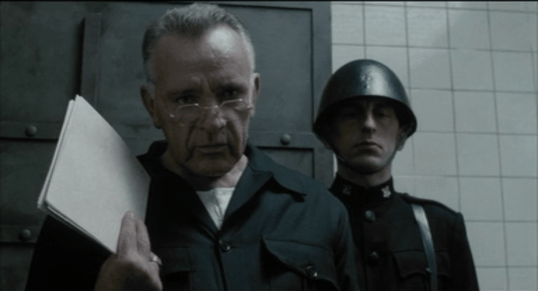
Yesterday, as I was flipping through the channels, I came across a documentary that was being shown on This TV.  The documentary was called Nineteen Eighty-Four and it told the story of a low-level British bureaucrat named Winston Smith (who bore a strong resemblance to a youngish John Hurt)  who, after having a secret affair with a free-spirited woman, was charged with committing “thought crimes” against the state.  As a result, he was tortured by a man named O’Brien (who looked a lot like Richard Burton) until Winston finally came to love the government above all else…

What’s that?

Okay, you caught me.

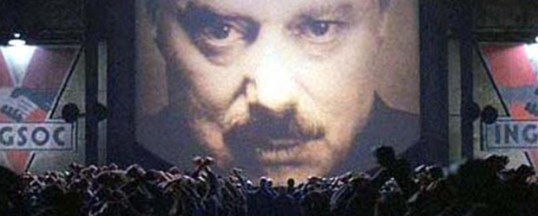
This movie was not a documentary.  Instead, it was an adaptation of George Orwell’s famous novel about a dystopian future Britain (quite cleverly renamed Airstrip One in both the book and the film) where the citizens spend their time giving thanks to Big Brother, a leader who may or may not actually be a fictional creation of the ruling party.  It’s a world where everyone knows that “Big Brother is watching you” and every day is scheduled around the “two-minute hates” that are directed towards Big Brother’s enemy, Emmanuel Goldstein (who, much like Big Brother, may or may not actually exist).  It’s a world dominated by three separate superstates that are in a state of perpetual war, though we’re also given reason to suspect that the war is just as fictional as Big Brother and Goldstein might be.  It’s a world where order is kept by the Thought Police and history is regularly changed for the benefit of the ruling party.  It’s a world where people can become unpersons and cease to exist and where all good citizens understand that one plus one equals three if the government says that it does.

So, no, it’s not a documentary.

It just feels like one.

Richard Burton 1984

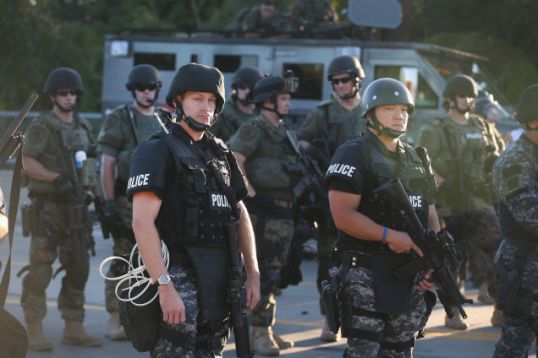
As I watched Nineteen Eight-Four, it was impossible for me not to compare Orwell’s vision of the future (which is faithfully visualized in the film) with our present world.  Even though the book was written in 1948 and this film was shot and released in 1984, it was hard not to feel as if Nineteen Eighty-Four could have just as easily been made yesterday.  Beyond the obvious NSA-as-Big-Brother comparisons that everyone makes, it was hard not to compare the brainwashed citizens waiting to hear from Big Brother with the people today who slavishly repeat whatever talking points they hear on MSNBC or Fox News.  How different, I wondered, was Big Brother railing against Goldstein from our President continually telling us that we’re at war with the “forces of cynicism” and that anyone who disagrees with him is not just expressing an opinion but instead is being unpatriotic?  When O’Brien explained how the Party stayed in power by keeping the people perpetually angry at unseen enemies, he might as well have been talking about our own elected officials.  And, when the Thought Police finally arrested Winston and Julia, it brought to mind the images of the militarized police force of Ferguson, Missouri.

And that, I think, is why Nineteen Eighty-Four remains so powerful as both a book and a film.  We live in a world where we are told more and more often that, regardless of what it does, the government is in charge and must be obeyed.  We live in a world where we are currently told that good citizens must obey the law simply because it is the law.  We’re told not to question why a police force needs to resemble an invading army.  We’re told not to question why a member of the police force might happen to shoot an unarmed black teenager multiple times.  We’re told not to question the official history.  Instead, we’re just supposed to live in a state of blind obedience and accept, on faith alone, that those in charge are always right.  We’re supposed to “respect authority” and not think about the specifics.

Thought Police or the Ferguson PD?

Thought Police or the Ferguson PD?

In short, we’re living in the world of Nineteen Eight-Four whether we realize it or not.

As for the film itself, it’s a powerful and surprisingly faithful adaptation of Orwell’s novel.  John Hurt is perfectly cast as Winston Smith and Suzanna Hamilton is sympathetic as Julia.  The two of them have a very real chemistry in this film and it makes the inevitable final scenes all the more disturbing and tragic.  This was also Richard Burton’s final film.  After years of alcoholism, Burton died shortly after filming ended and he looks ill throughout Nineteen Eighty-Four.  But his obvious ill-health actually works to the role’s advantage.  As played by Burton, O’Brien becomes the perfect embodiment of the morally corrupt ruling Party.  The scenes where O’Brien tortures Hurt as difficult to watch, as they should be.  But both Hurt and Burton give such committed performances that you can’t look away even when you want to.  Finally, Nineteen Eighty-Four was an early job for the great cinematographer Roger Deakins and the film has a memorably bleak look to it.  The drabness of Air Strip One perfectly mirrors the empty life of its citizens and it serves as a perfect contrast to the lushness of Winston’s fantasies.

Nineteen Eighty-Four is not an easy film to watch but it’s one that everyone should track down and see.  Watch it and ask yourself how different 1984 is from 2014.

1984-john-hurt