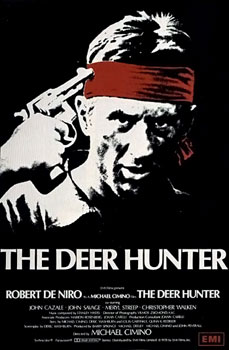
Lisa Reviews An Oscar Winner: The Deer Hunter (dir by Michael Cimino)


The Deer Hunter, which won the 1978 Oscar for Best Picture Of The Year, opens in a Pennsylvania steel mill.

Mike (Robert De Niro), Steve (John Savage), Nick (Chistopher Walken), Stan (John Cazale), and Axel (Chuck Aspegren, a real-life steel worker who was cast in this film after De Niro met him while doing research for his role) leave work and head straight to the local bar, where they are greeted by the bartender, John (George Dzundza).  It’s obvious that these men have been friends for their entire lives.  They’re like family.  Everyone gives Stan a hard time but deep down, they love him.  Axel is the prankster who keeps everyone in a good mood.  Nick is the sensitive one who settles disputes.  Steve is perhaps the most innocent, henpecked by his mother (Shirley Stoler) and engaged to marry the pregnant Angela (Rutanya Alda), even though Steve knows that he’s not actually the father.  And Mike is their leader, a charismatic if sometimes overbearing father figure who lives his life by his own code of honor.  The men are held together by their traditions.  They hunt nearly every weekend.  Mike says that it’s important to only use one shot to kill a deer.  Nick, at one point, confesses that he doesn’t really understand why that’s important to Mike.

Steve and Angela get married at a raucous ceremony that is attended by the entire population of their small town.  The community is proud that Nick, Steve, and Mike will all soon be shipping out to Vietnam.  Nick asks his girlfriend, Linda (Meryl Streep), to marry him when he “gets back.”  At the reception, Mike gets into a fight with a recently returned soldier who refuses to speak about his experiences overseas.  Mike ends up running naked down a street while Nick chases him.

The Deer Hunter is a three-hour film, with the entirety of the first hour taken up with introducing us to the men and the tight-knit community that produced them.  At times, that first hour can seem almost plotless.  As much time is spent with those who aren’t going to Vietnam as with those who are.  But, as the film progresses, we start to understand why the film’s director, Michael Cimino, spent so much time immersing the viewer in that community of steel workers.  To understand who Nick, Mike, and Steve are going to become, it’s important to know where they came from.  Only by spending time with that community can we understand what it’s like to lose the security of knowing where you belong.

If the first hour of the film plays out in an almost cinema verité manner, the next two hours feel like an increasingly surreal nightmare.  (Indeed, there was a part of me that suspected that everything that happened after the wedding was just Michael’s drunken dream as he lay passed out in the middle of the street.)  The film abruptly cuts from the beautiful mountains of Pennsylvania to the violent horror of Vietnam.  A Viet Cong soldier blows up a group of hiding women and children.  Michael appears out of nowhere to set the man on fire with a flame thrower.  An army helicopter lands and, in a coincidence that strains credibility, Nick and Steve just happen to get out.  Somehow, the three friends randomly meet each other again in Vietnam.  Unfortunately, they are soon captured by the VC.

They are held prisoner in submerged bamboo cages.  Occasionally, they are released and forced to play Russian Roulette.  Mike once again becomes the leader, telling Steve and Nick to stay strong.  Eventually, the three men do manage to escape but Steve loses his leg in the process and a traumatized Nick disappears in Saigon.  Only Mike returns home.

The community seems to have changed in Mike’s absence.  The once boisterous town is now quiet and cold.  The banner reading “Welcome Home, Mike” almost seems to be mocking the fact that Mike no longer feels at home in his old world.  Stan, Axel, and John try to pretend like nothing has changed.  Mike falls in love with Linda while continuing to feel guilty for having abandoned Nick in Saigon.  Steve, meanwhile, struggles to come to terms with being in a wheelchair and Nick is still playing Russian Roulette in seedy nightclubs.  Crowds love to watch the blank-faced Nick risk his life.

Eventually, Mike realizes that Nick is still alive.  Somehow, Mike ends up back in Saigon, just as the government is falling.  Oddly, we don’t learn how Mike was able to return to Saigon.  He’s just suddenly there.  It’s the type of dream logic that dominates The Deer Hunter but somehow, it works.  Mike searches for Nick but will he be able to save his friend?

The Deer Hunter was one of the first major films to take place in Vietnam.  Among the pictures that The Deer Hunter defeated for Bet Picture was Coming Home, which was also about Vietnam but which took a far more conventional approach to its story than The Deer Hunter.  Indeed, while Coming Home is rather predictable in its anti-war posture, The Deer Hunter largely ignores the politics of Vietnam.  Mike, Nick, and Steve are all traumatized by what they see in Vietnam.  Mike is destroyed emotionally, Steve is destroyed physically, and Nick is destroyed mentally.  At the same time, the VC are portrayed as being so cruel and sadistic that it’s hard not to feel that the film is suggesting that, even if we did ultimately lose the war, the Americans were on the correct side and trying to do the right thing.  (Many critics of The Deer Hunter have pointed out that there are no records of American POWs being forced to play Russian Roulette.  That’s true.  There are however records of American POWs being forced to undergo savage torture that was just as potentially life-threatening.  Regardless of what one thinks of America’s involvement in Vietnam, there’s no need to idealize the VC.)  Released just a few years after the Fall of Saigon, The Deer Hunter was a controversial film and winner.  (Of course, in retrospect, the film is actually quite brilliant in the way it appeals to both anti-war and pro-war viewers without actually taking a firm position itself.)

In the end, though, The Deer Hunter isn’t really about the reality of the war or the politics behind it.  Instead, it’s a film about discovering that the world is far more complicated that you originally believed it to be.  De Niro is a bit too old to be playing such a naive character but still, he does a good job of portraying Mike’s newfound sense of alienation from his former home.  In Vietnam, everything he believed in was challenged and he returns home unsure of where he stands.  While John, Axel, and Stan can continue to hunt as if nothing happened, Mike finds that he can no longer buy into his own philosophical BS about the importance of only using one shot.  Everything that he once believed no longer seems important.

It’s a good film and a worthy winner, even if it does sometimes feel more like a happy accident than an actual cohesive work of art.  The plot is often implausible but then again, the film takes place in a world gone mad so even the plot holes feel appropriate to the story being told.  Christopher Walken won an Oscar for his haunting performance as Nick and John Savage should have been nominated alongside of him.  This was Meryl Streep’s first major role and she gives a surprisingly naturalistic performance.  During filming, Streep was living with John Cazale and she largely did the film to be near him.  Cazale was dying of lung cancer and he is noticeably frail in this film.  (I cringed whenever Mike hit Stan because Cazale was obviously not well in those scenes.)  Cazale, one of the great character actors of the 70s, died shortly after filming wrapped.  Cazale only appeared in five films and all of them were nominated for Best Picture.  Three of them — The first two Godfathers and The Deer Hunter — won.

The Deer Hunter is a long, exhausting, overwhelming, and ultimately very moving film.  Whatever flaws it may have, it earns its emotional finale.  Though one can argue that some of the best films of 1978 were not even nominated (Days of Heaven comes to mind, as do more populist-minded films like Superman and Animal House), The Deer Hunter deserved its Oscar.
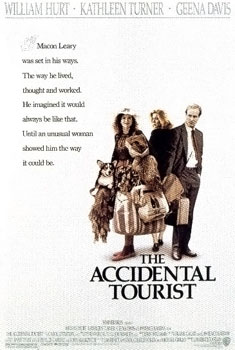
Lisa Reviews An Oscar Nominee: The Accidental Tourist (dir by Lawrence Kasdan)


the_accidental_tourist

I have to admit that I was tempted to be a little bit snarky in my review of the 1988 Best Picture nominee, The Accidental Tourist.  I was going to say that The Accidental Tourist was a perfect example of a genre of film that has always been oddly popular with the Academy, the emotionally stunted man in New England learns to love again genre.

But, then I realized that I was wrong.  The Accidental Tourist does not take place in New England.  It takes place in Baltimore which may be located up north but which is technically considered to be part of the mid-Atlantic.  But, even with that in mind, it was impossible for me to watch The Accidental Tourist without thinking of other New England-set Oscar nominees, such as Mystic River and Manchester By The Sea.

As for the film itself, it’s about a man whose depressing life would be unbearable to watch if not for the fact that everyone around him is so extremely eccentric.  Macon Leary (William Hurt) is a travel writer.  He’s writes books giving people advice on how best to behave while seeing the world.  Throughout the film, we hear snippets of his prose.  Macon warns people about overpacking.  He warns them about arriving late at the airport.  He warns them about not properly planning out their trip.  He suggests that travelers bring a book to read but not too many books.  And don’t bring magazines because they get wrinkled too easily.  Now, to be honest, I liked most of Macon’s advice but then again, I’m OCD and I spend most of my time trying to make sure that everything I own is properly organized and can be equally divided.

A year ago, during a fast food robbery, Macon’s son was shot and killed.  Withdrawing from the world, Macon barely reacts when his wife, Sarah (Kathleen Turner), leaves him.  After breaking his leg while trying to convince his dog to climb down the stairs into the laundry room, Macon ends up moving in with his three siblings: autocratic Porter (David Ogden Stiers), slightly less autocratic Charles (Ed Begley, Jr.) and sweet but neurotic Rose (Amy Wright).

And so it goes.  Even when his agent, Julian (Bill Pullman), starts to date Rose, Macon can’t bring himself to open up emotionally.  Fortunately, Macon meets Muriel (Geena Davis), a quirky dog trainer.  Though it takes a while, Muriel starts to pull Macon out of his shell.  Soon, Macon is spending his nights over at her apartment and bonding with her sickly son.

(Why does every single mother in these type of movies have a sickly son?  Just for once, couldn’t a single mother be portrayed as having a child who is well-adjusted, popular, and healthy?)

But, just when everything seems to be perfect, Macon’s phone rings.  It’s Sarah and she wants to give their marriage another chance…

Just judging from the tone of this review, you’re probably thinking that I disliked The Accidental Tourist.  Actually, nothing could be further from the truth.  While the film’s mix of grim reality and relentlessly quirky supporting character can be a bit overwhelming at first, the film works if you stick with it.  That’s the thing — you have to stick with it.  When William Hurt first stares at the camera with his dead eyes and starts to drone about the importance of not spending too much money while in Paris, it’s tempting to just give up.  But, as the film progresses, it improves and so does Hurt’s performance.  By the time he finally worked up the strength to hold Muriel’s son’s hand while walking the boy home from school, I had tears in my mismatched eyes.

The Accidental Tourist is low-key but rather sweet film.  While the film centers around the performances of Hurt and Geena Davis (who won an Oscar for her work here), my favorite performances came from Bill Pullman and Amy Wright.  I honestly would happily watch a film that was just about their characters.

The Accidental Tourist was nominated for Best Picture but lost to Rain Man.

Back to School Part II #12: Breaking Away (dir by Peter Yates)


Has Indiana changed much since 1979?

I ask because I just watched Breaking Away, a 1979 nominee for best picture.  Breaking Away was shot on location in Bloomington, Indiana and on the campus of Indiana University.  And though the film doesn’t go out of its way to idealize either the state, the town, or the university –in fact, the title refers to the desire of several characters to break away from their life in Bloomington — it still manages to make Indiana look like the nicest place on Earth.  Add to that, Indiana University is home to the Eskenazi Museum of Art, which I will someday visit.

Breaking Away is actually a film about a lot of things: it’s a comedy, it’s a quasi-love story, it’s bittersweet coming-of-age story, it’s a sports film, and it’s a sweet, good-natured film that made me cry.  At the heart of the film is Dave Stoller (Dennis Christopher), who has just graduated from high school and whose cheerful and eccentric exterior hides the fact that he appears to have no real future.  Dave is obsessed with bicycle racing and idolizes that the Italian cycling team.  In fact, he idolizes them so much that he decides to be Italian.  He rides around Bloomington, greeting people with a merry “Ciao!”  At home, he listens to opera and renames the family cat “Fellini.”  While his mother (Barbara Barrie) is understanding, his father (Paul Dooley) cannot understand what’s happening to his son.  Of course, Dave doesn’t truly believe that he’s Italian.  He just desperately wants to be something other than who he is.

And who is Dave?  He’s a citizen of Bloomington, a town that is divided between the upper class students at Indiana University and the blue-collar townies.  The students call Dave and his friends “cutters,” because the only real industry in town is working in the quarry, cutting stone.  The students look down on the cutters and the cutters resent the students.

Dave has three close friends, all of whom were big in high school and who are now facing an uncertain future of anonymity.  Cyril (Daniel Stern) is the funny and quirky one, the former basketball player who talks about how he would like to be a cartoon character.  Moocher (Jackie Earle Haley) is usually easy-going but loses his temper whenever anyone mentions that he’s short.  (At one point, Moocher’s boss orders him to, “Punch the time clock, Shortie!”  Moocher literally does just that.)  And finally, there’s Mike (Dennis Quaid).  Mike is their leader, a former high school quarterback who idolizes the Marlboro Man and who knows that he’s destined to spend the rest of his life in Bloomington, going from “20 year-old Mike” to “mean old man Mike.”

When Dave meets a student named Katherine (Robyn Douglass), he pretends to be an Italian exchange student and, soon, he’s serenading her on the lawn of her sorority house.  That doesn’t make Katherine’s boyfriend, Rod (Hart Bochner), happy.  Rod and his friends beat up Cyril, which leads to another fight at a bowling alley.  (Cyril, for his part, gets his finger stuck in a bowling ball.)  Seeking to broker some sort of peace and understanding between the students and the town, the university president (played by John Ryan, who was the real-life President of Indiana University at the time) announces that the cutters will be invited to take part in the annual Little 500 bicycle race at Indiana University.

And you can probably guess how the race turns out.  It’s a feel-good sports film so you already know who is going to win and that he’s going to have to win after initially falling behind and sacrificing a big lead.  You know all that but it doesn’t matter.  Breaking Away is such a sweet and well-acted movie that it still brought tears to my eyes even if the ending didn’t surprise me.

And really, the film does have a few surprises.  For one thing, Rod turns out to be not as bad a guy as you initially think he’s going to be.  Over the course of the film, he gets two small reaction shots, both of which hint that he’s not as much of a jerk as he often appears to be.  It’s a minor detail and it’s easy to miss but what’s important that it’s there and it’s one of the many small details that makes Breaking Away feel alive.  After watching the movie, I feel like I could go to Bloomington and still find all these character hanging out at the quarry.

There’s another scene that I want to mention.  This is the scene that made me cry.  Dave and his father walk around the university and his dad talks about how he and the fathers of all of Dave’s friends helped to cut the stone that was used to build campus.  His dad admits that, even though he helped to build it, he’s never felt comfortable on the campus and then tells his son that he doesn’t have to be a cutter.  And it’s such a heartfelt scene and so beautifully performed by Paul Dooley and Dennis Christopher that I started to cry.  Perfectly acted, perfectly directed, and perfectly written, what a great scene!  Fantastico!, as Dave might say.

I loved Breaking Away and I bet you would to.

Breaking Away