Retro Television Review: Fantasy Island 5.14 “Daddy’s Little Girl/The Whistle”


Welcome to Retro Television Reviews, a feature where we review some of our favorite and least favorite shows of the past!  On Tuesdays, I will be reviewing the original Fantasy Island, which ran on ABC from 1977 to 1984.  Unfortunately, the show has been removed from most streaming sites.  Fortunately, I’ve got nearly every episode on my DVR.

This week, the stars align and John Carradine shows up on Fantasy Island.

Episode 5.14 “Daddy’s Little Girl/The Whistle”

(Dir by Don Chaffey and Don Weis, originally aired on January 30th, 1982)

The plane is landing and Mr. Roarke and Julie are getting ready to meet their guests for the weekend.  But wait a minute — where’s Tattoo!?  Roarke explains that Tattoo has volunteered to spend the weekend learning how to do CPR.  When a voluptuous nurse walks by, Julie rolls her eyes and says that Tattoo only cares about learning “mouth-to-mouth.”

“Julie!” Mr. Roarke snaps, even though Julie is probably correct.

Anyway, any episode without Tattoo feels strange and that’s certainly true of this episode.  There are two fantasies, one of which was dramatically better than the other.  The lesser of the two fantasies involves Christa Ackland (Genie Francis) and her efforts to find out the identity of her father.  All she knows is that her mother (Carolyn Jones) knew her father in the Philippines during World War II.  Christa is going to be married on Fantasy Island and she wants her real father to give her away.

Three men, all of whom served in the Air Force together, step forward and claim, one after the other, to be Christa’s father.  When Christa finally confronts her mother, she learns that her father is not Gene (John Ericson), Al (Alan Hale, Jr.), or Bert (Gene Nelson).  Instead, he was a guy named …. well, Guy.  Guy was shot down while on a mission.  Gene, Al, and Bert all explain that the stepped forward and claimed to be her father out of loyalty to Guy and because they didn’t want Christa to learn on her wedding say that her father was dead.  (Apparently, they felt that information would be better received after the honeymoon.)  Christa is surprisingly forgiving.  She realizes that her stepfather (William Windom) has more than earned the right to give her away.  Christa marries George Stickney (James Daughton, the head of the evil frat in Animal House) and Julie cries at the wedding.  Awwww!

The main problem with this storyline was that Genie Francis gave a surprisingly bad performance as Christa.  Instead of coming across as someone who truly wanted to know about her real father, she instead came across as being petulant and more than a little self-righteous.  Carolyn Jones, William Windom, and the three potential fathers were all likable but none could make up for the unsympathetic lead character.

The other fantasy was a bit more fun, even if was impossible to follow the story.  Iconologist Adrian Brilles (Edward Winters) dreams of making a great discovery that will bring him fame and prove his theories about ancient hieroglyphics to be correct.  Mr. Roarke sends him to a ghost town that is also the home of a museum of ancient artifacts.  Working with curator Leila Proctor (Ann Turkel), Adrian discovers what he describes as being “the Rosetta Stone of hieroglyphics.”  He also discovers an ancient whistle that will grant him three wishes.

There are a few townspeople, all of whom take a lot of interest in Adrian’s work.  Their leader is the town’s mortician and he’s played by — YES! — JOHN CARRADINE!  And though Carradine doesn’t get to do much and was obviously physically frail when he filmed this episode, his famous voice and his piercing stare combine to make the Mortician a memorable character.  There’s also a fairly ridiculous scene where the townspeople reveal their true selves, which means dancing around while wearing rubber demon masks.  It’s silly but it’s effective.

It’s never quite clear what’s happening at the ghost town, beyond the three wishes being a set up to bring the demonic townspeople into the world and to cost Adrian his soul.  Fortunately, Mr. Roarke pops up and gives Adrian some cryptic advice about the third wish being the most important.  For his first wish, Adrian wishes for the townspeople to be their true selves.  (Cue the demon dance.)  For his second wish, he goes for fame and adulation.  For his third wish, he cancels the first two wishes and this somehow set free not only his soul but Leila’s as well.

Yep, it doesn’t make much sense but it’s got John Carradine and a bunch of horror imagery so it’s fun.  That’s all I really ask for when it comes to Fantasy Island.  The whistle fantasy makes up for the wedding fantasy and the lack of Tattoo.  This was a worthwhile trip to the Island.

October Hacks: Intruder (dir by Scott Spiegel)


The 1989 film, Intruder, is often advertised as being a Bruce Campbell film but Bruce only appears in the final few minutes.  I’m pointing this out because Bruce himself has criticized, in the past, the way that some distributors have used his name to promote Intruder and to fool potential viewers into thinking that Intruder features Ash or takes place S-Mart.  Bruce Campbell’s chin-tastic profile is put to good use as a police officer who shows up at the scene of a very bloody crime but Intruder is hardly a Bruce Campbell movie.

What is Bruce doing in Intruder?  It probably has something to do with the fact that Intruder was the directorial debut of Scott Spiegel, who co-wrote the script for Evil Dead II and who was a good friend of Sam Raimi’s.  (That probably also explains the presence of Ted Raimi in a tiny role and Sam Raimi himself in a bigger role.)

That said, if you’re looking for a good and suspenseful slasher film to watch as Halloween approaches, you could certainly do worse than Intruder.  Bruce Campbell may only appear in a cameo but the film itself is good enough that you’ll enjoy it while waiting for Bruce to make his appearance.

The film takes over the course of the night shift at a large but financially struggling grocery store.  When cashier Jennifer Ross (Elizabeth Cox) is harassed by her ex-con boyfriend, Craig (David Byrnes), the entire night crew comes together to protect her and to chase Craig out of the store.  The police are called but, when they finally do arrive at the store, they reveal that there’s not much they can do.  With Craig still making angry phone calls to the store, the crew prepares for the next day of business.  The store’s owners hold a store meeting and, after announcing how proud they are of the way the night crew handled the Craig situation, they announce that the store will be closing and soon, everyone will be out of a job.

No one is happy about that, with co-owner Bill (Dan Hicks) rather pathetically saying that the store was his entire life.  That said, it doesn’t seem like anyone at the store is going to have much of a life left because someone is determined to kill the entire night crew before the sun comes up.  Soon, the employees are dying in various bloody ways (and I do mean bloody!) and the storeroom is full of body parts.  Has Craig returned?  Could it be the butcher, played by Sam Raimi?  Could it be one the owners?  Or could it be some random intruder?  Watch the film to find out.

Intruder is an effective slasher film, one that is fortunate to have an above average cast (with Elizabeth Cox especially giving a good performance), memorable characters who have a bit more depth than the jocks and cheerleaders who usually populate films like this, and an interesting location in the form of the dark and shadow-filled grocery store.  Intruder also had a lot of very graphic horror.  The gore effects were provided by the same people who would later work on The Walking Dead and I have to say that even I, being the Italian horror fan that I am, was a bit shocked by just how much blood ended up flowing down the aisles.  If you’re scared of trash compactors, this film isn’t going to do anything to make you feel better about them.

Intruder is a superior slasher film.  And hey …. Bruce Campbell’s in it for a minute!

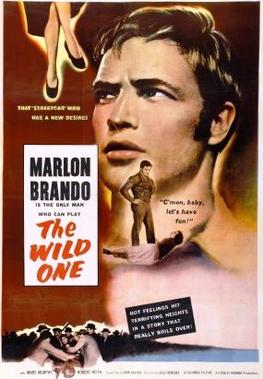
Film Review: The Wild One (dir by Laszlo Benedek)


Motorcycles have always been unbelievably sexy and, in 1953, so was Marlon Brando.

1953 was the year that Brando played Johnny Strabler in The Wild One.  Johnny’s the leader of the Black Rebels Motorcycle Club.  He wears a leather jacket and always has a cap tilted rakishly on his head.  When Johnny moves, he makes it a point to take his time.  He doesn’t run from anyone and, perhaps most importantly, he doesn’t run to anyone.  Johnny’s a rebel and he doesn’t care who knows it.  “What are you rebelling against?” Johnny is asked.  “Whaddya got?” Johnny replies and, when he says it, you not only believe him but you want to join him in his rebellion.

And yet, from the minute that we see Johnny, it’s obvious that there’s more to him than just his jacket and his attitude.  He speaks softly and when he smiles, there’s something almost shy about the expression.  You look into his brooding, soulful eyes and you know that Johnny isn’t just about making trouble.  He’s searching for something that society alone can’t deliver.  Johnny’s a bad boy, the type who you fool yourself into thinking that you — and only you — can reach and help heal.

At least, that’s the way that Kathie (Mary Murphy) feels about him, even though she’s way too smart to accept his invitation to go to a dance with him.  Kathie works at a diner in a small California town.  When Johnny and his gang ride into the town, all of the boring, responsible citizens want to force him to leave.  Kathie, alone, sees that Johnny’s not as bad as everyone assumes he is.  And if there’s any doubt about the fact that Johnny’s got a good soul despite his brooding nature, Chino (Lee Marvin) shows up to remind everyone of what a truly bad biker is like.

Chino and Johnny may both love their motorcycles but otherwise, they’re opposites.  If Johnny has the soul of a poet, Chino has no soul at all.  Johnny’s searching for freedom while Chino is merely searching for power.  Chino and Johnny were once friends, all part of the same gang.  However, Johnny eventually went off on his own and took the younger gang members with him.  Chino, in many ways, represents America’s destructive and wild path.  He’s an old west outlaw who rides a motorcycle instead of a horse.  Johnny, meanwhile, is a wanderer who represents the part of America that created Kerouac and Dylan.

(Interestingly enough, both Brando and Marvin were 29 years old when they made The Wild One.  However, Brando looked much younger and Marvin looked considerably older, which only added to the film’s theme of generational conflict.  Brando, himself, has never rode a motorcycle before making The Wild One and reportedly avoided the actual bikers who were hired to act as extras.  Lee Marvin, on the other hand, was an experienced rider and fit right in with the film’s cast.  To be honest, Lee Marvin is actually more convincing than Brando but Brando had the eyes and the wounded way of speaking whereas Marvin was every single guy who needlessly revs his motorcycle’s engine in the middle of the night.)

Anyway, needless to say, the townspeople are even less happy once Chino’s gang shows up.  Unfortunately, few of them understand the difference between Johnny and Chino.  In fact, the majority of the upright citizens prove themselves to be just as and, in some cases, more violent than the bikers that they’re trying to run out of town.  It all leads to violence, tragedy, and, ultimately, understanding.  This was a 50s film after all.  Director Laszlo Benedek may have played up the more sordid aspects of the story but the film was produced by the reliably and safely liberal Stanley Kramer and the film concludes on a very Krameresque note.

If you only know Marlon Brando from the latter half of his career, when he was best known for his weight, his eccentricities, and his personal tragedies, than watching The Wild One is quite a revelation.  It’s a well-directed film with a host of effective supporting turns but it’s Brando who makes the film unforgettable.  Watching the film, you understand why Brando became a star and you also see just how much he inspired so many of the actors who came after him.  James Dean’s performance in Rebel Without A Cause owes a huge debt to Brando’s work here.  In fact, every rebel owes a debt to The Wild One.  In the role of Johnny, Brando invites and inspires us all to ride down the road and see what we find.

The Wild One was a huge hit in 1953, leaving teenagers excited and parents concerned.  That same year, Brando also played Mark Anthony in Julius Caesar and received an Oscar nomination for the performance.  The Wild One was ignored at the Oscars but lives on whenever anyone hit the road and goes searching for America.

The TSL’s Grindhouse: A Boy And His Dog (dir by L.Q. Jones)


(Nearly every Saturday night, the Late Night Movie Gang and I watch a movie.  On January 20th, we watched the 1975 science fiction satire, A Boy and His Dog.)

A Boy and His Dog begins, quite literally, with a bang.  A bang followed by a mushroom cloud.  And then a second mushroom cloud.  And then another.  And another.  When the explosions finally stop, we are informed that World War IV only lasted five days.  Of course, it destroyed most of society.  The year is now 2024 and … well, things aren’t great.

(For those of you keeping track, that means we’ve got another six years left.  Enjoy them!)

The world is now a barren wasteland, an endless stretch of desert.  There are a handful of survivors but they’re not exactly the types who you would want to survive an apocalypse.  Take Vic, for instance.  Vic (played by Don Johnson) is an absolute moron.  He can’t read.  He’s not very good at thinking.  He has no conscience.  He’s someone who kills and rapes without giving it a second thought.  When Vic isn’t scavenging for food and supplies, he’s obsessing on sex.  When we first meet him, the only thing redeeming about Vic is that almost everyone else in the world is even worse than he is.

That Vic has managed to survive for as long as he has is something of a minor miracle.  Vic has been lucky enough to team up with a dog named Blood.  Blood is not only surprisingly intelligent but he’s also telepathic.  Unfortunately, the same experiment that granted him telepathy also caused him to lose his instinct as a hunter.  So, Blood and Vic have an arrangement.  Vic keeps Blood supplied with food and Blood helps Vic track down women.

Blood’s voice is provided by actor Tim McIntire and, from the minute we first hear him, it becomes obvious that Blood may be cute on the outside but, on the inside, it’s a totally different story.  Blood rarely has a good word for anyone or anything.  He delights in annoying Vic, calling him “Albert” while still demanding that Vic get him food.  He’s a surprisingly well-read dog but you wouldn’t necessarily want to get stuck in a kennel with him.  Much as with Vic, Blood’s only redeeming trait is that everyone else is marginally worse than he is.

(Sadly, if there was an apocalypse like the one that starts this movie, most of the survivors probably would be like Vic.  The only people who would survive something like that would be the people who were solely looking out for themselves.)

A Boy and His Dog is a highly episodic film, following Vic and Blood as they wander across the wasteland and bicker.  They fight other scavengers.  They spend a rather depressing night at a makeshift movie theater.  Eventually, they come across a young woman named Quilla June (Suanne Benton).  Blood dislikes her but Vic says he’s in love.  (Mostly, he’s just excited that he’s now having sex regularly.)  Eventually, through a whole series of events, Vic discovers an underground city named Topeka, where everyone wears clown makeup.  The head of the town (Jason Robards) informs Vic that his sperm will be used to impregnate 35 women.  Vic is excited until he finds out that reproduction in Topeka is a matter of artificial insemination.

(Both the wasteland and Topeka are nightmarish in their own different ways.  The wasteland is world without morality or compassion.  Topeka is a world where everyone looks like a mime, there’s always a marching band, and order is maintained by a robot wearing overalls.)

Of course, while Vic is dealing with life underground, Blood waits above ground.  By the end of the film, Vic is forced to make a choice between settling down or remaining loyal to his dog.  It all leads to a final comment from Blood that will either make you laugh or throw a shoe at your TV.  I did both.

A Boy and His Dog is a strange movie.  It definitely isn’t for everyone.  It’s a comedy but the humor is pitch black.  Still, that strangeness — along with the talent of the dog playing Blood and Tim McIntire’s savagely sarcastic voice work — is what makes the film watchable.  There’s literally no other film like A Boy and His Dog.  By the time Vic ends up in Topeka, the film has become almost a fever dream of apocalyptic paranoia and satire.  The ultimate message of the film appears to be that the apocalypse would really suck so let’s try to not blow each other up.

Who can’t get behind that?


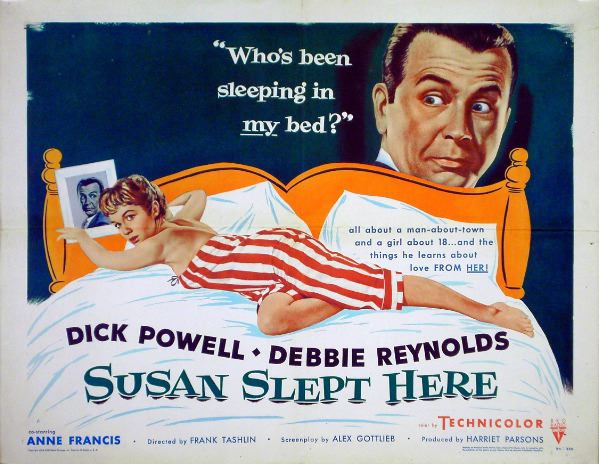
Naughty Or Nice: SUSAN SLEPT HERE (RKO 1954)


gary loggins's avatarcracked rear viewer

susan1

Looking for something a little offbeat in a Christmas movie? Try SUSAN SLEPT HERE, a film that could never get made today, as it concerns the romance between a 17 year old girl and a 35 year old man. I know some of you out there are already screaming “EEEEWWW!!!”, but indulge me while I describe the madcap moments leading to said romance.

susan3

For starters, the movie is narrated by Oscar. Not Oscar Levant, but THE Oscar, the fabled Academy Awards statuette. This particular Oscar was won by Mark Christopher, screenwriter of fluffy Hollywood comedies yearning to pen a dramatic yarn and prove his mettle as a writer. Into his life comes teenage Susan Landis, a juvenile delinquent dumped on his doorstep by two cops who don’t want to lock her up til after the holidays. They figure Mark can watch her and get a good story idea in the process before she…

View original post 693 more words