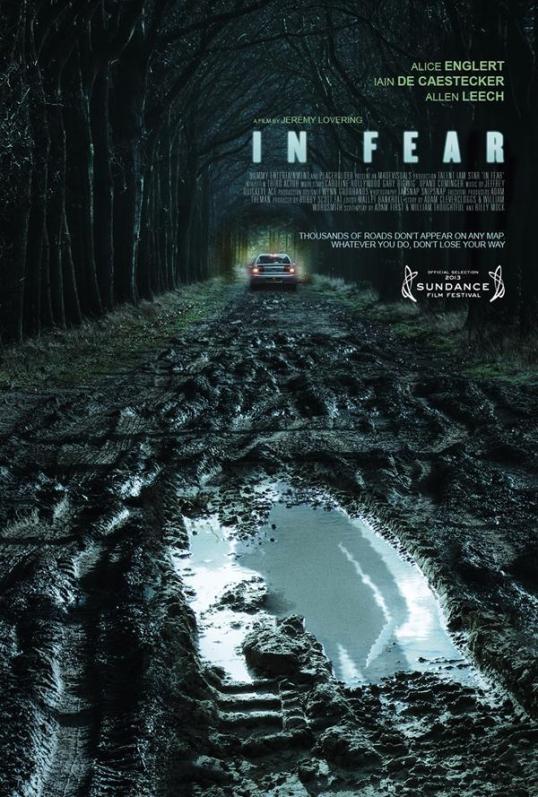
In Fear is a movie about two people who get lost while trying to drive to a festival in Ireland. Tom (Iain De Caestecker) and Lucy (Alice Englert) have only been dating for two weeks and Tom is already inviting her to a festival and going behind her back to make reservations at a hotel. Tom says, “It’s our two-week anniversary,” and that should have been red flag city. Two weeks is only 14 days. That’s a lifetime for some creatures but not humans.
Tom and Lucy drive up and down a country road, trying to find the hotel but they keep on ending up back at the same location, sitting in front of run-down fence with a sign that says “KEEP OUT” sitting on it. Lucy thinks that she sees someone following the car but Tom isn’t so sure until someone actually tries to grab Lucy. They meet a bloody man named Max (Allen Leech), who says that there are a group of madmen who are stalking Tom and Lucy because of an earlier altercation at a pub.
In Fear was scary for the first half and then, during the second half, there were some things that happened that didn’t really make much sense to me. Some of the twists felt half-baked and sometimes, the characters behaved in ways that didn’t make much sense. Of course, speaking of making sense, I wouldn’t go on a road trip with someone who I had only been dating for two weeks. Road trips are the ultimate relationship test so you better make sure that you and your partner are really compatible before you even attempt one! Tom and Lucy were sweet together but they should have waited before going to the country together. And Tom definitely shouldn’t have made hotel reservations without talking to Lucy first. A lot of trouble could have been avoided if Tom hadn’t been so eager to celebrate that two-week anniversary.
Despite those inconsistencies, In Fear was scary enough to make me jump. It’s the type of horror movie that you should not watch in the dark. I locked all the doors as soon as it was over.
It’s interesting how quickly a film can be forgotten.
Based on a novel by Thomas Savage, The Power of the Dog was one of the most anticipated films of 2021. It was considered to be a front runner for Best Picture even before it was released. Even though everyone knew 2021 was going to be the year that the Academy finally got around to giving Will Smith the Oscar, there was still a lot of excitement about the idea of Benedict Cumberbatch playing a sinister and closeted cowboy named Phil Burbank. The first teaser featured Cumberbatch being wonderfully creepy. I remember that I was certainly looking forward to it.
When it finally showed up in theaters and then premiered on Netflix, the reviews were …. respectful. They were positive but they weren’t exactly enthusiastic. This was the type of film where people noted that it was well-made and well-acted but it seemed to just be missing a little something. The film was nominated for a lot of Oscars but, in the end, it only won one, for Jane Campion’s direction. (And Campion, unfortunately, had to spend the days leading up to the ceremony dealing with a stupid controversy over a very mild joke she made to Serena and Venus Williams about how making a movie was more difficult than playing tennis.) People admired the skill that went into The Power of the Dog but, in the end, it was CODAthat captured the hearts of the Academy. CODA may not have been as technically well-made as Power of the Dog but CODA was a film that made people cry. And, in 2021, voters who had spent an entire year being told that they would die a horrible death if they even dared to leave their house without putting on a mask, decided to vote with their hearts.
Taking place in 1925 Montana, The Power of the Dog centers on two prominent ranchers, the Burbank brothers. Phil Burbank is a man’s man, a bluff and hearty type who lives to conquer the land and who doesn’t have much use for women. Phil looks down on anything that he considers to be a sign of weakness, like showing emotion or making paper flowers. And yet, Phil is also fiercely intelligent and Ivy League-educated, a man who is capable of playing beautiful music but who has decided not to. Phil is cruel and manipulative. Perhaps the only person that he’s ever respected is his mentor, Bronco Henry. Phil’s admiration for Henry and his collection of gay pornography tells us all we need to know about why Phil is so obsessed with maintaining his “manly” image.
His brother, George (Jesse Plemons), is a much more sensitive soul than Phil and yet, he allows himself to be dominated by his brother. It’s not until George meets and marries a widow named Rose (Kirsten Dunst) that he starts to come out of his shell. Angry that Rose seems to be freeing George from his domination, Phil goes out of his way to make her life miserable, even preventing Rose from playing the piano. In her loneliness, Rose starts to drink. Phil, meanwhile, sets himself up as a mentor (and potentially more) for Rose’s sensitive and introverted son (Kodi Smit-McPhee), who does like to make paper flowers but who also has an obsession with his late father’s medical books….
The Power of the Dog is a film that I had mixed feelings about. On the one hand, I did respect the craft that went into making the film. The Montana scenery was both beautiful and ominous. And I thought that both Jesse Plemons and Kirsten Dunst gave award-worthy performances. Dunst, especially, really captured the pain of Rose’s life on the ranch. Plemons, meanwhile, made George’s gentle nature compelling, which is not always the easiest thing for an actor to do. At the same time, Benedict Cumberbatch was miscast as Phil and Kodi Smit-McPhee’s performance was a bit too cartoonishly creepy for the film’s ending to really be as shocking as it was obviously meant to be. Ultimately, the main problem with the film was that Campion, as a director, kept the audience from really connecting with the characters. The film was well-made but almost as emotionally remote as Phil Burbank and it left the audience feeling as if they were on the outside looking in. While the book leaves you feeling as if you’re actually in Montana and allows you into the hearts of all of the characters, even Phil, the movie leaves you feeling as if you’ve just watched a really carefully-made film that ultimately treated you as scornfully as Phil treated Rose.
Because it is such a well-made film, The Power of the Dog is a film worth watching but it’s not necessarily a film that leaves you with any desire to watch a second time. For all the excitement that the film generated before it was released, it was largely forgotten after it lost the Oscar for Best Picture to CODA.
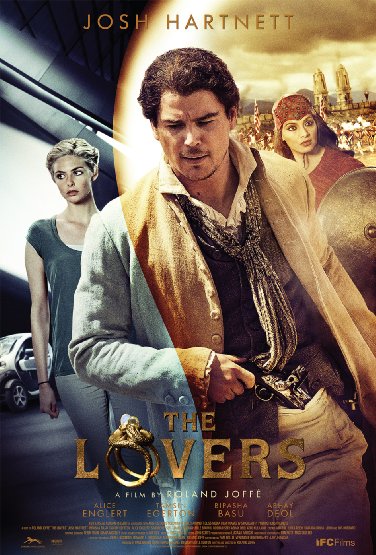
The Lovers played in theaters earlier this year but don’t be surprised if you’ve never heard of it. I hadn’t heard of it until I came across it on Showtime. The Lovers — much like Veronika Decides To Die — is one of those films that spent a while sitting on the shelf until it was almost grudgingly granted an extremely limited theatrical run. With little publicity and no critical support, The Lovers came and went and now it’s been relegated to cable and Netflix.
And watching The Lovers last night, I could see why some studios might be hesitant about it. The Lovers is an amazingly messy film, one that seems to randomly careen from tone to tone. Sometimes, it’s a romance. Sometimes, it’s an adventure film. Sometimes, it’s an attack on colonialism disguised as a history lesson. And then, occasionally, it’s even a science fiction film. It’s perhaps the messiest mishmash of themes since Cloud Atlas and that’s saying something!
And yet, despite all that, I still liked The Lovers. In many ways, I enjoyed the film despite some of my better instincts. I’m still not sure what the Hell’s going on in 50% of the film and don’t even get me started on trying to explain how the film’s multiple story lines are supposed to be connected. There’s so much that I could criticize about this film and yet, when it was over, I was not at all unhappy about having taken the time to watch it.
The story … well, it’s a little bit hard to explain. The film begins with a God-like being forging twin rings. We then jump forward a few centuries, to the year 2020. Two marine archeologists, Jay (Josh Hartnett) and his wife, Laura (Tasmin Egerton), are exploring the sunken wreck of a colonial British ship. In the wreckage, they comes across the two rings. They mention that someone named “D.E.” drowned while clutching onto the rings. When Laura gets trapped under some debris, Jay rescues her but ends up brain dead as a result. In a generically futuristic hospital, Laura has to decide whether to use machines to keep Jay alive or to let him go.
However, we don’t see much of Laura and Jay in that hospital. This is because, after Jay goes into his coma, the film’s other storyline starts up. Suddenly, we’re in India. The year is 1778 and Josh Hartnett is playing a Scottish captain in the British East India Company. When we first see Hartnett, we naturally assume that he’s playing the mysterious “D.E.” but instead, we learn that this character is named James Stewart.
(It’s not much of a spoiler to let you know right now that we never learn exactly who D.E. was or why he or she drowned with the rings.)
At first, I assumed that Jay was dreaming about being James and that the India storyline was meant to run parallel to the 2020 storyline. That, however, quickly turned out to not be the case. My next guess was that James was meant to be Jay in a past life and I still think that’s a possibility. But the fact of the matter is that the film itself never makes clear how James and Jay are related or even why we’re seeing both of their stories. In general, I like films that are willing to be ambiguous but The Lovers took it a bit too far.
James is assigned to escort an Indian princess to the capital city. Along the way, James has to protect her from both rebels and assassins. He also falls in love with one of the queen’s warriors, the beautiful Tulaja Naik (Bipasha Basu).
It’s the scenes set in India that make The Lovers worth watching. Full of opulent palaces, gorgeous costumes, fierce battles, and sexy chemistry between Josh Hartnett and Bipasha Basu, these scenes are a visual feast. Even if they don’t always make much sense, they’re fun to watch. When The Lovers concentrates on India, it’s the epitome of an enjoyably over-the-top romantic melodrama. It’s only when the film leaves India for the near future or those Godly ring forgers that its inherent messiness becomes a problem.
In the end, The Lovers is not as bad as you might think. Just enjoy it as a visual treat and don’t worry about making sense of it all.
 Through the Shattered Lens