The Getaway (1972, directed by Sam Peckinpah)


Doc McCoy (Steve McQueen) is doing a ten-year sentence in a Texas state prison when he’s offered a chance at parole.  The only condition that Jack Benyon (Ben Johnson) gives Doc is that, once out of prison, Doc is going to have to plan and carry out a bank robbery with two other criminals, Frank (Bo Hopkins) and Rudy (Al Lettieri).  Desperate for his freedom and to be reunited with his wife, Carol (Ali MacGraw), Doc agrees.  On the outside, Doc carries out the robbery but it turns out that no one can be trusted.  With everyone double-crossing everyone else, Doc and Carol head for the border, pursued by the police, Rudy, and Benyon’s brother, Cully (Roy Jenson).

Based on a novel by Jim Thompson, The Getaway is a fast-paced and violent heist film.  It was on this film that Ali MacGraw and Steve McQueen first met and famously fell for each other.  Married to producer Robert Evans, Ali MacGraw left him for McQueen.  Their very real chemistry gives the film its forward momentum and it is so palpable that it doesn’t matter that the stunningly beautiful Ali MacGraw couldn’t really act.  Steve McQueen, on the other hand, is at his coolest in The Getaway.  McQueen was an actor who didn’t need much dialogue to say a lot and The Getaway features him at his tough and ruthless best.  Doc is not one of the good guys.  He’s a bad guy but not as bad as Rudy, Frank, Jack, and Cully.

As was typical of Peckinpah, The Getaway is full of small moments and details that make the movie’s world come to life.  While Doc and Carol flee across Texas, Rudy has a twisted loves story of his own with Fran (Sally Struthers, in a role that will surprise anyone who only knows her as Gloria Stivic).  Jack Dodson plays Fran’s kindly husband and gives a performance that reminds us of the human cost of crime.  Slim Pickens has a wonderful cameo as an old cowboy whose truck is hijakced by Jack and Carol.  Those who thought of Peckinpah as just being a director of violent thrillers often overlooked the moments of humanity that regularly emerged amongst all the bloodshed.

The Getaway was not given the critical acclaim it deserved when it was released but today, it’s regularly recognized as a career best for both Sam Peckinpah and Steve McQueen.

Scenes That I Love: Convoy (RIP, Kris Kristofferson)


Rest in peace, Kris Kristofferson.

Today’s scene of the day comes from 1979’s Convoy and it features Kristofferson as the greatest trucker of all time, Rubber Duck.  In this scene, Rubber Duck rescues a fellow trucker from jail and lets the authorities know what they can do with their law.

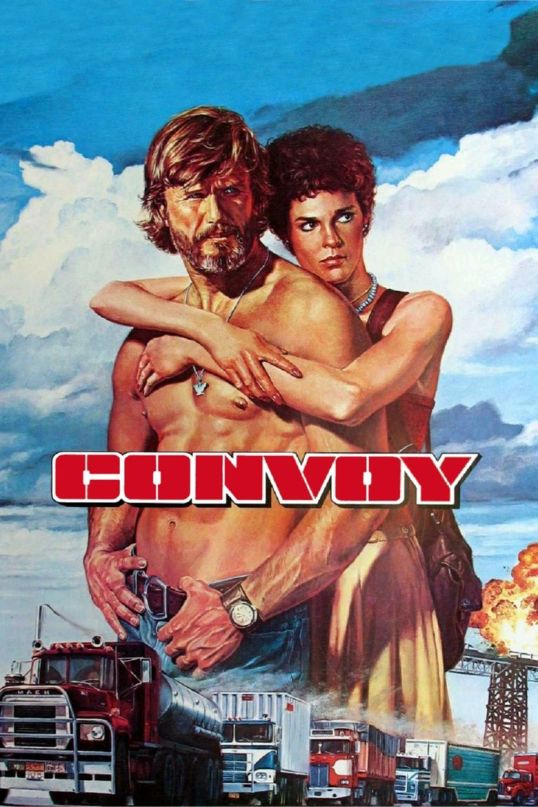
Film Review: Convoy (dir by Sam Peckinpah)


Well, it looks like we’ve got ourselves a Convoy!

The 1978 film Convoy opens with the image of a truck passing by some hills that have been covered with snow.  At a certain point, it actually looks like the truck is descending into a sea of white powder.  It’s an appropriate image because, to film lovers and cinematic historians, Convoy will always be associated with cocaine.

Convoy was meant to be a relatively small-scale B-movie, one that was meant to capitalize on the popularity of a novelty song, as well as the recent success of other car chase films.  Instead, it became a notoriously troubled production that went famously overbudget and overschedule as director Sam Peckinpah turned Convoy into a personal statement about modern cowboys and independence.  When the film was finally released, it was the biggest box office hit of Peckinpah’s storied career.  However, because so much money had been spent making the film, it still failed to make a profit and the film is regularly described as being one of the many flops of the late 70s that eventually led to the power in the film industry shifting away from the directors and over to the studio executives.  Many in Hollywood grumbled that it was Peckinpah’s well-known cocaine use that led to him having such trouble with what should have been a simple B-movie.  That’s probably a bit unfair to Peckinpah as it’s been written that just about everyone in Hollywood was using cocaine in 1978.

Add to that …. Convoy‘s not that bad.

Convoy tells the story of Rubber Duck (Kris Kristofferson), a legendary trucker who has never joined the Teamsters.  He’s an independent.  Rubber Duck’s nemesis is Sheriff Dirty Lyle (Ernest Borgnine), who is also an independent.  He’s never joined the policeman’s union.  As Rubber Duck puts it, “There’s not many like us anymore.”

Anyway, for reasons that are only vaguely defined, Rubber Duck leads a convoy of trucks across the southwest while being pursued by the police.  It has something to do with protesting the law enforcement tactics of Dirty Lyle, despite the fact that Rubber Duck appears to kind of like Lyle.  Soon hundreds of other independent truckers are joining Rubber Duck’s convoy, all to protest law enforcement.  Among those in the convoy are Pig Pen (Burt Young), Widow Woman (Madge Sinclair), and Spider Mike (Franklyn Ajaye), who just wants to get home to his pregnant wife.  Traveling with Rubber Duck is Melissa (Ali MacGraw), who is supposed to be some sort of photojournalist.  Rubber Duck and Melissa fall in love but there’s only so much you can do with a love story when it centers around two of the least expressive stars of the 70s.  During the chase, Rubber Duck picks up some non-truckers supporters, including some religious fanatics in a microbus.  He and the truckers also drive through and destroy a lot of buildings, which kind of makes it look like the cops might have had a point.

What sets Convoy apart from other chase films of the 70s is just how seriously it takes itself.  There’s an undercurrent of melancholy that runs through the entire film.  Rubber Duck seems to know that America is changing and as people become more comfortable with the idea of sacrificing their freedoms, his days as an independent trucker are numbered.  Dirty Lyle also seems to be stuck in a permanent existential crisis, taking no joy in being a crook but still forced to do so by being a part of an inherently corrupt government system.  There’s a scene where a truckstop waitress offers herself up as a gift to Rubber Duck on his birthday and Peckinpah films it as if he’s making an Italian neorealist drama about Rome after the war.  When Spider Mike says that he has to get home to his wife, he says it with the pain of a man who knows that the system only cares about control and not happiness.  These aren’t just truckers.  These are men and women who are on the front lines battling a creeping culture of oppression.

Surprisingly enough, the film’s serious tone actually works to its advantage.  You may not fully understand why Rubber Duck is leading that convoy but you hope that it succeeds because you get the feeling that the world might end if it doesn’t.  When the film ends with Ernest Borgnine laughing like a maniac, it comes across less like a moment of amusement and more like an acknowledgment that the universe is a tragic farce.  Life is a riddle wrapped inside an engima and only Rubber Duck and Dirty Lyle seem to understand that fact.

Add to that, this is a film about independents refusing to allow themselves to be limited by the regulatory state.  In its way, it’s one of the most sincerely Libertarian films ever made and, with all of us currently living under “lockdowns” and hoping that our governors don’t join those who have already surrendered their better instincts to their inner tyrant (sorry, Michigan, Kentucky, and New Jersey), Convoy remains an important film.  Go, Rubber Duck, go!


A Herman Wouk Double Feature: The Winds of War (1983, directed by Dan Curtis) and War and Remembrance (1988, directed by Dan Curtis)


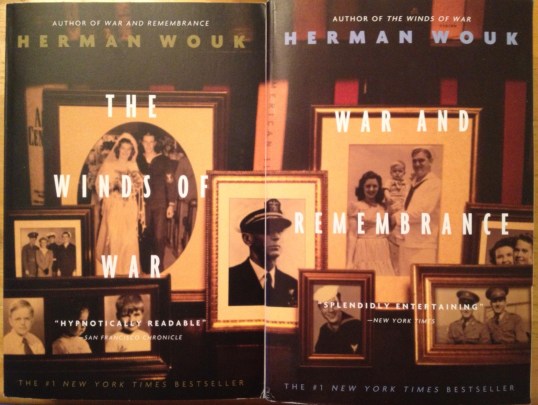
When the great American novelist Herman Wouk passed away earlier this month at the age of 103, he left behind a rich and varied literary legacy.  From 1947, the year that his first novel was published to 2016, the year that he published his memoirs, Wouk wrote about religion, history, science, and even the movies.  However, Wouk will probably always be best remembered for the three novels that he wrote about World War II.

Based on his own Naval service during World War II, The Caine Mutiny was published in 1951 and was later adapted into both a successful stage play and an Oscar-nominated film.  It also won Wouk a Pulitzer Prize and established him as a major American writer.  Nearly 20 years later, Wouk would return to the history of the Second World War with two of his greatest literary works, The Winds of War and War and Remembrance.  (Originally, Wouk was only planning on writing one book about the entire war but when it took him nearly a thousand pages to reach Pearl Harbor, he decided to split the story in two.)  Beginning in 1939 and proceeding all the way through to the end of the war, the two books followed two families, the Henrys and the Jastrows, as they watched the world descend into war. Along the way, the book’s fictional characters rub shoulders with historical characters like Hitler, Churchill, FDR, and even Stalin.  Carefully researched and meticulously detailed, the books were both critically acclaimed and popular with readers and, despite some soapy elements, they both hold up well today.

Given their success, it’s not a surprise that both The Winds of War and War and Remembrance were adapted for television.  Today, HBO would probably give the books the Game of Thrones treatment, with 8 seasons of war, tragedy, romance, and Emmys.  However, this was the 1980s.  This was the age of of the big-budget, all-star cast network miniseries.  Wouk’s epic history of World War II was coming to prime time.
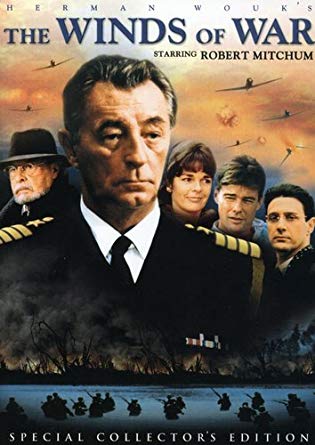
With a total running times of 15 hours, The Winds of War originally aired over seven evenings in 1983.  Produced and directed for ABC by Dan Curtis, The Winds of War had a 962-page script, a 200-day shooting schedule, 285 speaking parts, and a then-record budget of $35,000,000.  It also had Robert Mitchum, starring as Victor “Pug” Henry, an ambitious naval officer who somehow always managed to be in the right place to witness almost all of the events leading up to America’s entry into World War II.  Jan-Michael Vincent played Pug’s son, Byron, while John Houseman took on the pivotal role Aaron Jastrow, a Jewish scholar though whose eyes the home audience would witness the rise of fascism in Europe.  Terribly miscast as Natalie, Aaron’s niece and Byron’s lover, was 44 year-old Ali MacGraw.  Among those playing historical figures were Ralph Bellamy as FDR, Howard Lang as Churchill, and Gunter Meisner as Hitler.

I recently watched The Winds of War on DVD and, despite some glaring flaws that I’ll get to later, it holds up well as both a history of World War II and a tribute to those who battled Hitler’s evil.  Like Wouk’s novels, the miniseries does a good job of breaking down not only how Hitler came to power but also why the rest of the world was often in denial about what was happening.  Watching the entire miniseries in one setting can be overwhelming.  It’s a big production and it is also unmistakably a product of a time when the major networks didn’t have to worry about competition from cable.  It takes its time but, in the end, you’re glad that it did.  All of the little details can get exhausting but they’re important to understanding just how Hitler was able to catch the world off-guard.
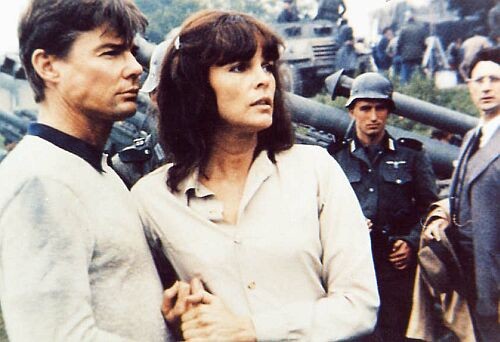
Jan-Michael Vincent and Ali MacGraw in The Winds of War

The miniseries does suffer due to the miscasting of some key roles.  Both Jan-Michael Vincent and Ali MacGraw were far too old for their roles.  Vincent was 38 and MacGraw was 44 when they were cast as naive and idealistic lovers trying to find themselves in Europe.  It’s perhaps less of a problem for Vincent, who had yet to lose his looks to alcoholism and who looked enough like Robert Mitchum that he could pass as Mitchum’s son.  But MacGraw is simply terrible in her role, flatly delivering her lines and looking more like Vincent’s mother than his lover.  It’s particularly jarring when she mockingly calls diplomat Leslie Sloat “Old Sloat,” because Sloat was played by David Dukes, who was six years younger than MacGraw.
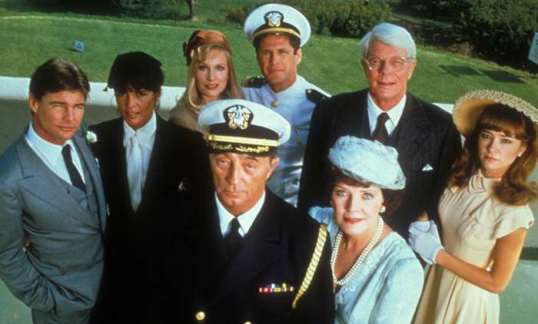
67 year-old Robert Mitchum was also much too old to play an ambitious junior officer, one whose main goal in life is still to ultimately become an admiral.  When he ends up having an affair with a younger British journalist played by 30ish Victoria Tennant, the difference in their ages is even more pronounced than in Wouk’s novel.  (Pug was in his 40s in The Winds of War.)  However, Mitchum overcomes his miscasting by virtue of his natural gravitas.  With his weary presence and authoritative voice, Mitchum simply is Pug.
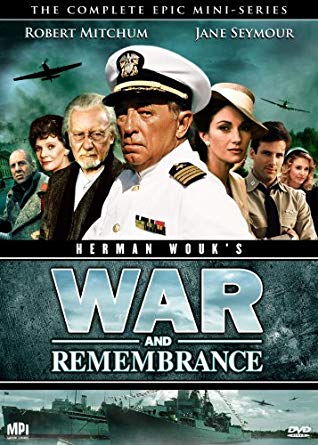
A ratings hit and a multiple Emmy nominee, The Winds of War was followed up five years later by War and Remembrance.  Like its predecessor, War and Remembrance set records.  The script ran 1,492 pages and featured 356 speaking parts.  The production employed 44,000 extras and filming took nearly two years, from January of 1986 to September of 1987.  With a budget of $104 million, it was the most expensive television production to date.  The final miniseries had a 30-hour running time, which was divided over 12 nights.  War and Remembrance not only made history because of its cost and length but also as the first major production to be allowed to film on location at the Auschwitz concentration camp.  For many members of the generation born after the end of World War II, War and Remembrance would serve as their first introduction to the horrors of the Holocaust.

Director Dan Curtis returned and with him came Robert Mitchum, now in his 70s and still playing a junior naval officer.  David Dukes once again played the hapless diplomat, Leslie Sloat.  Ralph Bellamy also returned as FDR as did Victoria Tennant as Mitchum’s lover, Polly Bergen as Mitchum’s wife, and Peter Graves as Bergen’s lover.  However, they were the exception.  The majority of the original cast was replaced for the sequel, in most cases for the better.  With John Houseman too ill to reprise his role, John Gielgud took over the role of Aaron Jastrow while Hart Bochner replaced the famously troubled Jan-Michael Vincent.  Robert Hardy took over the role of Churchill while Hitler was recast with Steven Berkoff.  Best of all, Jane Seymour replaced Ali MacGraw in the role of Natalie and gave the best performance of her career.  Other characters were played by a mix of up-and-comers to tv veterans, with the cast eventually including everyone from Barry Bostwick and Sharon Stone to E.G. Marshall and Ian McShane.
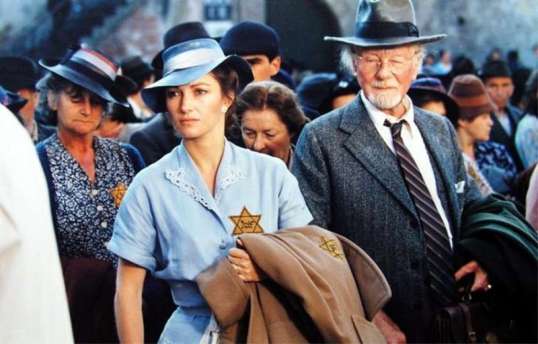
Jane Seymour and John Gielgud

With a stronger cast and (ironically, considering the running length) a more focused storyline, War and Remembrance is superior to The Winds of War in every way.  That doesn’t mean that it’s perfect, of course.  The scenes featuring Barry Bostwick as a submarine commander feel as if they go on forever and Robert Mitchum still seems like he should be preparing for retirement instead of angling for a promotion.  But none of that matters when the miniseries focuses on Aaron and Natalie Jastrow and their struggle to survive life in the Theresienstadt Ghetto and eventually Auschwitz.  At the time that War and Remembrance was initially broadcast, the concentration camp scenes were considered to be highly controversial and many viewers complained that they were so disturbing that they should not have been aired during prime time.  (This was four years before Schindler’s List.)  Seen today, those scenes are the most important part of the film.  Not only do they show why the war had to be fought but they also demand that the world never allow such a thing to happen again.

Though it was considered by a rating disappointment when compared to its predecessor, War and Remembrance was still a multiple-Emmy nominee.  Controversially, it defeated Lonesome Dove for Best Miniseries.  Both Winds of War and War and Remembrance have been released on DVD and, like the books that inspired them, they both hold up well.  They pay tribute to not only those who fought the Nazis but also to the humanistic vision of Herman Wouk.
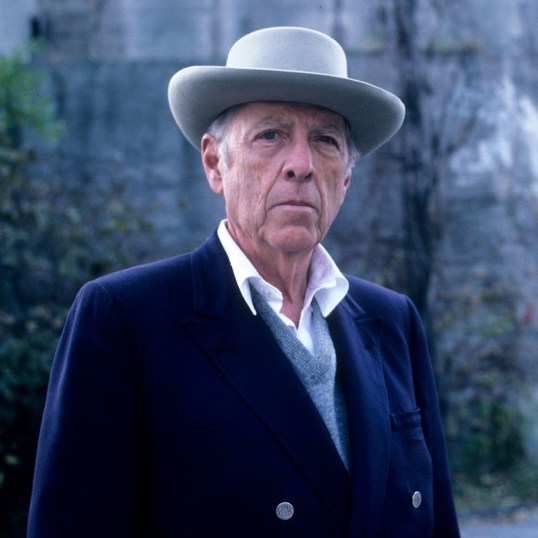
Herman Wouk (1915-2019)
Lisa Marie Laughs and Cries Over Love Story (dir. Arthur Hiller)


They are so freaking pretty!

I’ve discovered something as I’ve pursued my mission to see every single film ever nominated for best picture.  Quite a few of the nominees (perhaps the majority of them) are no longer impressive because they’ve simply become dated by the passage of time.  We can still watch these films and understand (and believe) that they were probably quite groundbreaking and impressive when initially released.

And then there’s the films like the 1970 best picture nominee, Love Story.  These are the nominees that you quickly realize were never good.  These are the films that were nominated because they either dominated the box office or perhaps they just lucked out and were released in a bad year for cinema in general.  At least that’s what we tell ourselves.  In all honesty, the circumstances of how they came to be nominated are often enigmatic and shrouded in mystery.  I have yet to read a single critic — from either 1970 or the present day — who has had a single kind thing to say about Love Story and, after sitting through it last night, I can say that for once, me and the critical establishment are in agreement.

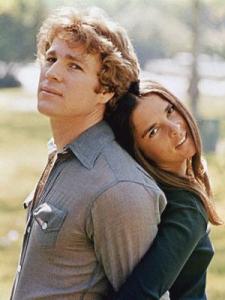
The plot of Love Story is pretty simple and I’m going to go ahead and include the entire story here because quite frankly, it’s impossible to spoil something this predictable.  Oliver (Ryan O’Neal) meets Jenny (Ali MacGraw).  Oliver is a rich jock who is attending Harvard.  Jenny is a poor music student.  Upon first meeting her, Oliver calls Jenny a “bitch.”  Jenny calls Oliver “a dumb jock.”  Oliver falls in love with Jenny.  Jenny calls Oliver “a dumb jock.”  Oliver and Jenny get married.  Oliver’s father (Ray Milland) disapproves.  Jenny’s father (John Marley) is just kind of confused.  Cut off from the family fortune, Oliver struggles to provide for Jenny.  (Apparently, the 70s were a tough time to be a graduate of Harvard Law School.)  Jenny and Oliver have a fight.  Oliver cries.  Jenny says, “Love means never having to say you’re sorry,” which seems to be an underhanded way of admitting that most guys aren’t ever going to say that anyways.  Oliver is happy.  Jenny comes down with a never-named terminal illness and dies.  The end.

I know that I’m supposed to watch a movie like Love Story and just shrug my shoulders and go, “Oh well, it’s not very good but I’m a girl so I’ll love it unconditionally.”  And God knows, I tried my best,  I tried so very hard to just shut down my mind and give control over to my heart.  Because, believe it or not, I’m just a dorky, asthmatic romantic.  I’m the type of girl who gets all giggly and excited when she gets flowers, despite all of my allergies.  I can remember every sunset I’ve ever watched.  The rare times we actually do have a winter down here in Texas, I’m all about the snowball fights that end with a long, passionate kiss.  I love Valentine’s Day and I remember anniversaries.  I still have every gift that I’ve ever been given, even the really cheap and ugly things that I wouldn’t be caught dead wearing in public.  Every trinket, every stuffed animal, every card, every piece of jewelery, every note, every article of lingerie, every movie ticket — if it’s an artifact of a past or current relationship, I have it all safely stored in a place of honor. 

Yes, I adore everything that Love Story was selling and yet, as I watched Love Story, I felt myself growing more and more cynical with each passing moment.  Fortunately, the movie only last 99 minutes because if it had gone on for a few 120, I probably would have ended up “an old maid…closing up the library!” like Donna Reed in It’s a Wonderful Life.  The problem with Love Story isn’t that it’s not romantic; it’s that it takes the standard clichés of romance and embraces them to such an extent that I didn’t feel as if I was being manipulated by the film as much as I felt like I was being brutally violated by it.

Seriously, the entire time I was watching, I felt like the film was screaming at me, “Look at how beautiful they are!  Look at that sunset!  Listen to that music!  Cry, damn you, cry!”  Never mind the fact that MacGraw and O’Neal — pretty as they are to look at — generate close to zero chemistry.  Never mind that  MacGraw responds to being terminally ill by laying in bed with her hair artfully spread on the pillow behind her while director Arthur Hiller practically bathes her in a warm, saintly glow.  Never mind that “Love means never having to say you’re sorry,” doesn’t make any freaking sense at all.  Trust me, if you love me and yet you still insist on acting like an asshole, you sure as Hell have to apologize to me. 

On the plus side, the film’s got one of those overdone, lush soundtracks; the type that can make you cry as long as you don’t pay attention to what’s happening on-screen.  (That said, Taylor Swift is nowhere to be found.)  Ryan O’Neal is surprisingly likable as Oliver but Ali MacGraw — oh my God, where do I begin?  Actually, I don’t think I will because there’s simply no way I can explain just how bad of a performance she gives here.  Instead, I’ll just point out that Love Story also features the film debut of Tommy Lee Jones.  He’s credited as Tom Lee Jones here and he plays Oliver’s roommate.  He’s an on-screen for about 12 seconds and he delivers exactly one line. 

Needless to say, he pretty much steals the entire film.