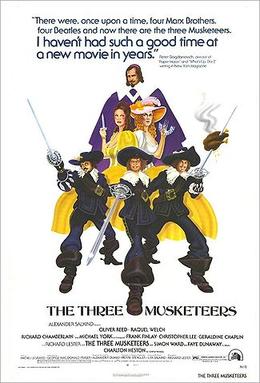
The Three Musketeers (1973, directed by Richard Lester) and The Four Musketeers (1974, directed by Richard Lester)


In 1973, director Richard Lester and producer Ilya Salkind decided to try to get two for the price of one.

Working with a script written by novelist George McDonald Fraser, Lester and Salkind had assembled a once-in-a-lifetime cast to star in an epic film adaptation of Alexandre Dumas’s The Three Musketeers.  Michael York was cast as d’Artagnan, the youthful swordman who goes from being a country bumpkin to becoming a King’s Musketeer.  His fellow musketeers were played by Oliver Reed, Richard Chamberlain, and Frank Finlay.  Faye Dunaway and Christopher Lee were cast as the villains, Milady and Rochefort.  Charlton Heston played the oily Cardinal Richelieu.  Geraldine Chaplin played Queen Anne while Simon Ward played the Duke of Buckingham.  Comedic relief was supplied by Roy Kinnear as d’Artagnan’s manservant and Raquel Welch as Constance, d’Artagnan’s klutzy love interest.  The film was a expensive, lushly designed epic that mixed Lester’s love of physical comedy with the international intrigue and the adventure of Dumas’s source material.

The only problem is that the completed film was too long.  At least, that’s what Salkind and Lester claimed when they announced that they would be splitting their epic into two films.  The cast and the crew, who had only been paid for one film, were outraged and the subsequent lawsuits led to the SAG ruling that all future actors’ contracts would include what was known as the Salkind clause, which stipulates that a a single production cannot be split into two or more films without prior contractual agreement.

But what about the films themselves?  Both The Three Musketeers and The Four Musketeers are currently available on Tubi.  I watched them over the weekend and, of the many films that have been made out of Dumas’s Musketeer stories, Richard Lester’s films are the best.  Lester captures the swashbuckling spirit of the books while also turning them into two films that are easily identifiable as Lester’s work.  There’s a lot physical humor to be found in Lester’s adaptation, especially during the first installment.  d’Artagnan runs through the streets of Paris, convinced that he has been insulted by the haughty Rochefort.  d’Artagnan manages to get challenged to three separate duels, all to take place on the same day.  After his first swordfight as a member of the Musketeers, d’Artagnan tries to tell the men that he wounded about an ointment that will help them with their pain.  Raquel Welch also shows a genuine flair for comedy as Constance, which makes her fate in the second film all the more tragic.
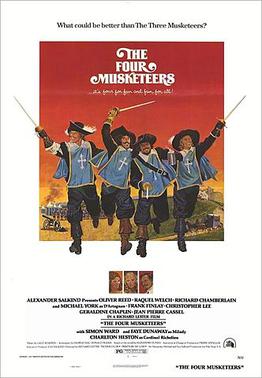
For all the controversy that it caused, splitting the story into two films was actually the right decision.  If The Three Musketeers is an enjoyable adventure film, The Four Musketeers is far more serious.  In The Four Musketeers, Oliver Reed’s melancholic Athos steps into the spotlight and his story of his previous marriage to the villainous Milady casts his character in an entirely new light.  In The Four Musketeers, the combat is much more brutal and the humor considerably darker.  Likable characters die.  The Musketeers themselves commit an act of extrajudicial brutality that, while true to Dumas’s novel, would probably be altered if the film were made today.  From being a naive bumpkin in The Three Musketeers, The Four Musketeers finds d’Artgnan transformed into a battle weary soldier.

The cast is fabulous.  This is a case of the all-star label living up to the hype.  Oliver Reed, Frank Finlay, and Richard Chamberlain all seems as if they’ve been riding and fighting together for decades.  Christopher Lee plays Rochefort as being an almost honorable villain while Faye Dunaway is a cunning and sexy Milady.  What truly makes the film work, though, is the direction of Richard Lester.  Lester stay true to the spirit of Dumas while also using the material to comment on the modern world, with the constant threat of war and civil uprising mirroring the era in which the films were made.  Interestingly enough, Richard Lester first became interested in the material when Ilya Salkind reached out to the Beatles to try to convince them to play the Musketeers.  While the Beatles were ultimately more interested in a never-produced adaptation of The Lord of the Rings, Richard Lester was happy to bring Dumas’s characters to life.

Both The Three Musketeers and The Four Musketeers are currently on Tubi, for anyone looking for a truly great adventure epic.
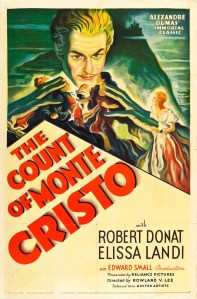
The Count of Monte Cristo (dir. by Roland V. Lee)


Note that this maybe a bit brief and off tangent. This may be one of the first reviews I’ve written for a film created well before my time. I won’t have as many movie references or personal anecdotes to add here.

I love the story of The Count of Monte Cristo. At the time of this writing, it can be found on both Amazon Prime and on Tubi.

Written in 1844 by Alexandre Dumas, it’s a tale of revenge and depending on which version you watch, there’s also a bit of redemption to it. Though it’s adapted numerous times on stage and screen, I’m familiar with 3 main movie versions. You have the modern 2002 version from Kevin Reynolds, starring Jim Caviezel, Henry Cavill and Guy Pearce. There’s the 1975 TV Movie (my personal favorite), directed by David Greene and starring Richard Chamberlain, Donald Pleasance, Tony Curtis and Kate Nelligan. And finally, we have the classic 1934 rendition, directed by Donald V. Lee and starring Robert Donat, Elissa Landi, Sidney Blackmer and Louis Calhern. Most audiences may know of the film from the references made of it in 2005’s V for Vendetta.

The Count of Monte Cristo is the story of Edmund Dantes (Robert Donat, The 39 Steps) , a sailor who has everything going for him. He’s the newly minted Captain of the Pharaon, a title bestowed to him after the original captain died during a voyage near the island of Elba. Before the original Captain passes, he gives Edmond a letter to be delivered to an individual who will make himself known. This promotion and the letter also draws the jealous eyes of the would be Captain Danglars (Raymond Walburn, Christmas in July). Edmond has the heart of the lovely Mercedes de Rosas (Elissa Landi, The Yellow Ticket), but not the affections of Mercedes’ Mother (Georgia Caine, Remember the Night), the Madame de Rosas. Together with Fernand Mondego (Sidney Blackmer, Rosemary’s Baby), they often try to convince Mercedes to find someone better.

During the party for his wedding, Edmond meets the letter’s recipient and makes the delivery. Shortly afterward, both this man and Edmond are arrested. We learn the man is the father of The King’s Magistrate, Renee de DeVillefort (Louis Calhern, Julius Caesar). Choosing to protect his father (now considered a Bonapartist), DeVillfort puts on the blame on Dantes. With Mondego and Danglars as co-conspirators, they send Dantes to the dreaded Chateau D’if, an Alcatraz-like prison on the sea. To make things worse, after Napoleon is defeated, Edmond’s captors list him as deceased and his name is struck from the prison record. Dantes spends nearly 15 years in the Chateau, falling out of everyone’s memory. During his time, he discovers and befriends the Abbe Faria (O.P. Heggie, Anne of Green Gables), another prisoner who teaches Dantes various topics of the world. The Abbe also shares the secret of the De Sparda Treasure, hidden away just off the island of Monte Cristo. Edmond eventually escapes the Chateau D’If, acquires the treasure and returns to the Paris as the mysterious Count of Monte Cristo.

The film has fine performances throughout, given the time frame. Donat’s Dantes is quite naive prior to the imprisonment, but as the Count, I felt he brought a lot of style and class to the character. It was much like watching an old serial of The Batman or The Shadow. Another major surprise (for me, anyway) was Sidney Blackmer as Mondego. I’ve only ever seen Blackmer as the old and strange Roman Castavet in Roman Polanski’s Rosemary Baby, so it was very interesting to see him in his prime. There’s a nice duel between Mondego and Dantes that showcased Blackmer’s athleticism as well as his acting. I also enjoyed Walburn’s Danglars, who felt like a weasel you’d find in a classic Disney animated film.

Visually, for a black and white film, there’s some good use of light and shadow here, particularly during the dimly lit scenes in the Chateau D’If and the face off between the Count and Mondego.

How Edmond chooses to face his enemies was interesting. A bit of scandal for one, greed for another and a full-on courtroom drama for a third. I thought the court case element was bit much, but given where the story was going, it made sense. Overall, The Count of Monte Cristo is a wonderful classic with great pacing throughout.

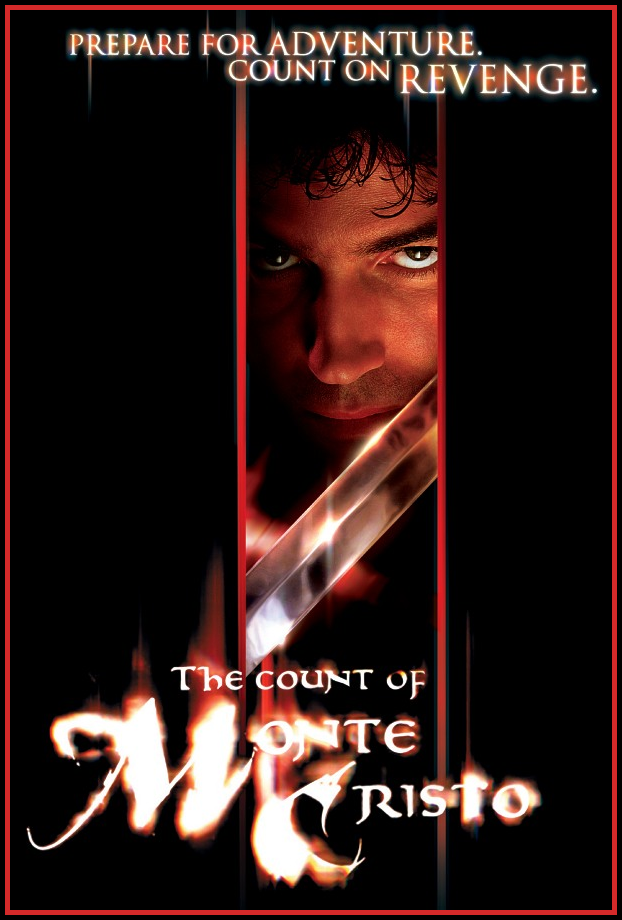
Review: The Count of Monte Cristo (dir. by Kevin Reynolds)


In what has become an unofficial ritual for myself whenever my birthday rolls around I always end up watching a film from 2002 that flew under the radar of most people. While it made modest box-office returns it wasn’t the head-turning blockbuster that some of its producers hoped it would turn out to be. It’s a romantic adventure piece by Kevin Reynolds and for readers of classic literature they’d recognize the title of the film, The Count of Monte Cristo. A film loosely based on the classic novel of adventure, revenge and redemption by French author Alexandre Dumas. The film ends up being a fun, thrilling throwback to films of an era which had marquee stars such as Errol Flynn and Basil Rathbone.

The story is one known well enough. It’s a tale of a man, Edmond Dantès wrongly accussed of a capital crime and imprisoned in the Alcatraz-like prison Chateau d’If through the machinations of three individuals: his best friend Fernand Mondego, first mate Danglars and the ambitious deputy prosecutor Villefort. Dantès spends the next several years in Chateau d’If under the cruel and sadistic eyes of it’s warden, Armand Dorleac (played by Michael Wincott with his usual flair for sadism). It’s while Dantès  has started to contemplate suicide after rejecting God for the pain and suffering he has had to endure that he has a fortuitious meeting with another guest of Chateau d’If. It’s this relationship between Dantès and Abbé Faria (Richard Harris in the mentor role he had begun to play in his later years) which take up the bulk of the first third of the film.

Dantès tells him of the circumstances which led to his imprison in Chateau d’If and the thoughts of vengeance on those responsible for his predicament. Faria tries to turn him from his dark path, but seeing how determined his young friend seems on journeying down its twisted path he agrees to teach him how to become adept at being a noble, finances and in swordcraft in exchange for help in digging themselves out of their prison. Taking several more years to complete the education Dantès needs to exact his revenge it ends at the death of Faria and his mentor’s final gift to his student. The location of a treasure so vast that Dantès could retire to a life of peace and contemplation or fund his plans of vengeance.

The middle section of the film shows Dantès finding the treasure and remaking himself through his newfound wealth as the Count of Monte Cristo to better insinuate himself amongst the wealthy and noble-born his targets mingle in. With the help of a bandit whose life spares after a duel in Jacopo (Luis Guzman) the plans Dantès has worked on for years begin to bear fruit as he manipulates and fools Fernand, Villefort and Danglars into his confidence to better see to their downfall. It’s during this time he meets his former fiancee Mercedes (played by the ridiculously beautiful Dagmara Dominczyk), now Countess Mondego after being told of Edmond’s execution earlier in the film, and Fernand’s son Albert. The circumstances of how his former love having had a child and married to one of the men who had conspired against him brings a new complication to Dantès plans.

The last third of the film shows the culmination of Dantès and his elaborate plans to bring about the downfall of all those who had wronged him. While the plans, at times, strain the bonds of disbelief at actually having fooled and worked against his enemies the way the film makes the audience root for Dantès to succeed helps. This is a Dantès who comes off as noble despite being of commoner origins who we stand behind and support in his plans of vengeance. With the amount of wealth at his disposal it’s not too difficult to put oneself in the same shoes and not think of vengeance as well to strike a balance.

It’s a testament to the direction of filmmaker Kevin Reynolds that the film and it’s story never bogs down despite a story with many elaborate plots and secondary characters introduced midway. The fact that the film only borrows some of its complexity from an even more labyrinthine novel shows how the filmmakers actually had to simplify the story as to not make it so complex that it loses the bulk of its audience.

The Count of Monte Cristo also benefit from a strong cast led by Jim Caviezel in the titular role with Guy Pearce playing his former friend and betrayer Fernand Mondego and James Frain as the prosecutor Villefort. Caviezel plays his role as Dantès and as the Count of Monte Cristo as two different people with distinct personalities. There’s Dantès the earnest sailor who just wanted to get back to his love, Mercedes and then there’s the sophisticated and ruthless Count whose machinations would lead to the destruction of lives and reputations. It’s a mystery why Caviezel hasn’t become the star he surely was in the making and this film showed that he had the talent to become one of the industry’s new leading men. I blame Mel Gibson in casting him as Jesus in The Passion of the Christ for having put a curse on Caviezel.

Guy Pierce in the role of Fernand plays the conniving and remoreless villain role to the hilt. With an overbearing and effete noble bearing to his performance it was a character written to inspire hatred not just in its main protagonist but in the audience as well. Pearce knows what his roles represent and has fun playing up the role as main heavy.

Richard Harris as the priest Faria did his usual great work as the elder mentor to a younger man. It was a role he began to be known for starting with Ridley Scott’s Gladiator right up to his final mentor role as the wizard Dumbledore in the Harry Potter film franchise. It’s hard to explain to people that Harris was not always this wise and mentoring father figure, but one who played roles where he’d play womanizers, charming cads and roguish rebel.

The Count of Monte Cristo ended up being more fun than it should be with enough complexities in its storytelling that the film doesn’t dumb down too much the story it was adapted from. To be honest the only way one could truly adapt Dumas’ novel of revenge and redemption is through a long-form tv series. It is just that complex with so many characters that a film adaptation would just be too long or just unnecessarily crowded with characters the audience would care to know. It’s a good thing that the film by Kevin Reynolds was still able to keep to the spirit of the original source while whiling away the story down to its basic core.

It’s a film that plays like a throwback to the swashbuckling films from Hollywood of the 30’s and 40’s and it wouldn’t be too difficult to see Caviezel in the roles Errol Flynn once inhabited. There’s very little special effects in the film which adds more to this sense with swordfight scenes as expertly choreographed as any of the past. The Count of Monte Cristo, for some reason still unknown to me, continues to be the one thing that keeps airing on my birthday and the fact that it’s such a fun and thrilling film that I continue to watch it everytime my day of days roll around. Can’t wait for next year.