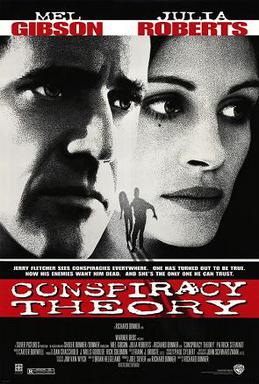
 Jerry (Mel Gibson) is the taxi driver that most people would dread getting stuck with. He’s obsessed with conspiracies, ranting and raving as he drives his passengers around New York City. The moon landing was fake, he says. The New World Order is real. Fluoridation in mind control. Freemasons control the world. Black helicopters patrol the skies. Implausibly, Justice Department lawyer Alice Sutton (Julia Roberts) enjoys listening to Jerry’s paranoid monologues but she finds them to be a lot less amusing when they turn out to be true. Soon, she and Jerry are being pursued by Dr. Jonas (Patrick Stewart), the head of MK-Ultra and the man who bred Jerry to eventually become an assassin.
Conspiracy Theory has a good premise and a great Mel Gibson performance and Patrick Stewart is entertaining as the main bad guy. Though it really is just a slightly above average 90s action film, Conspiracy Theory is still a movie that seems prophetic. Many of Jerry’s theories were obscure and not well-known when the movie was first released, nearly 30 years ago. Today, a lot of them have been popularized by social media and podcasts. Conspiracies have gone mainstream. Jerry would love listening to Joe Rogan today. In fact, Jerry would probably have a podcast of his own. Because the movie was released in 1997, a lot of the things that Jerry talks about feel quaint and almost old-fashioned when you compare them to what Jerry would be ranting about today. Compared to today’s anti-vaxxers and 9-11 truthers, Jerry’s fear of the black helicopters seems harmless. Or, at least, it does until the black helicopters suddenly show up in the middle of a chase scene, nearly invisible in the night sky.
Conspiracy Theory can’t really hold up to Richard Donner’s best films. There aren’t as many memorable lines as in Lethal Weapon and it never finds the same balance between kitsch and art that Donner was able to find with both The Omen and Superman. Donner still gets some good moments, like the opening montage where Jerry scares the Hell out of a yuppie passenger played by Alex McArthur. I wish Conspiracy Theory had followed its premise through to its natural conclusion instead of having Jerry suddenly turn into what was then a typical Mel Gibson action hero. (Today, of course, it would probably be much easier for audiences to accept the idea of Gibson playing a mentally ill, paranoid conspiracy theorist.) Overall, though, both the movie and the theories hold your interest.
 Through the Shattered Lens