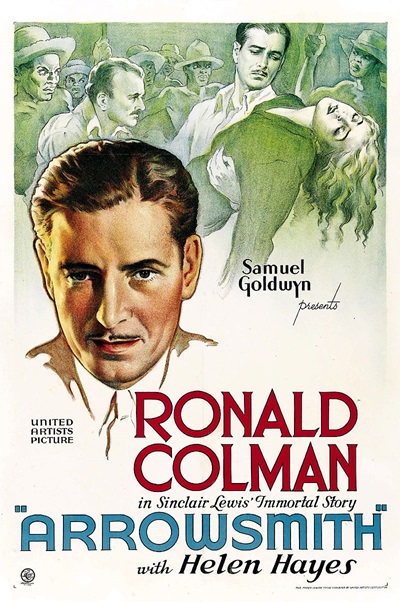
In the 1931 Best Picture nominee Arrowsmith, Ronald Colman stars as Martin Arrowsmith, a doctor who is trying to save lives without compromising his ethics.
Arrowsmith is mentored by the famed bacteriologist, Max Gottlieb (A.E. Anson) and married to a nurse named Leora (Helen Hayes). At first, Arrowsmith makes his living as the local doctor in Leora’s small hometown in South Dakota. However, Arrowsmith is ambitious and wants to do more with his life and career than just take care of a small town. He wants to cure the world of disease. When he’s offered a position at the prestigious McGurk Institute in New York, he enthusiastically accepts. Having just suffered a miscarriage, Leora supports Arrowsmith’s decision and travels to New York with him. No matter what happens, Leora is always there to support her husband, even when he doesn’t seem to appreciate it.
When Arrowsmith thinks that he’s discovered an antibiotic serum that appears to be capable of curing all sorts of diseases, he attempts to stay true to the methods taught to him by Dr. Gottlieb. He takes his time. He tests carefully. He doesn’t rush out and give the serum to everyone. However, Arrowsmith finds his methods continually sabotaged by his colleagues, who hope to raise money by telling the press about a miracle serum that can “cure all diseases!” When Arrowsmith later finds himself combatting an outbreak of the Bubonic Plague in the West Indies, he again tries to employ the scientific method but finds himself being pressured by government officials to give his untested serum to every single person on the island. Eventually, Arrowsmith’s ethics are pushed to their limits when even Leora falls ill.
Arrowsmith was based on a best-selling novel by Sinclair Lewis, though the plot was changed to make the story more palpable for film audiences. In the novel, Arrowsmith is a bit of cad who regularly cheats on his wife. In the film, Arrowsmith is passionate and driven but the exact nature of his relationship with wealthy Joyce Lanyon (Myrna Loy) is left so ambiguous that it actually leaves one wondering why the character is in the film at all. What both the film and the novel have in common is an emphasis on the importance of science and the scientific method. Arrowsmith’s idealism runs into the harsh reality of life during an epidemic. Government officials are more concerned with saying that they’ve done something as opposed to considering whether their actions have ultimately done more harm than good. In its way, Arrowsmith predicted the COVID era.
Arrowsmith was the first John Ford film to be nominated for Best Picture and its financial success allowed Ford the freedom to go on to become one of Hollywood’s most important directors. Seen today, Arrowsmith feels a bit creaky and self-important, with little of the visual flair that Ford brought to his later films. Ronald Colman’s performance as Arrowsmith seems a bit stiff, especially when compared to the much more lively (and sympathetic) performance of Helen Hayes. Arrowsmith is a big and serious film and, if we’re going to be honest, it’s a little bit boring. Still, it’s interesting to see the issues of today being debated 90 years in the past.
As for the Oscars, Arrowsmith was nominated for Best Picture, Adaptation, Cinematography, and Art Direction. It lost in all four of the categories in which it was nominated. That year, Best Picture was won by Grand Hotel, which curiously didn’t receive any other nominations at all.
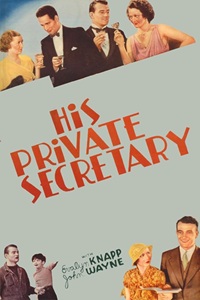 Business tycoon Mr. Wallace (Reginald Barlow) is sick and tired of his hard-drinking, hardy-partying son refusing to act in a responsible manner. Hoping to teach Dick Wallace about the value of hard work, Mr. Wallace sends Dick to a small town with instructions to collect a debt from the local preacher (Alec B. Francis). Dick, however, is more interested in the preacher’s daughter, Marion (Evelyn Knapp). After Dick finally convinces Marion that he’s not as bad his reputation, they got married. Mr. Wallace is disgusted and refuses to meet his new daughter-in-law, convinced that she’s a golddigger. Without revealing his true identity, Marion gets a job as Mr. Wallace’s private secretary and attempts to repair the relationship between father and son.
 Through the Shattered Lens