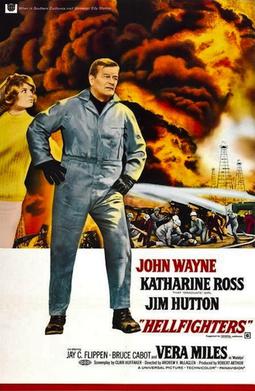
Hellfighters (1968, directed by Andrew McLaglen)


Chance Buckman (John Wayne) is the best there is when it comes to fighting oil fires.  Along with Greg Parker (Jim Hutton), Joe Horn (Bruce Cabot), and George Harris (Edward Faulkner), Chance travels the world and puts out fires that the regular authorities can’t handle.  Chance loves his job but he also loves his ex-wife, Madelyn (Vera Miles).  When Madelyn indicates that she wants to remarry Chance but only if he pursues a less dangerous line of work, Chance retires from firefighting and becomes an oil executive.  He leaves his firefighting company to his new son-in-law, Greg.  When Greg and Chance’s daughter (Katharine Ross) head down to Venezuela to battle a fire and find themselves not only having to deal with the flames but also with a band of revolutionaries, Chance is the only one who can help them.

When I was growing up, Hellfighters was one of those movies that seemed to turn up on the local stations a lot.  The commercials always emphasized the idea of John Wayne almost single-handedly fighting fires and made it seem as if the entire movie was just the Duke staring into the flames with that, “Don’t even try it, you SOB” look on his face.  As a result, the sight of John Wayne surrounded by a wall of fire is one of the defining images of my childhood, even though I didn’t actually watch all the way through until recently.  When I did watch it, I discovered that Hellfighters was actually a domestic drama, with an aging Wayne passing the torch to youngster Jim Hutton but then taking it back.

The fire scenes are the best part of Hellfighters and I wish there had been more of them.  The movie gets bogged down with all of Chance’s family dramas but it comes alive again as soon as John Wayne and his crew are in the middle of a raging inferno, putting their lives at risk to try to tame the fire.  Wayne was always at his best when he was playing strong, no-nonsense men who were the best at what they did.  Hellfighters is slow in spots but the fire scenes hold up well.  There’s no one I’d rather follow into an inferno than Chance Buckman.
Film Review: Two Mules For Sister Sara (dir by Don Seigel)


In 1970’s Two Mules For Sister Sara, Clint Eastwood and Shirley MacClaine take on the French!

It’s an often forgotten piece of history that, during the American Civil War, the French invaded Mexico and tried to turn it into a colony, one that was ruled by the hapless Archduke Maximillian.  The French were then led by Napoleon III, a rather enigmatic figure who spent his entire reign trying to live up to his namesake (and failing).  While the Americans would never have tolerated a French invasion of Mexico under normal circumstances, the Civil War provided enough of a distraction for Napoleon III to make his move in 1861.  Of course, as soon as the Civil War ended, America turned its attention to getting the French out of Mexico and, by the end of 1867, Maximillian had been executed and Napoleon III had withdrawn his forces.

Two Mules For Sister Sara takes place shortly after the end of the American Civil War, when the latest Mexican Revolution was in full swing.  Clint Eastwood plays Hogan, a former union officer who is now in Mexico working as a mercenary.  He’s been hired to help the revolutionaries attack a French garrison, in return for being given half of whatever is found inside.  Traveling through the desert, he comes across a group of bandits who are about to rape a woman named Sara (Shirley MacClaine).  Hogan guns down the bandits and is then shocked when Sara dons a habit and introduces herself as a nun who has been helping the revolutionaries.  She requests that Hogan travel with her and continue to protect her.  Hogan is reluctant, saying that he doesn’t want to become Sara’s mule when she already has one.  (That would be two mules for Sister Sara …. get it?)  But since Sara is a nun and claims to have no idea how to defend herself in the wilderness, Hogan agrees.  Sara and Hogan become unlikely allies as they get further and further involved in the Mexican Revolution.

Two Mules For Sister Sara owes a good deal to the Spaghetti westerns that were then coming out of Italy.  (Eastwood, of course, owed much of his stardom to his appearances in Sergio Leone’s Dollars trilogy.)  The Mexican Revolution was always a popular subject amongst the writers and directors of the Italian Spaghetti westerns.  Of course, Two Mules For Sister Sara is lacking in the political subtext that appeared in many of the Italian films.  Director Don Siegel may have been a liberal but, unlike many of his Italian contemporaries, he wasn’t a Marxist.  Instead, Two Mules For Sister Sara shows its Spaghetti influence in its panoramic visuals, it’s somewhat cynical sense of humor, and the casting of Eastwood as a taciturn mercenary whose main concern is using the revolution to make some money.  Eastwood plays a slightly more humorous version of his Man With No Name.  Hogan may be a cynic who doesn’t speak unless it’s absolutely necessary but he also possesses a good enough heart that there’s no way he’s going to abandon Sister Sara to fend for herself.  (The Man With No Name, on the other hand, would probably not have been so generous.)  Of course, Sister Sara has a secret of her own….

Supposedly, Eastwood and MacClaine didn’t get along particularly well while making Two Mules For Sister Sara.  (During preproduction, the film was envisioned as starring Eastwood and Elizabeth Taylor.)  If there was hostility between the two leads, it worked in the film’s favor because both Eastwood and MacClaine do a good job of playing off of each other.  MacClaine, at first, seems too contemporary for the role but, as the film progresses, she becomes more convincing.  There’s a revelation towards the end of the film that reveals that many of the moments that made MacClaine seem miscast were actually deliberate.  As for Eastwood, there’s a subtle humor running through his performance, as if he’s poking fun at his own tight-lipped persona. His performance here shows hints of the actor that he would become.

Two Mules For Sister Sara is an entertaining western, one that features Eastwood and Seigel celebrating and, at the same time, poking fun at the genre.  A year after this film, Eastwood and Seigel would make film history with Dirty Harry.

Retro Television Review: Fantasy Island 5.5 “Mr. Nobody/La Liberatora”


Welcome to Retro Television Reviews, a feature where we review some of our favorite and least favorite shows of the past!  On Tuesdays, I will be reviewing the original Fantasy Island, which ran on ABC from 1977 to 1984.  Almost the entire show is currently streaming on Daily Motion, YouTube, Plex, and a host of other sites.

This week, Charo shows up but Tattoo doesn’t.

Episode 5.5 “Mr. Nobody/La Liberatora”

(Dir by Cliff Bole, originally aired on November 7th, 1981)

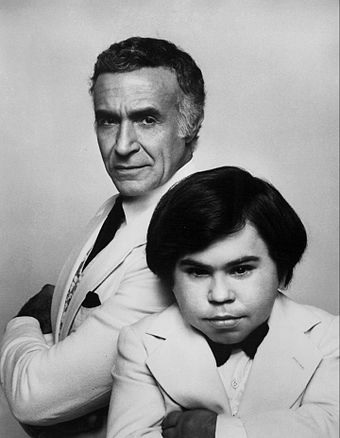
Once again, we have an episode the features only stock footage of Tattoo shouting, “The plane, the plane!”  Otherwise, Herve Villechaize is not in this episode.

What excuse does Mr. Roarke come up with this week to explain Tattoo’s absence?

He’s hung over.

Seriously, that’s what Mr. Roarke goes with!  He explains to Julie that Tattoo was up very late, helping another guest celebrate a drunken fantasy.  It must be said that Ricardo Montalban seems to be quite amused to be labeling his sidekick a drunk.  Apparently, Herve Villechaize was holding out for more money when this episode was shot and I’m guessing Tattoo being hung over was a “take that” on the part of the show’s producers.  To be honest, it feels a bit petty.

It falls to Julie to help Charles Atkins (Sherman Hemsley) fulfill his fantasy.  Charles is a short man who has been picked on by bullies all his life.  He wants to feel strong and confident.  Julie gives him a potion that she thinks will give him “inner strength” but — whoops! — instead it turns Charles into the world’s strongest man.  As Roarke admonishes Julie for not being specific when she ordered her potion, Charles embarks on a wrestling career.  Can Charles defeat Sampson Smith (H.B. Haggerty), the most savage wrestler in the world?  Or will he instead fall in love with Sampson’s publicist, Carrie Wilson (Vernee Watson) and realize that true strength comes from inside?  We all know the answer.  A more important question is whether Mr. Roarke will ever be foolish enough to let Julie handle a fantasy again?

This fantasy was nothing special.  The comedy was a bit too broad, though I did like the heartfelt performances of both Sherman Hemsley and Vernee Watson.  The main problem is that the whole thing hinged on Julie screwing up in a way that really didn’t make any sense.  Surely, she would have been smart enough to make sure she had the right potion before giving it to Charles.  I mean, not being careful with your potions sounds like a lawsuit waiting to happen.  Surely, Mr. Roarke would have kept a closer eye on his goddaughter as she handled her first fantasy ever.  Poor bumbling Julie doesn’t really work as a sidekick.  The show suffers without Villechaize’s snarky attitude.

Villechaize’s absence means that we also miss the chance to see him acting opposite Charo and that just seems like a crime against pop culture.  I have to admit that I was a little worried when I saw Charo’s name in the opening credits, largely because I thought she would be playing her silly Love Boat character.  Instead, Charo plays a world-famous guitarist named Dolores DeMurica, whose fantasy is to go back to the days of Spanish California and meet her ancestor, the famous El Lobo Rojo.  (El Lobo Rojo is basically Zorro but if Fantasy Island’s producers weren’t going to give Herve Villechaize a raise, they certainly weren’t going to pay for the rights to Zorro.)

I have to say that I was pleasantly surprised by Charo’s fantasy.  There was a lot of swashbuckling action, Cesare Danova and Alex Cord both gave good supporting performances, and Charo seemed to be energized by playing a character who, while comedic, was not quite as silly as The Love Boat‘s April.  Charo actually gave a pretty good performance here and the entire fantasy was fast-paced and fun to watch.  It would have been even more fun if Tattoo had shown up but it was not to be.

This episode was a mixed bag, with one forgettable fantasy and one entertaining fantasy.  In the end, both fantasies would have been better with Tattoo.