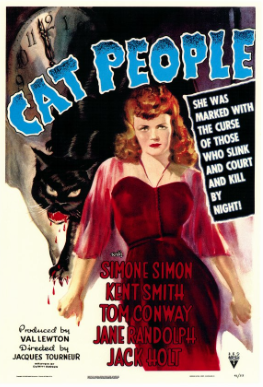
Horror Film Review: Cat People (dir by Jacques Tourneur)


Cat_People_poster

The 1942 horror classic Cat People is often described as being a horror film where, up until the last few minutes, the monsters are mostly psychological.  And there is some definite truth to that.  The title creatures remain a mystery for the majority of the film and, up until those final minutes, the audience would have every right to wonder whether or not they actually existed.  This is a film that seems to take place almost totally in the shadows, a film noir without detectives or gangsters but featuring a memorable and compelling femme fatale.

However, I would argue that there is a monster who is present on-screen long before the audience first sees the shadowy form of a cat person.  That monster is named Louis Judd and he’s the true villain of this story.  As played by Tom Conway, Louis Judd is a psychiatrist and, from the minute we first see him, we know that he’s not to be trusted.  He’s far too smooth for his own good and his soothing tones barely disguise the arrogant condescension behind his words.  If his pencil-thin mustache didn’t make him sinister enough, Dr. Judd also keeps a sword concealed inside of his walking stick.

Irena Reed (Simone Simon) is one of Dr. Judd’s patients.  A fashion designer from Serbia, Irena has recently married an engineer named Oliver Reed (Kent Smith).  Despite the fact that she loves Olivier, she cannot bring herself to be intimate with him.  As Dr. Judd discovers, Irena fears that she has been cursed and, if she ever allows herself to become aroused, she will be transformed into a panther.  Dr. Judd repeatedly tells her that her belief is just superstition and that her fears are the result of repressed trauma from her childhood.  When Irena refuses to accept his diagnosis and continues to insist that she is cursed, Dr. Judd assumes that he can prove her wrong by forcing himself on her.  (Big mistake.)

Meanwhile, Oliver loves Irena but her refusal to consummate their marriage is driving him away.  He finds himself growing more and more attracted to his co-worker, Alice (Jane Randolph).  At first, Irena is upset to discover that Oliver has been telling Alice about their problems.  But eventually Irena realizes that all she can do is watch as Oliver and Alice grow closer and closer.  Irena knows that she can’t give Oliver what he desires but the confident and outspoken Alice can.  As Irena grows more and more jealous, Alice starts to feel as if she’s being watched and followed.  She starts to hear growls in the shadows and when she’s at her most vulnerable — swimming alone at night — she is shocked when Irena suddenly appears and demands to know where Oliver is.

And really, that’s what makes Cat People such a great film.  It’s not necessarily a scary film, at least not to modern audiences.  Sadly, we have seen so much graphic real-life horror and have become so jaded by CGI that we’re no longer scared by the mere cinematic suggestion of a monster.  But the film still works because we can relate to both Irena and Alice.  When I look over my relationships, I can see times when I’ve been both the insecure Irena and the confident Alice.  For a film where the word “sex” is never uttered once, Cat People is a penetratingly honest look at relationships, love, and sexuality.

And it also features a truly memorable monster.

Seriously, that Dr. Judd is the worst!

A Quickie With Lisa Marie: Big Jim McLain (dir by Edward Ludwig)


During my sophomore year of college, I was acquainted with a bearded sociology major who would tell anyone that he met that he was a communist.  He also insisted that he was a revolutionary in the tradition of Che Guevara though, for the most part, he never seemed to do much more than hang out in the lobby of Bruce Hall and yell at the top of his lungs.   When he wasn’t attacking George W. Bush and Dick Cheney, he was busy quoting Karl Marx and telling people about how communism would fix all of America’s problems.  He would also get very upset if you called him a socialist.  “No,” he would say, “I’m a communist and I’m proud of it!”

I have to admit that I usually went out of my way to avoid him and I would cringe whenever I would hear him shouting my name and inviting me to come sit down next to him so he could attempt to give me my daily indoctrination while he stared at my breasts.  I could never summon up much enthusiasm for his ideology or his idolization of Hugo Chavez.  It all sounded rather dreary and boring to me.

I recently found myself thinking about those days in Bruce Hall lobby after I watched the 1952 anti-communist melodrama, Big Jim McLain.

Produced by and starring John Wayne, Big Jim McLain was made at the height of the red scare.  Produced in full cooperation with the infamous House Un-American Activities Committee, Big Jim McLain was meant to be an answer to all those weak-willed liberal types who claimed that the committee was going too far in its hunt for communist subversives.

Big Jim McLain starts out with a thunderstorm.  While stock footage of lightning illuminates the screen, a medley of patriotic songs play on the soundtrack and a somber-voiced narrator quotes The Devil Vs. Daniel Webster.  

Suddenly, the scene changes.  We’re in Washington D.C. and we’re watching a meeting of the House Un-American Activities Committee.  A shifty little man with a beard is being interrogated by the members of the committee.  They ask him if he’s ever been a communist.  He takes the fifth amendment.  He’s asked if he would ever take up arms against the United States.  Again, he pleads the fifth.

The camera pans back to reveal two remarkably tall men listening to the man’s testimony.  They both share the same look of disgust, a look that leaves no doubt how they feel about this sleazy little subversive and his constitutional rights.  They are Big Jim McLain (John Wayne) and his partner, Mal Baxter (James Arness) and they fight communists.

Suddenly, we hear the familiar sound of John Wayne’s determined drawl on the soundtrack and we realize that Big Jim McLain was using multiple voice-overs long before Terrence Malick even made his first film.

Wayne, speaking in character as Big Jim, explains that he and Mal have spent the last few months proving that the witness is a communist.  And now, they have no choice but to watch as he hides behind the constitution.  We’re told that this communist will be able to return to his position of teaching economics at an unnamed “north eastern college.”

That opening scene pretty much tells you everything that you need to know about the ideological outlook of Big Jim McLain.  The government is looking out for our best interests, outsiders are dangerous, and good men know the importance of following orders.

HUAC sends Big Jim and Mal to “the territory of Hawaii,” where they hand out a lot of subpoenas, conduct a smattering of illegal wiretaps, and try to figure out who is actually in charge of the local communist party.  Along the way, Big Jim meets and romances a naive secretary named Nancy (played by Nancy Olson).  Nancy just happens to work for a communist doctor but we know that she’s okay because she’s the widow of a serviceman.

Big Jim McLain is a real curiosity piece, a true product of its time.  Perhaps not surprisingly, the film really does feel like a time capsule.  Full of simplistic characters and nonstop speech-making from John Wayne, it’s easy to laugh at and dismiss a film like this.

Then again, the main idea behind Big Jim McLain seems to be that the government is justified in doing anything to fight its enemies and that anyone who openly questions or disagrees our leaders most be either evil or mentally incompetent.  Just how much has our culture changed since then?  How different is anti-communist crusader Big Jim McLain from those who today continually assure us that we have nothing to fear from the NSA?  One gets the feeling that if this film were made today, Big Jim would be hunting down Edward Snowden and directing drone strikes against America’s enemies.

Perhaps for obvious reasons, Big Jim McLain is a fairly obscure film.   I first found out about it from reading J. Hoberman’s Army of Phantoms.  Oddly enough, within a day or two of my reading about it, Big Jim McLain turned up on TCM.  It’s not a very good film but, in the best exploitation tradition, it is a document of its time and therefore, worth seeing as a piece of history.

As for the communist of Bruce Hall, he ended up dropping out at the end of the semester and, apparently, he later turned up in New York doing the whole Occupy Wall Street thing.  I’ve been told that he was recently spotted in Austin, still wearing his Che Guevara t-shirt.

One thing’s for sure.

Big Jim McLain would have taken him out with one solidly placed right hook.