October True Crime: Deadly Vows (dir by Alan Metzger)


The 1994 made-for-TV movie Deadly Vows opens with a football game.

It’s just a friendly football game in the park.  The majority of the players appear to be frat boys.  They’re muscular and athletic and they play hard but they’re not professional athletes.  However, there is one player that sticks out.  Tom Weston (Gerald McRaney) is taking the game very seriously and he is determined to win.  He continually begs his team’s quarterback to throw him the ball.  When he’s tackled, he staggers back up and run back to the huddle, even though he’s limping and out-of-breath.  Again, Tom is taking the game very seriously.  Tom is also nearly twenty years older than the other players.

Tom is desperate to prove that he can still keep up with the young guys around him, even though it’s obvious that he can’t.  Tom also drives a truck for a living and spends his time on his CB radio, bragging about how good he is at his job and trying to pick fights with anyone who he feels doesn’t treat him with enough respect.  Incidentally, Tom is not driving a big truck.  He’s driving a small truck.  It’s actually more of a van than a truck…..

In other words, Tom is having a midlife crisis.

I think everyone either knows or has, at least, come across someone like Tom Weston.  He’s the balding, forty-something guy who brags about how he’s in the best shape of his life and who shamelessly flirts with every young woman that he sees, despite the fact that he’s married to a woman his own age, Nancy (Peggy Lipton).  Nancy, for her part, tries to be understanding.  Like a lot of insecure men, Tom is a very active gaslighter.  Indeed, when Nancy first meets Bobbi (Josie Bisset), she believes Tom when he says that Bobbi is just a friend.  Of course, the truth of the matter is that Tom is having an affair and he even married Bobbi a few weeks earlier.  Tom’s not just a guy having a mid-life crisis.  He’s also a bigamist.  And eventually, he’s a murderer.

Deadly Vows is based on the true story of Robert Harnois, a man who is currently in prison for murdering one wife and trying to kill the other.  When this film was made, Harnois had not yet been convicted of the murder which is why the character’s name was changed to Tom Weston.  The film itself is slightly ambiguous as to the circumstances that led to the murder.  While we see Tom reading about it in prison and smirking, we don’t actually see him taking the contract out on the victim’s life.  But, in a safely made-for-TV style, it’s pretty clearly implied that Tom hired someone to carry out the murder.  (And, in real life, that’s exactly what happened.)

Deadly Vows is, in many ways, a typical made-for-TV true crime film.  What sets it apart from other entries in the genre is Gerald McRaney’s chilling performance as Tom Weston.  McRaney plays Weston as the type of sociopath who thinks that he can charm his way out of any situation.  Instead, most people can see right through him and his manipulative bluster.  Indeed, the film portrays Tom as being a very stupid and pathetic man.  Unfortunately, one doesn’t have to be smart to hurt other people.  Peggy Lipton and especially Josie Bisset both give good performance as well but this film is ultimately dominated by McRaney’s performance as a murderous loser who simply cannot accept that he’s not 22 anymore.
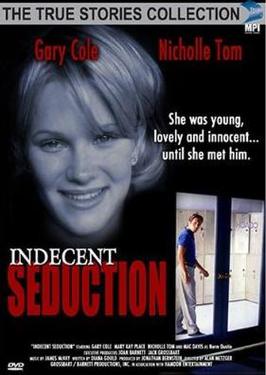
Retro Television Review: For My Daughter’s Honor (dir by Alan Metzger)


Welcome to Retro Television Reviews, a feature where we review some of our favorite and least favorite shows of the past!  On Sundays, I will be reviewing the made-for-television movies that used to be a primetime mainstay.  Today’s film is 1996’s For My Daughter’s Honor (a.k.a. Indecent Seduction)!  It  can be viewed on YouTube, Tubi, and Prime.

Welcome to Tate, Oklahoma.

It’s a nice little town in what is usually referred to as being the heartland of America.  It’s a place where the streets are clean, the people are friendly, and where everyone roots for the local high school football team.  That makes Coach Pete Nash (Gary Cole) a pretty important person in Tate.  At a start-of-the-year pep rally, the football team is introduced as “Oklahoma’s team” and that would make Pete Nash Oklahoma’s coach.  Make no mistake about it, they love football in Oklahoma.  They love it almost as much as we love it in Texas.

Coach Nash also teaches Biology and he’s known for being the cool teacher that all of the students like to hang out with.  Soon, Nash is hanging out with 14 year-old Amy Dustin (Nicholle Tom) and Amy’s friends, Kelly (Allyson Hanigan) and Kimberly (Sara Rue).  With Coach Nash, they all get to drink beer.  They get to break into the school library and have fun with the copy machine.  Coach Nash sends Amy flirty little notes and she writes back.  Nash even encourages his daughter to invite Amy over for a sleepover so that she can lose her virginity.  Yikes!

Amy’s mother (Mary Kay Place) and her father (Mac Davis) both have their concerns about the amount of time that Amy is spending with Coach Nash.  Amy’s father is especially upset when he hears that Coach Nash threw a fit after he saw Amy dancing with a boy her own age.  But everyone in town tells them that they’re being paranoid and that Coach Nash is a good guy who just happens to be very close to his students.  He’s a family man and he’s a good football coach and that’s all that matters.

Though the names and the central location have all been changed, For My Daughter’s Honor is based on a true story.  The actual events took place in Texas and, as happens in the movie, the parents of the victim ended up suing the school district for failing to do anything about the predatory teacher.  The film certainly does capture the feeling of living in a small community where everyone thinks that they know everyone else and where people often choose not to believe what is obviously happening right in front of them.  Coach Nash makes no effort to hide his activities but he gets away with it because no one wants to confront what’s going on.  It’s easier to just say that Coach Nash is a passionate teacher or that he’s someone who lets his emotions get the better of him.  For many in the town, it’s easier to blame Amy and her family than it is to hold Coach Nash responsible for his own actions.

Gary Cole gives a strong performance as Coach Nash and is equally believable whether being blandly affable or obsessively creepy.  One of the reasons why this film works is because everyone has had at least one Coach Nash in their lives, that person who seems friendly but just gives off a strange vibe.  In the end, this is a film that says that it’s okay to be concerned.

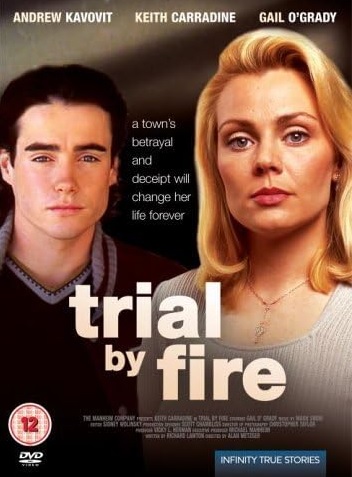
Retro Television Reviews: Trial By Fire (dir by Alan Metzger)


Welcome to Retro Television Reviews, a feature where we review some of our favorite and least favorite shows of the past!  On Sundays, I will be reviewing the made-for-television movies that used to be a primetime mainstay.  Today’s film is 1995’s Trial By Fire!  It  can be viewed on YouTube!

Trial By Fire opens with an absolutely heart-breaking scene, in which a teenager named Kip Bouchmeyer (Andrew Kavovit) enters his bedroom, closes and locks the door (and, in the process, locks out his dog, who sits out in the hallway sadly), and then proceeds to shoot himself.

The upper class community in which Kip lived is stunned by his suicide but they are soon also scandalized by reports that Kip had been having an affair with one of his teachers, Paulette Gill (Gail O’Grady).  Paulette denies the rumors but soon, Kip’s friends are coming forward and saying that Kip not only told them about the affair but that some of them spied on Kip while he was with her.  Paulette continues to deny the accusations but still loses her teaching license.  Paulette is put on trial, accused of seducing Kip and setting off the chain of events that led to his death.  The only people who seem to be willing to believe Paulette’s side of the story are Paulette’s husband, Roger (Michael Bowen), and her attorney, Owen Turner (Keith Carradine).

Indeed, it doesn’t take long for Owen to discover that there are several inconsistencies in the stories that the other students are spreading about Paulette and how she behaved as a teacher.  Owen starts to suspect that Kip’s friends met after Kip’s suicide and concocted the story of Kip and Paulette’s affair on their own.  But why would they do that and, more importantly, can Owen convince anyone else?

There have been a lot of movies made about teachers seducing and carrying on affairs with students.  (I wrote about one of them, Murder in New Hampshire, just a few weeks ago.) There have been far less films made about teachers who are falsely accused.  Interestingly enough, Trial By Fire is based on a true story.  Paulette Gill was a real teacher and, just as in the movie, she really was accused of contributing to the death of one of her students.  Because it’s based on a true story, Trial By Fire doesn’t answer every question that was raised by the case.  Though the film leaves no doubt that Paulette was innocent of seducing Kip, the film leaves it to the viewer to decide whether she was the victim of an actual conspiracy or if a bunch of teenagers just had an overactive imagination.  The film also leaves it to the viewer to decide as to whether or not Paulette allowed herself to get too close to her students, even if she didn’t actually have an affair with Kip.  It could be argued that Paulette allowed herself to care too much about Kip and was rather naïve in not realizing how easily gossip can spread in a high school.  But I think it could also be argued that it’s better to care too much than to not care at all.

It’s a good movie, though a rather sad one.  (The image of that dog sitting outside of Kip’s bedroom left me depressed for a full day.)  The cast, which is full of TV regulars, does a good job with their characters.  I especially liked Keith Carradine’s performance as the tough but fair-minded attorney.  Trial By Fire takes a familiar subject and gives it an unexpected spin, leaving the audience to consider what their own complicity would have been if they had found themselves in the same situation.

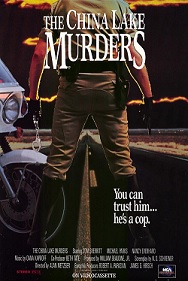
The China Lake Murders (1990, directed by Alan Metzger)


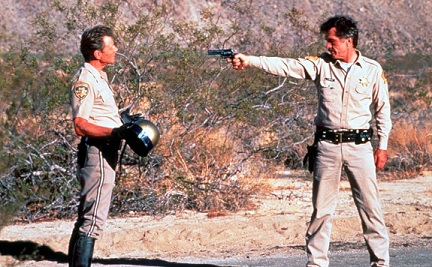
Officer Donnelly (Michael Parks) of the Arizona Highway Patrol has snapped.  One day, he doesn’t show up for roll call and instead drives out to the desert.  Sometimes, he pulls people over and tells them that they’ve violated a traffic law.  Sometimes, he stops to help a stranded motorist.  Every encounter ends with Donnelly killing someone.  When Donnelly reaches the town of China Lake, he flirts with a waitress (Lauren Tewes) and befriends Sheriff Sam Brodie (Tom Skerritt).  Brodie is investigating the mystery of why so many people are turning up dead in the desert and he slowly comes to realize that his new friend is the one responsible.

The China Lake Murders was produced by the USA Network and it used to air regularly throughout the 90s.  For a while, it held the record for the highest rated basic cable film.  One reason why so many people would watch it whenever it aired was because the movie started out with a warning that it contained strong violence and some sexual content.  That warning was all that it took to convince most people to watch the movie.  While the sexual content is tame (we see someone’s bare back at one point), the violence is indeed strong. 

So is the performance of Michael Parks, who plays Donnelly as the ultimate nightmare cop.  In many ways, Donnelly epitomizes everything that people hate about the police.  He’s a bully who hides behind his uniform and his badge.  The movie never explains why Donnelly suddenly snapped but watching him, it’s easy to guess that he’s always been a sadist.  He channeled his cruelty into law enforcement and now that he’s crossed the line and is killing random people, he still believes that his uniform will protect him.  Tom Skerritt, on the other hand, is the epitome of what most people would hope a cop would be, fair-minded and more concerned with helping the community than controlling it.

The China Lake Murders is a little slow.  Since it’s revealed early on that Parks is the killer, there’s not much suspense during the middle section of the film.  Things pick up, though, when Skerritt and Parks finally go after each other.  The two veteran actors bring a lot of gravitas to their roles and their final confrontation does not disappoint.