Doctor Who — The Invisible Enemy, Image of the Fendahl, The Sun Makers, Underworld, The Invasion of Time


Having survived the Horror of Fang Rock, the Doctor and Leela resumed traveling through space and time.  Along the way, they picked up a new companion named K-9.  Here is the rest of the fifteenth century, which began in a British lighthouse and ended on Gallifrey.

The Invisible Enemy (1977, directed by Derrick Goodwin)

This the one where K-9 makes his first appearance.

As a story, The Invisible Enemy is no great shakes.  The Doctor (Tom Baker) and Leela (Louise Jameson) materialize on a spaceship that has been infected by a sentient virus.  Everyone, except for Leela, gets infected.  The virus wants the Doctor to lead an infection of the entire universe.  When the virus orders the Doctor to kill Leela, he breaks free from its control.  He and Leela go to a space medical center, where Prof. Marinus (Frederick Jaeger) uses Leela’s natural immunity to help create a cure for the virus.  At one point, the Doctor and Leela are cloned and the clones are injected into the Doctor to fight the virus.  It’s a fantastic voyage for all.

Prof. Marinus’s assistant is a boxy robot dog named K-9 (voice by John Leeson).  Since Marinus has to go back to Earth, he gives K-9 to The Doctor and Leela as a gift.

How you feel about K-9 says a lot about how you will feel about the remainder of Tom Baker’s time as the Doctor.  Some fans consider the introduction of K-9 to be the show’s jump the shark moment.  A lot more, myself included, have always liked K-9 and view him — along with the sonic screwdriver — as being an essential part of the original show’s charm.  Love him or hate him, K-9, who come figure out any puzzle and who could shoot a loser from his nose, became one of the most recognizable symbols of the Tom Baker years.

Image of the Fendahl (1977, Directed by George-Spenton Foster)

The Doctor and Leela are drawn back to modern-day Earth, where scientists, witches, and cultists are all being influenced by skull that is estimated to be at least twelve million years old.  The scientists assume that the skull is human but actually, it’s the skull of a Fendahl, a race of psychic vampires who developed on the legendary “Fifth Planet.”  The Time Lords tried to destroy the Fendahl but one escaped in the form of a skull.  It first killed all the life on Mars.  (But what about the Ice Warriors and the Pyramids?  Doctor Who continuity rarely added up.)  Then it landed on Earth, where it influenced human evolution to create a race that it could use to its own advantage.

Image of the Fendahl feels like a spiritual descendant of The Daemons, with the same emphasis on rural British atmosphere and paganism (Leela teams up with a white witch) but without the assurance of UNIT waiting on the sidelines to take care of the threat.  Image of the Fendahl, with its suggestion that humanity was specifically developed to be food, is considerably darker than The Daemons and Tom Baker, so often criticized for playing up the humor of the Doctor’s character, gives one of his more serious performances.  When one of the scientists who has been possessed by Fendahl seeks to kill himself and bring an end to the threat, the Doctor hands him a gun.

Image of the Fendahl is yet another Doctor Who serial in which the main threat is revealed be the result of the Time Lords meddling.  The Fourth Doctor spent a lot of time cleaning up Gallifrey’s messes.

The Sun Makers (1977, directed by Pennant Roberts)

The Doctor, Leela, and K-9 materialize on Pluto, where they discover that colonists and workers are expected to pay exorbitant taxes to the Company or risk being exiled to the Undercity.  The Company’s tax collector is the Controller, who turns out to be a quivering mass of seaweed.

The Sun Makers is Doctor Who at its most satirical, poking fun at the British tax system.  Apparently, the original script was much more pointed in its attacks on the Inland Revenue services but the BBC, being the BBC, demanded that the script be watered down.  In human form, the Controller still clearly resembles Denis Healey, the then-Chancellor of the Exchequer.

The Sun Makers is Doctor Who at its most straight-forward, an enjoyable diversion from the more serious episodes.

Underworld (1978, directed by Norman Stewart)

The TARDIS materializes on the R1C, a spaceship that has been on a millennia-long quest to find a missing ship that was on its away to Minyos 2 and which contained the genetic files of the original Minyans who lived on Minyos 1.

This is another story where the Doctor has to deal with the bad decisions of the Time Lords.  Before adapting their policy of non-intervention, the Time Lords meddles in Minyan evolution and the end result was that the Minyans viewed the Time Lords as gods and the Minyans also used all of the Time Lord technology that they had been given to fight a civil war.  The Doctor feels a responsibility to help the crew of R1C complete their quest.

The R1C eventually ends up going through a space nebula and crashing into a planetoid, where they discover the ship they were searching for.  The crew of the ship is being used as slaves by the Oracle, a super computer.

Underworld is one of the more boring of the Fourth Doctor’s serials.  The story feels slapdash and the idea of a supercomputer was a well that the Doctor Who had already gone to far too many times.

The Invasion of Time (1978, directed by Gerald Blake)

The Doctor returns to Gallifrey and assumes his position as President of the Time Lords.  He also seems to go through a total personality change, exiling Leela and announcing that a group of psychic aliens known as the Vardans will be the new masters of Gallifrey.

Leela, even after being exiled, is convinced that this is all a part of some plan on the Doctor’s part and it turns out that she’s right.  The Doctor is only pretending to be allied with the Vardans so that he can discover the location of their planet and put them into a time loop.  What the Doctor does not realize is that the Vardans are themselves being used by the Sontarans, who are planning on invading Gallifrey.

In retrospect, it seems inevitable that the 15th season would end on Gallifrey.  It also seems inevitable that the Sontarans would eventually try to invade Gallifrey.  The main threat of the Sontarans has always been that they are so stupid that they will try to invade any planet.  The most surprising thing about this serial is that Leela stays behind on Gallifrey so that she can marry Andred (Chris Tanchrell), the head of the Citadel Guard.  The idea of Leela living with the Time Lords has been responsible for a lot of fan fiction and it does seem unfortunate that the show didn’t do more with the idea.

Louise Jameson had already decided to leave the show and originally, Leela was to die while fighting the Sontarans.  This was changed because it was felt Leela’s death would be too traumatic for younger viewers.  Instead, the younger viewers were traumatized by K-9 announcing that he would be staying on Gallifrey with Leela and Andred.  Luckily, for them, the final shot of the fifteen season was The Doctor looking at a crate labeled “K-9 Mark II” and smiling.

Little did the Doctor suspect that the quest for the Key of Time was waiting in his future.


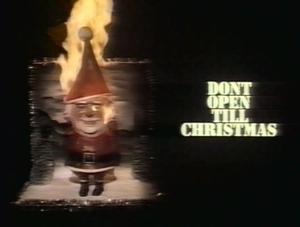
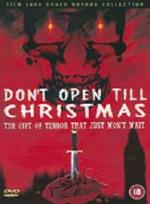
Film Review: Don’t Open ‘Til Christmas (dir. by Edmund Purdom, et al)


It’s been a while since I reviewed a real grindhouse/exploitation film on this site so I want to remedy that by talking about an English slasher film called Don’t Open ‘Til Christmas.

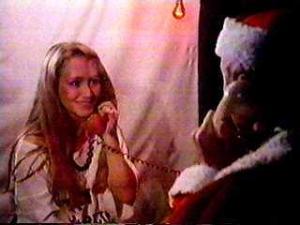
As the movie opens, we find ourselves in England with Christmas quickly approaching.  The fog-drenched streets of London have apparently been besieged by drunk old men dressed up like Santa Claus.  However, at least one citizen has taken things into his own hands by wandering the streets at night and killing anyone he comes across dressed as Santa Claus.  Seriously, we see a lot of Jolly St. Nicks meeting an untimely end in this film.  Most of them are done in by straight razor but at least one ends up getting shot and then another ends up bursting into flame and one Santa even up getting a spear driven through the back of his head.

That Santa has a daughter named Kate (Belinda Mayne) and Kate has a boyfriend named Cliff (Gerry Sundquist).  While they make most of their money by standing out in the middle of street and playing the flute, Cliff also has a side job as just a generally sleazy guy.  The day after Kate’s father dies, Cliff tries to convince Kate to take part in a pornographic, Santa-themed photo shoot.  Needless to say, Kate doesn’t react well to this and storms out.  So, Cliff convinces another model to wear the Santa suit.  That model is later caught outside in that Santa suit by the killer.  However, after opening the suit and giving the camera an excuse to linger over the model’s body the killer leaves without harming her.  This would seem to indicate that he’s only looking to kill men in Santa suits.  Normally, I’d be all for this development because fair play is fair play except for the fact that its eventually revealed that the whole Santa suit thing is pretty much just a red herring.  But, more on that later.

Anyway, Kate wants justice for her father but unfortunately, the police investigation is being headed up by Inspect Harris and you know that Harris isn’t going to be much help because he’s played by Edmund Purdom.  Purdom appeared in a lot of Italian and Spanish horror films in the 70s  and 80s and he was always the epitome of British incompetence.  Purdom is also credited as being director here but again, more on that later.

Now, by the time the 100th Santa has been brutally murdered, you might think that people would just naturally stop dressing up as Santa Claus when they’re out in public but no, that doesn’t appear to occur to anyone.  Instead, we get a mall Santa getting castrated while standing at a urinal.  And then we get another one getting killed while visiting a local sex shop and talking to a character credited as “the Experience Girl” (played surprisingly well by Kelly Baker).  Yet another Santa finds himself getting murdered while backstage at a TV variety show.  His body is discovered by Caroline Munro (star of Starcrash and Maniac) who plays herself and gets to sing a disco song before finding the body.  She also gets to wear this really amazing red dress that I would kill to own because, seriously…

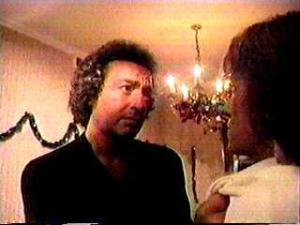
Suddenly, this guy named Giles (played by Alan Lake, who apparently died right before this film was released) pops up and tells Kate that he’s a reporter and he starts asking her all theese questions about her father.  Kate gets mad and tries to call up Inspector Harris just to be told that Harris is out for the day taking care of some personal business.  Hmmm…could Harris be our killer?  It makes sense since he’s played by Edmund Purdom.  Then again, Cliff could be the killer as well because, while Kate is doing all this, Cliff is making money by selling her sexual favors to his friends.  Then again, it seems that Giles might be the killer because he then promptly shows up and kills Kate.

Meanwhile (we’re only about 40 minutes in to the film by this point), the Experience Girl is being interviewed by Harris’s partner, a tall guy named Powell who hates women.  The Experience Girl tells Powell that she would know who the killer is if she saw the killer smile.  Powell tells her she’s an idiot.  So, the Experience Girl goes back to work.  Giles shows up and smiles.  Experience Girl screams.  Giles kidnaps her but instead of killing her, he takes her to his flat and chains her up.  Giles explains that he’s a killer because Inspector Harris is his brother and Giles is jealous.  The Experience Girl knows who Harris is despite the fact that we’ve only seen her meet Powell. 

Speaking of Powell, he investigates Kate’s death and realizes he may have made a mistake dismissing the Experience Girl.  Then he tries to open a car door and gets electrocuted until he eventually ends up blowing up.

Now, none of this qualifies as being a spoiler because, even at this point, there’s still nearly 40 minutes of plot left.

Like a lot of 80s grindhouse films, the production of Don’t Open ‘Til Christmas is shrouded in mystery.  Shooting on the film apparently started in 1981 but it the film wasn’t actually completed and released until 1984.  Reportedly, Edmund Purdom was the original director but he ended up walking off the set which led to screenwriter Derek Ford taking over the movie for two days before he was apparently fired.  The film was then completed by Alan Birkinshaw (and possibly a few other people), working under the name of Al McGoohan.

Certainly, this explains why the film is such a huge mess but it’s also a part of the fun as watching the movie becomes a game of trying to figure out who directed what. 

Since Purdom walked off the film, I think it’s fairly safe to assume that he directed all of the scenes that he appears in.  (It also explains why his character disappears from the movie after the first 40 minutes.)  These scenes are all distinguished by the general immobility of the camera.  Purdom’s scenes are so static and so defiantly dull that they almost work in a strangely Warholian way.  The actors wander into frame, the actors wander out of the frame, the out-of-focus lens rebelliously refuses to follow them. 

The non-Purdom scenes — the scenes in which men dressed like Santa are graphically murdered and the scenes featuring the “Rxperience Girl” — appear to have snuck in from a totally different movie and often, they’re only link to anything we’ve seen in the Purdom scenes is some awkwardly dubbed dialogue.  These scenes feel as if they’re drenched in sleaze.  The camera not only moves, it lingers and it invades like a voyeur looking at dirty pictures in a public library.  Unpleasant on their own, these scenes somehow become even more distasteful when compared to the aritificiality of the Purdom scenes. 

It all makes for a very disorienting viewing experience and if the film isn’t really well-done enough to ever become disturbing or nightmarish, it still had a very odd dream-like feel to it.  Major characters wander through the film without every actually meeting each other.  Seemingly important plot points are brought up just to be quickly abandoned and forgotten.  Even all the multiple murders turn out to have very little to do with Santa Claus or Christmas.  If nothing else, this is a unique slasher film in that the murders are pretty much just  red herrings.

There’s a lot in this movie that doesn’t work but, as with many grindhouse films, that just adds to the charm of Don’t Open ‘Til Christmas.  Even the ending — which everyone seems to criticize — is oddly appropriate in that it makes as little sense as everything else we’ve seen on screen.  Also, like most grindhouse films, there’s a handful of memorable moments that actually do work.  For instance, the killer’s mask is genuinely creepy.  The scene where Giles chases the Experience Girl through the streets of London is also handled well and is even more suspenseful in that it takes place during the day as opposed to expected dark and foggy night.  And again, Kelly Baker is a sympathetic, if unexpected, protaganist in the role of the Experience Girl (though you get the feeling that the role was created and cast long after Purdom left the initial production).  Finally, this is a film that epitomizes the spirit that makes the Grindhouse great — i.e., it may have taken two years and multiple directors and the end result might be kind of chaotic but, in the end, the movie got made.

I ended up watching Don’t Open ‘Til Christmas last night because there have been reports that its about to finally snow here in North Texas and, as a result, I was in a holiday mood.  Since this is apparently one of those movies that has entered the public domain, the version I own is a part of one of those “50 Horror Classics” collections that Mill Creek puts out.  As a result, the transfer looked and sounded terrible.  But you know what?  That terrible transfer added a certain charm to the film.  Don’t Open ‘Til Christmas is a movie that was meant to be seen with a lot of random scratches and faded colors flashing across the screen. 

So, in the end, Don’t Open ‘Til Christmas is a pretty bad movie but it’s an undeniably watchable and oddly memorable one.  Plus, it features that really great red dress.  Seriously, just to die for…