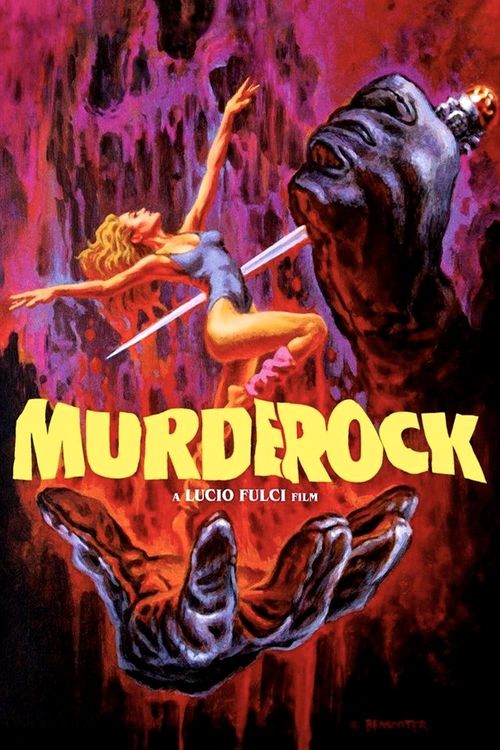
October Hacks: Murder Rock (dir by Lucio Fulci)


Are the streets to blame?  Paranoia’s coming your way….

Ah, Murder Rock.

This 1984 film is often dismissed as being one of director Lucio Fulci’s lesser efforts, an attempt to combine the trappings of the giallo genre with the sexy, choreographed dance routines of Flashdance.  And certainly, the film does lack the visceral, dream-like horror of The Beyond trilogy and Zombi 2.  The film’s killer isn’t even as interesting as The New York Ripper‘s killer who talked like a duck.  That said, I think some critics have been a bit too hard on Murder Rock over the years.  Taken on its own terms, it’s a well-made slasher with a healthy does of 80s style.  Of course, I should admit that, as someone who grew up attending dance classes and dancing through the pain, I could relate to the film’s milieu.  I’ve never had to deal with a zombie in real life but I did meet my share of dancers who would do anything to move up.

The film takes place at the Arts For The Living Center in New York City, where young dancers are hoping to land a spot on a televisions show and also hoping to avoid getting killed by the murderer who is haunting the locker rooms and using a long hairpin needle to stop the hearts of his victims.  (The sound of a previously healthy victim’s heart beating on the soundtrack and then abruptly stopping is far more powerful than one might expect.)

Previously seen losing an eye in Fulci’s Zombi 2, Olga Karalatos plays Candice Norman, the owner of the dance studio.  When one of her dancers is murdered while taking a shower, Candice is just one of many suspects.  Candice, however, is haunted by a dream in which she sees herself being stalked by a handsome man (Ray Lovelock) carrying a hairpin.  Later, Candice realizes that she’s seen the handsome man before.  He’s George Webb, a male model whose face adorns a billboard.  Candice starts to investigate George on her own, discovering that he’s apparently an alcoholic who lives in a run-down apartment.  When evidence starts to show up suggesting that George could be the murderer, he claims that he’s being framed.

Of course, George isn’t the only suspect.  There’s also Willy Stark (played by Christian Borromeo), a dancer whose girlfriend ends up as a victim of the murder spree.  With his blonde hair and aristocratic bearing, Christian Borromeo was one of the most handsome actors to appear in Italian films in the early 80s.  He didn’t do many films before retiring but he still managed to appear in films directed by Dario Argento, Federico Fellini, Ruggero Deodato, and Lucio Fulci.  He played very different characters in all of his films and gave a good performance each time.  One reason why I specifically want to single out Christian Borromeo here is because there’s still a lot of people online who are under the impression that Borromeo died a heroin overdose in the 80s.  This is largely due to a comment that was made during an interview with David Hess, who co-starred with Borromeo in The House At The Edge of the Park.  Hess was confusing Borromeo with their co-star, Garbiele Di Giulio.  Di Giulio did indeed die of a heroin overdose.  Christian Borromeo is still alive, though retired from acting.

As for Murder Rock, the killings are nowhere near as gory as in Fulci’s other films but that actually adds to the film’s creepy atmosphere.  The killer is frightening because the killer is coolly efficient and can kill without resorting to the out-of-control, manic violence of quacking sociopath at the center of The New York Ripper.  As is usual with Fulci, the film’s visuals are Murder Rock‘s greatest strength.  The first murder occurs while the locker room’s light blink on and off, creating a truly frightening sequence as the camera seamlessly assumes the killer’s point of view.  When the police investigate the crime, the flashes of the police cameras are almost blinding as they record the stark crime scene.  Candice’s nightmares play out like a particularly macabre perfume commercial (and yes, that it meant as a compliment).  Fulci’s camera roams from location to location, keeping the audience off-balance throughout the film.  As he did in so many of his other films, Fulci makes New York look like the grimiest, most claustrophobic city in the world.

As for the dance sequences, they’re so over-the-top that you can’t help but love them.  The film was obviously envisioned as a way to cash in on the popularity of Flashdance but Fulci’s dispenses of the romanticism that made Flashdance a hit and instead just focuses on bodies moving in a explosion of choreographed carnality.  There’s nothing subtle about the way the film lingers on the spandex-clad dancers but then again, that’s why we love Fulci.  He was not one to make apologies.

Fulci once said that Murder Rock was meant to be the first part of a projected trilogy of musical gialli.  Who knows whether or not that’s true.  (As an interview subject, Fulci was always quick to boat of the grand projects he had planned for the future.  As the diabetic Fulci was in precarious health at the same time that he made his most popular horror films, there was always something rather poignant to Fulci’s constant boasting about all of the great films he planned to make.)  As I said at the start of this review, Murder Rock is one of Fulci’s less-appreciated films but, as someone who loves both dancing and watching horror movies, I’ve always liked it.  Even the fact that the killer is exposed in a way that doesn’t really stand up to close scrutiny just adds to the film’s charm.  (Seriously, a good giallo rarely makes that much sense.)

In closing — SING IT!

Are the streets to blame?

Paranoia’s coming your way!
 

Italian Horror Showcase: The Beyond (dir by Lucio Fulci)


David Lynch reportedly once described Eraserhead as being a “dream of dark and disturbing things” and the same description can easily be applied to Lucio Fulci’s 1981 masterpiece, The Beyond.

The second part of Fulci’s Beyond trilogy, The Beyond sits between City of the Living Dead and The House By The Cemetery.  With its portrayal of naive humans getting an unwanted look at the inexplicable reality that hides just a little beyond ours, it’s a film that very much calls to the mind the work of H.P. Lovecraft.  While insanity was often the punishment for gaining knowledge of Cthulhu and the Great Old Ones, the punishment for discovering the Beyond often seems to be blindness.

(Ocular damage was one of Fulci’s trademarks.  Starting with Zombi 2, almost every Fulci film seemed to feature someone losing an eye.  In The Beyond, a plumber played by Giovanni De Nova loses an eye while wandering about a flooded basement and, over the course of the narrative, several character are rendered blind, making them incapable of seeing the true horror of what they’re experiencing.  Fulci struggled with diabetes and the threat of blindness runs through almost all of his horror films.)

The Beyond starts with a striking, sepia-toned sequence that’s set in the year 1927.  While a young woman named Emily (played Cinzia Monreale) reads from a book, a mob attacks a painter named Schweik.  They believe Schweik to be a warlock and they view his grotesque paintings as being proof.  (In many ways, the mob is comparable to the critics who insisted on judging Fulci solely based on the subject matter of his films while ignoring the skill with which Fulci directed them.)  Schweik is tortured and left crucified in the basement of the Seven Doors Hotel in New Orleans, Louisiana.

Jump forward 54 years.  A woman named Liza (Catriona MacColl, who appeared in different roles in all three of the Beyond films) has inherited the long-closed Seven Doors Hotel and she’s moved down to New Orleans to reopen it.  Unfortunately, her efforts to renovate the place aren’t going smoothly.  It’s been one disaster after another, almost as if someone or something is trying to keep her from reopening the place.  The latest was the flooded basement and the plumber who lost both his eye and his life.  Of course, Liza would probably be even more concerned if she knew just what exactly it was that attacked the plumber in the first place.

While driving down one of Louisiana’s many bridges to nowhere, Liza is forced to come to a stop when she sees a blind woman and her guide dog standing in front of her car.  The woman is Emily, who doesn’t appear to have aged at all since we last saw her.  Emily is now blind.  She tells Liza that her hotel was once home to an evil warlock and she warns her to stay out Room 36.

Meanwhile, the plumber’s wife and his daughter visit the plumber’s corpse in the morgue.  This not only leads to the plumber and several other dead people coming to life but it also leads to an accident with a beaker of acid that was, for some reason, sitting on a desk.  Soon, the daughter is blind herself.  On the plus side, all of the drama at the hospital does give Liza a chance to meet Dr. John McCabe (played by the always welcome David Warbeck).

Fulci never got much credit for his work with actors.  (Some of that, of course, is due to the fact that most of Fulci’s film were atrociously dubbed for overseas release.)  However, The Beyond is definitely one of the best-acted of all of his films.  In fact, one reason why we stick with the film even when things start to get really, really weird is because we genuinely like Liza and John.  Warbeck and MacColl had a lot of chemistry and, in the midst of all the mayhem, they created two very real characters.  Cinzia Monreale is also impressive in the role of Emily.  Fulci made good use of her other-worldly beauty and Monreale keeps us wondering whether Emily is trying to help of Liza or if she has a secret agenda of her own.

(Towards the end of the film, during a zombie siege, there’s a scene where John and Liza get in an elevator and, as the doors close, Warbeck tries to reload a gun by forcing a bullet down the gun’s barrel.  MacColl sees what he’s doing and breaks character, laughing as the doors close.  The Italian crew apparently did not realize that Warbeck was playing a joke because this was the take that they used in the film.  Needless to say, it temporarily takes you out of the film and yet it’s such a charming moment that you can’t help but love it.  It’s nice to see that with all the grotesque insanity going on around them, Warbeck and MacColl were having fun.)

The Beyond gets progressively more bizarre as it continues.  It doesn’t take long for Fulci to abandon any pretense of traditional narrative and the film soon becomes a collection of vaguely connected, increasingly surreal set pieces.  A man goes to a library and ends up getting eaten by an army of spiders.  Ghouls suddenly roam through the hallways of the hospital.  Yet another person loses an eye, this time to a loose nail.  Another relatively minor character suddenly has a hole in her head.  A chase through the hospital’s basement leads to the characters somehow finding themselves back in the hotel.  And finally, we go to the Beyond….

This is going to be heresy to some but, as much as I appreciate it, The Beyond is actually not my favorite Fulci film.  Overall, Zombi 2 is my favorite and, as far as the trilogy goes, I actually prefer The House By The Cemetery.  That said, The Beyond is the film that best exemplifies Fulci’s cinematic philosophy.  Fulci called it pure cinema, the idea that if your visuals are strong and properly edited together, the audience will use them to supply their own narrative.  That’s certainly the case in The Beyond.  A lot happens in The Beyond and it’s not always clear how everything’s related.  But since every scene is full of Fulci’s trademark style, the viewers builds the necessary connections in their own mind.  The end result is a film that, perhaps more than any other Fulci film, capture the feel of having a dream.  It’s not a film that will be appreciated by everyone.  Fulci’s work rarely is.  Still, for fans of Italian horror, The Beyond is one of the key films.

Fulci followed The Beyond with one of his best-known movies, The House By The Cemetery.  I’ll look at that film tomorrow.

Halloween Havoc!: ZOMBIE (Variety Film 1979)


gary loggins's avatarcracked rear viewer

zomb1

I’ll admit, I’m a latecomer to the Lucio Fulci bandwagon. I viewed my first film by The Maestro, THE HOUSE BY THE CEMETERY , earlier this year, and absolutely loved it! I’ve been looking for more Fulci films to discover ever since, and recently recorded his most famous, ZOMBIE, off the El Rey Network (which I highly recommend to Grindhouse fans out there). ZOMBIE goes by many names, but this is the title I watched it under, so we’ll stick with that.

zomb2

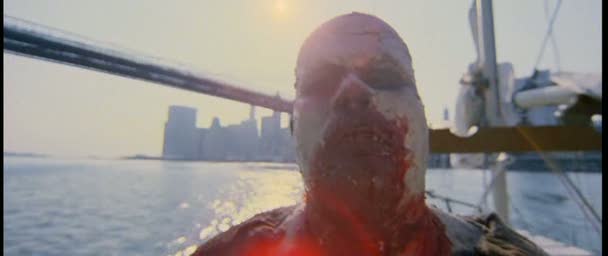
From that opening shot of a gun pointed at the camera, then blasting the head of a rising corpse, I knew I was in for a good time! After the credits roll, we see a derelict ship floating in New York harbor. The harbor patrol boards it, and find it deserted, with rotting food and supplies strewn everywhere. One of the cops investigates further, and is killed by a zombie…

View original post 746 more words

The TSL Daily Sci-Fi Grindhouse: Contamination (dir by Luigi Cozzi)


contamination-02

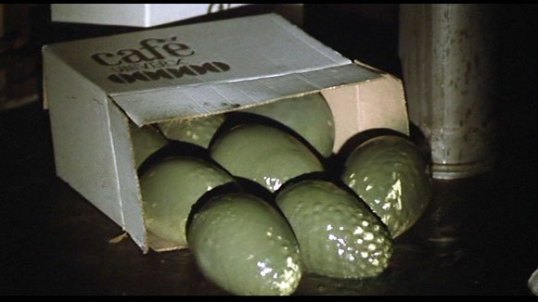
See those green things in the picture above?  You’re probably looking at them and you’re thinking to yourself, “Those are the biggest avocados that I’ve ever seen!”

Well, they’re not avocados.

No, instead they are green eggs from Mars.  They may look harmless but if they start glowing, pulsating, and making an eerie womping noise, you might want to get away from them.  When those eggs explodes, they spray out a green goo.  Any living creatures that is so much as even splashed by this goo will then explode in a mass of blood and guts.  It’s messy.  I would not want to clean up after anyone is sprayed with green goo.

Those eggs are at the center of this week’s daily sci-fi grindhouse, the 1980 Italian film, Contamination.  How much you enjoy Contamination will largely depend on how much you like old school Italian exploitation films in general.  If you’re the type who rolls your eyes at bad dubbing and who demands that a film follow some sort of narrative logic, you are not the ideal audience for this movie.  However, if you’re like me and you enjoy the pure shamelessness of Italian exploitation, you’ll probably have an easier time enjoying Contamination.

It won’t come as a surprise to any student of Italian or grindhouse cinema to learn that Contamination was ripped off from several films that were popular in the late 70s.  The eggs are largely lifted from Alien and, whenever the goo-sprayed bodies explode, it’s reminiscent of that ugly little thing bursting out of John Hurt’s chest.  The second half of the film feels like a secondhand James Bond film, complete with a sinister conspiracy, a mysterious mastermind who earlier faked his own death, and a femme fatale.  The conspiracy is headquartered on a coffee plantation in South America.  It’s not difficult to imagine Baron Samedi or some other villain from Live and Let Die showing up and laughing before throwing an exploding egg at someone.

Contamination opens with a seemingly deserted ship floating into New York harbor.  Fans of Italian cinema will immediately think about the opening of Lucio Fulci’s Zombi 2.  Just as Zombi 2 opened with the New York City police investigating an abandoned boat and getting attacked by a zombie, Contamination features the New York City police investigating an abandoned boat and getting sprayed with green goo.  The only cop who doesn’t explode, a tough New Yawker named Tony (Marino Mase), works with Col. Stella Holmes (Louise Marleau) to figure out why those eggs were on that boat.

Helping them out is an alcoholic former astronaut named Commander Ian Hubbard (Ian McCulloch).  Somewhat appropriately, McCulloch was also in Zombi 2.  (And let’s not forget about his role in Zomie Holocaust…)  I once read an interview with McCulloch (in Jay Slater’s overview of Italian zombie cinema, Eaten Alive) in which he said that he didn’t feel he did a very good job in Contamination but I think he’s being too hard on himself.  Is the very British and slightly uptight Ian McCulloch miscast as a cynical, alcoholic, American astronaut who can’t even walk to his front door without stumbling over discarded beer cans?  Sure, he is.  But he’s so miscast that it actually becomes rather fascinating to watch him in the role.  He may be miscast but you can tell he’s really trying and he’s just so damn likable that you almost feel like it would be a disservice to him not to watch the film.

Anyway, Stella, Tony, and Hubbard have to discover out why the green eggs are on Earth and they eventually do figure out what’s going on.  I’ve watched the film multiple times and I have to admit that I’m still not sure what they figured out.  It’s a confusing movie and I doubt that there’s really any way that it could have ever made any sort of coherent sense but then again, that’s part of the film’s charm.

So, here’s what does work about Contamination.  The exploding green eggs are both scary and wonderfully ludicrous.  Ian McCulloch is a lot of fun as drunk Commander Hubbard.  Goblin provides an excellent and propulsive score.  And finally, there’s an alien monster who simply has to be seen to be believed.  To his credit, director Luigi Cozzi realized that the monster looked cheap and he uses all sorts of creative editing and employed an arsenal of jump cuts to try to keep you from noticing.  Much as with McCulloch’s performance, you can’t help but appreciate Cozzi’s effort.

As I said before, you’re enjoyment of Contamination will probably be determined by how much you enjoy Italian exploitation films in general.  If you’re not familiar with the Italian grindhouse, Contamination is not the film to use for an introduction.  However, if you are already a fan, you might appreciate Contamination.

Contamination is in the public domain and, as such, very easy to track down.

http://www.youtube.com/watch?v=xulOEFLoeK0

Sci-Fi Film Review: Warriors of The Year 2072 (dir by Lucio Fulci)


New Gladiators

Before The Hunger Games

Before The Purge

There was…oh wait, does this sound familiar?  Did you just read those two lines and get hit by a sudden feeling of déjà vu?  Well, that might be because I used those exact same lines to start my review of the 1965 Italian sci-fi film, The Tenth Victim.

They’re still applicable for this review though.  In many ways, the 1984 film Warriors of the Year 2072 (a.k.a. The New Gladiators) is a loose remake of The Tenth Victim.  (I imagine some critics would say it’s more of a rip-off than a remake.  What you label it will probably depend on how much tolerance you have for Italian exploitation films in general.)  Of course, Warriors of the Year 2072 draws inspiration from more than just The Tenth Victim.  A Clockwork Orange, Escape From New York, the Mad Max films, Blade Runner; bits and pieces from all of them show up here.

Even if you didn’t already know it, you might be able to guess that this film was directed by Lucio Fulci.  The film features Fulci regulars Al Cliver (of Zombi 2 fame) and Howard Ross (of New York Ripper fame) in supporting roles.  Cinzia Monreale, who had her throat ripped apart in Fulci’s The Beyond, appears in a cameo in which she again has her throat ripped apart.  (Actually, she just hallucinates having her throat ripped apart and is seen alive afterward, as if Fulci himself is saying, “See, it’s all just film trickery.  Nobody really gets hurt in my movies.”)    Finally, and most obviously, a character graphically loses an eye.  It’s simply not a Fulci film without some sort of graphic ocular trauma.

The film also features a theme that would show up in a lot of Fulci’s post-New York Ripper works.  Warriors of the Year 2072 is about the role of violent entertainment in both maintaining and destroying society.  Which is not to say that the film really has that much to say about it.  Thematically, Warriors of the Year 2072 is all surface level but those themes are still present.

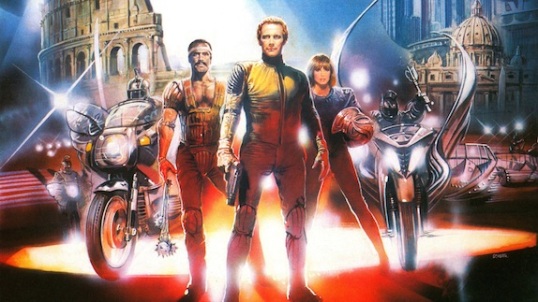
As for the film itself, it takes place in the year 2072, so at least the title is being honest with us.  The world is now run by competing television networks.  The American television network has the highest rated show: Kill Bike, in which men on motorcycles battle to the death.  Cortez (Claudio Cassinelli), the program director for Rome-based WBS-TV, is ordered by the station’s owner, the mysterious Sam, to come up with a program that will be more popular than Kill Bike.  At first, Cortez tries to put on a show called The Danger Game, where people are forced to hallucinate dying in violent ways.  When that show fails to beat Kill Bike, Cortez decided to just rip-off Kill Bike

And let’s just stop a moment to point out the obvious.  Neither The Danger Game nor Kill Bike would feel at all out-of-place on television today.  Remember Fear Factor?  How different is The Danger Game from that old show?

Anyway, Cortez’s new show is basically Kill Bike with a twist.  The motorcycle combat will now take place in the Roman coliseum and the contestants will all be convicted murderers awaiting execution.  Fortunately, the very popular star of Kill Bike — Drake (Jared Martin) — has recently been convicted of murder!  It’s convenient how that worked out…

As we discover through the magic of slow motion flashbacks, Drake was returning home one night when he discovered that his wife had been murdered by three young men who all appeared to be doing a bad impersonation of Malcolm McDowell in A Clockwork Orange.  The three men were then murdered and Drake was convicted.  However, Drake insists that he’s innocent and, even when confronted by laughing hallucinations of the three men, he refuses to attack them.

Could it be that someone is framing Drake?  Of course!  But why…

Well, before we find out the answer to that, we watch as Drake is brought to the coliseum and is trained in gladiatorial battle.  He immediately makes an enemy out of the head guard, the sadistic Raven (Howard Ross, who is hilariously over-the-top).  He also bonds with the other gladiators, one of whom is named Abdul.  Abdul is played by Fred Williamson, largely because it’s not a mid-80s Italian sci-fi dystopia without Fred Williamson.

Warriors of The Year 2072 cannot compare to Fulci at his best.  This is no Zombi 2 or The House By The Cemetery.  At the same time, it’s definitely better than most of the films that Fulci made after The New York Ripper.  Fulci was a supreme stylist and, as a result, Warriors of the Year 2072 is always watchable.  Even when you don’t have the slightest idea what’s going on, you still can’t quite bring yourself to look away.  Yes, the special effects are nothing special.  And yes, it’s obvious that futuristic Rome was just a miniature set.  But the cheapness of the film gives it an odd charm.  It’s the cheapest future imaginable and somehow, it actually feels appropriate.  Why do we always assume the future will be sleek and shiny?  Maybe it’ll look like cardboard, like in Warriors Of The Year 2072!

Warriors of the Year 2072 is a campy, frequently silly, and oddly entertaining look at the future of the human race.  If you’re a Fulci fan or a lover of Italian exploitation cinema, track it down.

http://www.youtube.com/watch?v=L_YyJm5KyhM

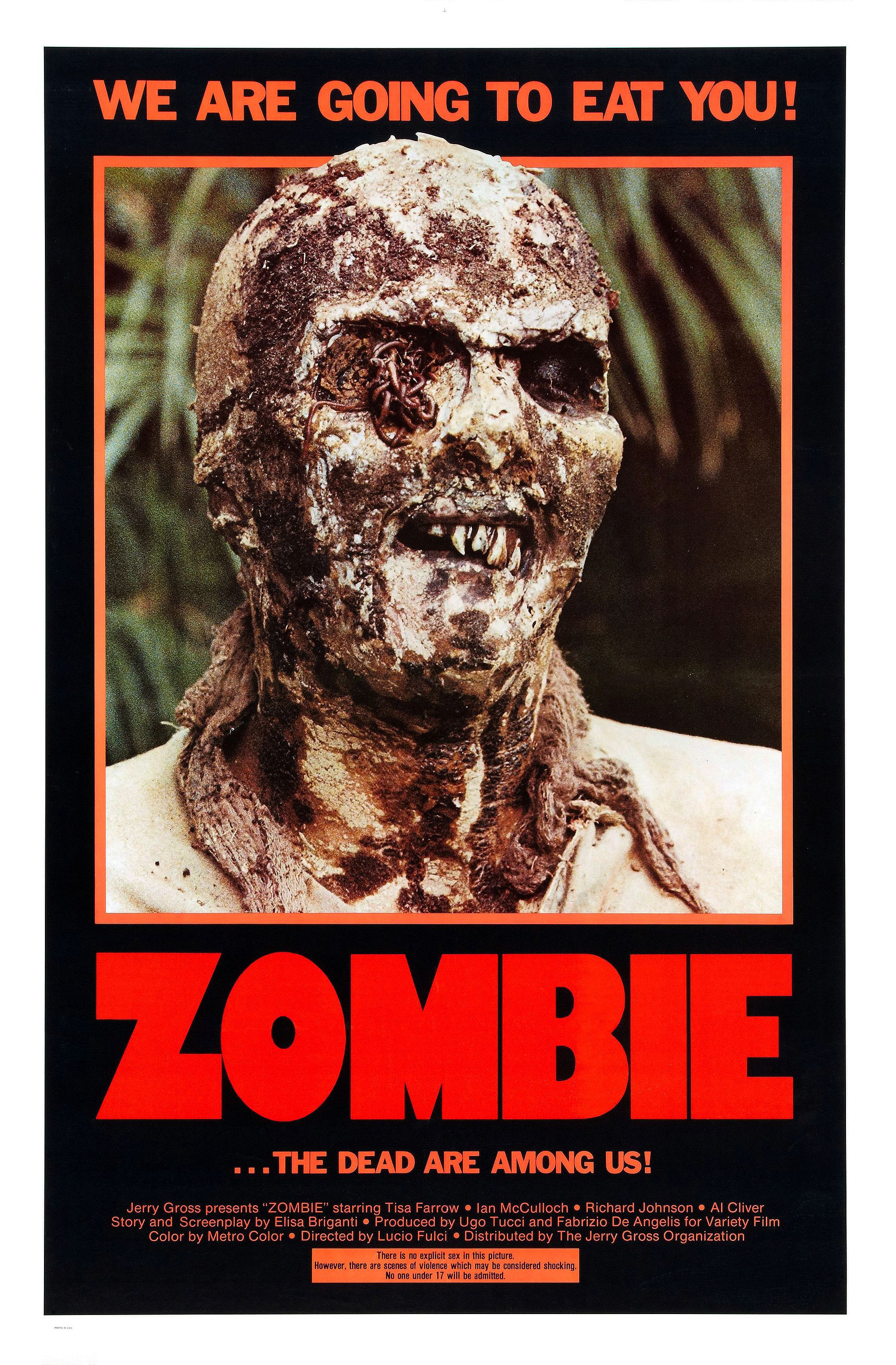
The Daily Horror Grindhouse: Zombi 2 (dir by Lucio Fulci)


Zombie_Flesh_eaters

(After reading my review, please be sure to check out Arleigh’s thoughts on Zombi 2!)

Two questions:

1) Do you love Zombie movies?

2) Have you seen Lucio Fulci’s 1979 film Zombi 2?

If your answer to the first question was yes, then you should definitely have had the same answer for the second.  Along with launching the long and extremely influential genre of the Italian zombie film and being one of the best zombie films ever made, Zombi 2 is also one of the best horror films ever made.

First off, a few words about that title.  Zombi was the Italian title for George Romero’s Dawn of the Dead.  Zombi was a huge hit on Italy and, in that shameless way that is beloved by all Italian horror fans, producers Fabrizio De Angelis and Ugo Tucci decided to take advantage of Zombi‘s success by naming their upcoming zombie film Zombi 2.  And, while I have always liked to think of Zombi 2 as being a prequel to Romero’s Dead trilogy, Zombi 2 is actually in no way related to Dawn of the Dead.

It has often been assumed that Zombi 2 was directly inspired by Dawn of the Dead.  While Romero’s film certainly provided more of an influence than just providing a title, Zombi 2 was actually in production before Dawn of the Dead opened in Italy.  And, ultimately, Zombi 2 is a far different film from Romero’s film.  Eschewing the social commentary and satire that ran through Dawn of the Dead, Zombi 2 is instead a work of pure horror.  They’re both excellent films but Dawn of the Dead ultimately inspires debate while Zombi 2 inspires nightmares.

Zombie_2_1978

Opening with a previously dead body being shot in the head as it slowly sits up on a stretcher and ending with a haunting vision of apocalypse, Zombi 2 is coated in a palpable atmosphere of doom.  A boat floats into a New York harbor and the two cops who investigate are greeted by a lumbering and hungry corpse.  Tisa Farrow plays the daughter of the boat’s owner.  When she and a reporter (Ian McCulloch, giving a likable and bemused performance that often finds him playing straight man to a bunch of decaying corpses and which provides a nice run up for his openly subversive performance in Zombie Holocaust) team up to find her father, their investigation leads them to an isolated island where the haunted and alcoholic Dr. Menard (Richard Johnson, bringing so much gravity and self-loathing to his role that he literally elevates the entire film) is struggling to deal with an outbreak of zombies.  Along with a boat captain (Al Cliver) and his girlfriend (Auretta Gay), McCulloch and Farrow try to escape the island before they end up joining the ranks of the undead…

As a director, Lucio Fulci was known for bringing his own unique visual flair to the horror genre.  Fulci, perhaps more than any of the other great Italian horror directors working during the Italian horror boom of the 80s and 90s, literally brought nightmares to cinematic life.  As a result, Zombi 2 is probably one of the most visually memorable zombie films ever made.  From the minute that McCulloch, Farrow, Cliver, and Gay arrive on the island, you can literally feel the oppressively hot wind and dusty wind that blows through every scene.  When the dead walk across the desolate landscape, Fulci emphasizes the decayed state of these zombies, forcing the audience to consider just how fragile the human body truly is.  The fact that the undead manage to be so pathetic and so dangerous at the same time only serves to make them all the more frightening.  When a group of conquistadors come back to life, Fulci films it from their point of view and, for a few minutes, we literally are one of the undead, clawing our way out of a grave.  Needless to say, Fulci doesn’t shy away from the gore of a zombie apocalypse either.  His zombies are ravenous and destructive.  The Walking Dead may be bloody but it’s got nothing on Zombi 2.

Along with the conquistador scene, Zombi 2 is especially remembered for two scenes, both of which showcase the best of both Fulci and Italian horror.

zombi-2-04

One is the scene where Dr. Menard’s wife (Olga Karlatos) is menaced by zombies after taking a shower.  Even after she slams the bathroom door, a zombies hand breaks through the door and grabs her by the hair and starts to pull her through the jagged hole in the door.  As she is slowly pulled to her doom, her eyeball is pierced by a splinter of wood.  It’s definitely an over-the-top moment, the type of thing that we expect from an Italian horror film.  But, as over-the-top as it may be, it’s also incredibly effective and terrifying.  It’s a scene that lets us know that there is no escape from our fate.  It’s a scene that reminds us that the zombies will always win because there is no way to lock out death.

(In fact, it’s such an iconic scene that almost all of Fulci’s subsequent films would feature a character losing an eye.  Adding a certain poignancy to his trademark scenes of ocular destruction was the fact that Fulci, himself, was diabetic and reportedly often feared that he would lose his eyesight.)

a

The other is a scene that always seems to bring a smile to the face of anyone who see it.  That’s the scene where a zombie gets into a fight with a shark while Auretta Gay swims nearby.  Again, it’s a bit ludicrous but it’s also incredibly effective.  If nothing else, it invites us to wonder how — if a shark can’t beat a zombie — can there be any hope for humanity?

The answer, of course, is that there isn’t.  Ultimately, in the world of Fulci’s film, whether by causes natural or unnatural, we’re all destined to become one of the zombies.

Zombi-2-Zombie-Flesh-Eaters

(This review is cross-posted over at Fourth-Day Universe where all of October has been Zombie Month!)


A Quickie Horror Review: The Black Cat (dir. by Lucio Fulci)


For my first horror review of October, I want to tell you about a movie that was directed by one of my favorite Italian filmmakers, Lucio Fulci.  That movie is the unjustly neglected Gato nero, or the Black Cat

In The Black Cat (loosely — and I do mean loosely — based on Edgar Allan Poe’s short story), the great David Warbeck plays a detective who is  sent to a small English village to investigate a series of mysterious deaths.  Corpses are turning up covered in scratches.  A man crashes his car after a black cat suddenly shows up in the passenger’s seat.  A young couple is found dead in a locked-up boathouse.  Evidence suggests that the killer entered through a small air vent.  No human could fit through that vent but…how about a cat?  Warbeck enlists the aid of a visiting American photographer (Mimsy Farmer) to investigate the crimes and he soon comes across a half-crazed medium (Patrick Magee) who just happens to own an adorable, if ill-tempered, black cat…

Fulci is well-known for directing such seminal (and gory) horror films as Zombi 2 and The Beyond trilogy.  The Black Cat was made during the same period of time as his more infamous films but it has never received as much attention.  Perhaps that’s because The Black Cat almost doesn’t feel like a Fulci film.  The gore is played down, the plot is coherent and (for a Fulci film) surprisingly linear, and the film even has a playful sense of humor to it.  Indeed, this often feels more like a minor, if entertaining, Hammer film than a Fulci film.  However, visually, this film is clearly the work of Lucio Fulci.  With his constantly prowling camera following isolated characters through dark streets and passageways, Fulci manages to make a small English village feel just as menacing as the dying Caribbean island from Zombi 2.  For all the attention given to Fulci as a “master of gore,” the true strength of his best films came from Fulci’s ability to create a palpable atmosphere of dread.  Fulci used gore as a tool but not as a crutch and if The Black Cat is a minor Fulci film, it’s still a film that proves that he was a far better director than even many of his fans give him credit for.

The Black Cat is surprisingly well-acted by a cast that’s made up of an appealing  combination of Fulci regulars and English B-movie veterans.  I read an old interview in which Warbeck complained that he felt his performance here was “boring,” but actually he was the perfect lead for this type of film, likable and with enough of a sense of humor to keep you watching.  Al Cliver may not be a household name but he and his blonde mustache seemed to show up in just about every movie Fulci made and he shows up here as well.  This time, he’s playing a local English constable and he’s no more believable here than he was playing a scientist in The Beyond or a boat captain in Zombi 2.  Still, any true Fulci fan will always be happy to see Cliver show up in a Fulci film because — much like familiar but bland wall paper — he lets us know that we’re home.  Patrick Magee is probably best known for his over-the-top performance as Mr. Alexander in A Clockwork Orange.  Magee goes just as much over-the-top here but, just as in A Clockwork Orange, Magee’s performance fits in perfectly with the film he’s appearing in.  Much as Stanley Kubrick contrasted Magee’s performance with Malcolm McDowell’s more subtle work, Fulci contrasts Magee’s theatrical approach with the more relaxed performances of Warbeck and Farmer.  Did I just compare Lucio Fulci to Stanley Kubrick?  Yes, I did and I stand by it.

However, the real star of this film is the black cat.  Trust me, this black cat (or black cats as I imagine several were used) is both adorable and blood-thirsty.  I still say that our cat Doc is the cutest black cat in the world but this film’s murderous feline comes in a very close second.

Doc, the greatest black cat ever!

6 Trailers To Go On The Road With


This weekend, I’m busy getting ready to go on a road trip with Jeff.  I’ll be away from home for two whole weeks!  However, fear not!  With the help of WordPress and my wonderful, beautiful older sister Erin, I will still be updating and posting even while we’re on the road.  I might even be able to convince my fellow Shattered Lens writer to spend the next two weeks watching the Lifetime Movie Channel and posting “What Lisa Would Have Watched Last Night.”  How about it, guys? *wink wink*

Anyway, while I deal with shopping and packing, why not enjoy the latest entry of Lisa Marie’s Favorite Grindhouse And Exploitation Trailers.

(And by the way, just because I’m going to be out of town next weekend won’t stop me from posting six more trailers next Saturday.  Why?  Because I love you, silly!)

1) The Klansman (1974)

In this infamous little film from the 1970s, Richard Burton, Lee Marvin, and O.J. Simpson fight the Ku Klux Klan in Alabama.  Believe it or not, I’ve actually seen this movie though the copy I saw was one of those public domain DVDs that I think was actually a copy of the edited-for-TV version of this movie.  (I say that because every time someone cursed, there was an awkward silence on the soundtrack.)  Even more odd is the fact that I’ve actually read the old novel that this movie is based on.  Anyway, this movie is pretty bad but the book is okay.  The film was directed by the same guy who directed the first James Bond films.

2) Beyond the Door (1975)

Okay, so this is pretty obviously an Exorcist rip-off but wow, this trailer freaks me out.  Needless to say this is an Italian film.  My favorite part of the trailer, to be honest, is the use of the Ryder truck.  It’s a moment that epitomizes Italian exploitation in that you can tell that the filmmakers really thought that displaying the one word — “Ryder” — would convince viewers that they were watching an American-made film.

3) 2020 Texas Gladiators (1985)

Speaking of Italian exploitation cinema, here we have another example.  I pretty much had to include this trailer because I live in Dallas and 2020 is just 9 years away.  That said, I’m not sure what part of Texas this film is supposed to be taking place in.  I’m guessing by all the shots of boots marching through grass that this is supposed to be up in North Texas but if you can find mountains like that around here then you’ve got far better eyesight than I do.  Add to that, the sudden indian attack seems more like an Oklahoma thing.  Not surprisingly, according to Amazon, this film was not only directed by Joe D’Amato but features both George Eastman and Al Cliver.

4) 1990: The Bronx Warriors (1982)

Apparently, it didn’t start in Texas.  This is also an Italian film.  It was directed by Enzo Castellari and, not surprisingly, George Eastman is in this one as well.

5) Empire of the Ants (1977)

The is the trailer that  dares to ask — who are you going to listen to?  Common sense or H.G. Wells?  I’ll tell you, nothing freaks me out more than when I see  one of those ant lines carrying a dead cricket back to the anthill.  Ants are one thing that I will not allow in the house.  However, I kinda admire them.  They’re so neat and organized.  Plus, males in ant society know their place.

6) Mr. Billion (1977)

“20th Century Fox presents Mr. Billion …. starring Terence Hill, the 5th biggest star in the  world…”  I haven’t seen very many Terence Hill films but I always enjoy seeing him in trailers.  I can’t really say whether he’s a good actor or not because every time I’ve seen him, he’s been dubbed.  But he definitely had a very likable presence.  You wanted him to be a good actor whether he was or wasn’t.  That said, even if I had been alive at the height of Mr. Hill’s fame, it never would have worked out for us as I’m Southern Italian and Hill is quite clearly from the north.  That’s just the way it is.  Anyway, back to Mr. Billion — I’m including two trailers for this one.  The first is the “Prestige” trailer.  The second one is much shorter and features one of those odd little songs that gets stuck in your head.