The 2017 best picture nominee, Darkest Hour, opens with Europe at war.
While the United States remains officially neutral, the Nazi war machine marches across Europe. After years of appeasement, the United Kingdom has finally declared war on Germany but the feeling in Parliament is that Prime Minister Neville Chamberlain (Ronald Pickup) is not strong enough to take on Hitler. When the Opposition demands that Chamberlain resign, Chamberlain does so with the hope that he’ll be replaced by Lord Halifax (Stephen Dillane). Like Chamberlain, Halifax continues to hold out hope for some sort of negotiated peace with the Germans. However, Halifax declines, saying that it’s not yet his time. Instead, Chamberlain’s successor is Winston Churchill (Gary Oldman), the only Conservative that the Opposition is willing to accept as Prime Minister.
(This is a bit of invention on the part of the filmmakers. In reality, the Opposition did demand Chamberlain’s resignation but they did not stipulate that he could only be replaced by Churchill.)
No one is particularly enthusiastic about the idea of Winston Churchill becoming prime minister. Chamberlain and Halifax both view him as being a war monger who is so determined to prove himself as a military strategist that he’ll sacrifice thousands of British lives just for his own glory. The King (Ben Mendelsohn) worries that Churchill is an unreliable radical and he still resents Churchill for defending the marriage of Edward VIII and Wallis Simpson. Churchill is regularly described as being a buffoon and an eccentric. He’s quick-tempered and obsessive about things that many people would consider to be of no importance. When we first see Churchill, he’s making his new assistant (played by Lily James) cry because he’s discovered that she single-spaced a memo as opposed to double-spacing it. The only people who seem to like Winston are the member of his family and even his loyal wife (Kristin Scott Thomas) is frequently frustrated with him.
Churchill’s enemies are not impressed by his first actions as prime minister. They listen in disgust as he lies about the prospects of victory in France. They are shocked by his refusal to even consider a negotiated peace. They are horrified by his ruthless pragmatism as he willing sacrifice a thousand British soldiers in order to save several thousand more at Dunkirk. An aristocrat who has been rejected by his peers, Churchill is betrayed by those serving in his government but beloved by the people who ride the Underground and who are being asked to potentially sacrifice everything to defeat Hitler’s war machine.
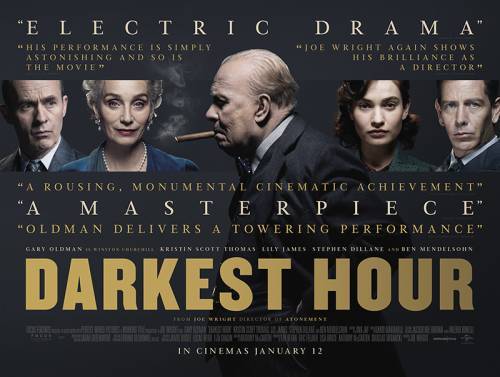
As directed by Joe Wright, Darkest Hour plays out like a dream, with 1940s Britain recreated in hues of black and gray. The film’s visual palette is so dark that, at times, Gary Oldman’s Winston Churchill appears to literally emerge out of the shadows, an almost mythical figure who symbolizes a society in transition. In many ways, Churchill is an old-fashioned Edwardian who nostalgically remembers the glory days of the British Empire. At the same time, Churchill is enough of a realist to see that the world is changing and, regardless of who wins the war, that it will never be the same. Churchill is enough of an aristocrat to be unaware of what a backwards V-sign means but also enough of a commoner to laugh uproariously upon learning its meaning.
Churchill spends a good deal of the film bellowing and, at times, it’s easy to see why many initially dismissed him as being a buffoon. Indeed, in Darkest Hour, Churchill frequently is a buffoon. But he’s also a pragmatic leader who truly loves his country and its people. Oldman has a lot of scenes where he’s loud but he also has other scenes in which he reveals Churchill to be a thoughtful man who loves his country and who is determined to win a war that many believe to be unwinnable. When he’s reduced to calling the United States and has to pathetically beg President Roosevelt to honor a treaty, you feel for Churchill and you share his frustration as he tries to get the flaky FDR to understand the reality of what’s happening in Europe. When Churchill explains why he’s willing to sacrifice a thousand in order to save 41,000 more, Oldman delivers his lines with a steely certainty. As played by Oldman, Churchill knows what has to be done, even if no one else has any faith in him.
It’s a good film, even if it ultimately feels more like a showcase for one actor than a cohesive narrative. The rest of the cast does a good job, especially Ronald Pickup as the haunted and dying Neville Chamberlain. But ultimately, Darkest Hour is Gary Oldman’s show. That’s appropriate. Much as how Churchill dominated British politics, Gary Oldman has dominated British acting. Not surprisingly, Gary Oldman won his first Oscar for playing Winston Churchill in Darkest Hour. The film was also nominated for best picture but it lost to Shape of Water.


 Through the Shattered Lens