The Films of 2024: Unfrosted (dir by Jerry Seinfeld)


Unfrosted is a thoroughly amiable and goofy comedy about the invention of the Pop Tart.

Taking place in an imaginary 1963, Unfrosted tells the story of the Cereal Wars.  Kellog’s and Post are competing for dominance in the kids breakfast food market, dominating the scene while the dour folks at Quaker can only shake their heads in holier-than-thou shame.  Bob Cabana (played by the film’s director, Jerry Seinfeld) is a Kellog’s exec who spends his day dealing with pompous cereal mascots (led by a hilarious Hugh Grant) and the somewhat random whims of his boss, Edsel Kellog III (Jim Gaffigan).  He dreams of someday having a lawn made out of sod and also having enough money to send his kids to a good college.  “Those colleges can cost $200 a year!” he says, at one point.

Life is good until he discovers that Post — headed up by Marjorie Post (Amy Schumer) — is developing a type of new breakfast food that could revolutionize the industry and dethrone Kellog’s as America’s top cereal company.  Bob gets Edsel’s permission to try to create something that will beat Post’s new product to the shelves.  But first, Bob has to go to NASA and convince brilliant engineer Donna “Stan” Stankowski (Melissa McCarthy) to abandon the moon project and return to Kellog’s.  “You know we’re never going to land on the moon,” Bob tells her.

Soon, the entire nation is riveted by the competition between Post and Kellog’s.  Walter Cronkite (Kyle Dunnigan) reports on every development, in between complaining about his wife and playing with silly putty.  The Russians decide to help Post, leading the world to the brink of nuclear war while President Kennedy (Bill Burr) spends his time with the Doublemint Twins.  Harry Friendly (Peter Dinklage), head of the milk syndicate, warns that kids better not stop eating cereal while Bob finds himself being menaced by a sinister milkman (Christian Slater).  A German scientist (Thomas Lennon) and Chef Boyardee (Bobby Moynihan) combine a sea monkey with a square of ravioli, leading to a new life form that lives in the Kellog’s ventilation system.  Steve Schwinn (Jack McBrayer), the bicycle guy, risks his life to test a prototype while a super computer is shipped to Vietnam and turns into Colonel Kurtz and….

Okay, you’re getting the idea.  This is a silly, joke-a-minute film that is in no way meant to be taken seriously.  It’s obvious that Seinfeld and his co-writers greatly amused themselves while writing the script and your amusement will depend on whether or not you’re on the same wavelength.  I enjoyed the film, because I love history and I love pop culture and I like random homages to other films.  Not all of the jokes landed.  There’s a lengthy Mad Men parody that, while funny, still feels several years too late.  But, for the most part, I enjoyed the amiable goofiness of it all.

Unfrosted is currently getting some savagely negative reviews but that has more to do with Seinfeld’s recent comment that the “extreme left” was ruining comedy.  Though most people would probably consider Seinfeld’s comment to be common sense (and would also realize that Seinfeld was condemning the “extreme” as opposed to liberalism in general), the online folks, many of whom were already angry over Seinfeld’s outspoken support of Israel, were scandalized and most mainstream film reviewers today never want to get on the bad side of an online mob, regardless of how annoying that mob may be.  (Even a positive review in The Hollywood Reporter contained an odd passage in which the reviewer seemed to beg forgiveness for giving a non-condemnatory review to a film made by someone on the other side.)  Of course, there are also some reviewers who are currently overpraising this film as a way to “own the libs.”  The fact that a film as silly and inoffensive as this one could suddenly find itself at the center of the culture war tends to prove Seinfeld’s point.

The important thing is that Unfrosted is amusing and, in the end, rather likable.  I enjoyed it.
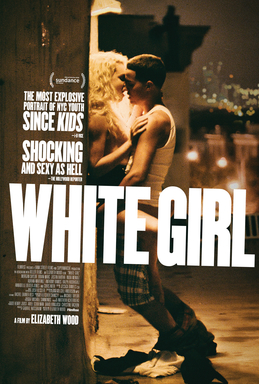
Playing Catch-Up: White Girl (dir by Elizabeth Wood)


white_girl_film_poster

Ever since it premiered at the Sundance Film Festival, I’ve read the White Girl was the most “shocking” film of 2016.  You can take a look at the poster above and see that, according to The Hollywood Reporter, White Girl is “SHOCKING … AND SEXY AS HELL!”

Well, I finally got a chance to watch White Girl on Netflix and the only thing shocking about it is that so many (male) critics were apparently convinced that it was the most shocking movie ever made.  I certainly wouldn’t call it shocking.  (And considering that White Girl features two graphic rapes, I’d love to know why the critic thought “sexy as Hell” would be an appropriate description.)  A better description of White Girl would be “honest.”  Then again, considering the way that the movies usually present the experience of being young, female, and in the city, perhaps the fact that White Girl is an honest film is the most shocking thing of all.

Morgan Saylor plays Leah, a college student who, along with her friend, Katie (India Meneuz), moves into a New York apartment.  The apartment is located in a largely Spanish neighborhood, one that has yet to surrender to gentrification.  While Katie and Leah’s hipster friends are immediately suspicious of everyone else in the neighborhood, the Oklahoma-born Leah is far more adventurous (or perhaps reckless).  She approaches Blue (Brian Marc) on a street corner and asks him if he has any weed.

Blue has weed and a lot more.  He’s the neighborhood drug dealer and soon, he’s also Leah’s boyfriend.  When Leah isn’t getting high and having sex with Blue, she’s working as an intern at a magazine where, early on in the film, she’s sexually assaulted by her boss, Kelly (Justin Bartha, playing a predator who, for many, will seem disturbingly familiar).  Leah invites Blue to a party given by the magazine and Blue is able to make a lot of money selling cocaine to Leah’s wealthy co-workers.

For Blue, drugs are a business and he refuses to do hard drugs himself.  To Leah, it’s an adventure, one that she believes doesn’t have any real consequences.  Or, at least, that’s the way she sees it until Blue is arrested.  With Blue, a repeat offender, facing a life sentence, Leah manages to find a lawyer (Chris Noth, who will make you skin crawl) but she needs to raise the money to pay him.  Fortunately, Leah has a stash of cocaine that Blue was supposed to sell.  Blue tells Leah that she needs to return the cocaine to his dealer but instead, Leah decides to sell the cocaine herself.  Or, at the very least, she’s going to sell whatever cocaine she doesn’t end up snorting herself…

White Girl has been called shocking because of its open and nonjudgmental portrayal of both drugs and sex but, honestly, there’s nothing shocking about it.  It may be a generational thing but, to me, Leah’s story was a familiar one.  I’ve known a lot of Leahs and, personally, there were moments in White Girl that left me cringing just because I could relate to one of Leah’s naive notions or I could remember what it was like to feel like, no matter what I did, there would never be any consequences.  Leah may not always be a likable character but it’s not because she has sex or experiments with drugs.  Instead, it’s because she spends most of the film blissfully unaware of her own privilege.  Leah thinks that she understands the realities of Blue’s world but, as she learns by the end of the film, she’s really just a tourist.  And, unlike Blue and the rest of her neighbors, Leah can always leave whenever she wants.

So, White Girl was not a shocking film to me.  Instead, it was a very honest film.  It can currently be viewed on Netflix.

Film Review: Focus (dir by Glenn Ficara and John Requa)


2015_Focus_film_poster

The snow and ice finally melted today so, this afternoon, Jeff and I went down to the Alamo Drafthouse and we saw the just released Will Smith/Margot Robbie film, Focus.

You know how there’s some films that you see and you know that you had a good enough time while you were watching it and then, a few hours later, you realize that the movie itself is quickly fading from your memory?  It’s not that you just saw a bad movie as much as you just watched one that was not exceptionally good.  To a large extent, that sums up how I felt about Focus.  I watched it.  I was mildly entertained.  And I have a feeling that, 6 months from now, I’m going to come across this review and say something like, “Oh yeah, I guess I did see that movie.”  It gets the job done but it doesn’t do much else.

(I was actually tempted to start this review by saying that Focus was good for a “March movie” but then I remembered that last year, The Grand Budapest Hotel came out in March and proved that the date of release is no longer an excuse.)

In Focus, Will Smith plays Nicky Spurgeon.  Nicky’s nickname is Mellow but he didn’t get that nickname for the reason that you probably think he did.  (Though, rest assured, we do find out the exact reason why Nicky is called Mellow and yes, it does factor into the film’s final twist.)  Nicky is anything but mellow.  Instead, he’s a professional con artist who is always scheming, who always considers every detail, and who is always focused on getting what he wants.

The film is split into two parts and the first part is actually pretty good.  An inexperienced con artist named Jess (Margot Robbie) attempts to rob Nicky and gets a lecture as a result.  Nicky isn’t so much upset that Jess tried to con him as much as he, as a professional, is annoyed that Jess did such a bad job of it.  This leads to Nicky eventually becoming Jess’s mentor.  Nicky teaches Jess all the tools of the trade, introduces her to all the properly quirky members of his crew, and he even goes against his own advice (which is to never get close to anyone) when he and Jess become lovers.

The highlight of the first part of the film is a football game where Nicky and a compulsive gambler (B.D. Wong) end up making a series of increasingly ludicrous bets.  B.D. Wong gives such a memorably unhinged performance that he briefly made the entire film seem more interesting than it actually was.  In fact, as I look back over Focus, I find myself wishing that the entire film has just been about his character.

But, unfortunately, the film isn’t about B.D. Wong.  Instead, it’s about Nicky and Jess.  The second part of the film, which takes place three years after the first part, features Jess and Nicky as equals and it feels like almost an entirely different movie.  Whereas Smith and Robbie had a nice chemistry as teacher and student, that chemistry vanishes after the time jump.  Unfortunately, that’s not all that vanishes.  The film’s pace and playful sense of fun disappears as well.  If the first half of the film felt like an above average first episode of a quirky TV show, the second half felt like a long-running sitcom on which the show runner had been fired and suddenly replaced.  It was similar to what had come before but, ultimately, it felt very different.

Focus does end with a big twist but, long before it was revealed, Jeff and I both guessed what it was.  The problem is that we’ve seen so many movies about con artists that we know that all of them are destined to end with a big twist that reveals that there was another con going on that we didn’t know about.  It’s impossible to be surprised by the eventual twist because we all know that it’s coming.  For a “con movie” like Focus to work, it has to either be so cleverly written or so much fun to watch that we actually stop thinking about the inevitability of the upcoming twist.  But, since Focus is never as clever as it thinks it is, we instead spend our whole time thinking about the twist and, seeing as how you’re a clever and experience filmgoer, you probably won’t have much trouble predicting it.

But here’s the thing: I think it’s possible to be too critical of a film like Focus.  Focus may not be good but it does have it fun moments.  Will Smith could play Nicky in his sleep.  (And, to be honest, he occasionally seems to be doing just that.)  Margot Robbie looks like she belongs in an old film noir.  The settings are glamorous.  The clothes are to die for.  Ultimately, Focus is both moderately enjoyable and extremely forgettable.  If you don’t see it in a theater, you won’t regret it.  However, when it show up on cable in December, it’ll make for inoffensive background noise.