Two From Sean Christensen : “Questions Of Molten Motion”


Ryan C. (fourcolorapocalypse)'s avatarRyan C.'s Four Color Apocalypse

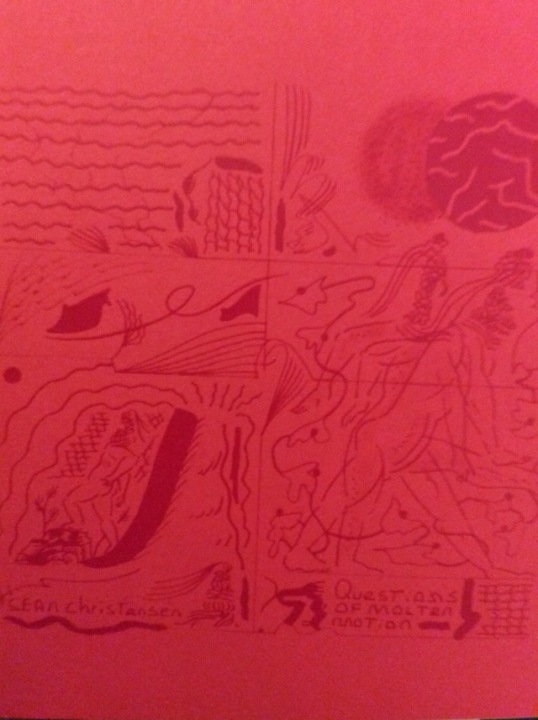
Consistently one of the more interesting artists working in the small press and self-publishing milieu, Portland’s Sean Christensen never fails to surprise and enthrall with his cartooning, and the latest of his works that I’ve managed to get my hands on (although I believe he actually self-published it last year), Questions Of Molten Motion, may be his most abstract and challenging ‘zine to date — an entirely wordless mini full of single-panel illustrations that convey fluidity in its various aspects, yet attempt to capture it by means of static and intransigent imagery, with most of his individual pen-and-ink drawings “hemmed in” by straight-rule lines at the top and bottom, but open at the sides.

Now, don’t ask me what the fuck some of these images actually depict in a concrete sense, although both bodies and loosely-rendered “objects” (after a fashion, at any rate) are reasonably inferred at the ocular…

View original post 549 more words

A Pretty Strong “Wimp Digest”


Ryan C. (fourcolorapocalypse)'s avatarRyan C.'s Four Color Apocalypse

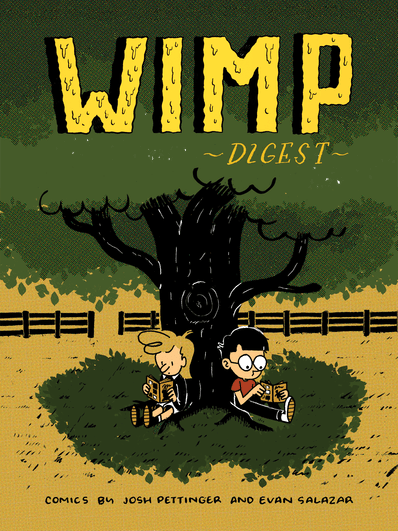
To address the elephant in the room right at the outset, yes — Josh Pettinger and Evan Salazar’s new eight-page mini, Wimp Digest, is a “gimmick” comic, the stunt in question being that Salazar is writing and drawing a mildly embarrassing anecdote about Pettinger’s childhood, and Pettinger is writing and drawing a mildly embarrassing anecdote about Salazar’s childhood. Got that?

I’m sure you do, as the idea of one cartoonist telling the other a story for them to commit to paper, and the other doing the same, isn’t a terribly difficult conceit to grasp — nor is this comic itself a difficult one to kick back and spend about 15 minutes with. It’s a fun, kinda heartwarming, and certainly well-illustrated little number by two of the more promising new (-ish, at any rate) talents in the “indie”/self-publishing scene (although, as I’m sure you won’t be surprised to discover, the…

View original post 489 more words

On The Road To Ruin And Revelation : Mara Ramirez’s “MOAB”


Ryan C. (fourcolorapocalypse)'s avatarRyan C.'s Four Color Apocalypse

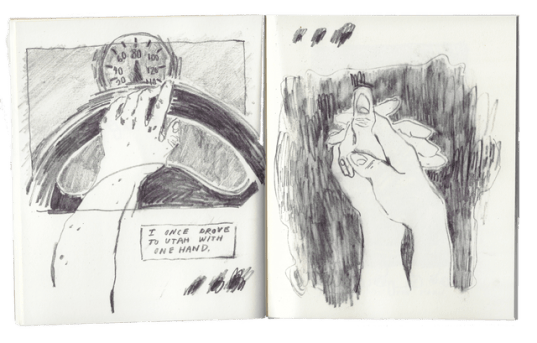
There’s truth in packaging, and then there’s this : Oakland-based cartoonist Mara Ramirez’s recently-released debut graphic novel, MOAB — which comes our way courtesy of Freak Comics — is formatted to look like a sketchbook/diary with a lush moleskine cover because, well, it is a sketchbook/diary with a lush moleskine cover, it’s just that it happens to tell one complete story. And one complete true story, at that.

think, at any rate. Granted, there’s no indication that the narrative herein is strictly autobiographical — or even loosely autobiographical — but even if it isn’t, that doesn’t mean the story, and the emotive and expressive qualities that positively ooze from its metaphorical pores, is any less real. In fact, it only takes a few pages to clue readers in to the fact that this, right here, is as absolutely real as it gets.

And no sooner do I say…

View original post 713 more words

The “Broken Pieces” Of David Tea’s Consciousness Coalesce in “Five Perennial Virtues” #11


Ryan C. (fourcolorapocalypse)'s avatarRyan C.'s Four Color Apocalypse

After spending the last couple of years mainly re-visiting old material (as opposed to merely re-printing it, given that he’s made changes ranging from the significant to the less so to pretty much all his earlier comics in their new iterations), it’s nice to see that Minneapolis cartoonist David Tea is back to producing original stuff with Five Perennial Virtues #11, the latest issue of his intermittent self-published series that’s been going for, what? Nearly two decades now?

My, how time flies — even if, in Dave’s ‘zines, it seems to either crawl or loop back in on itself. Or both. In any case, the “Broken Pieces” subtitle for this issue is entirely apropos, and while tonally and structurally it’s of a piece (or, if you prefer, of a broken piece) with previous installments, it’s also quite different and fairly unique unto itself. Spoiler alert, then : I think you’re…

View original post 756 more words

More Of The Same, But Totally Different : George Horner’s “Incoherents 2/UBU”


Ryan C. (fourcolorapocalypse)'s avatarRyan C.'s Four Color Apocalypse

Originally self-published at the tail end of 2018 but only making it into this critic’s hands now, Brooklyn-based artist George Horner’s Incoherents 2 is as curious an item as its predecessor, and while it plays by the same rules, the end results are a unique experience unto themselves.  But hey — that’s only half the story.

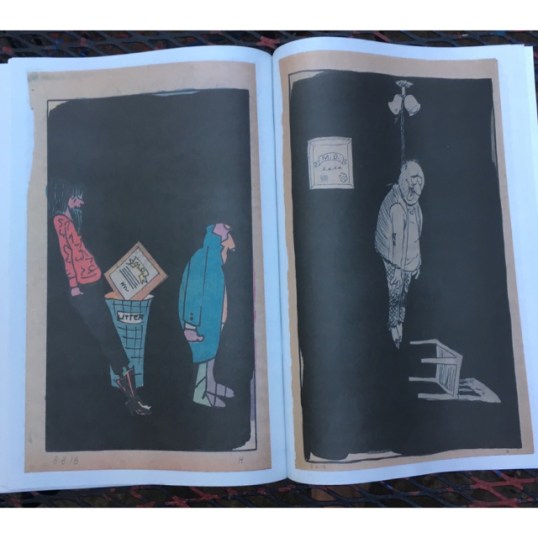
Okay, yeah, there is no “story” here per se, but this is a dual project, with each section of it approached in a singular manner, then presented in the form of an offset-printed comic book on cheap newsprint in a “flipbook” format. Horner’s preferred full title is, then, Incoherents 2/UBU, and as you’ve already no doubt surmised, the UBU portion functions as the de facto “B-side” of the publication. With those particulars out of the way, then —

We present to you even more particulars! Horner’s general modus operandi is that he…

View original post 572 more words

Howling At The Moon With Brandon Lehmann’s “The Werewolf Expert”


Ryan C. (fourcolorapocalypse)'s avatarRyan C.'s Four Color Apocalypse

I trust I’m not going out on a limb when I assert that we’re living in absurd times — the evidence is, quite literally, both constant and everywhere. What’s easy to forget in the midst of it all, though, is that absurdity needn’t necessarily have tragic consequences, as is the case all too often now — in fact, absurdity can be downright funny. And while this has probably never seemed further from the truth, the good news is that you don’t need to take my word for it. You can ask Seattle-based cartoonist Brandon Lehmann instead.

Come to think of it, you probably should, because unlike me, he can write and draw a comic that proves it — hell, he already has many times over, and his latest mini, The Werewolf Expert (released under the auspices of his own Bad Publisher Books imprint), is perhaps the most succinct…

View original post 543 more words

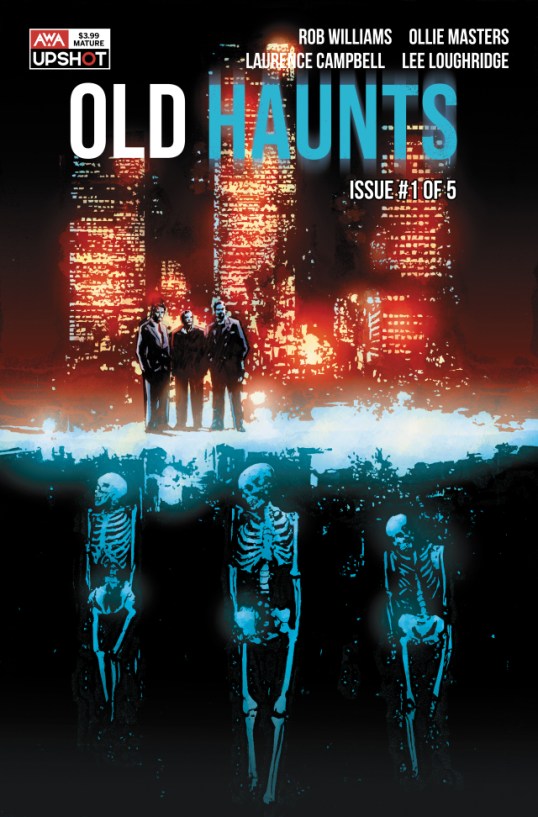
Mainstream Comics Worth Paying Attention To : “Old Haunts”


Ryan C. (fourcolorapocalypse)'s avatarRyan C.'s Four Color Apocalypse

Making their publishing debut the last week Diamond was open for business before the COVID-19 shutdown hit was a rough break for AWA (short for Artists, Writers and Artisans) and their Upshot line, but they adjusted on the fly quickly, offering the first issues of their various and sundry titles online for free (albeit in this really annoying, one-panel-at-a-time format) and bumping their release dates down the schedule accordingly — and now that shops are back up and running, so is this new brainchild of former Marvel head honchos Bill Jemas and Axel Alonso. Their slate of offerings has been a mixed bag in terms of quality, no doubt about it, but their professionalism and ability to adjust on the fly — not to mention their comparably deep financial pockets — has shown them to be a resilient new presence in a still-crowded market, and by and large I’m interested…

View original post 617 more words

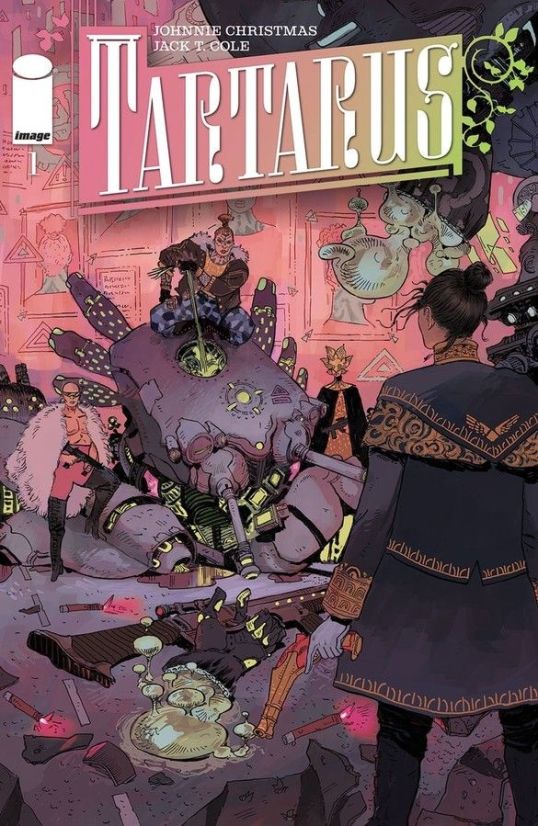
Mainstream Comics Worth Paying Attention To : “Tartarus”


Ryan C. (fourcolorapocalypse)'s avatarRyan C.'s Four Color Apocalypse

Granted, it’s early days yet, but at three issues in I’m already prepared to say that writer Johnnie Christmas and artist Jack T. Cole’s ambitious sci-fi/comedy epic Tartarus is my favorite thing coming out from Image Comics at the moment, and perhaps my favorite thing coming out of the mainstream in general. And why wouldn’t it be? It’s got everything you want : compelling characters, breakneck action, smart scripting, a solid premise — and, oh yeah, absolutely gorgeous art.

Cole first came across my radar screen via Boom! Studios’ The Unsound, where his stunning visuals elevated a rather derivative horror script from Cullen Bunn and turned the insane asylum of the book’s setting into a Dante-esque phantasmagoria of despair and delight, revenge and revelation, but to say he’s kicked it into another gear here is to sell his visionary work short — his design work and figure drawings belie…

View original post 688 more words

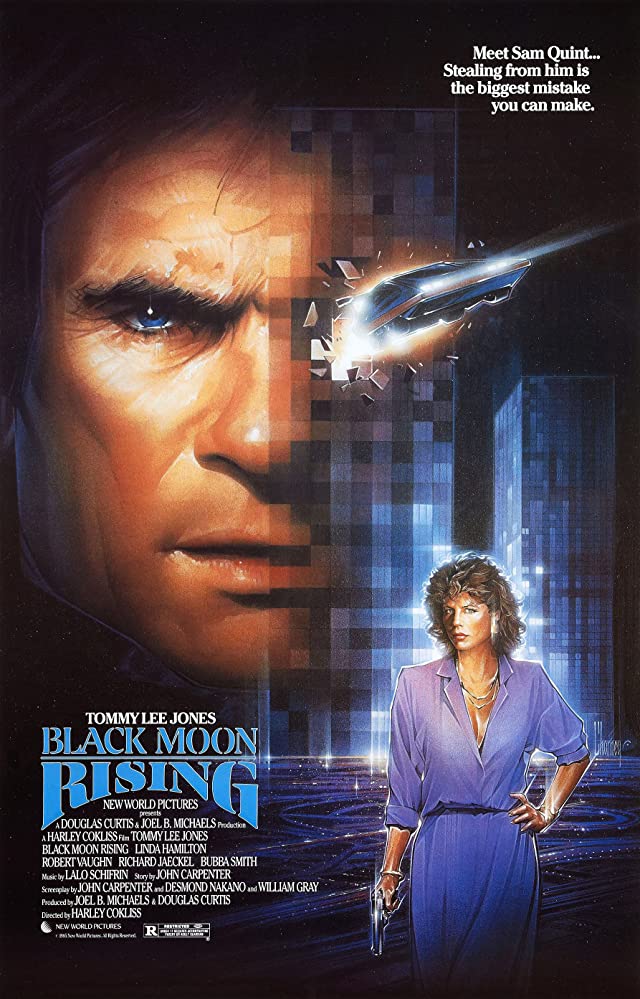
Black Moon Rising (1986, directed by Harley Cokeliss)


The FBI needs someone to steal a computer disk that can bring down a corrupt Las Vegas corporation so they hire reformed thief Sam Quint (Tommy Lee Jones).  Quint manages to steal the disk but he finds himself being pursued by Ringer (Lee Ving), an old acquaintance who now works for the corporation.  In order to keep the disk from falling into Ringer’s hands, Quint hides it in the back bumper of an experimental racing car called the Black Moon.  The Black Moon, which runs on water and can fly when it reaches its top speed, is being taken to Los Angeles by Earl Windom (Richard Jaeckel) so Quint assumes that he’ll just follow Window to L.A. and then retrieve the disk when no one is watching.

However, as soon as the Black Moon arrives in Los Angeles, it’s stolen by Nina (Linda Hamilton).  Nina works for Ed Ryland (Robert Vaughn), an outwardly respectable businessman who secretly runs a syndicate of car thieves.  Now, Quint and Nina (who conventiently falls in love with Quint) have to steal the car back from Ryland while staying one step ahead of both Ringer and the FBI.

Black Moon Rising is not a movie that you watch for the plot or for the non-existent romantic chemistry between Tommy Lee Jones and Linda Hamilton.  You don’t even watch it for the white collar villainy of Robert Vaughn, who basically just recycles his performance from Superman III.  This is a movie that you watch for the car!  The Black Moon is definitely an impressive vehicle.  Who wouldn’t want to steal one of these?

In a car chase movie like Black Moon Rising, the most important thing is that the car must be cool.  The Black Moon looks like something Mad Max would drive and it can actually fly so, by definition, it’s pretty cool.  Unfortunately, Black Moon Rising doesn’t spend as much time with the car as it should.  The movie gets bogged down with the scenes of Quint and Nina falling in love and Quint having to deal with his FBI handler (played by Bubba Smith).  This is a film that would have benefited from being directed by someone like Hal Needham, who understood that people don’t come to car chase movies for the plot.  They come to car chase movies because they want to see people driving fast and cars crashing in spectacular ways.  Still, even though the car isn’t onscreen as much as it should be, the car is still cool enough to make Black Moon Rising watchable.

One final note: the screenplay is credited to John Carpenter.  Though the imdb claims that this was the first script that Carpenter ever sold and that the film spent ten years in development, Carpenter says that he wrote the script around the same time that he made Escape from New York.  He also says that he’s never actually seen the completed film.