6 Trailers For The End Of The First Week of Horrorthon


As week 1 of the 2023 Horrorthon comes to a close, it’s time for me to admit that I am absolutely, 100% exhausted.  Hopefully, this latest edition of Lisa Marie’s Favorite Grindhouse Trailers will help to keep me awake!

  1. Nightmare on Elm Street (1984)

Here’s a trailer that’s as good as any when it comes to giving you a reason to try to stay awake!

2. Bad Dreams (1988)

Freddy isn’t the only person haunting the dream world.

3. Dreammaniac (1986)

Actually, there’s a lot of dangerous things out there in Dream Land.

4. The Cell (2000)

Even Jennifer Lopez and Vince Vaughn know better than to get lost in someone else’s dream.

5. Phantasm (1979)

And, of course, we can’t talk about sleep and dreams and nightmares without including the classic trailer for Phantasm.

6. Dreamscape (1984)

Fear not, though!  If things get too intense in the dreamworld, we can always call Dennis Quaid.

Sweet dreams!

The TSL Horror Grindhouse: Chopper Chicks in Zombietown (dir by Dan Hoskins)


An all-women motorcycle gang called the Cycle Sluts roars through the desert. Why are they called the Cycle Sluts? As their leader puts it, they know what people are going to call them so they’re reclaiming the term for themselves. Nobody tells the Cycle Sluts what to do and nobody but the Cycle Sluts decides or defines who the Cycle Sluts are. They’re rebels and they’re singers, making music and fighting the patriarchy as they make their way through the dusty corners of America.  Go, Cycle Sluts, go!

When the Cycle Sluts drive into the small desert town of Zariah, the residents are not happy to see them. Zariah is a peaceful and boring town and the citizens would like to keep it that way.  The citizens are happy having a town where there’s only a few buildings, next to no businesses, and only a few residents.  It’s a town where not much happens and everyone can live in peace, far away from all the evil temptations of the big city and corrupt civilization.  However, the town becomes a lot less peaceful when the local mortician starts to bring the dead back to life. Soon, zombies are wandering through the desert on their way back to their former home and only the Cycle Sluts and a bus full of stranded blind kids can save the town!

That slight plot description probably tells you all you really need to know to get a feel for what type of film 1989’s Chopper Chicks in Zombietown is. It was released by Troma, which means that the humor is crude, the zombie attacks are bloody, and the film’s aesthetic is undeniably cheap. That said, the film itself is enjoyable when taken on its own dumb terms. The action moves quickly, the members of the cast perform their silly roles with an admirable amount of dedication, and the whole thing ends with a message of peace and equality. The townspeople learn how to be tolerant and the Cycle Sluts learn how to trust other people. It’s about as dumb as a movie about about bikers fighting zombies can be but it’s a surprisingly fun movie.  It’s hard not to cheer a little when the Cycle Sluts and the towns people and the blind kids finally set aside their differences and do what has to be done.  They even manage to save the life of a baby and anyone who has seen any other Troma films knows how rare that can be.  In its way, Chopper Chicks in Zombietown serves as a reminded that not every Troma film is as bleak as Combat Shock or Beware!  Children at Play. The Cycle Sluts do a good job and so does the film.

Speaking of doing a good job, keep an eye out for Billy Bob Thornton, making an early appearance as the unfortunate boyfriend of one of the residents of Zariah. Billy Bob seems to be having fun with this early job and his appearance here serves as a reminder that everyone started somewhere.

The TSL Horror Grindhouse: Snuff (dir by Michael Findlay, Horacio Frederiksson, and Simon Nuchtern)


For a film that has a reputation for being one of the most controversial ever to be released, Snuff is incredibly boring.

Filmed in Argentina in 1971 as Slaughter, the majority of this film deals with a cult leader whose name is Satan (Enrique Larratelli).  Satan pronounces his name with the emphasis on the second syllable, so that it sounds less like the name of the Lord of the Darkness and more like, “Sah-TAN.”  I guess even he understood that the importance of not being too obvious when it comes to naming yourself.  That said, everything about Satan indicates that he worships the Devil so I’m not really sure why he felt the need to get all fancy with the pronunciation of his name.  Interestingly enough, Satan does not have a last name.  I imagine that if he did have a last name, he would be one of those pretentious people who would try to spruce up his last name with a “von” or “de,” like Satan von Smith or Satan de Jones.

Anyway, Satan has a group of followers.  They’re all young women who ride motorcycles and who look like hippies but they’re actually knife-wielding murder groupies.  Over the course of the film, they seduce several men and then kill them.  One of them carries a knife in the waistband of her panties, which is not something that I would ever have the courage to do because, seriously, if you sit down at the wrong angle or trip and fall, you’re probably going to have blood everywhere.

An actress named Terry London (Mirta Massa) comes to Argentina with her boyfriend and producer, Max Marsh (Aldo Mayo).  They’re going to be making a movie but mostly, Terry just wants to sleep and hang out around their mansion.  Some of Terry’s decadent Hollywood friends show up for the carnival.  Someone dies and I assume he was a friend of Terry’s.  Satan and his followers start plotting to attack and kill all of the Hollywood phonies and their rich friends.  Satan is especially offended that one of them is the son of an arms dealer.  Satan is about world peace, don’t you know.

Anyway, if you’re dumb enough to actually get caught up in the story of Satan and his followers, prepare to be disappointed because that story ends abruptly and without resolution.  Instead, some woman that we’ve never seen before suddenly declares that the movie is turning her on and an actor who is supposed to be the director of the movie proceeds to dismember her while the cameras roll.  The idea is that the crew of the movie actually murdered a woman, filmed it, and then decided to release the move into theaters because it’s not like people get prosecuted for murder or anything….

Of course, the murder footage was faked.  It’s painfully obvious that it was faked, just as its obvious that the footage was shot long after filming was completed on Slaughter.  It’s not even the same film stock.  But, in 1976, when Slaughter was released under the name Snuff, there were actual protestors who showed up at the theaters and claimed that the footage was real.  Some of those protestors were hired by the film’s distributor but reportedly, some of them were actual grass roots activists who believed what they had heard.  As a result, this extremely dull film became a box office success.  In New York City, it was the number one film in theaters for three weeks.

Controversy sells and Snuff will always have a place in the history of grindhouse films.  That said, the film itself is pretty much unwatchable.  If you’re going to watch it, hire someone to come march outside of your house with a sign to keep things interesting.  Otherwise, prepare for boredom.

The TSL Horror Grindhouse: Beware! Children At Play (dir by Mik Cribben)


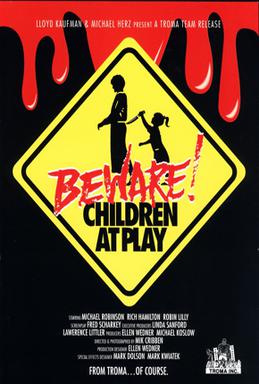
1989’s Beware!  Children At Play opens with a son and his father on a camping trip.  They’re having a great time, up until the minute the father steps on a bear trap and ends up trapped on the ground.  His son fails to open up the bear trap and, over the course of three days, his father slowly dies.  With his dying breath, the father tells his son to cannibalize his body after he passes.

Ten years later, a small town in New Jersey has a problem.  People, most of whom are children, are mysteriously vanishing.  Sheriff Carr (Rich Hamilton) has no idea what’s happening, which is especially frustrating as his daughter Amy is among the missing.  Sherriff Carr’s old friend, novelist John DeWolfe (Michael Robertson), comes to town for a visit and he discovers that the townspeople are being killed by their own children.  The children have been brainwashed by a feral teenager who lives in the woods, a teenager who calls himself Grendel.

Even as John tries to track down Grendel’s compound, the townspeople prepare to go to war against the children who are living in the woods.  Early on, an ill-destined traveling bible salesman refers to the town as being a part of the “New Jersey Bible Belt,” and it turns out that, just as the children are following Grendel, the adults are obsessed with their own idea of divine retribution.  Can John save the children from both Grendel and the townspeople?

No, he cannot.

Beware!  Children At Play opens with the Troma title card, which should be enough to frighten even the most resilient of audiences.  Like most Troma films, it’s violent and, at times, surprisingly mean-spirited.  The budget is low but the gore is grotesquely memorable, with characters getting chopped in half and used as scarecrows and every other horrible thing that you might expect to happen to someone on a farm.  As for the performances, it’s a typical Troma film, with everyone either overacting or underacting.  The townspeople shake with rage as they prepare to enter the woods in search of the children.  Michael Robertson attempts to change their minds by shouting random insults at them.  There’s a moment, at the start of the film, where John and his wife (Lori Romero) debates the merits of John’s books and the pedantic dialogue was so stiffly delivered that I nearly yelled at the screen.

That said, I don’t think anyone who sees this film will remember much about anything that happens before the film’s final ten minutes.  At the end of the film, the adults finally find their children and set out to get their revenge.  Those final ten minuets are considered to be some of the most controversial in the history of Troma, with Lloyd Kaufman claiming that they caused a mass walkout when the trailer for the film played at Cannes.  One could argue that the finale is meant to suggest that the children learned their evil from their parents but, more realistically, this is a Troma film and Troma has always understood the power of controversy to sell tickets.  The final ten minutes would be incredibly disturbing, if the actors were more convincing and if the special effects weren’t so cheap looking, particularly when compared to the gore effects seen earlier in the film.

Killer kids will always been creepy and they are certainly creepy in this film.  In the end, though, this is still a Troma film and never as disturbing as a film about a cult of killer children should be.  In the end, I could only ask myself, “Why does this stuff always happen in New Jersey?”

The TSL Horror Grindhouse: Combat Shock (dir by Buddy Giovinazzo)


In the late 80s, Staten Island was the worst place on Earth.

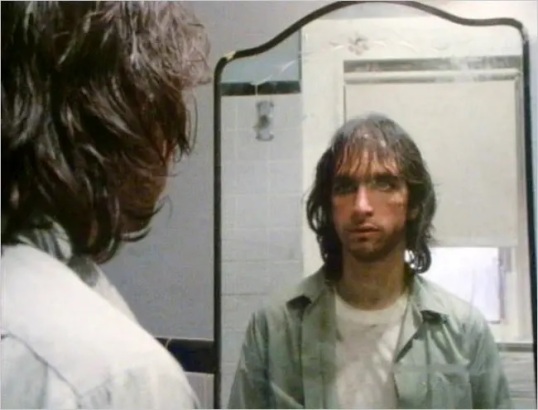
That was one of the takeaways that I got from watching the 1986 film, Combat Shock.  The film was shot on location on Staten Island and, indeed, it’s a grim viewing experience.  Frankie Dunlan (played by Rick Giovinazzo, the brother of the film’s director, Buddy Giovinazzo) is a Vietnam war vet who, having spent time in a coma as a result of his war injuries, has returned home to a country that doesn’t have much use for him.  He lives in a run-down and dirty apartment with his wife (Veronica Stork) and their gray, constantly-crying mutant baby.  (The baby’s mutation is explained by Frankie’s exposure to Agent Orange.)  Because Frankie has no skills, he can’t get a job.  Because he can’t get a job, he has no money and his wife keeps yelling at him to call his father.  But Frankie doesn’t want anything to do with his father, who was apparently a jingoistic racist and who currently believes that Frankie was killed in Vietnam.

(And perhaps Frankie was.  There’s a part of me that wonders if the whole film was meant to be Frankie’s end-of-life vision as he lay dying in Vietnam.)

The television at the apartment only show static but Frankie and his wife watch it anyways.  The milk in the refrigerator is expired but Frankie drinks it regardless.  Frankie gets a note announcing that he and his family are about to be evicted but he doesn’t seem to be particularly upset about it.  Frankie, who has the 1,000-yard stare of a man continually woken up by nightmares and the ever-present dirty stubble of a meth addict, is too trapped in the horrors of the past to fully comprehend the horrors of the present.

Leaving his apartment, Frankie wanders around the dirtiest and most depressing areas of Staten Island.  The buildings are abandoned.  Every wall is covered in graffiti.  Gangs roam the streets.  Frankie runs into a desperate drug addict who is later seen ripping open his arms so that he can sprinkle heroin into his flesh.  Outside an employment office, a mysterious blonde on a motorcycle looks at Frankie and appears to invited him to join her but Frankie refuses to move.  Inside the employment office, Frankie’s case worker speaks in non-sequiturs.  “Life is hot, and because life is hot, I must take off my jacket,” the case worker says while Frankie stares at him with a blank look on his face.

Frankie has visions and hears voices.  His flashbacks to Vietnam are filmed in haunting slow motion, all the more to make us wonder if he’s actually seeing what happened in the past or if he’s hallucinating an entirely different existence for himself.  Combat Shock is a horror film but it’s the horror of Frankie’s fractured mind.  Frankie served his country but now his country views him with disgust.  The film ends on a dark note, one that is not pleasant to watch but one that equally feels pre-destined.

Combat Shock is a film that is so grim and dark that it’s developed a semi-legendary reputation.  Watching the film, I respected the filmmaker for staying true to his dark vision and essentially refusing to compromise or let up in the least.  At the same time, I have to admit that I got a little bit bored with film’s nonstop darkness.  As a character, Frankie is not particularly compelling.  (The film has been frequently compared to David Lynch’s Eraserhead but Combat Shock has none of that film’s quirky humor and Frankie is nowhere near as sympathetic as Jack Nance’s Henry.)  The film succeeds by staying true to itself but, in the end, it’s not a film that most people will want to watch a second time.  And perhaps that’s the point.  Frankie may be too desensitized to be angry but the film is outraged at way the country treats men like Frankie, who carry the scars of serving their country but who have simply been pushed to the side by a society that doesn’t want to be reminded of the bad times.  Much like An American Hippie In Israel, Combat Shock is a film that demands that we stop pushing buttons and take care of each other.

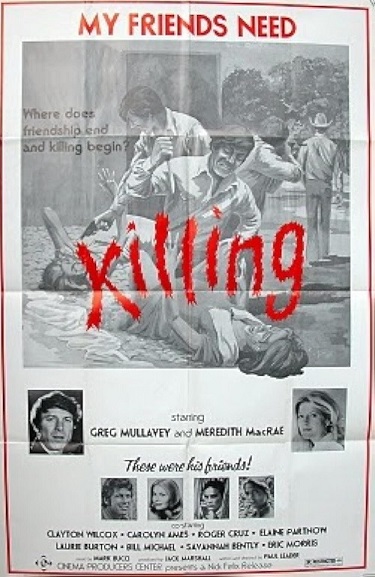
The TSL Horror Grindhouse: My Friends Need Killing (dir by Paul Leder)


At the start of 1976’s My Friends Need Killing, Gene Kline (Greg Mullavey) and his wife, Laura (Meredith MacRae) lie in bed together.  Gene can’t sleep.  He’s haunted by the sounds of gunfire and explosions and people barking out orders at him.  A Vietnam vet, Gene has been seeing a Dr. MacLaine (Eric Morris) for help with dealing with his wartime PTSD but it hasn’t done him much good.  Without telling Laura, Gene has been sending letters to the former members of his platoon, letting them know that he will soon be visiting them in each of their home cities.  Gene says that he’s just dropping by for a visit but the reality is that Gene has decided that his friends need killing.

Without telling his wife, Gene leaves home in the morning and heads to San Francisco.  While Laura is looking at old pictures of Gene and having flashbacks to their perfect wedding day, Gene is stalking the people with whom he committed an atrocity in Vietnam.  Like Gene, the former members of his platoon have struggled to adjust to returning home.  One lives in Texas, loves to hunt, and brags about how he never thinks about the war.  Another has found work as a trucker.  Another has a nice big house and a pregnant wife and still suffers from flashbacks of his own.  Perhaps the most tragic of Gene’s friends is Les Drago (Roger Cruz), who is now a performance artist and an anti-war activist and who recites Lady MacBeth’s “out damn spot” speech while discussing his activities during the war.

My Friends Need Killing is a short but intense movie.  It may only have a 73-minute running time and a portion of that running time may be taken up with filler but Gene pursues his mission with a relentless and ruthless determination that is ultimately very unsettling to watch.  As played by Greg Mullavey, Gene wanders through the film with the thousand-yard stare of a man who has truly snapped.  Years after the war, he can’t forgive anyone, including himself.  To him, it doesn’t matter that someone like Les returned from Vietnam and decided to dedicate his life to preventing another pointless war.  What matters to Gene is getting vengeance on those who he blames for his sins.  Even though the film makes clear that Gene’s actions are due to his experiences during the war, Gene himself never becomes a sympathetic figure.  He’s too vicious in his murders, even targeting the wife of one of his platoonmates.

Adding to the film’s unsettling and grim atmosphere is the film’s rather ragged editing.  Scenes begin and end abruptly, sometimes in mid-conversation.  Each murder is followed by a shot of an airplane landing in another city as Gene continues his mission.  Scenes of Gene having flashbacks are haphazardly mixed with scenes of Laura and Dr. MacLaine trying to figure out where Gene has disappeared to.  One is tempted to smile at the film’s score, which sounds more appropriate for a 70s cop show than a movie about a murderous vet, but even the score ultimately adds to the film’s off-center feel.  The score feels as out-of-place as the happiness of his friends does to Gene.  My Friends Need Killing ultimately feels like a film about a world that is spiraling out of control.  The film ends on a truly odd note, one that suggests that there is hope for the future, even if there’s no place for Gene in it.

Much like Bob Clark’s Deathdream, My Friends Need Killing suggested that mainstream America would never be ready to fully accept what happened in Vietnam.

The TSL Horror Grindhouse: I Dismember Mama (dir by Paul Leder)


Ugh.  It’s hard for me to think of any film that left me feeling as icky as the 1972 film, I Dismember Mama.  Seriously, who would have guessed that a film with a title like I Dismember Mama would be disturbing and offensive?

Zooey Hall stars as Albert, a puritanical young man who idealizes the Victoria Age, when “men were gentlemen and women were pure.”  Albert has tried to murder his rich mother three times for being “a whore,” and he’s now living in a minimum security mental hospital where he spends his time watching pornographic movies.  When Albert escapes from the mental hospital, he heads straight to his mother’s house.  His mother isn’t there but Alice (Marlene Tracy), the maid, is.  After raping and murdering Alice, Albert heads down to the living room where he meets Alice’s 9 year-old daughter, Annie (Geri Reischl, who would later take on the role of Fake Jan on the Brady Bunch Variety Hour).  Albert doesn’t know Annie but Annie instantly recognizes Albert from the pictures that his mom has up around the house.

Suddenly enchanted by Annie and her innocence, Albert lies and tells Annie that Alice has been taken ill and had to go see a doctor but she asked Albert to keep an eye on Annie until she got back.  (Is there a reason why everyone’s name starts with an A?  My ADD is going crazy just trying to type this up.)  Albert then takes Annie for a ride around town, telling her about how much he loves the Victoria era and eventually checking into a motel with her.  (Ewwwwww!)  When Albert murders a woman that he picked up at a bar, Annie runs away from the hotel and Albert, suddenly convinced that Annie is now a harlot, chases after her.  It all leads to a properly violent conclusion.  Say what you will about the film but the final five minutes make great use of slo mo of doom as Albert and Annie run through a mannequin factory in slow motion.

My favorite character in this film was the police detective played by Greg Mullavey.  When Albert’s liberal doctor (Frank Whiteman) argues that even Albert can be cured with the right amount of treatment, the detective just smirks and complains about how his tax dollars are being used “to baby murderers.”  Normally, I would argue that the doctor has a point but Albert is such a creep and his fixation on Alice is so disturbing that I was totally on the Detective’s side.  Whether he could be cured or not, Albert deserved a bullet in the head.

It’s a competently-made and well-acted film and Zooey Hall deserves a lot of credit for making Albert into an all-too plausible madman.  It’s also a thoroughly icky film, the type of film the features flashbacks to scenes of rape and violence that occurred mere minutes before.  This is one of those grimy films that leaves the viewer feeling as if they’re going to need to take multiple showers after watching.

The film is today is best remembered for the gimmicks that were used to promote it.  Theater patrons were given an upchuck cup, in case the film proved to be too intense for them.  And, of course, the film’s famous trailer featured people who had been driven insane by watching the film.

Director Paul Leder and Greg Mullavey would reunite for another grindhouse horror film, My Friends Need Killing.  Look for my review of that film tomorrow!

The TSL Horror Grindhouse: Blackenstein (dir by William A. Levey)


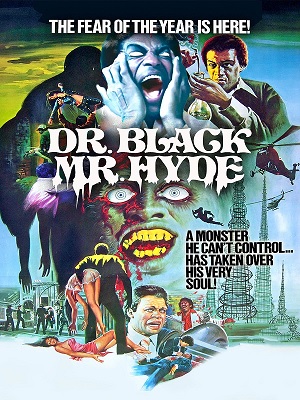
1973’s Blackenstein tells the story of Eddie Turner (Joe De Sue), a black man who served in Vietnam.  Unfortunately, while serving his country, Eddie stepped on a landmine and lost his arms and his legs.  Now back in Los Angeles, Eddie spends his days laying in a bed in a VA hospital, where he’s taunted by an orderly who, it turns out, is actually just upset because he wanted to join the army but he failed his physical.  Because this film was made on the cheap, Eddie’s limbless state is represented by continually having the covers of his bed drawn up to his neck.

Eddie’s girlfriend, Dr. Winifred Walker (Ivory Stone), is upset because Eddie is having a hard time adjusting to life in the States and, having lost the lower half of his body, Eddie has been rendered impotent.  She gets a job working with Dr. Stein (John Hart), a doctor who has down amazing things with DNA and RNA.  He lives in a castle-like mansion and he has a laboratory that is full of lasers and beakers that are labeled “DNA.”  Apparently, Dr. Stein can inject people with DNA …. don’t look at me like that, I didn’t write this movie …. and not only reverse the aging process but also help people regrow limbs.

Eddie is brought to the mansion to be Dr. Stein’s latest patient.  Unfortunately, Dr. Stein’s assistant, Malcomb (Roosevelt Jackson), has fallen in love with Winifred and is stung when she tells him that her heart belongs to Eddie.  Malcomb sabotages Eddie’s DNA injections so that Eddie, along with growing back his arms and his legs, also transforms into a turtleneck-wearing monster with a flattop.  Eddie spends his days in a coma and his nights stalking Los Angeles.

Blackenstein was released at the height of the blaxploitation boom, when filmmakers were reinterpreting classic genres with black actors.  Some of these films, like Shaft and Superfly, hold up very well and remain a part of the pop cultural landscape.  And others, like Blackenstein, would be largely forgotten if not for the strangeness of their title.  Blackenstein was clearly inspired by the success of Blacula, though it comes nowhere close to being as compelling as that film.

Blackenstein has more than a few problems.  The pacing is abysmal.  The plot requires a lot of smart people to do a lot of dumb things.  As opposed to other films based on Mary Shelley’s novel, the Monster is neither scary nor sympathetic.  Eddie Turner was played by a non-actor named Joe de Sue, who was hired because he was a client of the Frank Salteri, the criminal lawyer-turned-filmmaker who produced the film.  Joe de Sue rarely speaks and when he does, he turns his face away from the camera and it is fairly obvious that his dialogue was dubbed in after the scene was shot.  Ivory Stone and Roosevelt Jackson awkwardly deliver their lines about DNA and RNA in a tone that suggests that neither they nor the filmmakers were exactly sure what either one of those were.  John Hart is perhaps the most mild mad scientist in the history of horror cinema.

One could argue that there’s an interesting subtext to this film, with its scenes of a white scientist conducting a dangerous medical experiment on a black man who is not in a position to refuse.  But let’s not fool ourselves.  This film is not Blacula, with its title character being transformed into a vampire as punishment for standing up to Dracula’s racism.  Blackenstein had very little on its mind, beyond cashing in on the then-blaxploitation boom.  The title promises a certain over-the-top silliness but, ultimately, this film is way too boring for something called Blackenstein.

6 Trailers For The First Day Of Horrorthon


Today is the first day of our annual October Horrorthon!  In honor of our favorite time of the year, here is a special edition of Lisa Marie’s Favorite Grindhouse and Exploitation Film Trailers.

Enjoy and happy Horrorthon!

  1. House of Frankenstein (1944)

All of the great Universal monsters came together for this film from 1944!

2. House of Dracula (1945)

Everyone had so much fun during House of Frankenstein that it only makes sense that they would get back together a year later for House of Dracula!

3. Frogs (1972)

House of Frogs?  No, just ordinary but vengeful frogs.  Reportedly, this was one of Andy Warhol’s favorite films.

4. The Being (1983)

The frogs aren’t the only ones looking for revenge.

5. Waxwork (1988)

With all those monsters out there, perhaps it’s best to just hide out in the local wax museum….

6. Waxwork 2: Lost In Time (1992)

Seriously, the wax museum seems like the best place!

Happy October!  Happy Horrorthon!

The TSL Grindhouse: Trucker’s Woman (dir by Will Zens)


The 1975 drive-in film, Trucker’s Woman, opens with the tragic (and rather horrifying) death of Jim Kelly, a trucker who meets his demise when the breaks on his truck fail.  We watch as Jim is tossed back and forth inside the cab of his truck and, in fact, the film’s opening credits play out over freeze frames of Jim’s gruesome end.  Jim was a beloved member of the trucking community and his funeral is about as well-attended as a funeral taking place in a low-budget film can be.  Everyone is going to be miss Jim but fortunately, his son Mike (Michael Hawkins) is going to carry on the family business!

As Mike explains to his father’s permanently soused friend, Ben Turner (Doodles Weaver), he’s giving up a lot to take over for his father.  Mike is dropping out of college and sacrificing his dream of becoming a philosophy professor.  Of course, Mike appears to be nearly 50 so, if he still hasn’t gotten that degree, it’s probably for the best that he went ahead of gave up on that dream.  From what little we saw of Jim, he appeared to be 50 as well so you have to kind of wonder if Mike is actually his son.  My theory is that Mike was just a drifter who happened to see a funeral occurring off the side of the road and decided to cash in.

Anyway, Mike is soon driving a truck and discovering that his boss, Fontaine (Jack Canon), is a bit of a jerk who favors certain truckers more than others.  Mike also meets Fontaine’s daughter, Karen (Mary Cannon), at a roadside bar and ends up following her back to her motel, pounding on her door until she gets out of the shower and answers it while wearing a towel, and then announcing that he’s going to be accepting her offer to spend the night with her….

So, you can probably already guess what the main problem with this film is.  At best, Mike is a jerk.  At worst, he’s an alcoholic misogynist who breaks into a woman’s motel room, demands sex, and is then offended when she leaves the next morning without telling him where she’s going.  The film tries to portray Mike as being a strong, independent man who works hard and refuses to be ordered around.  However, he comes across less like Burt Reynolds in Smokey and the Bandit or Kris Kristofferson in Convoy and more like one of those truckers who eventually gets caught with a dead body in the back of his cab.  Everything about Mike just screams homicidal drifter.  Not even the title character from Henry: Portrait of a Serial Killer would have accepted a ride from this guy.

Anyway, Mike and Ben attempt to discover who sabotaged the brakes on old Jim Kelly’s rig and since only a mechanic could have done it, suspicion immediately falls on Diesel Joe (Larry Drake) because he’s the only mechanic in the film!  And who paid Diesel Joe to sabotage the brakes?  Well, there’s only person in the film who has any money so it looks like it’s time for Ben to rally the other truckers and Mike to toss a bunch of people into Fontaine’s pool.

Trucker’s Woman does not work as a thriller or a mystery or a comedy.  It does work as a time capsule of the 70s.  Seriously, look at all of those wood-paneled rooms!  Look at all of those plaid jackets!  Seriously, there’s enough plaid in this film it could have just as easily been called Forever Plaid.  Filmed on the highways of South Carolina, Trucker’s Woman is a film the epitomizes an era but there’s plenty of other films that do the exact same thing and don’t feature an alcoholic misogynist as the lead character.  (Seriously, Rubber Duck would have tossed Mike Kelly out of a moving truck.)

Finally, Trucker’s Woman is infamous in some circles for featuring a random shot of a pepperoni pizza sitting on a wooden deck.  It’s a shot that pops up out of nowhere and has nothing to do with the rest of the film.  It’s thought that the shot was included as an experiment in subliminal advertising and I will admit that my sister and I did order a pizza after this film ended.