Every film about the Son of Sam and his reign of terror in New York City inevitably faces one huge question.
What to do about the dog?
Before he started blaming Satanists, David Berkowitz claimed that a dog told him to kill. Most people who have made films about the Son of Sam have been content to just have a dog barking in the distance. Spike Lee, however, had the guts to actually have a dog trot into Berkowtiz’s apartment and start yelling at him.
From 1999’s Summer of Sam:
The dog is voiced by John Turturro. I have to say that, for such an evil creature, it really is a cute dog.
Since today is Claudio Fragasso’s birthday, my first instinct was to select the famous “OH MY GAAAAAAAWWWD!” scene from Troll 2 as today’s horror scene that I love. However, I then remembered that I’ve already shared that scene a few times on this site.
So, instead, here’s a different scene from Troll 2. In this scene, Drew visits the town of Niblog and stops by the general store, where he’s pressured into drinking the poisonous Niblog milk. The milk will eventually turn Drew into a plant so that he can then be eaten by the town’s goblins. The goblins are all vegetarians but apparently, it’s okay to eat meat that’s been transformed by evil magic. It’s kind of weird. Personally, I think the Goblins are kind of hypocritical. They remind me of this girl I went college with who we’ll call Bree. Bree was vegan and would never hesitate to tell you that she was better than you. And yet, she still wore leather shoes. So, screw her, screw her pathetic attempts to steal everyone’s boyfriend, and screw the goblins.
Anyway, there’s two ways of looking at this scene. On the one hand, it’s an oddly acted and oddly paced scene in a film that was full of odd performances and odd directorial choices. On the other hand, it’s so strange and off-center that it contributes to the film’s dream-like atmosphere. Since today is Fragasso’s birthday and I tend to always assume the most positive explanation to be the correct one, I’m going to go with the second possibility.
Today’s horror scene that I love (and the inaugural entry in this year’s collection of Horrothon scenes) comes from the 2010 film, Sharktopus! And here it is:
A lot of people have made fun of this scene over the years but put yourself in the shoes of this unfortunate painter. Here you are. You’re just doing your job. You’re painting the side of a boat. It’s not glamorous work. It probably doesn’t pay very well. But you’re doing your best and you’re collecting a paycheck and you’re taking care of your family. It hasn’t always been easy. When you first got out of prison, you never thought you’d be able to find a job. Everyone wanted to do a background check. Your parole officer kept busting your ass. You were tempted to go back into a life of crime. You kept thinking about the old crew and wondering if they were still hanging out on the street corners, murking and doing time. But then the boat painting people said, “We know you’ve had some problems. But you’re damn good with a paint brush.”
And then suddenly, this happens. You wanted to die surrounded by your family. You want your last words to be, “I did okay, didn’t I?” Instead, you’re getting grabbed by an shark/octopus hybrid. Who wants to die that way? “Oh no! Not like this!” is one of the most honest lines in the history of horror cinema. It perfectly captures the existential dread that one undoubtedly feels while being pulled into the ocean by a sharktopus.
Since this weekend is going to see both the release of The Many Saints of Newark and the start of our annual October Horrorthon, I thought that this would be an appropriate time to share a creepy scene that I love from The Sopranos.
The Sopranos was well-known for its dream sequences. For me, this dream from the season 4’s Calling All Cars is one of the best of the series. It’s full of menace and ominous atmosphere, from the minute we see Tony being led to the house by the deceased Ralphie. And then, when that mysterious shadow appears on the staircase — AGCK!
I’ve read online speculation that the woman in the shadows was meant to represent Tony’s mother, who will be played by Vera Farmiga in The Many Saints of Newark. Young Tony Soprano, meanwhile, will be played by Michael Gandolfini, the son of the late (and missed) James Gandolfini.
I look forward to watching (and, hopefully, reviewing) The Many Saints of Newark on October 1st!
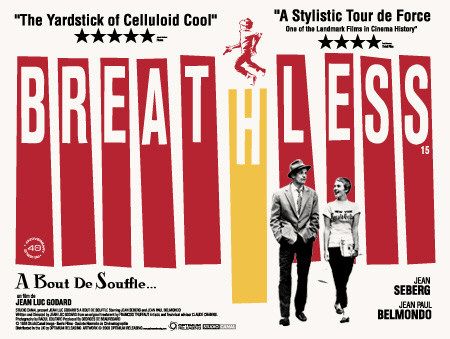
I was saddened to learn of the death of French actor Jean-Paul Belmondo earlier today. He was 88 years old and still an international icon of movie star charisma at the time of his death.
Belmondo spent the majority of his career in France, where he was one of the early faces of the New Wave and also a prominent action star, famed for doing his own very dangerous stunts. In America, he was best-known for his starring turn in Jean-Luc Godard’s Breathless. In Breathless, Belmondo was the perfect existential outlaw, living life day-by-day and obviously doomed but still so incredibly magnetic and stylish.
In tribute to Belmondo, here is a scene that I love, the final moments of Breathless.
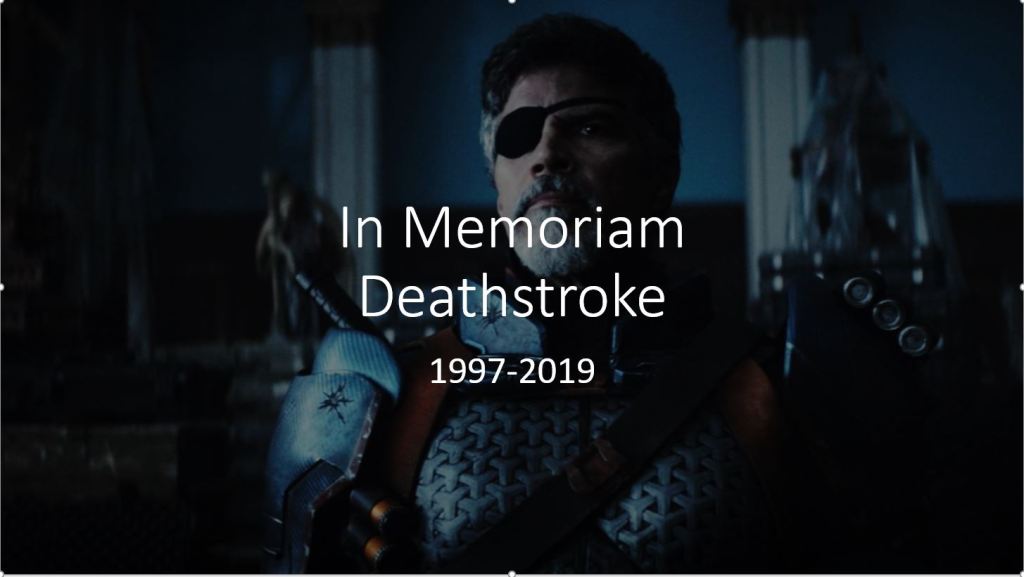
“Nightwing”- The final boss battle. Titans v Deathstroke! Fight!
The episode opens with a Cadmus infomercial. They have mind mushed Conner and now he is a mindless obedient super-soldier. Cadmus will begin phase II of their evil plan at a county fair. They’re food prices are already evil. Gar goes from eating a sno-cone at the fair to a hungry Tiger.
Dramatization:
LIKE THIS BUT WITH MORE EATING PEOPLE AND HE’S GREEN
Dawn, Raven, Wondergirl, and Starfire respond, but during their commute- Deathstroke -badasses and attacks. Just as he’s about to kill everyone-
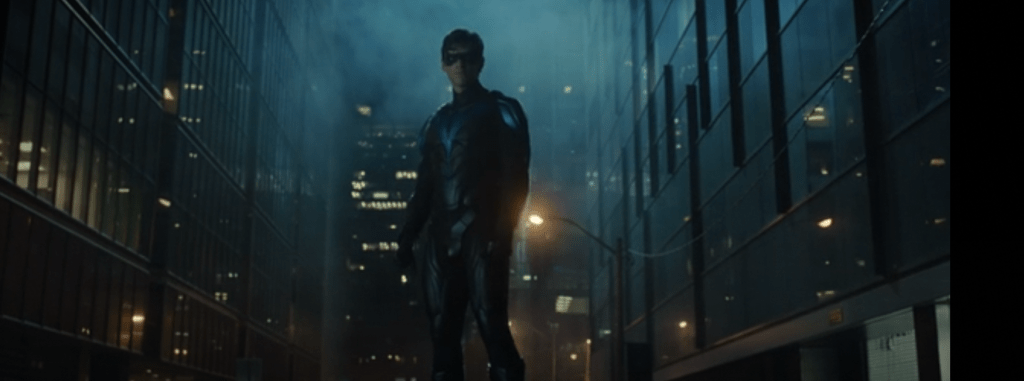
Nightwing enters!
Nightwing!!!!
Nightwing Vs Deathstroke! Fight!
So sad, Rose joined up with the Titans. Kids today. Rose goes all Patricide and my favorite Villain goes down. Esai Morales is truly a national treasure. Such an amazing performance. You couldn’t help but see his POV. He was moral within his form of Bushido. His son was lied to and manipulated by the Titans. Deathstroke’s humor and snark was just great!
I wish that this final boss battle had gone on longer and maybe even had him escape. It’s so hard to see this character gone.
We return to the county fair. Gar is apparently never full. I always get tired after Fair Food. Conner easily dispatches to pesky kitty.
Now, it’s Conner V Titans! FIGHT!
Cadmus is doing an auction for the rights to own Conner. It’s identical how Sotheby’s runs. Bruce intercedes and cancels the bidding and blocking communication.
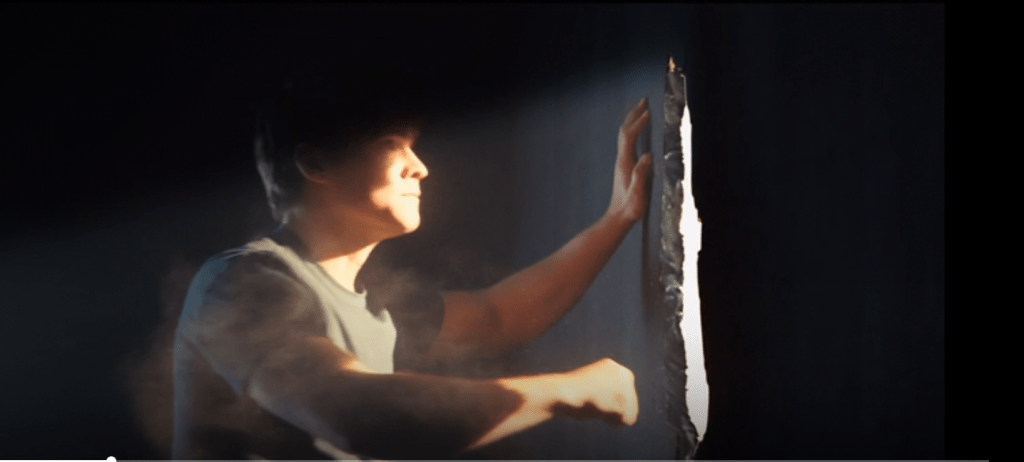
To defeat Conner, the Titans must work together. Rachel gets Dick inside Conner’s mind and chats/redecorates to save him. Not just for the return of Conner’s mental health, but it really opened up the room.
They end up at a virtual Kansas and Conner’s all normal again. Everything is all better, except for the powerlines……
Poor Wondergirl stops the power tower from falling on everyone and….she dies. UGHHH! Really?! She’s my favorite. Raven thinks she can bring her back to life. PLEASE DO!!!
The ending scene between Bruce and Dick put their past to rest. I liked it.
Hank and Dawn’s last scene; you can see the strength in Dawn and weakness in Hank. He wants to get back together and she shoots him down and that’s probably for the best, BUT she’s open to fighting as Hawk and Dove.
The episode ends with an awkward dinner and the beginning of a new mission – a crime has begun. The Titans are back.
The episode ends with Blackfire taking over a mom. Bummer. Those poor kids are all alone?!
Question: Dick and Conner are wanted fugitives. Dick’s in his hometown at his last known residence. Did the F.B.I. and US Marshals get really lazy. I’d find him in 15 minutes.
Monday would have been the 90th birthday of Tom Laughlin, the actor who revolutionized independent American cinema through his Billy Jack films.
In four films, Laughlin played Billy Jack, an American Navajo, a former Green Beret, a veteran of the Vietnam War, a hapkido master, and a man who just protects children and other living things. When he first appeared in 1967’s TheBornLosers, he was protecting a woman from bikers. In 1971’s BillyJack, he was protecting the Freedom School from ignorant townspeople. In 1974’s TheTrialofBillyJack, he was …. well, in that film, Billy Jack did a little bit of everything but the National Guard still ended up destroying the Freedom School. Finally, in 1977’s BillyJackGoesToWashington, Billy was appointed to the United Stated Senate because what else are you going to do with someone who has killed a tremendous amount of people over the course of three films?
(Of course, in Senator Jack’s defense, they were all bad people.)
Laughlin not only starred as Billy Jack but he also directed all four of the films and, starting with BillyJack, he also handled the distribution of them. A huge box office hit, BillyJack is considered to be a seminal counter culture film. The other three films are a bit less acclaimed and TrialofBillyJack is often cited as one of the most pretentious and self-indulgent films ever made. But, regardless of their individual artistic merits, all of the Billy Jack films share an appealing mix of sincerity and silliness. Laughlin was a good actor and, visually, he was a stronger director than he was often given credit for. Some of the shots in the original Billy Jack are breath-taking. At a time when even self-styled progressive films still portrayed women in the most condescending and demeaning way possible (check out GettingStraight or R.P.M., if you dare), the BillyJack films were as much about Jean (played by Delores Taylor, Laughlin’s wife and creative partner), the founder of the Freedom School, and her beliefs, as they were about Billy Jack and his struggles to accept pacifism. If nothing else, the Billy Jack films featured actual conversations and debates about actual ideologies and philosophies, as opposed to the usual shallow Hollywood politics. Unfortunately, Laughlin was also a heavy-handed storyteller and a terrible editor. TheTrialofBillyJack goes on for three hours.
And yet, of all the BillyJack films, TheTrialofBillyJack is my favorite. It’s just so weird that it’s hard not to like it. It’s a film that doesn’t really work but, at the same time, you can’t help but appreciate all the effort that was put into it. Whatever else you might be able to say about him and his films, it’s obvious that Tom Laughlin truly did think that the movies could make a difference. There’s an aching sincerity to Laughlin’s work that pretty much cannot be found in the majority of today’s films.
In honor of Laughlin’s birthday and his legacy, here’s a scene that I love from TheTrialofBillyJack. In this scene, Billy goes on a vision quest and experiences the Three Levels. I would be lying if I said I really followed much of the logic in the scene but at least we get to see Billy hit a hippie professor. Billy also smacks Jesus, which isn’t cool but Jesus shows exactly how to handle that type of belligerence and hopefully, he provides a lesson for us all.
Learn about the Three Levels, with Billy Jack. And be sure to spare a thought for the hard work of Tom Laughlin.
Not all scene that we love come from the movies. Some of them come from real life!
Behold, from a Cubs/Pirates game, the worst play in the history of baseball!
It’s the top of the third. There’s a runner on second base. There are already two outs. All the Pirates have to do is get one more out and the inning ends. So, what happens? When Javy Baez gets a hit, the shortstop scoops up the ball and throws it to first baseman Will Craig. Instead of simply going back a few steps and stepping on first, Craig runs after Baez, trying to tag him with the ball. This gives the baserunner time to run from second base all the way to home., which he crosses safely because Craig is so busy chases Baez that he doesn’t throw the ball to the catcher in time. The catcher then makes a bad throw of his own that gives Baez time to then make it to the first base and then all the way around to second. (At first, it looked like he might even have been able make it to third.) That’s a run and a double on what should have been an easy out! At the end of the clip, you can see that not even Baez can believe that he’s actually safe on second.
It’s all so amazing that it is easy to overlook that Will Craig is not the only person who made a mistake. If second baseman Adam Frazier had gone over to cover first while Craig inexplicable took off after Baez, he would have been in a position to make the play when the catch threw the ball back to first.
It’s wild moments like this that make me love baseball!
Today is the 124 anniversary of the birth of Frank Capra and, in honor of this day, here’s a scene from one of my favorite films of all time, 1946’s It’s A Wonderful Life. In this wonderfully acted and directed scene, George Bailey tells off Mr. Potter, for the first but certainly not the last time:
The great Orson Welles was born 106 years ago today, in Kenosha, Wisconsin. Orson Welles was one of the greatest directors of all time, a showman and an artist who changed the way that people watched and thought about films. He was the visionary who helped to usher in the era of modern filmmaking and who proved that movies could be art and Hollywood never forgave him for it. Merely seven years after the release of Citizen Kane, Orson Welles found himself as such a pariah in the American film industry that he relocated to Europe. There, he made some of his best films though few of them would be fully appreciated when first released.
(Indeed, there still seems to be the strange need among some to try to diminish Orson Welles’s talents and achievements. Just last year, Mank tried to deny him the credit that he most certainly deserved for Citizen Kane. Interestingly enough, David Fincher claimed that his father’s original script portrayed Welles even more negatively than Welles came across in the finished film. One has to wonder about the motives of anyone who would slander Orson Welles while deifying Upton Sinclair.)
1965’s Chimes At Midnight is one of Welles’s best. Filmed in Spain, Chimes at Midnight is combination of five of Shakespeare’s plays, primarily Henry IV, Part 1 and Henry IV, Part 2, but also Richard II, Henry V, and The Merry Wives of Windsor. Welles cast himself in the role of Falstaff, enjoying life while educating the young Prince Hal in the ways of the world. When Prince Hal becomes Henry V, Falstaff attends his coronation, just to be rejected. The new king has new place in his court for someone like Falstaff. Was Prince Hal perhaps a stand-in for the many filmmakers who claimed to have been inspired by Welles’s work but who still refused to help Welles when he later came to them for help? Perhaps.
In the scene below, Falstaff is rejected by the new king. It’s a heart-breaking moment and one that features some of Welles’s best work as both an actor and a director.



 Through the Shattered Lens