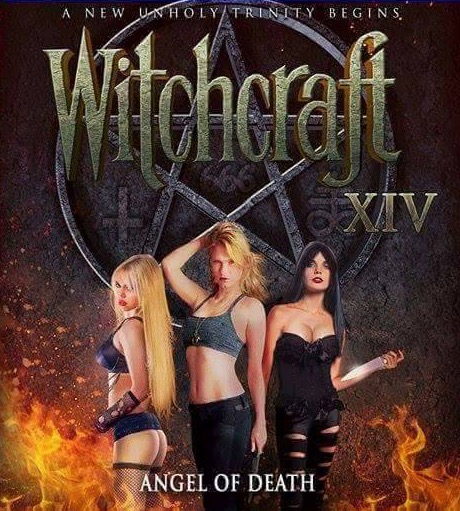
Cinemax Friday: Witchcraft 14: Angel of Death (2016, directed by David Palmeiri)


Eight years since his last appearance, warlock-turned-attorney Will Spanner is back!

A record eight years passed between the release of Witchcraft 13 and this installment, enough time for the franchise to go from being a cheap joke to something that people looked back on with nostalgia.  All of the your old favorites are back, with the exception of Kelly.  This time, Berna Roberts plays Lutz and Leroy Castanon plays Garner.  Will is played by Ryan Cleary, who has apparently not only come to terms with his warlock heritage but who is also now wearing guyliner.

There’s a series of deaths in Los Angeles, all involving people who know and who have displeased Rose (Molly Daughtery).  Rose is a witch but doesn’t realize it.  When she discovers that her boyfriend is cheating on her, she gets so angry that her powers destroy not only her boyfriend but also the woman that he was cheating with.  With people dying around her, Rose is starting to catch on that she might be a witch and she’s concerned about it.  Samuel (Jeremy Sykes) is the nefarious owner of a yoga studio who wants to use Rose’s powers for his own evil ends.  He sends a coven of witches to recruit her.  It’s all a part of another stupidly complex ritual, this one designed to release the Angel of Death from Hell.  As usual, it falls to Will to prevent the ritual.

Despite the eight year gap between the last chapter and Witchcraft 14, not much has changed as far as the Witchcraft movies are concerned.  The special effects are cheap, the nudity is frequent, and the plot has so many holes that the Angel of Death could probably just slip through one of them and save Samuel a lot of trouble.  The main thing that Witchcraft 14 does have going for it is that it’s more intentionally comedic than some of the previous Witchcraft films.  Samuel may be a Satanist but he and his yoga-based coven are also the epitome of almost every cliché about spacey Californians.  Roberts and Castanon also have good comedic timing as Lutz and Garner. As for Ryan Cleary, he sleepwalks through the role of Will but Lutz and Garner actually get more screen time than he does.

Despite the 8-year gap between installments, Witchcraft 14 is a typical Witchcraft film, just with more intentional laughs.  Those who have nostalgia for the series will probably enjoy it.  Everyone else will just wonder how they could have possible made 16 of these films.
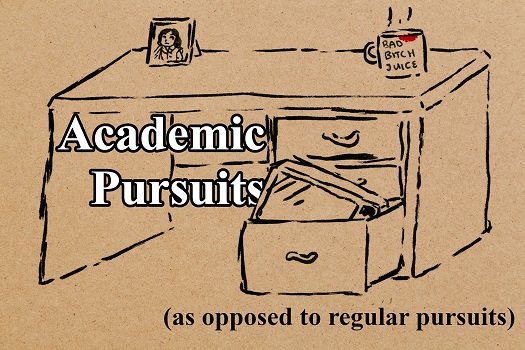
Game Review: Academic Pursuits (as opposed to regular pursuits) (2020, ruqiyah)


This game is an entrant in the 2020 Interactive Fiction Competition.  All of the entries can be browsed and played here.

You have just received a position in a prestigious university’s architecture department.  As was mentioned in your acceptance letter, it’s a role that you can “sink your teeth into.”  You’ve just arrived at your office, which is pretty bare.  Someone even took the curtains and the chair.  You’ve got plans for your new job and one colleague in particular but before you can worry about any of that, it’s time unpack.

Academic Pursuits in a moving-in sim, where the challenge is to not only find an appropriate place for all of your things but also to give your office the right feel.  Will you make you office feel academic or will you make it feel ominous?  While you’re unpacking, you can also examine each object and, even more importantly, think about each object.  Gradually, your backstory and your reasons for taking the position will be revealed.  Let’s just say that you’re more than just an academic looking to enlighten young minds.  How you decorate your office and what you decide to keep will also determine the future of both your career and your relationship/rivalry with another professor.

Academic Pursuits a simple but satisfying game.  I especially liked the way that the office changed depending on what you threw away and what you actually put on display.  Because there’s so many different ways to unpack (and yes, you do have the option to throw almost everything away), this is a game that can be played and replayed several times.

You can play it here.

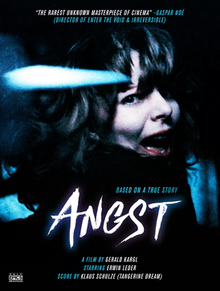
International Horror Film Review: Angst (dir by Gerald Kargl)


The 1983 German film, Angst, is one of the most disturbing films that I’ve ever seen.  It tells a thoroughly unpleasant story about a man who is truly worthy of hate and yet it’s so well-made that, once it starts, it’s nearly impossible to look away, even though you may want to.

Erwin Leder plays the role of K., a young man who, when we first see him, is shooting a random elderly woman.  K. is arrested for that crime and, over a series a still photographs, we listen as a dispassionate voice-over fills us in on the details of K.’s life.  Like a lot of serial killers, K. was not wanted by his parents.  He was abused by his mother, his grandmother, and everyone else that he met in life.  He spent years in and out of prison.  Though he claimed that he shot the elderly woman on impulse and that he didn’t really know what drove him to the act, the authorities still decide that the murder was a robbery gone wrong.  K. goes to prison for ten years and, we’re told, he’s a model prisoner.

Eventually, K. takes over the narration.  He tells us that he’s spent ten years pretending to be reformed, fantasizing about the moment that he’s released and once again free to kill.  When K. finally is released from prison, no one is there to meet him.  He has no family or friends.  A trip to a diner, in which he’s eyed suspiciously by everyone as he rather animalistically eats a sausage, leaves him even more determined to find people to kill.  After an unsuccessful attempt to strangle a taxi driver, K. comes across a secluded house.  The house is owned by a woman and her two adult children, one of whom is disabled.  K. breaks into the house and …. well, things go to Hell.

As I said, Angst is not a pleasant film to watch.  How hateful is K?  Listen, I’m against the death penalty.  I’ve signed petitions opposing the death penalty.  I believe that when we celebrate the death of even the worst people, we sacrifice a bit of our soul.  That said, if Angst ended with K. going to the electric chair or being shot in the back of the head by some anonymous execution, I wouldn’t have shed a tear.  What makes K. such a terrifying monster is that he’s a very real threat.  He’s not some sort of paranormal creature.  He doesn’t have any supernatural powers nor is he motivated by some sort of esoteric belief.  Instead, he’s a man with a traumatic childhood and an unending obsession with killing.  The film offers us no easy escape when it comes to considering K. and his actions.  We can’t just shrug him off as just being another horror movie villain.  Instead, he’s the type of person who is probably walking the streets right now.  Angst left me wondering if I’ve ever walked past a murderer without even realizing it.

Angst is a well-made film.  In fact, there are times when you kind of resent how well-made it is.  If it was just some cheap serial killer flick with fake blood and a boom mic occasionally slipping into view, it would be a lot easier to dismiss the film.  Instead, the film plays out almost like a documentary.  Whether he’s leaving the prison or staring at a potential victim or running around the house, the camera often holds K. in a tight close-up, forcing us to watch as the madness plays across his face.  Later, when K. is attempting to steal a car, the camera views him from above, putting us in the position of a deity who is looking down upon K. and his actions and perhaps wondering how the world could have gone so wrong.

Angst is an antidote to all those films that portray serial killers as being witty and clever antiheroes.  There’s nothing particularly witty or clever about K.  When he succeeds at his crimes, it’s not due to him being particularly smart or coming up with an elaborate plan.  It’s just that most people are in denial about the existence of men like K.  He uses that to his advantage.

Angst is somewhat legendary for having been banned in a number of countries when it was first released.  It is a totally disturbing film and I don’t necessarily recommend it to the easily triggered.  That said, it’s also a remarkably well-made film.  For better or worse, it sticks with you.

4 Shots From 4 Sam Raimi Films: The Evil Dead, Evil Dead II, A Simple Plan, Drag Me To Hell


4 Shots From 4 Films is just what it says it is, 4 shots from 4 of our favorite films. As opposed to the reviews and recaps that we usually post, 4 Shots From 4 Films lets the visuals do the talking.

Today, we wish a happy birthday to the one and only Sam Raimi!

4 Shots From 4 Sam Raimi Films

The Evil Dead (1981, dir by Sam Raimi)

Evil Dead II (1987, dir by Sam Raimi)

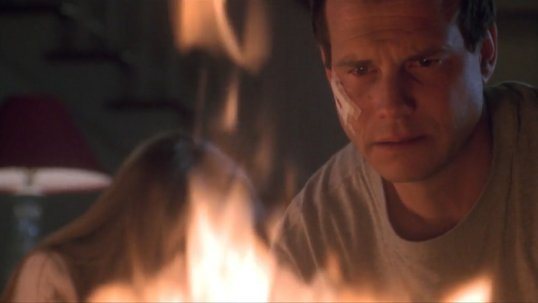
A Simple Plan (1998, dir by Sam Raimi)

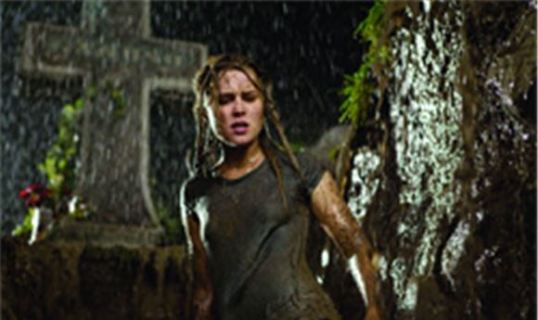
Drag Me To Hell (2009, dir by Sam Raimi)

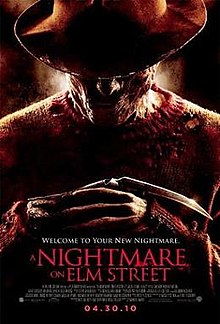
Horror Film Review: A Nightmare on Elm Street (Samuel Bayer)


“Hey, you guys!  The 2010 remake of A Nightmare on Elm Street is on TV!”

“Alright!  I NEVER MISS A ROONEY MARA HORROR MOVIE!”

Indeed, way back in 2010, there a lot of hype accompanying the release of the remake of A Nightmare on Elm Street.  It came out at a time when a lot of classic horror films were being rebooted for no particular reason.  Halloween got a reboot.  Friday the 13th got a reboot.  Texas Chainsaw Massacre has gotten a reboot.  So, it was just kind of expected that Nightmare on Elm Street would get a reboot, bringing the story into the modern age and making the story less problematic and blah bah blah.

And yet, for all the hype that accompanied the Nightmare on Elm Street reboot, it was pretty quickly forgotten.  If I remember correctly, it failed to live up to box office expectations and, as a result, there was never a sequel to this reboot.  Jackie Earle Haley never got a second chance to play Freddy Krueger and, to be honest, that’s probably for the best.  Haley’s a great actor who deserves better than to be typecast as the actor who played the second best version of Freddy Krueger.  No matter how good a performance Haley could have given in any of the hypothetical sequels to the Nightmare reboot, he would have been overshadowed by Robert Englund’s definitive interpretation of the character.

Today, the movie seems to be best remembered as one of the films that Rooney Mara made before she was cast in the title role of David Fincher’s rehash of The Girl With The Dragon Tattoo.  Mara plays the role of Nancy, the sleep-deprived teenager whose friends are all having nightmares and dying in various grotesque ways.  In Nightmare on Elm Street, Rooney Mara is even more boring than usual but then again, the same can be said of just about everyone else in the movie, with the exception of Jackie Earle Haley and Clancy Brown.  The majority of the actors just go through the motions.  It’s as if they decided that, since they were appearing in a horror movie, they didn’t really have to make any sort of effort to do anything interesting with their characters.  One need only compare the performances of Heather Langenkamp and Rooney Mara to see why the original Nightmare On Elm Street remains a classic while the remake has been forgotten.

Of course, another reason why the reboot has been forgotten is because it’s not really that scary.  The original Nightmare is still scary.  The original can still give you nightmares.  Robert Englund’s performance still holds up.  The death of Tina is still terrifying.  The scene where Nancy looks at the gray streak in her hair and says that she looks like she’s in her 20s is still funny.  Nightmare on Elm Street still holds up.  The reboot, however, falls flat in the scares department.  I think part of the problem is that the dreams are too obvious in the reboot,  In the original, the waking world would segue so effortlessly into the dream world that you were always kept off-balance.  In the remake, the dreams are too easy to spot and they’re too dependent on CGI to be convincing as a actual nightmares.

The remake does do one interesting thing.  There are several scenes in the film that seem to be designed to hint that maybe, in life, Freddy was actually innocent of the crimes for which was accused and that he was just set on fire because he was a convenient scapegoat.  That’s an intriguing idea and it certainly would have brought a whole new dimension to Freddy and his quest for revenge.  Just imagine how much of a mind-screw the film would have been if it had been revealed that Freddy had actually been framed by one of the same adults who later set him on fire.  Unfortunately, after making you think that the movie might actually do something unexpected, the film then reveals that Freddy actually was guilty and the whole story becomes a bit less interesting.  Revealing that Freddy was just a somewhat slow handyman who was wrongly accused would have brought some subversive life to this film but this reboot has no interest in being subversive.

Ignore the remake.  Watch the original.

Horror on the Lens: Attack of the Crab Monsters (dir by Roger Corman)


For today’s horror on the lens, we have the 1957 science fiction film, Attack of the Crab Monsters!

About a month ago, I watched this film along with Patrick Smith and all of our friends in the late night movie gang.   To be honest, everyone else seemed to enjoy it a lot more than I did.  It was a fun little movie but … well, maybe I was just having a bad night.

Here’s why you should take 62 minutes out of your Saturday and watch Attack of the Crab Monsters on the Shattered Lens.  First off, it’s a Roger Corman film and anything directed by Roger Corman automatically needs to be watched.  Secondly, it’s about giant crabs that communicate through telepathy.  And when was the last time you saw that!?

(“Last night,” someone in the audience shouts, “as the sun went down over the crab-covered beaches of Denmark!”  I pretend not to hear.)

Anyway!  Here, for your viewing pleasure, is Attack of the Crab Monsters!

Horror On TV: One Step Beyond 1. 16 “The Burning Girl” (dir by John Newland)


When I first started searching YouTube for episodes to use in this feature, I came across quite a few episodes of an old black-and-white TV show called One Step Beyond.  Running for three seasons (from 1959 to 1961), One Step Beyond was hosted by John Newland.  Every week, Newland would tell the audience about some sort of possible paranormal phenomena.  Then, a dramatization of a “real” event would be shown and occasionally, the show would end with Newland interviewing the real people whose story we had just watched.

To me, that all sounds like a lot of fun.

The 16th episode of One Step Beyond was called The Burning Girl and it dealt with a teenage girl who, whenever she got upset, could apparently cause fires to spontaneously erupt.  It was written by Catherine Turney and directed by John Newland himself.

It was originally broadcast on May 5th, 1959 — presumably long before Stephen King even had the idea to write about a girl named Carrie.