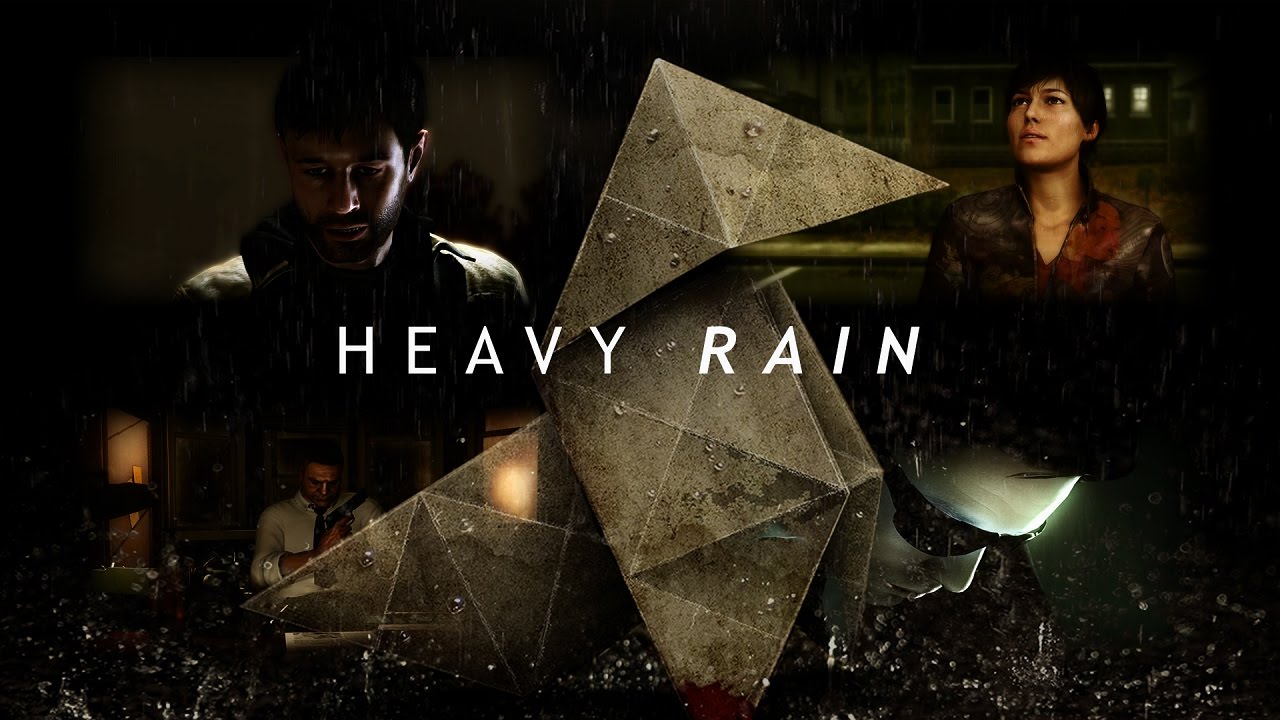
Retro Game Review: Heavy Rain (2010, Quantic Dream)


When it comes to Heavy Rain, it seems that there are two schools of thought.

Some people consider it to be one of the most important and ground-breaking games ever developed, a challenging mystery where nearly every decision that you make will effect what happens next in the game.  Unlike other games, there’s no easy do-overs in Heavy Rain.  If you get one of the four playable characters killed, the game will continue without them.  At a time when people had just started to get bored with games that featured a handful of endings, Heavy Rain revolutionized the entire concept with not just a good and a bad ending but instead with over 20 possible endings.  Your goal is to both discover the identity of the Origami Killer and also to save the life of little Shaun Mars before he drowns in a cage.  Fail and the chances are that the last thing the game will show you is an image of the flooded cage with Shaun nowhere to be seen.

Other people consider Heavy Rain to be a game where the main goal is to get Madison Paige naked as many times as possible.

Madison

Madison

Madison is the photojournalist who, suffering from insomnia, checks into a cheap motel and happens to meet Shaun’s father, Ethan.  Madison seems to spend the entire game either undressing or getting threatened by men who want her to undress.  If the player chooses, Madison and Ethan can make love in his hotel room.  The bra removal mini-game is actually one of the more challenging parts of Heavy Rain.  For the record, it is possible to play the game without Madison taking a shower, stripping for a club owner, having sex with Ethan, or even getting attacked by the crazy doctor who repeatedly tries to stab her in the crotch with a surgical tool.  It’s possible but I doubt many players have done so.
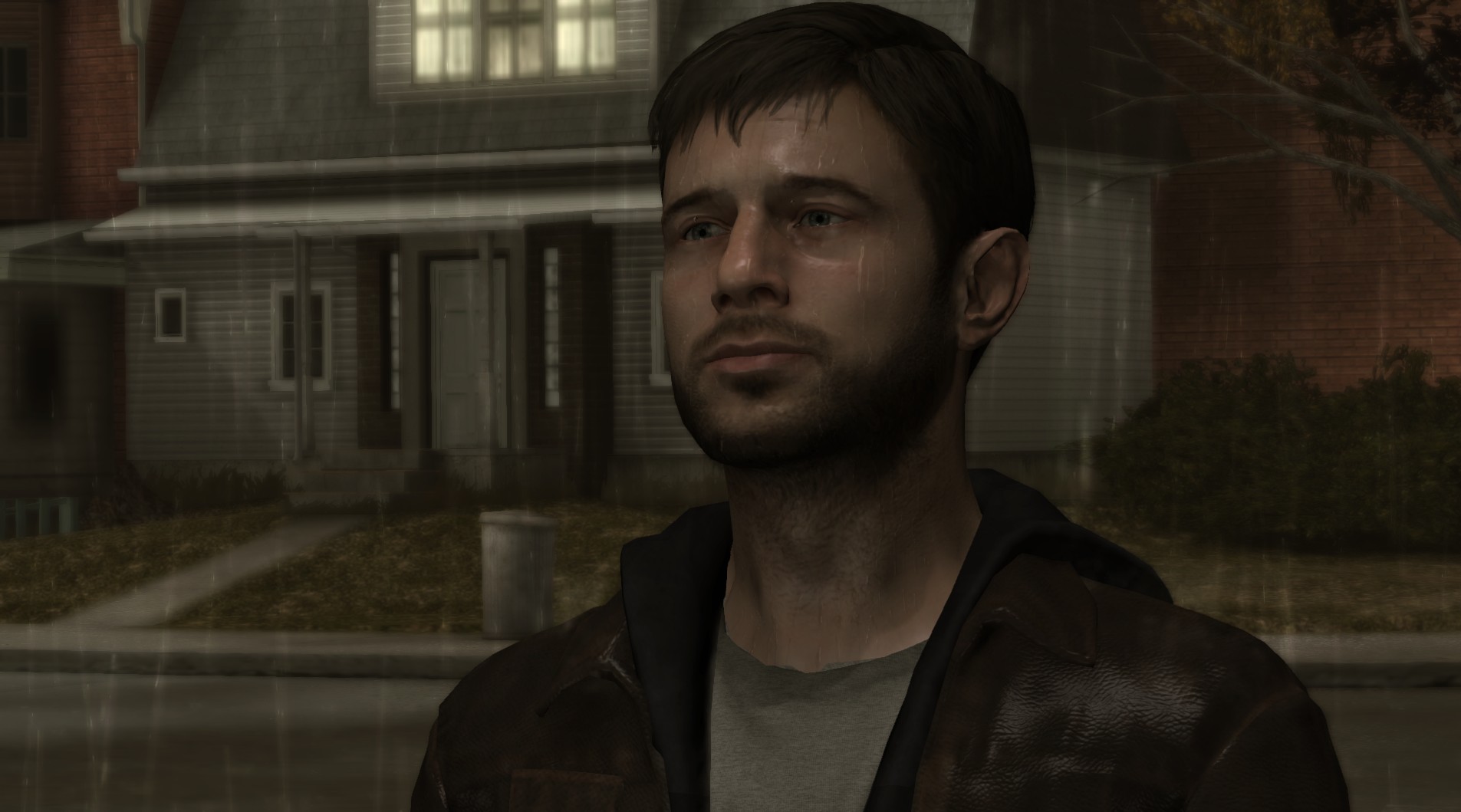
Ethan


How does Heavy Rain hold up after 9 years?  Surprisingly well.  The game has its flaws.  There’s the infamous and much parodied scene where Ethan searches for his son in a mall while calling out his name in a flat monotone.  Quantic Dream is a French company and, when you play the game, it is obvious that some of the voice actors were more comfortable with the English language than others.  But the the game’s rain-soaked and doom-heavy imagery all hold up well and the multiple endings make this a game that’s worthy of multiple replays.
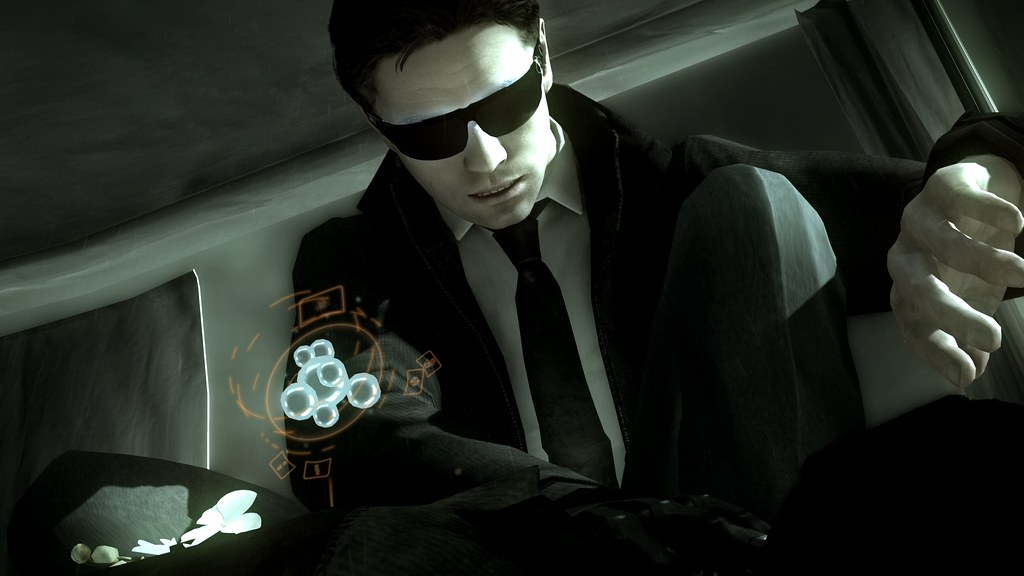
Norman

All four of the main characters are intriguing, even the much-criticized Madison Paige.  The best of them is Norman Jayden, the drug-addicted FBI agent who uses VR technology to solve his cases.  Unfortunately, the game also seems to be determined to kill Norman.  If you can make it to the end without Norman either dying or abandoning the case, you will have truly triumphed at Heavy Rain.  My only complaint is that Lauren Winter, the prostitute who joins forces with private eye Scott Shelby, wasn’t a playable character because she had one of the most interesting storylines.  If Lauren and Scott both somehow survive the game, you’ll get one of the best endings that Heavy Rain has to offer.

Lauren

Scott Shelby, the private investigator, gets some of the game’s best scenes.  He is big and slow and he always seems to need to use his inhaler but he can still handle himself in a fight.  He gets the game’s big action set piece, where he takes out an entire army of armed guards in just a matter of minutes.  At the end of the scene, he also gets to make one of the game’s biggest decisions.  Do you do the “honorable” thing or do you leave a bad man to die?  Whichever decision you make, it is one of Heavy Rain‘s most satisfying moments.
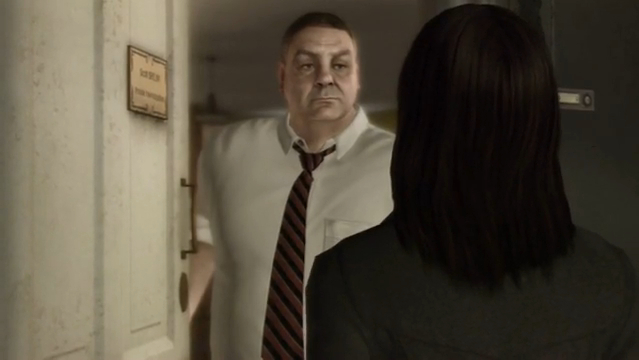
Scott Shelby

The majority of the game centers on Ethan, the father who has has to avoid the police while trying to save his son.  He is given a set of challenges by the Origami Killer, all designed to prove whether he’s worthy of being a father.  The bra-removal mini-game may be the most challenging part of Heavy Rain but the sawing off your own finger mini-game may be a close second.  A close third would have to be the diaper-changing mini-game.  It’s amazing how many different things you end up doing while trying to keep a little boy from drowning.  At the same time, I was as proud of myself for changing that diaper as I was for unsnapping that bra.  I was less proud about sawing off Ethan’s finger but it had to be done.
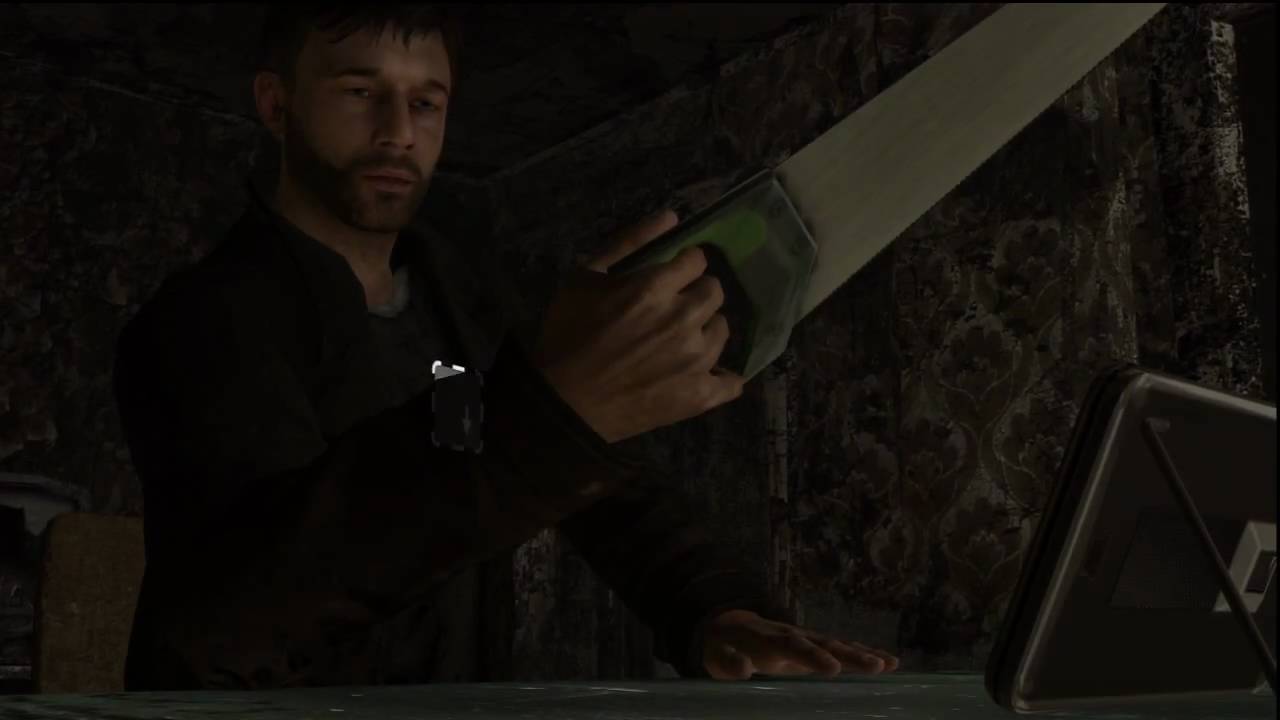
Ethan and saw

9 years after it was first released, Heavy Rain holds up better than I was expecting.  It’s flaws are still there and the plot holes become even more obvious with each time that you play it.  A frequent complaint that I’ve read about the game is that, in order for the mystery’s solution to make any sense, you have to be willing to accept that the Origami Killer would not only lie to other people but would also lie to himself.  The challenges that Ethan are put through are sometimes too reminiscent of Saw and even the rightly celebrated atmosphere sometimes leans too heavily on the obvious influence of Davids Fincher and Lynch.  (That Norman Jayden is based on Twin Peaks‘s Dale Cooper should be obvious to the most casual of viewers.)

Norman and Mad Jack

But, flaws and all, it’s impossible not to like this game or to appreciate the influence that it’s had on many of the games that have followed it.  Even it’s cheesiest moments are fun.  With the way the storyline branches out and changes depending on almost every decision that you make, this is a game that rewards frequent replays.  Each decision you make, you find yourself thinking, “What would have happened if I had done something else?”  Fortunately, with this game, you’ve got a chance to find out.  For that reason, Heavy Rain remains one of my favorites and a game that I’m looking forward to replaying soon.
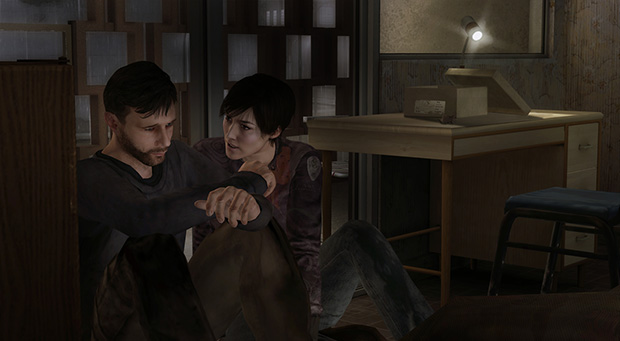
Ethan, moping. Madison, helping.
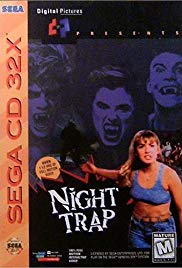

 

Game Review: Night Trap (1992, Sega)


Moral panics about video games are nothing new.

Long before people were worrying about the violence in Grand Theft Auto or the nudity in Heavy Rain, they were holding Congressional hearings about a game called Night Trap. 

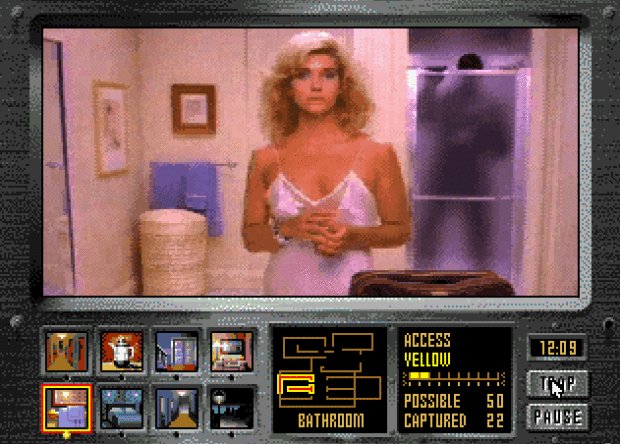
Night Trap was an interactive movie video game, one that was presented through full motion video at a time when that was still a big deal.  The player was a member of S.C.A.T., the Special Control Attack Team.  For 25 minutes, your job was to watch as blood-sucking creatures known as Augers attempted to launch a sneak attack on five girls at a slumber party.  Whenever an Auger approached a trap, the player had to click a button to capture the Auger.

It sounds pretty simple and it was.

It also sounds pretty stupid and again, it was.

Night Trap initially received some attention because it featured former Diff’rent Strokes star Dana Plato as one of the girls.  Plato played Kelly, who was actually an undercover member of S.C.A.T. and who searched for clues while you were busy trapping Augers.  Plato gave such an annoying performance that many gamers probably purposefully let a few Augers escape just so they could get the “bad” ending, with Kelly plunging into Hell.


However, even more than Dana Plato running around in a sports bra, it was a scene of one of the girls being stalked while wearing a nightgown that truly worried the moral guardians of 1993.  At the Congressional hearings, Senators Joseph Lieberman and Herb Kohl spent hours reviewing this scene and demanding to know whether it had any socially redeeming qualities.  The hearings also focused on Mortal Kombat and the senators seemed to be far more offended by an actress in a nightgown than they were about Kano ripping his opponent’s still-beating heart out of his chest.

Night Trap seems tame today but, of course, it was also tame back in 1993.  One reason why the “nightgown scene” got so much attention at the hearings is because it was the only scene in the entire game that could be considered the least bit racy.  There’s no sex or nudity in Night Trap.  For the most part, there’s also not any violence.  Whatever actual blood sucking that happens in Night Trap happens off-camera.  Probably the most intense scenes in the game involved Dana Plato scolding you if you let too many of the girls get captured.  Since the only thing the player could do during the game was activate a trap by pushing a button at a certain moment, this game required not so much skill as just being able to keep track of time.  Now, If you enjoyed just pushing a button over and over again, Night Trap might have some appeal but otherwise, this is a dull and poorly acted game.  Not even as formidable a thespian as Dana Plato could liven things up.

Ironically, those Congressional hearings made Night Trap.  If people still remember the game today, it’s because of those hearings.  If you want to know how a boring game like Night Trap could get a special 25th anniversary edition, it was because of those hearings.  There’s nothing like a moral panic to boot sales.


Game Review: Suspect (1984, Infocom)


The time is Halloween, circa 1984.  You are a newspaper reporter who has been invited to the annual Halloween costume party that is being thrown by your old friend, Veronica Ashcroft-Wellman.  You show up, eager to find a story.  You are dressed as a cowboy, complete with a lariat and a gun belt.  Shortly after you arrive, Veronica goes to her office.  Not long afterwards, Veronica is discovered dead.  Around her neck is your lariat.  Lying near her body is a bullet from your gun belt.  You’re not only a suspect.  In the eyes of the police, you’re the only suspect!

Infocom’s third and final murder mystery followed Deadline and The Witness.  Just like those two games, you have a limited amount of time to explore your surroundings, find clues, and talk to the other people at the party.  Run out of time and you’ll once again be approached by the trusted Sgt. Duffy.  This time, though, Duffy is coming to take you to jail.  The stakes have never been higher and the mystery has never been more complex.  Not only is the house bigger than the houses in Deadline and The Witness but there’s also many more suspects, all of whom are in costume and all of whom move around at their own free will.  Clues are not difficult to find but it can be a struggle to not only figure out how they link together but to also the convince the investigative detective that they are important.  This is not an easy game to win.  I played it several times and failed to solve the mystery every time.  Finally, I did what anyone would have done in my situation.

I cheated.

I found a walk-through for the game and, following it step-by-step, I solved the murder and cleared my name.  If I hadn’t used that walk-through, I probably never would have solved the case.  This is not a game for casual text adventurers.  This is for people who want to totally immerse themselves in a world and then spend hours working out a plan of attack.

It’s also an elegantly written game, with its fair share of Easter eggs for experienced gamers.  Just count the number of guests who have come to the party costumed like characters from other Inform games.  This game is tough but rewarding, even if you do end up having to cheat to win.

Suspect can be played at the Internet Archive.

Game Review: Aisle (1999, Sam Barlow)


Image by Sam Barlow

Aisle is perhaps the greatest work of Interactive Fiction ever created.

It’s Thursday night.  You’ve had a long day and you’re ready to go home.  You just have to pick up some gnocchi from the grocery store.  You are standing on the correct aisle, with your cart.  There is a woman standing a few feet away from you, with a grocery cart of her own.  What will you do?

Choose your action carefully because this is only a one-move game.  There are hundreds of commands that you can choose from but each command will lead to a different conclusion.

Some commands will lead to happy ending.  Some commands will lead to a sad ending.  Some will trigger old memories.  Sometimes, the memories will be happy and romantic.  Sometimes, they will involve death, insanity, and horror.  Sometimes, you are a good man and sometimes you are a bad man.  Sometimes, you are healthy and sometimes you are sick.  It all depends on which command you chose.

Because each command leads to different details of the story being revealed, Aisle is a game that rewards frequent replays.  Deciding to laugh in one game led to me typing “Remember Clare” in the next game.  Even simply choosing to leave the aisle can lead to a variety of different endings, depending on how you decide to leave.  This game can be a romantic or it can be horrific.  It all depends on which word, out of the hundreds that the game is prompted to respond to, you type in at the prompt.

Aisle can be downloaded from here.


Game Review: 9:05 (2000, Adam Cadre)


(Image by Adam Cadre)

I’m still working on my review of Heavy Rain so, while I do that, why not play Adam Cadre’s 9:05?

9:05 is a text adventures which opens with a scenario that should be familiar to anyone who has previously played an interactive fiction game.  It’s the morning.  The phone is ringing.  The person on the other line says that you have overslept and the boss is asking why you’re not at work.  Now, you have to get out of bed and quickly do what you need to do to be able to leave the house.  It’s a scene that has served as the premise of many IF games but 9:05 adds a macabre twist at the end, one that makes the game worth replaying.

9:05 is a short game and most of the puzzles are deliberately simple to solve.  It should not take any longer than 5 to 10 minutes to play the game for the first time.  If you’ve never played an IF game before, 9:05 is a good one to start with.  If you’re a veteran player, you will enjoy the way that 9:05 plays with and subverts the usual IF conventions.

The game can be downloaded from here.

Game Review: Shadows Out Of Time (2018, Brendon Connelly, Dan Q, Liz McCarthy, and Bodleian Libraries)


I was going to review Heavy Rain today but it looks like I’m going to need an extra day to work on that review and hopefully figure out an appropriately way to describe Madison Pagie’s role in the game.

Until I do that, how about taking a look at Shadows Out of TimeShadows Out Of Time is a text adventure game that begins with you, a student at Oxford, waking up in your favorite chair in the Old Bodleian Upper Reading Room.  In front of you is a copy of Lovecraft’s Shadow Out Of Time, which you were reading before you fell asleep.  Upon waking up, you discover that the library appears to be deserted.  Further searching reveals that the entire town appears to be bereft of human life!  Are you alone or is there something with you?  You’ll have to explore to find out.

Shadows out of Time is a choose your own adventure-style game.  You read the descriptions and then you decide which of two options to go with.  Do you go out to the quad or do you continue to explore the library?  Do you try to reach Rad Cam or do you steal a bike and try to return to your home?  It can be a challenging game but, fortunately, you always have the option to “wake up” if you want try again.  (Or you can “stay asleep forever.”)

It’s an atmospheric game that captures the unique feel of Oxford.  (The game itself was obviously specifically written for students at Oxford.  For any Americans who may want to play, Radcliffe Camera is not a camera shop.)  It’s an entertaining tour through haunted Oxford.  You can play it here.

Halloween Scenes I Love: Spider-Man Goes To ESU’s Halloween Party in PS4’s Spider-Man


Not all good Halloween scenes have to come from a movie.  Sometimes, they can come from a video game!

One of my favorite missions in PS4’s Spider-Man is Back To School.  That’s where you, as Spider-Man, have to search the Empire State University Halloween Party for an Oscorp scientist named Dr. Delaney and rescue him from Mister Negative and the Demons.  Because it’s a Halloween party, you should be able to search for Delaney without anyone realizing that you’re the Spider-Man.  The bad news is that, again because it’s a Halloween party, almost every party goer is dressed up like one of your enemies.  And when Mister Negative does attack, it turns out that a drunk college student dressed up like the Rhino can be almost as dangerous as the actual Rhino!

Game Review: Dwelling: Insomnia (2014, 0vr)


This piece of interactive fiction is a strange game.  I’m not quite sure how else to describe it.

The premise is a simple one.  Each night, you try to sleep.  Every night, you are awoken by someone or something pounding on your door.  Every.  Single.  Night.  In Choose Your Own Adventure fashion, you are given a set of options.  Do you try to go back to sleep or do you go to the door?  Do you look through the peephole or do you return to bed?  Open the door or hide?  Left or right?  At every step, you’re given the option to explore further or to try to return to safety.  The problem is that if you make the wrong choice, you might make it back to your apartment in one piece but you’re still going to be woken up the following night.  Make the right choice and something bad might still happen to you but at least you’ll no longer be woken up in the middle of the night.

What makes the game so strange is the way that it constantly loops back to the beginning, until you finally make the “right” choices.  The only thing that changes is the number that lets you know how many nights you’ve been woken up by someone pounding at your door.  Is someone really knocking at your door or are you stuck in some sort of time loop or permanent dream state? Having played the game and gotten to the end, I am still not sure.

The game itself is well-written and vivid enough to justify its placement in the horror genre.  It can be played here.

Retro Game Review: L.A. Noire (2011, Rockstar Games)


(This review is based on my experience replaying L.A. NoireBe sure to reread Leonard Wilson’s review, from when the game was originally released.)

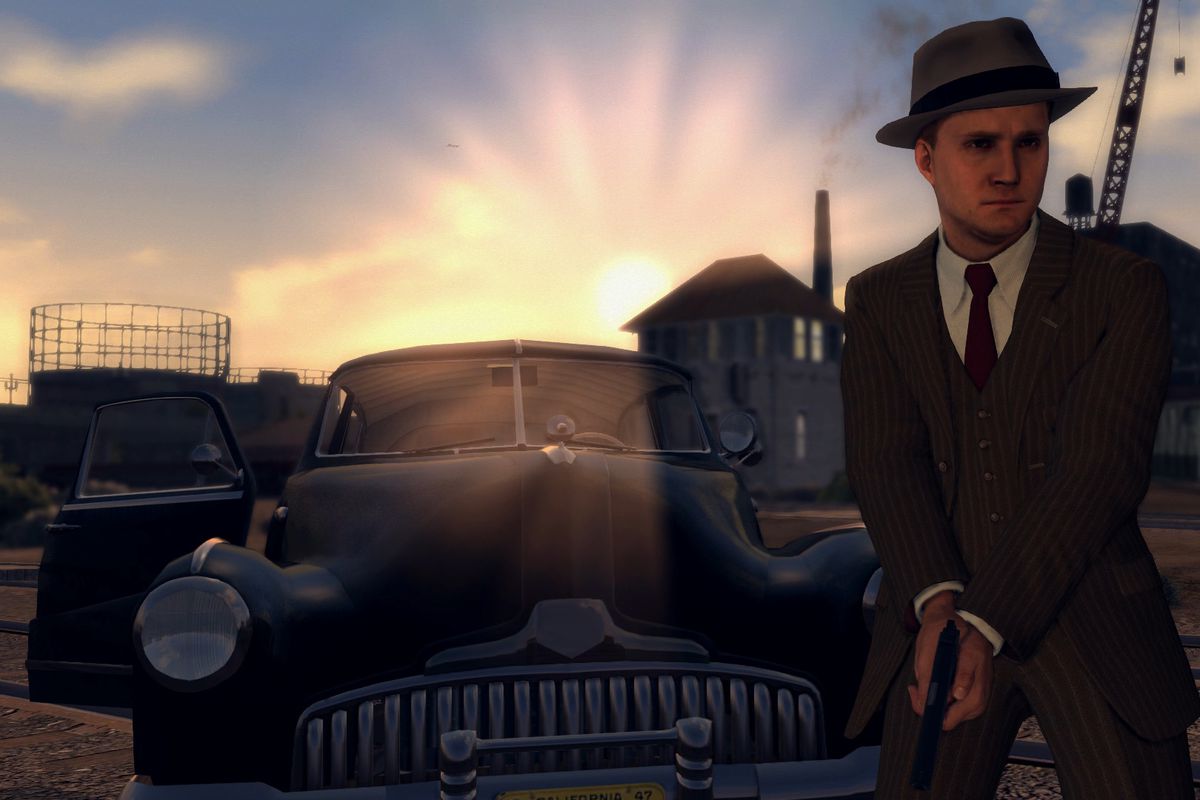
I recently replayed L.A. Noire, a game that I enjoyed when it was first released in 2011.  I was curious to see if, after eight years, it still held up.  The first time I played L.A. Noire, it was on the Xbox 360.  For the replay, I used the version that was released for the PS4.  This version included extra rewards and cases that were not originally included in the game.

L.A. Noire takes place in Los Angeles in the years immediately following World War II.  For the majority of the game, you control the actions of Cole Phelps, a decorated USMC veteran who works his way up through the LAPD.  He starts as a uniformed policeman before being promoted to detective.  The game follows him through three different department until, as a result of a personal scandal, he ends up being demoted down to arson.  Along the way, Phelps learns the truth about the Black Dahlia murderer and gets involved in the deadly aftereffects of a morphine heist.  Through a series of flashbacks, we also discover that Phelps may not be the war hero that everyone thinks that he is.  Cole’s an interesting hero because he’s so openly ambitious and judgmental that he is sometimes easy to dislike.  Nearly everyone who works with Cole in the game either beings their partnership disliking him or grows to dislike him over time.  Cole can be abrasive but he also has a strong moral sense and, when he says that he’s a better detective than his partners, he has a point.  From the start, the games teases us about Cole’s inevitable downfall but, when it actually does happen, it catches both Cole and the player by surprise.

L.A. Noire is an open world game, meaning that Phelps can temporarily abandon a case and spend some time walking and driving around Los Angeles.  The game’s recreation of 1947 Hollywood is impressive but, when compared to other open world games, there’s not much to do when you’re not actually on a mission.  This isn’t like Grand Theft Auto, where you can spends weeks mugging people and stealing cars until deciding to return a phone call so that you can get your next task.  L.A. Noire is a story-centered game so be prepared to spend most of your time searching crime scenes for clues, going back to the police station to pick up lab reports, and interrogating suspects.

When L.A. Noire first came out, it was the interrogation scenes that received the most attention.  The game used MotionScan technology and 32 cameras to capture every possible facial expression of the actors appearing in the game.  When you ask someone a question, you can watch their expressions while they answer and make the determination whether they’re lying or telling the truth, as well as whether to be a good cop or a bad cop.  You can watch an liar refuses to make eye contact with you or as an innocent man sweats out an aggressive questioning.  It puts you right in the world of the game, though I was disappointed to discover that wrongly accusing someone of lying doesn’t actually have much of an effect on how each case ends.

The main flaw with L.A. Noire‘s stoy is that, during the final fourth of the game, a new character is introduced.  Jack Kelso served with Cole in the Marines and knows the truth about Cole’s wartime “heroism.”  For the final few cases, Jack replaces Cole as the playable character and Cole is reduced to supporting him.  Because Jack is written to be perfect and basically has none of Cole’s flaws, he’s also not a very interesting protagonist.  Switching from playing Cole to Kelso bothered me the first time that I played L.A. Noire and it bothered me even more when I replayed it.  A final cut scene, which revealed that Kelso knew more than he originally let on, did not help.

Fortunately, the rest of the game still held up very well.  The cases are all challenging without being impossible to solve and the game does a great job of recreating the atmosphere of classic California noirs like Chinatown and L.A. Confidential.  Cole, his partners, and all of the suspects are vividly written and voiced characters and the cases that Cole works for Homicide are just creepy enough to make this game appropriate for October playing.  Be careful chasing the Black Dahlia killer into the catacombs.  I didn’t bother to pay attention to where I was going and I spent an hour running around in circles before I finally found him and promptly got gunned down.

There are puzzles to be solved and suspects to be pursued.  This game may mostly be about interrogating people and analyzing clues but it does have its share of car chases.  Fortunately, if you fail to complete an action scene too many times in a row, the game will give you the option of just skipping it.  When you’re working with a partner and heading to a crime scene, that game also give you the option of telling your partner to drive to the location.  That’s something I, being among the directionally challenged, appreciated.

However, if you do enjoy driving through a video game, L.A. Noire‘s recreation of Los Angeles in the 40s has much to recommend it.  Driving through the game’s version of Los Angeles, you’ll find plenty of evidence of America’s post-World War II optimism.  New houses are being constructed.  Innocent young women are hanging out on every street corner, looking to become a star.  The theater marquees advertise movies like Odd Man Out.   All of the famous Hollywood landmarks are lovingly recreated.  An early case leads to you searching for clues behind the Hollywood sign.  Another case actually leads to a firefight at the old Intolerance set while yet another case tests how much attention you’ve been paying by requiring you to solve a series of riddles that will lead you from one landmark to another.  In the tradition of Raymond Chandler and James Ellroy, L.A. Noire challenges you to take a look at what’s happening underneath Los Angeles’s pleasing surface.

As a game, L.A. Noire holds up well.  I won’t hold my breath for that sequel that was promised seven years ago but I did enjoy replaying it.

Game Review: The Last Half of Darkness (1989, SoftLab Laboratories)


Today, I was planning to take a look back at L.A. Noire but, due to last night’s storms, I lost power right as I was about to start composing my thoughts.  The power has since come back but, rather than do a rush job on one of my favorite games, I’m going to hold off on posting about L.A. Noire until tomorrow or Wednesday.

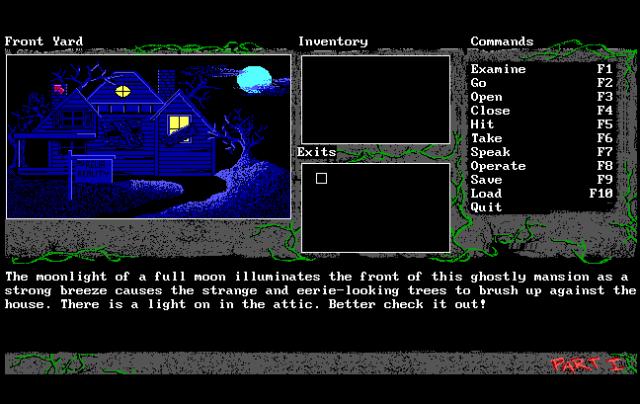
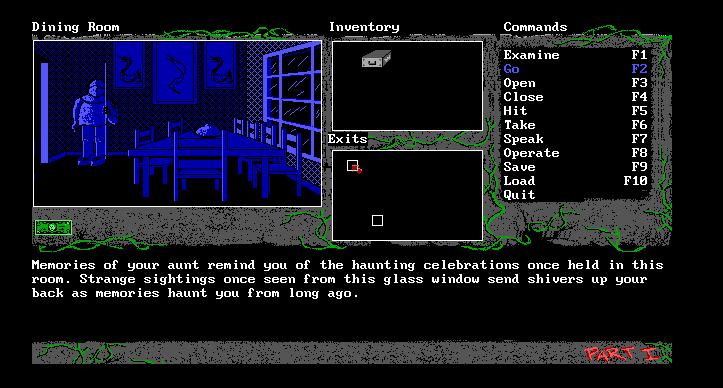
Instead, for today, I’ll recommend The Last Half of Darkness, a haunted house game that can be played at the Internet Archive.  In The Last Half of Darkness, you are searching the home of your late aunt.  Your aunt was a voodoo witch and you stand to inherit her considerable estate if you can finish the potions that she was working on and also solve the mystery of her death.  To do that, you are going to have to go through and search her home.  The problem is that you are not alone.  Open the right door and you will find the secret to returning life to the dead.  Open the wrong closet or cabinet and prepare to meet your fate at the fangs of a snake or the hands of an angry ghost.

The Last Half of Darkness is a challenging game that is also a lot of fun, assuming that you can get the hang of the game’s point-and-click interface.  Instead of typing out your commands, you click on a list of options that are on the right side of the screen.  You then have to click on the picture of whatever object you want to pick up or direction you want to head.  It took me a while to get used to it but, once I did, it barely bothered me.

This is a good game, full of wit and atmosphere and puzzles that require some concentration but which are not impossible to solve.  For those of you like me who sometimes need to cheat to win a game, here’s a helpful walk-through.

The game itself can be played by clicking here.