The Films of 2020: My Psychedelic Love Story (dir by Errol Morris)


Errol Morris is a documentarian who has made a career out of interviewing the eccentric and the quirky.

In My Psychedelic Love Story, he interviews Joanna Harcourt-Smith who, way back in the 1970s, was the lover of Acid guru Dr. Timothy Leary.  She was in her 20s and he was in his 50s but they still apparently had a wonderful time as exiles in Europe.  Leary, at the time, was a fugitive, having escaped from prison and fled to Switzerland.  (Before his escape, he was serving a 20-year sentence after being convicted of possessing two joints.  Leary claimed that he was set up by the arrest officer.  Still, the fact that two joints led to a 20-year sentence tells you all you need to know about American drug laws in the 60s and 70s.)  Leary and Joanna spent a few years as glamorous international exiles, staying at the homes of the rich and self-styled decadent.  Eventually, Leary was captured and, upon returning to the United Sates, became an informant for the FBI.  Though Leary always claimed that he gave the FBI useless information (and reportedly, no one was ever convicted of any crimes based on any of the information that Leary provided), his decision to “cooperate” with the authorities was viewed as a betrayal by many members of the counterculture.

As usually happens whenever a male cultural figure lets down his disciples, the woman was blamed.  Many — including Allen Ginsberg — suggested that Joanna Harcourt-Smith was actually an agent of the CIA who had not only arranged Leary’s capture but who was also responsible for him eventually cooperating with the government.  Interestingly enough, in My Psychedelic Love Story, Joanna also suggests that she may have been unknowingly manipulated by the CIA to take Leary down.

That’s one of the many stories that Joanna Harcourt-Smith tells over the course of My Psychedelic Love Story.  Though the film largely focuses on her relationship with Leary, Harcourt-Smith also talks about her childhood and her life after her break-up with Leary.  Some of the stories are interesting and, to be honest, some of them are more than a little boring.  The documentary never quite convinces us that Joanna Harcourt-Smith is as fascinating as she and Morris seem to believe that she is.  Perhaps her most interesting moment comes when she says that she has a long history of lying.

If anything, Harcourt-Smith comes across as being the type of figure who is familiar to anyone who has actually researched the counter culture of the 60s and 70s, the wealthy hippie who can afford to rebel because her position in society is guaranteed regardless of how that rebellion turns out.  Harcourt-Smith often comes across as something a dilettante, someone who got involved in radical politics because, at the time, that was the thing to do.  Listening to her speak, I was reminded of the end of the film Guerilla, in which former left-wing terrorist Patty Hearst, having been pardoned by the president, smiled and said that she was looking forward to going home.  (Home happened to be a mansion.)  That’s not to say that Harcourt-Smith was brainwashed as much to suggest that one reason why she could do what she did was because she had the escape clause of being from a wealthy and connected family.

As for Leary, the documentary features recordings of him speaking but he remains an enigmatic figure.  At times, he comes across as being very sincere.  At other times, he comes across as being a manipulative Svengali.  At his worst, he comes across as being a character straight from an Aaron Sorkin screenplay.  One can easily imagine Sorkin writing a screenplay about how Leary was betrayed by every woman he ever met.  (“I could have turned the world on, if not for those women with their pesky opinions!”)

Despite all of that, My Psychedelic Love Story is still an interesting historical document.  If you’re a student of the 60s and 70s cultural history, you’ll want to watch it.  The film may leave you frustrated but it’s still a chance to hear about the era from someone who was there.

The Films of 2020: Natalie Wood: What Remains Behind (dir by Laurent Bouzereau)


It’s a bit frustrating that I have to start this review of a documentary about one of my favorite classic film actresses by discussing the gossip and innuendo that has surrounded her death but, unfortunately, that’s the world that we live in nowadays.

It’s been nearly 40 years since the death of Natalie Wood and the circumstances of her drowning are still debated, largely by people who know nothing about the incident beyond what they’ve read online.  In 2011, when an employee of Wood and her husband, Robert Wagner, suddenly changed the story that he had been telling for 30 years, the Los Angeles Police Department reopened the investigation into Wood’s death.  Suddenly, all over twitter, people were accusing Wagner of having killed Wood, either deliberately or accidentally.  Interestingly enough, Christopher Walken was also on the boat on the night that Wood drowned but very few people accused him of having anything to do with it, largely because Walken is better-known to most twitter users than Wagner.  (It’s easier to accuse someone of murder when he’s not a celebrated cultural icon.)  Things were not helped when the LAPD announced that Wagner a “person of interest” in the case.  Of course, “person of interest” is a vague term that can mean anything.

Also not helping matters was that Lana Wood, Natalie’s sister, publicly accused Wagner of having something to do with Natalie’s death.  I can still remember that bloviating gasbag, Dr. Phil, having Lana on his show and asking her if she thought Wagner murdered Natalie.  Footage from that interview appears in the HBO documentary, Natalie Wood: What Remains Behind.

Fortunately, in the documentary, Robert Wagner is also interviewed about the night that Natalie Wood drowned and there’s a marked contrast between the obviously emotional Wagner who appears in the documentary and the monstrous caricature of Wagner that’s been presented by many Wood conspiracy theorists.  If I didn’t already think that Wagner was innocent and that Wood’s death was a tragic and terrible accident, this documentary would have convinced me.

Natalie Wood: What Remains Behind is a documentary about the life and, sadly, the death of Natalie Wood.  It’s hosted by her daughter, Natasha Gregson Wagner.  The film is tribute to Wood and her career, featuring interviews with the journalists who wrote about her, the photographers who snapped pictures of her, the stars who co-starred with her, and finally, the members of of her family.  There’s also a good deal of archival footage of Wood talking about her life.  One thing you quickly realize, while listening to Wood, is that she knew how to play the PR game.  In her interviews, Wood always said enough to be interesting while, at the same time, keeping up enough wall that she remained somewhat enigmatic.  Natasha, for her part, describes her mother as being a down-to-Earth person who, when she had to, could play the role of the glamorous film star.

The film examines Natalie’s career, from her time as a child actor to stardom in the 50s and 60s.  As the documentary points out, Wood was an actress who literally grew up on scree.  The film also takes a look at her semi-retirement in the 70s.  (She was making a comeback at the time of her death and Wagner, in fact, admits to getting into a rather loud argument with Christopher Walken about whether or not Wood should have been accepting more film roles.)  The documentary candidly discusses her difficult relationship with her mother, along with her occasionally tumultuous private life.  The film provides a look at both what made Wood a star and why her performances continue to resonate with so many of us.

(For the record, my favorite Natalie Wood performance will always be Splendor in the Grass.)

But, sadly to say, Wood’s death and the rumors surrounding it casts a shadow over almost every minute of the documentary.  Again, that’s the world we live in.  It’s a world dominated not only be innuendo and gossip but also a desire to destroy anyone who has ever led a public life.  As a result, there’s no way to make a documentary about Natalie Wood without discussing the conspiracy theories surrounding her death and it’s tragic that a few publicity hungry individuals continue to attempt to capitalize on the tragedy of Wood’s passing.  The film gives Wagner a chance to tell his story and for that, we should be both thankful.  This is film that will inspire viewers to celebrate Wood’s life and to despise those who have exploited her death.

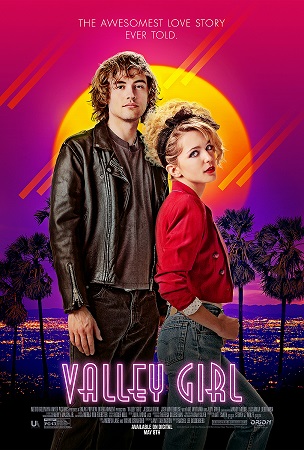
The Films of 2020: Valley Girl (dir by Rachel Lee Goldenberg)


Valley Girl is a remake of the 1983 film of the same name.  The original Valley Girl was a sweet but occasionally edgy comedy that starred Deborah Foreman and, in one of his first starring roles, Nicolas Cage.  Foreman played a popular rich girl who fell in love with a quirky punk rocker (Cage, of course).  Full of interesting characters and very much attuned to what it’s like to be a teenager in love, the original Valley Girl was fun and funny but it also had a serious subtext and the film, as whole, holds up surprisingly well.

The remake of Valley Girl tells basically the same story.  Jessica Rothe plays Julie Richman.  Josh Whitehouse plays Randy.  They meet.  They fall in love.  They both have to deal with the fact that they’re from different parts of Los Angeles.  Their friends say that they don’t belong together.  The story still has potential but the remake falls flat.

A huge part of the problem is that the Valley Girl remake is a jukebox musical.  In the style of Rock of Ages, it features characters expressing themselves by singing songs from the 80s.  Like many jukebox musicals, Valley Girl picks the most obvious songs and then deploys them in the most literal way possible.  For instance, Julie’s jock boyfriend is named Mickey, just so the cheerleaders can perform Mickey during a pep rally.  When Randy and his punk friends show up for the first time, it’s time to sing Bad Reputation.  When it appears that his relationship with Julie is doomed, it’s time for Randy to offer up a rather wan version of Boys Don’t Cry.  When Julie and her friends go to the beach and start to talk about how they want have to fun …. well, can you guess what song they start singing?  The film does make good use of Kids In America but, for the most part, the song choices are too predictable and the cast performs them with a notable lack of enthusiasm.

As for the cast, Jessica Rothe has a few good moments and she at least bring some playful energy to her role.  Unfortunately, Josh Whitehouse is perhaps the least convincing punk rocker that I have ever seen.  There’s nothing quirky, angry, or dangerous about Whitehouse’s Randy.  Instead, he’s a nice young man who has some eccentric friends.  He’s the punk who you can take home to meet your parents.  He’s like the one jock who hangs out with the nerds and, as a result, everyone’s decided that he must be deeper than he actually is.

Speaking of jocks, Julie’s boyfriend — named Mickey, of course — is played by Logan Paul.  Yes, that Logan Paul.  Yes, he’s terrible in the role.  Josh Whitehouse may have not been a convincing punk rocker but Logan Paul gives a performance that’s so bad that he’s not even a convincing human being.  He comes across like an animatronic Disneyland character.  He should be in the Hall of Presidents, standing next to George Washington and stiffly nodding whenever Lincoln starts talking.  Logan Paul is a huge reason why the film doesn’t work.  He’s also a huge reason why Valley Girl sat on the shelf for about three years before finally being released, as Paul’s YouTube controversies led the studio to be weary about releasing a film featuring him.

I guess one reason why I got so annoyed with Valley Girl is that I wanted to like it.  Jessica Rothe was great in the Death Day films.  I love 80s music.  I wanted this to be a good film but it’s just not.  Like, sorry.

The Films of 2020: Shooting Heroin (dir by Spencer T. Folmar)


Shooting Heroin takes place in a small town in Pennsylvania, a once close-knit community that is dying a painful death.

As the film opens, we meet several people who have lost loved ones to the Opioid Epidemic.  Hazel (Sherilyn Fenn) speaks at a school assembly about how both of her sons overdosed within hours of each other and the only response she gets is a few students snickering at her.  Adam (Alan Powell) loses his sister to heroin and has to take her baby into his home.  Sitting in a bar, prison guard and local hunter Edward (Lawrence Hilton-Jacobs) demands to know why the police aren’t doing more to lock up the dealers.  The town’s sole lawman, Jerry (Garry Pastore), can only explain that he is only one person and that he can only arrest someone if he has proof that they’re actually dealing drugs.  Suspicions and gossip aren’t enough.

After a night of heavy drinking and heavier emotions, Adam comes up with the idea of a voluntary drug taskforce.  He recruits Edward and Hazel and, after Jerry reluctantly deputizes them, the three of them set out to battle the drug dealers their own way.  (“By any means necessary,” as Edward puts it.)  Of course, all three of them have their own thoughts on how to best deal with the issue.  Hazel puts up crudely painted but well-intentioned signs, asking teenagers if they truly want to break their mother’s heart.  Edward stops every car that’s heading into town and does a search.  (Yes, it’s highly unconstitutional.)  As for Adam, he wants revenge against the man who he believes was his sister’s dealer.  And if that means setting a house on fire and picking up a rifle to go hunting, that’s what Adam’s going to do.

Now, from that plot description, you might think that Shooting Heroin is a run-of-the-mill revenge flick but it’s not.  It definitely has its pulpy elements but, for the most part, Shooting Heroin is an intelligently written and well-directed look at how the Opioid Epidemic is ravaging communities across America.  The film approaches the subject with the type of empathy that, far too often, is missing from films like this.  There are no easy villains, the film tells us, and there are also no perfect heroes.  Adam, Edward, and Hazel all have their own approaches, each with their own set of strengths and flaws but the ultimate message of the film is that nothing is going to get better until we stop attacking and demonizing one another.  That’s an important message and one that, unfortunately, doesn’t get broadcast as much as it should.  Far too often, the war on drugs is a war on those members of the community who are at their most vulnerable.

The film is full of familiar faces, with Sherilyn Fenn giving the strongest and most poignant performance as Hazel.  There’s something very touching about the combination of Hazel’s determination to get through to teenagers and her total cluelessness about the best way to actually do so.  For all of her grief and anger, Hazel remains innocent enough to believe that telling a drug addict that they’re breaking their mother’s heart is the ultimate solution to the crisis.  When she joins the task force, she hands out adrenaline shots so that addicts can be revived.  When she confronts of a pharmacy worker who has filled an obviously faked prescription, Hazel speaks with the anger of someone who has seen the damage done to her community.  When she’s handed a gun, she says that she’s not going to carry anything that can kill.  Hazel, like so many people, is just trying to do her best in a unwinnable situation and it’s sometimes both heartbreaking and inspiring to watch her.

Shooting Heroin brings empathy to its look at the Opioid Epidemic, which is something that has been lacking in far too many other examinations of the what’s currently happening in America.  What’s happening in middle America is, for many in the political and media establishment, an inconvenient truth.  During the Obama years, the Opioid Epidemic was ignored because acknowledging it would have meant acknowledging the failure of Obama’s economic policies.  During the Trump years, the victims of the Opioid Epidemic were dismissed by a media and a political class who insisted on viewing every issue through the prism of red state vs. blue state.  One can only guess how these ravaged communities will fare during the Biden years, though there’s little reason to be optimistic that a 78 year-old career politician is going to do anything differently from his predecessors.  Shooting Heroin is a film about what’s happening today and it’s a film that will leave you thinking about the future.

The Films of 2020: Olympic Dreams (dir by Jeremy Teicher)


Filmed on location at the 2018 Winter Games, Olympic Dreams tells the story of two lost souls.

Penelope (Alexi Pappas) is a skier who competes early and doesn’t win a medal.  Ignored by the media and unsure of how to talk to her fellow athletes (or, for that matter, anyone else that she meets), Penelope is left with little else to do but explore Pyeongchang and have an existential crisis about what the future means.  She’s 22, which is an age when many amateur athletes are retiring and transitioning into the next stage of their life.  Of course, it would be a lot easier to do that if Penelope was leaving South Korea with a gold medal in her luggage.

Ezra (Nick Kroll) is a dentist who is volunteering at the Olympics.  He’s 37 and is having as much of an existential crisis as Penelope.  If Penelope’s problem is that she often struggles to talk to other people, Ezra’s problem is that he talks too much.  He’s constantly talking but, in the end, he’s just as socially awkward as Penelope.

Eventually, Ezra and Penelope meet and they explore South Korea and they discuss the big issues of life and it looks like they might even be falling in love.  Along the way, both Ezra and Penelope also meet and talk to a lot of real-life Olympians, all of whom play themselves.

I have to admit that, at first, I found Olympic Dreams to be a bit off-putting.  I was kind of dreading having to watch yet another socially awkward love story and Ezra seemed like such a whiny character that I wasn’t sure I wanted to spend any amount of time dealing with him and his issues.  The film had an improvised feel, which was a bit of a mixed blessing.  Some people in the film were better at improvising than others.  Nick Kroll, for instance, has been performing for a while and obviously knows how to think on his feet.  Alexi Pappas was also a surprisingly adroit performer.  However, many of the real-life Olympians that they interacted with had this sort of deer-in-the-headlights look about them that made it obvious why they became athletes as opposed to actors.

That said, Olympic Dreams did eventually win me over.  Once Ezra stopped complaining all the time and Penelope started to get a little bit more assertive, it became easier to sympathize with the characters and to hope that they managed to find some sort of meaning in their lives.  The 2nd half of the film, in which both Ezra and Penelope realized that they were going to have to go back to the “normal” world in just a few more days, was really nicely done and the film’s final shot was far more effective than I was expecting it to be.

Whether intentional or not, Olympic Dreams has a lot in common with Lost In Translation.  In fact, I’d argue that it has a bit too much in common with Lost In TranslationOlympic Dreams sometimes seems to be struggling to escape from that earlier film’s shadow.  That said, Olympic Dreams is uneven but ultimately effective.  And, if nothing else, it’s full of behind-the-scenes footage of the 2018 Winter Games so fans of the Olympics should enjoy it.


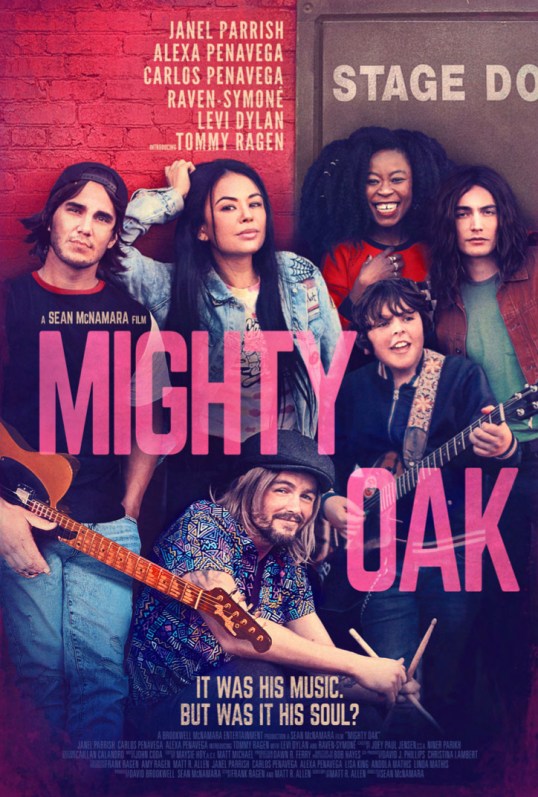
The Films of 2020: Mighty Oak (dir by Sean McNamara)


Mighty Oak tells the story of Army of Love.

Back in the day, Army of Love was an up-and-coming band in Los Angeles.  They were led by charismatic frontman Vaughn Jackson (played by Bob Dylan’s incredibly handsome grandson, Levi Dylan) and managed by Vaughn’s overprotective sister, Gina (Jannel Parrish).  Unfortunately, one night. they were driving home from a gig when a drunk driver collided with their van.  Vaughn was thrown through the windshield and killed.  Army of Love went into permanent hiatus.

However, ten years later, Army of Love is back!  Gina is once again managing and they’ve got a new lead singer.  His name is Oak Scroggins (Tommy Ragen) and he’s ten years old!  But he plays guitar and sings like he’s at least in his early 20s!  At first, some members of the band are skeptical but everyone is won over once Oak starts to perform.  Gina is especially impressed, to the extent that she becomes convinced that Oak is literally Vaughn’s reincarnation.

Of course, Oak’s life isn’t perfect.  Despite his talent (or perhaps because of it), he’s a bit of an outcast at school.  His father’s dead and his mother is the type of drug addict who misses her son’s musical debut because she’s too busy getting arrested on the California-Mexico border.  His grandparents are back in Minnesota and they seem like they mean well but his grandfather has a habit of shouting stuff like, “Kids should be seen not heard!,” so who knows?  Can Gina and the band provide Oak with the family that he needs and will Gina ever discover whether or not Oak is actually her dead brother?  Watch the film to find out.

This is kind of a weird movie.  Sean McNamara previously directed Soul Surfer, which was such a sincere and unapologetically emotional film that it was pretty much impossible not to love it.  Mighty Oak is also extremely sincere and unapologetic but it’s also such a mishmash of different elements and contradictory tones that it’s hard to really know what to make of it.  It starts out as a drama and then it becomes a bit of a broad comedy and then it goes back to being a tear jerker and, in the end, it seems to be trying too hard to convince you that reincarnation is a logical solution as opposed to just being wishful thinking.  Even if you can buy into the idea that Vaughn was reincarnated as Oak, you also have to be willing to believe that the members of defunct hard rock band wouldn’t have any issue with reforming so that they could back up a ten year old.

That said, it’s difficult to really dislike a film like Mighty Oak.  Yes, the plot is a mess and the tone is totally inconsistent and I don’t know much about reincarnation but I’m sure there’s more to the belief than what is presented in this film.  But, as I said at the start of this review, the film’s heart appears to be in the right place and everyone involved seems to mean well and there is something to be said for that.  It helps that Tommy Ragen is a real-life musical prodigy and that he actually can play the guitar just as well in real life as he does in the film.  If nothing else, this elevates the film in a way that casting a typical child actor would not.  It’s a silly movie but you can’t deny that Tommy Ragen is a talented kid.

The Films of 2020: Possessor (dir by Brandon Cronenberg)


Tasya Vos (Andrea Riseborough) is a professional assassin.

That really shouldn’t come as too much of a surprise.  For whatever reason, films about assassins have become very popular over the past few years and those assassins are often women.  However, what sets Tasya apart from other assassins is the technique that she uses.  Under the direction of Girder (Jennifer Jason Leigh), Tasya can possess someone else’s body.  While controlling that other person’s body, Tasya commits her murders and then commits suicide.  The host dies while Tasya’s mind returns to her original body.  The media then reports that the murder was some sort of random incident and, with the killer dead by their own hand, their true motives will probably never be known.  It’s an outlandish premise and yet, it’s one that feels oddly plausible.  Most mass shootings and random acts of violence remain a mystery precisely because their perpetrators often take their own lives.  Three years after the deadliest mass shooting in U.S. history, we still don’t know why Stephen Paddock opened fire on a music festival in Las Vegas.  We’ve become conditioned, I think, to accept that these things just happen.

Wisely, Possessor doesn’t go into too much details about just how exactly Tasya possesses other people.  We see that it involves a lot of odd technology and we also discover that Tasya struggles to return to her “normal” self after her mind returns to her body.  That’s really all we need to see.  Too many films make the mistake of trying to explain all of the little details, as if the audience is going to be concerned as to whether or not a film about possession is 100% plausible.  The director of Possessor, Brandon Cronenberg, understands that all he really has to do is make it look convincing.  He doesn’t have to explain it and, indeed, there’s much that Cronenberg doesn’t explain.

Tasya’s latest assignment takes her into the body of Colin Tate (Christopher Abbott), who is engaged to marry the daughter of arrogant businessman named John Parse (Sean Bean).  Colin and Tasya find themselves fighting for control of Colin’s body.  Even while Tasya is setting up the circumstances that will lead to Colin killing both his girlfriend and her father, Colin is resisting and struggling to take control.  It all leads to some disturbingly surreal imagery, as well as some shockingly gory violence.  There’s a lot of blood in Possessor.  Both figuratively and literally, Possessor is a film that’s obsessed with what lies under the skin.  Throughout the film, bodies and minds are ripped open and what we discover inside of them is frequently grotesque.

Possessor is a film that raises a lot of questions and which often refuses to provide easy answers.  Does Girder sincerely care about Tasya or is she just manipulating her emotions to get the result that she desires?  Who exactly does Girder work for?  Does Tasya truly want to get back together with her estranged husband, Michael (Rossif Sutherland)?  Is Michael as clueless as he seems or does he secretly understand that Tasya is lying whenever she says that she has to go away on business?  Possessor is not always an easy film to follow but Cronenberg’s visuals are so strong and the performances are so wonderfully off-center that it remains enthralling regardless of whether or not it always makes it sense.  By the time one person is wearing someone else’s face as a mask, it’s pretty much impossible to look away.

With its emphasis on body horror and loss of identity (as well as its chilly Canadian setting), Possessor has a lot in common with the early work of David Croneberg.  That’s perhaps not surprising, considering that Possessor was directed by David’s son, Brandon Cronenberg.  Unfortunately, Possessor doesn’t really have the same dry sense of humor that distinguished David Cronenberg’s best films.  (David Cronenberg was, in his way, as much of a satirist as a horror director and Possessor doesn’t quite have the same subversive charge as something like Rabid or Shivers.)  That said, Possessor is still a fascinating and enthralling film, one that will stick with you long after it ends.

The Films of 2020: Ava (dir by Tate Taylor)


Ava tells story of Ava Faulkner (Jessica Chastain), who has a troubled past, a turbulent present, and an uncertain future.

As we learn via a series of still frames during the film’s opening credits, Ava was the valedictorian of her high school class but her bright future was derailed by her own alcoholism.  She killed two of her friends while driving drunk and, presumably to avoid prison, she instead went into the army.  In the army, she was noted for being an efficient killer while, at the same time, being a bit unstable.  She has issues with authority.  Well, don’t we all?  When she got out of the army, she was recruited by Duke (John Malkovich), who taught her how to be an international assassin!

Unfortunately, since Ava screwed up her last mission and has gotten into the habit of talking to her targets before she kills them, Simon (Colin Farrell) wants her dead.  Simon also used to be a student of Duke’s but now he is Duke’s boss or something.  It’s all a bit vague and, to be honest, I found myself spending way too much time trying to figure out the corporate structure of whatever group it was that everyone was supposedly working for.  Apparently, Duke works for Simon but Simon still has to get Duke’s permission before trying to kill Ava or, failing that, try to kill Duke so that Duke won’t complain about it.  Duke spends a lot of time fishing and Simon spends a lot of time with his adorable family.  I liked Simon’s house.

Anyway, Ava has returned to Boston, where she’s trying to reconnect with her family.  It turns out that teenage Ava discovered that her father was cheating on her mom and that’s what set Ava on her downward spiral.  Mom (Geena Davis) is now a hypercritical semi-recluse.  Meanwhile, Ava’s sister, Judy (Jess Wexler), is a singer in a band and she’s engaged to Michael (Common, who, for some reason, keeps getting cast in all of these extremely wimpy roles), who just happens to be Ava’s ex-boyfriend.  And Michael is a gambling addict who owes a ton of money to Toni (Joan Chen).  It’s hinted that Toni and Ava also have a past but then again, everyone in the film has a past with Ava.  It’s get a little bit difficult to keep track of it all.

Ava gets off to a bad start by making us sit through one of Ava’s jobs.  She kills an accountant but first she asks him a lot questions about why anyone would want him dead because apparently, she’s an ethical assassin.  The scene goes on forever and it features Jessica Chastain trying to speak with an Arkansas accent.  Things picked up a bit during the opening credits, which was largely made up of still frames from Ava’s past.  However, once the credits ended and the film’s actual story got started, things quickly went back downhill.

The main problem with Ava is one of sensibility.  Both Jessica Chastain and director Tate Taylor have totally the wrong sensibility for a film like this.  Ava is essentially a work of pulp fiction but Chastain takes herself far too seriously to actually bring a sense of fun to the title role.  Meanwhile, Tate Taylor directs as if he’s never had a single subversive thought in his life.  (In Taylor’s defense, he was a last minute replacement for the film’s original director, Matthew Newton.)  Ava is a film that cries out for a star like Gina Carano and a director like John Stockwell, people who have no hesitation about totally digging in and embracing the silliness of it all.  Instead, we get Chastain and Taylor trying to give us a semi-realistic look at a woman battling her addictions and trying make peace with her past.  Malkovich, Farrell, and Chen all seem to get the fact that Ava should be a fun B-movie, unfortunately, Taylor and Chastain apparently didn’t get the memo.  (Of course, Chastain produced the film so maybe it was her co-stars who didn’t get the memo.  Who knows?)

Ava commits the sin of taking itself too seriously.  Check out John Stockwell’s In The Blood or Phillip Noyce’s Salt instead.

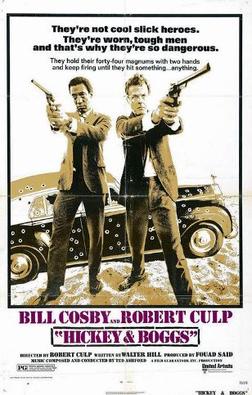
Hickey & Boggs (1972, directed by Robert Culp)


Frank Boggs (Robert Culp) and Al Hickey (Bill Cosby) are two private investigators who are constantly in danger of losing their licenses and going out of business.  Hickey is the responsible one.  Boggs is the seedy alcoholic.  When Hickey and Boggs are hired to track down a missing woman, their investigation lands them in the middle of a war between the mob and a group of political activists who are fighting over who is going to get the loot from a recent robbery.  Hickey and Boggs are targeted by the mob and soon, everyone is dying around them.

With its cynical themes and downbeat ending, Hickey & Boggs is very much a 70s film.  The script was written by future director Walter Hill and when it was eventually offered to Bill Cosby, Cosby agreed to star on the condition that his I Spy co-star, Robert Culp, be hired to direct.  Producer John Calley hired Culp but after Calley refused to provide the budget that Culp requested, Culp bought the script and raised the money himself.

There are a few problems with Hickey & Boggs, the main one being that the plot is next to impossible to follow.  As a director, Robert Culp apparently didn’t believe in either filming coverage or providing establishment shots so, especially early on, it is often impossible to tell how one scene is connected to another or even how much time has passed between scenes.  I don’t know if this was an intentional aesthetic decision or if the production just ran out of money before everything could be shot but it makes it difficult to get into the film’s already complicated story.  On a positive note, Culp did have a flair for staging action scenes.  The film ends with a shoot out on the beach that’s is handled with such skill that it almost makes up for what came before it.  Also, like many actors-turned-director, Culp proved himself capable of spotting talent.  Along with giving early roles to Vincent Gardenia, James Woods and Michael Moriarty, Culp also took the chance of casting sitcom mainstay Robert Mandan as a villain.  It was a risk but it worked as Mandan convincingly portrays the banality of evil.

Of course, the biggest problem with Hickey & Boggs is that it stars Bill Cosby as a straight-laced hero and that’s no longer a role that anyone’s willing to believe him in.  Cosby actually does give a convincing dramatic performance in Hickey & Boggs.  Just look at the final scene on the beach where Hickey has his “what have we done” moment and shows the type of regret that Cosby has never shown in real life.  The problem is that to really appreciate Cosby’s performance, you have to find a way to overlook the fact that he’s Bill Cosby and that something that I found impossible to do while watching Hickey & Boggs.  When you should be getting into the movie, you’re thinking about how many decades Bill Cosby was able to get away with drugging and assaulting women.  If not for a comment from Hannibal Buress that led to a social media uproar, Cosby would probably still be getting away with it.  If Buress’s anti-Cosby comments hadn’t been recorded and hadn’t gone viral, Bill Cosby would still be free and the media would probably still be holding him up as some sort of role model.

At the time Hickey & Boggs was made, both Bill Cosby and Robert Culp were at a career crossroads.  Cosby was hoping to transform himself into a film star.  Culp was hoping to become a director.  Hickey & Boggs, however, was disliked by critics and flopped at the box office.  Culp never directed another film and we all know what happened with Bill Cosby.  (Of course, it wasn’t just the box office failure of Hickey & Boggs that kept Cosby from becoming a movie star.  Say what you will about Robert Culp as a director, he had nothing to do with Leonard Part 6.)  Hickey  & Boggs is too disjointed to really work but Robert Culp and Bill Cosby were convincing action stars and the film’s downbeat style and cynical worldview is sometimes interesting.

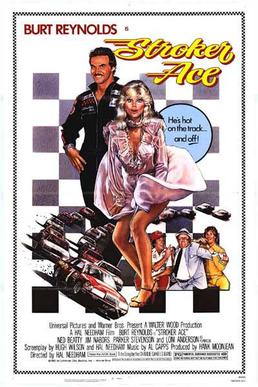
Stroker Ace (1983, directed by Hal Needham)


In 1983, Burt Reynolds had the choice of appearing in two films.

He was offered the role of former astronaut Garrett Breedlove in Terms of Endearment, a role that director/screenwriter James L. Brooks wrote specifically with Reynolds in mind.  The role was designed to play to all of Reynolds’s strengths and none of his weaknesses.  It was also a key supporting role in a film that was widely expected to be an Oscar contender.

Or, Reynolds could star in Stroker Ace, another car chase film that was going to be directed by his old friend, Hal Needham.  No one was expecting Stroker Ace to be an Oscar contender but Needham and Reynolds had made three similar films together and all of them had been hits at the box office.

Reynolds decided to star in Stroker Ace.  Jack Nicholson received the role of Garrett Breedlove and went on to win his second Oscar.  As for Burt, he later called Stroker Ace “the beginning of the end.”

The title character of Stroker Ace is a good old boy race car driver.  He’s a typical Reynolds character.  He grew up in the South and learned how to race cars by watching moonshiners outrun the police.  Now, he’s a star on the NASCAR circuit but he’s also arrogant and needlessly self-destructive.  Because this is a Hal Needham car chase movie, those are portrayed as being good traits.  When Stroker loses his former sponsor after pouring wet concrete on him, he’s forced to accept sponsorship from a crooked chicken mogul (played by Ned Beatty, who deserved better).  When Stroker’s not driving his car while dressed as a chicken, he’s romancing the prudish Pembrook Feeney (Loni Anderson).

It’s hard to describe the plot of Stroker Ace because it really doesn’t have a plot.  There’s a few scenes where Burt looks directly at the camera and smirks.  It’s supposed to remind us of Smoky and the Bandit but Stroker Ace doesn’t have the spectacular stunts that the first film had nor does it have the comedic energy of Jackie Gleason.  Instead, it’s got Jim Nabors as a mechanic named Lugs.  The former star of Gomer Pyle does say “Golly” but he doesn’t sing.

The main problem with Stroker Ace is that there’s no reason to root for Stroker Ace.  The Bandit was good at his job and cared about his car.  The same thing is true about the stuntman that Burt played in Hooper.  Stroker is a racer who would rather destroy his car than come in second and who loses his sponsorships because of his own stupid behavior.  Stroker Ace doesn’t care about anything so it’s difficult to get outraged over him having to wear a chicken suit while racing.

Reynolds later described turning down Terms of Endearment for Stoker Ace as being one of the biggest mistakes of his career.  When he talked about how the Terms of Endearment role won Nicholson an Oscar, Reynolds added that he didn’t win anything for Stroker Ace because “they don’t give awards for being stupid.”  It was a missed opportunity for sure and Reynolds would have to wait another fourteen years before Boogie Nights finally proved that he could do more than drive cars and smirk at the camera.

Despite the failure of Stroker Ace, Reynolds and Needham remained friends and even made two more film together (Cannonball Run II and Hostage Hotel).  Their friendship later served as the basis for the relationship between the characters played by Leonardo DiCaprio and Brad Pitt in Quentin Tarantino’s Once Upon A Time In Hollywood.