Since today is David Lynch’s birthday, it only seems appropriate to share what may be the most obscure of David Lynch’s early short films.
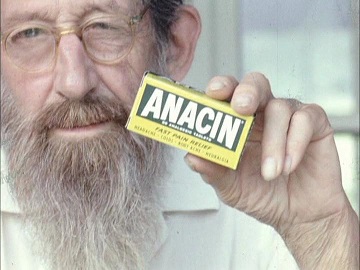
From 1967, Fictitious Anacin Commercial is a one-minute short film and a commercial for a real product. Jack Fisk, an early David Lynch collaborator who would later marry Sissy Spacek, plays a man in pain. God shows up, holding some aspirin. Suddenly, Jack Fisk is feeling a lot better. However, the audience is a little bit disturbed because God seems kind of menacing.
That’s my interpretation, anyways! David Lynch was 21 when he directed this film and it really is basically just a spoof of how commercials always act as if their product is the ultimate and only solution to whatever problem you’re having. One gets the feeling that, for the most part, Lynch and Fisk were just amusing themselves. And yet, because it is a Lynch film, there’s still a definitely unsettling vibe to it all. The man with Anacin almost seems like he could be an inhabitant of the Black Lodge.
Anyway, for your viewing pleasure, here is Fictitious Anacin Commercial!
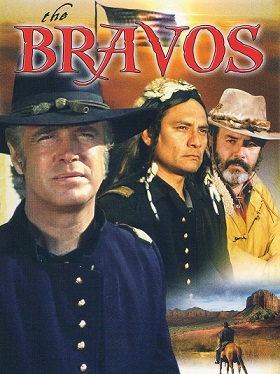
Major John David Harkness (George Peppard) is the commander of Fort Bravo, a small and ill-equipped frontier fort. Despite having only 77 soldiers and not many supplies, Harkness has managed to keep an uneasy peace between the local Indian tribes and the settlers who move through the area. The peace, however, is disturbed when an arrogant wagon master (Pernell Roberts) kills the son of the tribal chief.
That’s not all that Harkness has to worry about. A German outlaw (Bo Svenson) is hiding out at the camp. His head scout (L.Q. Jones) suspects that something is forcing the local tribes out of the area. Two settlers from Missouri (played by Barry Brown and Belinda Montgomery) are at the fort and trying to decide whether they should continue westward or return to Missouri. Finally, Harkness’s 12 year-old son, Peter (Vincent Van Patten), has been expelled from his New England boarding school and is being sent to Fort Bravo to live with his father. When Major Harkness refuses to turn the wagon master over to the Indians, they kidnap his son instead.
The Bravos was made for television and originally aired on ABC in 1972. It was apparently meant to serve as the pilot for a television series, one that would have followed the daily adventures of the Major, his son, and all of the men at Fort Bravo (who were played by television mainstays like Dana Elcar, Randolph Mantooth, and George Murdock.) For all intents and purposes, Pernell Roberts, Bo Svenson, Belinda Montgomery, and Barry Brown are all “special guest stars” and are meant to serve as examples of the type of television-friendly actors who would visit Fort Bravo on a weekly basis. That the pilot didn’t lead to a series isn’t surprising. TV westerns may have dominated the ratings in the 50s and the 60s but they quickly went out of fashion in the 70s as networks realized that they could make more money selling ad space for Norman Lear sitcoms and cop shows. In the 70s, the people that advertisers were wanting to reach were watching Archie Bunker and Starsky and Hutch, not George Peppard.
Because of its TV origins, The Bravos is a fairly bland western. It would be a few years before George Peppard would reinvent himself as a grizzled character actor and he’s sincere but fairly dull here. Pernell Roberts is more effective as the headstrong wagon master and perhaps The Bravos would have worked better if Roberts and Peppard had switched roles. In the end, the main reason to see the film is for the chance to see L.Q. Jones play a heroic role for once. A member of Sam Peckinpah’s stock company, Jones brings some authentic grit to his role as the fort’s only scout. Jones played a lot of villains but I always preferred him as one of the good guys.
The Bravos ends with a few major subplots unresolved. Maybe they would have been resolved during the show’s first season but it was not to be.
Adrian (Weston Cage Coppola) is an international criminal and terrorist, a man who isn’t going to let a little thing like being wanted by the FBI prevent him from getting what he wants. Adrian wants his brother to be freed from prison. He wants money. He wants a plane that he and his criminal associates can use to get out of the country. His plan is to take over a veteran’s hospital and hold the patients and the doctors hostage until he gets what he wants. Among the hostages is General Welch (Gerald Webb) of the Joint Chiefs of Staff.
Also inside of VA-33 is Jason Hill (Sean Patrick Flannery). Jason is a decorated veteran who is struggling with PTSD and a bad leg. Jason’s wife, Jennifer (Gina Holden), is a doctor at the hospital and also one of the hostages. With his 14 year-old daughter waiting for him outside and the initially skeptical police chief Malone (Michael Jai White) providing as much support as he can, Jason must take out of the terrorists and liberate VA-33.
Assault on VA-33 is an entertaining action film. The film was directed by Christopher Ray, the son of Fred Olen Ray. From his father, Christopher Ray obviously picked up the ability to make an enjoyable film on a low budget. However, Ray also served, for seven years, in the U.S. Navy and there’s a deep respect for veterans that runs throughout Assault on VA-33, a respect that sets this film apart from many of the other Die Hard-inspired action films that have come out over the years. For me, the film’s key scene is not any of the many action sequences but instead it’s when Jason first attempts to call the police and finds himself being dismissed because the man on the other end, upon hearing that Jason is at the VA, just assumes that Jason is suffering from paranoid hallucinations. “Thank you for your service,” the voice at the other end of the line says somewhat condescendingly as Jason struggles to get the police to understand that this is all really happening. The consequences of war is a theme that runs through the entire film as both Jason and the General struggle to deal with the physical and mental scars with which they’ve been afflicted.
Sean Patrick Flannery is a good action hero, playing Jason not as being superhuman but instead as just being a tough but weary man who, due to his past injuries, doesn’t move quite as fast as he used to but who is still trying to do the right thing and protect innocent people, including his wife and his daughter. Adrian’s henchmen are all properly memorable and menacing. I especially liked Tim McKiernan as the terrorist who is left in charge of the front desk. Rob Van Dam has some good moments as the terrorist who has been assigned to wait outside in the van and who keeps reminding everyone that his name is Zero.
Assault on VA-33 is a fun and quickly paced action movie. Flannery is an effective hero and the villains are all properly evil. I would also suggest sticking around through the end credits, just so you can enjoy the film’s musical score, which is definitely a bit better than the music that we typically associate with indie action films. It’s an enjoyable movie and a good way to spend 88 minutes of your life.
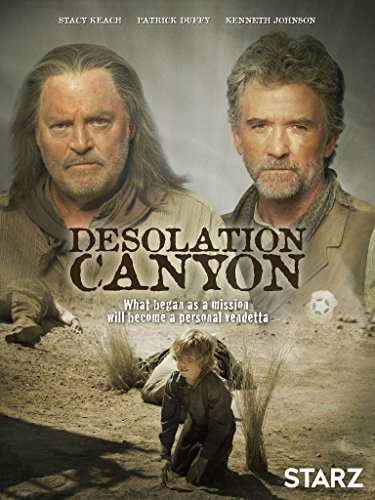
After robbing a bank in a small western town, an outlaw stops by the home of his estranged wife and takes his own son hostage. The town’s aging sheriff (Patrick Duffy) teams with the boy’s grandfather (Stacy Keach) to take the outlaw down and save the child’s life. Accompanying them is the bank president, Edwin Bornstein (David Rees Snell). Edwin may be a city boy who talks about how much he’s always wanted to say “I reckon,” but it turns out that there’s more to him than meets the eye. He’s also good with a gun.
I probably should have given up on Desolation Canyon as soon as I saw that it was a “Hallmark Presents” film but I like westerns and Stacy Keach has always done well whenever he’s been cast as a gunslinger so I decided to give it a try. Starting with a bank robbery and endings with a duel, Desolation Canyon is about as old-fashioned as an old-fashioned western can be. Because it was made by Hallmark, there’s nothing dangerous or edgy about the film. A few people do get shot but there’s no blood. The shoot outs in Red Dead Redemption are more violent and suspenseful than anything to be found in this film. (Of course, that’s because most of the shootouts in Red Dead Redemption occur because the play pushed the wrong button while trying to greet someone. I still feel bad for accidentally shooting the kindly old homesteader who just wanted someone to help him collect some flowers for his wife.) This is the type of western that you can safely watch with your grandparents, since that’s who the film was made for. That’s not bad because grandparents need movies to but if you’re looking for a complex or an unpredictable western in the style of a Larry McMurtry novel or a later Eastwood film, I reckon this ain’t it.
Giving some credit where credit is due, Stacy Keach, David Rees Snell, and even Patrick Duffy are credible in their roles. Stacy Keach is especially convincing a former gunfighter who can still outdraw anyone. Stacy Keach is 81 years old and still working. Someone needs to write a great Stacy Keach role and they need to do it now.
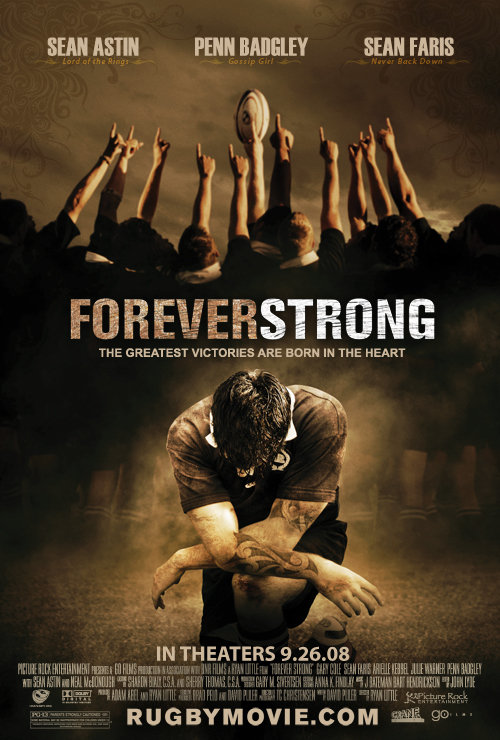
Rick Penning (Sean Faris) is the captain of his high school rugby team and the team’s highest scorer. He’s also the son of the team’s coach (Neal McDonough). Coach Penning is obsessed with winning at all costs and refuses to tell his son that he’s proud of him. Coach Penning believes that emotion equals weakness and that only losers brag about doing their best. After a loss to the Highland High school rugby team, which is coached by Larry Gelwix (Gary Cole), Rick and his teammates blow of steam by drinking, driving, and crashing a car.
Rick is sentenced to juvie but his case officer (Sean Astin) can see that Rick needs rugby in his life so he arranges for Rick to play with the Highland Team. At first, Rick resents the new team and doesn’t want to follow Coach Gelwix’s advice on or off the field. Coach Gelwix makes the team do community projects while they’re not training and Rick says that’s not his thing. Rick just wants to score points and he doesn’t care about teamwork. But the team and the coach eventually win Rick over and, once Rick gets over being selfish and starts playing for the team instead of just himself, Highland High starts winning games and Rick becomes the team’s newest captain. But, when Rick gets paroled from juvie, he’s sent back home to his father, who expects Rick to reveal all of Highland’s secret plays and weaknesses. When Rick refuses to betray Coach Gelwix, his former teammates frame him and get him sent back to juvie. Rick ends up playing for Highland again, just in time for the state championship and a chance to lead Highland against his father’s team.
Forever Strong had a good message but, from the first minute, I know what was going to happen and how it was going to all end. The story was pretty predictable and the movie seemed to assume that everyone watching would already know everything that they needed to know about rugby. At my high school, athletics pretty much meant football. I don’t think we even had a rugby team. (If we did, we never cheered at their games, which I feel bad about.) Whenever everyone in the movie was arguing about the right way to play rugby and which position on the team was the most important, I was lost. I did like Gary Cole as Coach Gelwix. He was the type of coach that every parent should hope coaches their child’s team.
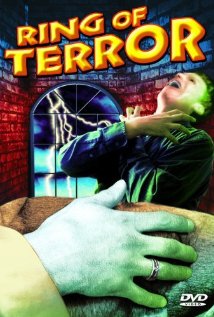
Whilst stumbling around his office in a drunken daze, graveyard keeper R.J. Dobson (Joseph Conway) accidentally steps on his cat’s tail. The cat runs out of the office. Dobson stumbles after it. Dobson eventually finds the cat sitting by a grave in the cemetery. Dobson picks the cat up and starts to tell it (or maybe the people watching at home), the story behind the tombstone.
Lewis B. Moffit (George E. Mather) was a med student who had a reputation for not being scared of anything. He killed a rattlesnake without a second’s hesitation. He didn’t flinch while watching an autopsy. For some reason, this upsets his frat brothers so they decide to pull a prank on him to see how brave he really is. As a part of his initiation, Lewis has to break into the mortuary and retrieve a gold ring off of a corpse’s finger. Of course, the prank goes wrong and there are serious consequences to Lewis’s sanity.
Ring of Terror is based on the old urban legend in which a promising but tightly wound college student is either killed or driven mad by a thoughtless fraternity prank. Ring of Terror doesn’t really add anything to the basic story. The only thing that distinguishes it is that all of the college students are played by middle-aged actors so they all seem as if they should have graduated from college and outgrown the frat life a long time ago. George E. Mather was in his 40s when he starred in this film so even if the prank hadn’t broken his mind and he had graduated from medical school, he wouldn’t have had a very long practice.
The story would feel slight for even a 30-minute episode of The Twilight Zone so the director tries to pad out Ring of Terror with a visit to a “swinging” jazz club (and I use the term swinging loosely because there ain’t swinging about that joint), an autopsy, and, of course, those scenes in the cemetery with RJ and his cat. The padding doesn’t help make the story any more intersting but the autopsy scene is at least amusing. Because all of the college students are played by middle-aged actors and are wearing suits, the scene really does look as if a group of wall street brokers decided to spend their lunch hour in the hospital basement. It’s like the episode of Seinfeld where Jerry and Kramer observe an operation and accidentally drop a junior mint in the patient’s chest cavity.
Today, Ring of Terror is best known for being featured on an early episode of Mystery Science Theater 3000. (It was actually such a short movie that it had to be paired up with the third chapter of The Phantom Creeps serial.) I’ve seen both the original version and the version with Joel and the Bots and the MST 3K way is the best way to watch this movie. Without Joel and the Bots, it’s so slow and poorly acted that it is nearly unwatchable. With Joel and the Bots, there’s at least a few laughs to be found.
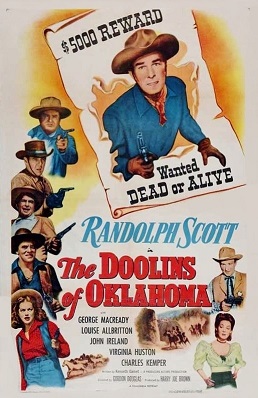
Randolph Scott stars in The Doolins of Oklahoma, a fictionalized account of the career of the real-life western outlaw, Bill Doolin.
Doolin (played, naturally, by Randolph Scott) may have once rode with the fearsome Dalton Brothers but, according to this film, he was actually just an ordinary, salt of the Earth type who wanted to settle down with the right woman and lead a normal life. It looks like he might get that opportunity after the Daltons are killed and Doolin tires of leading his own gang of outlaws. Doolin settles in a Oklahoma town, takes a new name, and falls in love with Elaine (Virginia Hutton). But when both the members of his old gang and a veteran lawman (George Macready) show up in town, Doolin learns that the past cannot be escaped.
The plot of The Doolins of Oklahoma is nothing special, though it’s portrayal of the outlaws being more honorable than law enforcement may have been surprising in 1949. The main thing that distinguishes The Doolins of Oklahoma is the cast, which is full of western veterans like John Ireland, Noah Beery Jr., Charles Kemper, Frank Fenton, and Jock Mahoney. Not surprisingly Randolph Scott is ideally cast as a weary cowboy who just wants to settle down and live the rest of his life in peace. Scott is well-matched by MacReady, as the marshal who will not let anything stand in the way doing his duty as a member of law enforcement. Gordon Douglas directs crisply and energetically and every member of the main cast gets at least one big moment in which to distinguish themselves. The Doolins of Oklahoma may not be a groundbreaking film but it will be enjoyed by fans of the western genre.
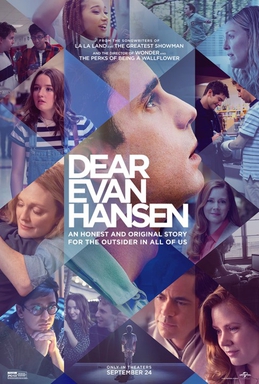
Dear Evan Hansen is the film adaptation of the Tony-award winning Broadway musical of the same name. Recreating his stage role, Ben Platt plays Evan Hansen, a teenager who suffers from social anxiety and who is mistaken for having been the best friend of Connor Murphy (Colton Ryan), a troubled classmate who committed suicide after stealing a letter that Evan had written to himself. (Somewhat awkwardly, it was also a letter in which Evan somewhat obliquely wrote about the crush that he had on a member of Connor’s family.) When the letter is subsequently found on Connor’s body, it’s assumed that it’s a suicide note that Connor meant for Evan. Evan, who is in love with Connor’s sister, Zoe (Kaitlyn Dever), allows everyone to believe that he and Connor were friends. Connor’s mother, Cynthia, (Amy Adams) and his stepfather (Danny Pino) adopt Evan as a sort of replacement for their dead son. Cynthia views Evan as being the only way that she’ll ever understand what Connor was going through and Evan continually reassures that Murphys that Connor really did love all of them and that he was trying to change his life for the better. With the Murphys now treating Evan as a member of their own family, Evan’s mother (Julianne Moore) feels that her son is now ashamed of her. And Evan’s classmate, Alana (Amandla Stenberg), launches a movement to raise money to preserve the apple orchard where Evan claims that he and Connor spent all of their time together.
As a musical, Dear Evan Hansen was very popular. As a film, it doesn’t work and it doesn’t work for all the reasons that everyone assumed that it wouldn’t work. Believe me, I wanted it work. From the minute that the trailer first dropped, the reaction to the film has been so overwhelmingly negative that I was really hoping that the film itself would turn out to be an overlooked gem. I was really hoping that this would be one of those underappreciated films that just needed a few brave champions. Instead, it turned out to be not terrible in the way that Cats was terrible but still too flawed to be considered a success.
First off, the plot itself doesn’t transition well from the stage to film. There’s too many holes and there’s too many places in the story where you find yourself wondering why you should care about Evan and his problems. Those plot holes may not have been as big of a problem when the story was presented on the stage because watching any story play out against an artificial backdrop requires a certain suspension of disbelief. But, on film, seeing Evan attending an actual school and walking down an actual street and visiting an actual house, you’re much more aware of how inauthentic the story feels. Evan’s actions rarely make sense and it’s difficult to accept that anyone, even Connor’s emotionally desperate parents, would believe the stories that Evan concocts about his friendship with Connor. On stage, you could perhaps accept that Zoe would buy that Evan and Connor were friends who confided in each other despite the fact that Evan doesn’t seem to know anything about Connor’s family or home life. On screen, especially when one considers the fierce intelligence that Kaitlyn Dever brings to the role of Zoe, it’s a bit more difficult to believe.
The other big problem with the film is Ben Platt is too old for the role of Evan. Platt first played the role in 2015, when he was 23. He won a Tony and certainly, he deserves a lot of credit for creating the role from the workshop phase all the way to Broadway. Now, however, he’s 28 and he looks considerably older. So much of what Evan does is acceptable only if you believe that he’s an immature 17 year-old who is desperately looking for a place and a family where he belongs. The same actions go from being poignant to being creepy when they’re done by someone who appears to be in his mid-30s. While Platt has a great singing voice and shines in the musical numbers, he’s a bit too mannered when he just has to recite dialogue. He’s still giving a stage performance, even though he’s now playing the role on film and everyone around him is giving a film performance. Platt’s talent is undeniable but he’s miscast here and casting him opposite performers who can actually still pass for teenagers doesn’t help the situation at all.
(When I watched the film, I thought that obvious age difference between Ben Platt and Kaitlyn Dever occasionally made the scenes between Evan and Zoe uncomfortable to watch. Then I did some research and discovered that Dever is only three years younger than Platt. It’s just that Dever still looks like a teen while Platt looks very much like an adult. And there’s no shame in looking your age. Someone just needs to cast Platt in an adult role.)
In Platt’s defense, the film doesn’t really make perfect use of any of the members of its talented cast. Amy Adams is such a good actress but the film casts her as a stereotypically flakey rich suburbanite who flitters from one trend to another. Julianne Moore and Amandla Stenberg are similarly wasted, playing characters who have potential but who are never quite given as much to do as they deserve. Of the cast, Kaitlyn Dever is the stand-out, even though Zoe is a bit of an inconsistent character. Initially, she seems like the one person willing to call out everyone on their BS and then, just as suddenly, she’s oddly forgiving of someone who essentially manipulated her emotions for his own benefit.
Not surprisingly, Dear Evan Hansen works best when people are singing. Ben Platt and Colton Ryan bring so much energy to Sincerely, Me that I briefly had hope that the film was turning itself around. Unfortunately, that wasn’t the case but still, it’s a good production number. Unfortunately, the rest of the movie doesn’t really live up to it.
She says it’s because Jack “won’t stop teasing me.” Is Jack to blame or does Judy need to toughen up? Should Jack’s classmates have said, “Lay off?” Should Judy’s friends have tattled to the teacher? Should Judy have teased Jack back? What would you do?
This short film from 1951 considers all of those issues and yet, it’s hard not to feel that the ultimate message is that Judy needs to stop taking everything so personally. Sorry, movie. Sorry, judgmental narrator. I disagree. Myself, I think the skinny kid with the glasses should have followed through with his threat to beat Jack up. Up until I was 12, I had a really severe stutter so I know what Judy was going through. Fortunately, in my case, I also had three older sisters and a bunch of overprotective cousins that were always looking after me. Judy doesn’t seem to have that type of support system. To be honest, in most cases like this, I put the blame on the teachers. Jack and Judy are sitting up at the front of the class so there’s really no excuse for no one noticing what was going on.
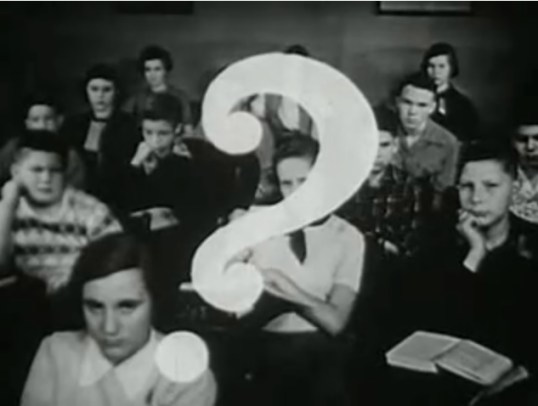
This short film is another one that feels like a Herk Harvey production but it was actually directed by Arthur Wolf. My favorite shot is the entire class staring at the camera while the narrator asks, “What would you do?” Seriously, someone’s in a lot of trouble once these kids come to a consensus on who is to blame.
From 1951, it’s time to consider …. The Other’s Fellow’s Feelings.
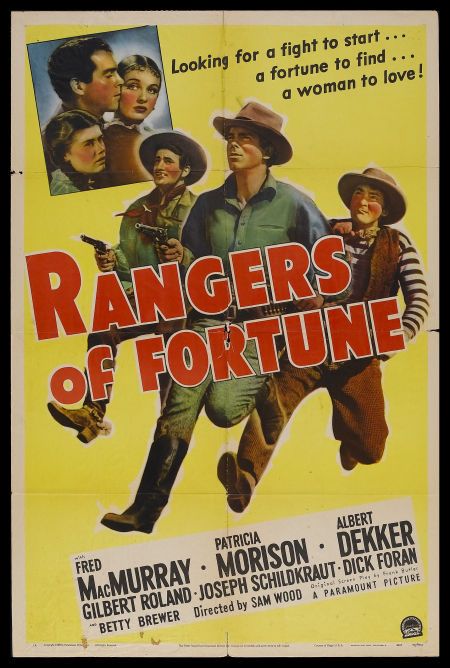
After narrowly avoiding execution by a firing squad in Mexico, three good natured outlaws head back to Texas. Gil (Fred MacMurray) is their leader, a former army officer. Antonio (GIlbert Roland) is the charming caballero. George (Albert Dekker!) is the punch-drunk former prizefighter who provides comedic relief. When they reach Texas, they meet and become involved in the efforts of a newspaper publisher (Brandon Tynan) and his daughter (Betty Brewer) to free their hometown from the control of an aristocratic landowner named Col. Rebstock (Joseph Schildkraut), who rules the town with the help of a sadistic group of cowboys. It turns out that the three outlaws aren’t so bad while the respectable and wealthy Col. Rebstock is as bad as they come.
Rangers of Fortune is a standard 1940’s western programmer, though it’s distinguished by a better than usual cast and the quick-paced direction of Sam Wood. It starts out almost as a comedy, with MacMurray, Roland, and Dekker cracking jokes and getting the better of almost anyone that they come across. The screenwriter of Rangers of Fortune, Frank Butler, also wrote some of Bing Crosby and Bob Hope’s road films and he’s just as good as coming up with comedic dialogue for the team of MacMurray, Roland, and Dekker as he was for Hope and Crosby.
But the movie takes a serious turn once MacMurray, Roland, and Dekker cross the Texas border and they discover that Col. Rebstock will do almost anything and kill just about anyone to keep his hold on the town. Even a successful scheme to install Gil as sheriff just leads to more innocent people dying. When Rangers of Fortune turns dark, it turns very dark, with characters, who we usually don’t expect to die in a film like this, meeting a violent end. Though it won’t convert any skeptics, it’s an interesting film for those who are already fans of old Hollywood westerns.
Rangers of Fortune has never gotten a proper video release but it is on YouTube. Unfortunately, the copy uploaded to YouTube was in terrible condition so it’s difficult to fairly judge the film’s production values. However, even on a damaged print, the natural authority of Fred MacMurray’s lead performance comes through and Joseph Schildkraut is as good a villain as always. Patricia Morrison plays the prettiest girl in town and, even on YouTube, it’s easy to see why every man in town is competing for her attentions. Seeing Albert Dekker, usually cast as intelligent and often conniving character, playing dumb is also an interesting experience, even on a bad print. Hopefully, someday, Rangers of Fortune will get a decent restoration.

 Through the Shattered Lens