Retro Television Review: City Killer (dir by Robert Michael Lewis)


Welcome to Retro Television Reviews, a feature where we review some of our favorite and least favorite shows of the past!  On Sundays, I will be reviewing the made-for-television movies that used to be a primetime mainstay.  Today’s film is 1984’s City Killer.  It  can be viewed on YouTube!
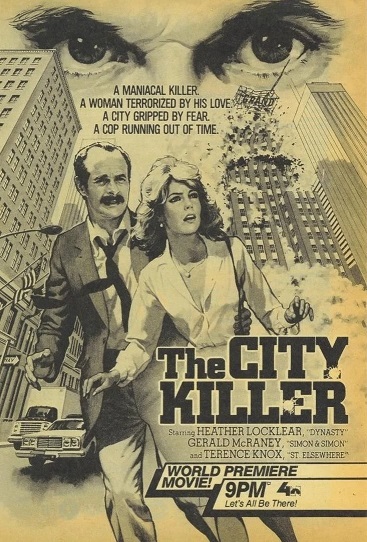
Leo Kalb (Terrence Knox) has come to Chicago.  In many ways, Leo would appear to have a lot going for him.  He’s intelligent.  He’s reasonably good looking.  He served honorably in the military.  Despite his intelligence, he comes across as being a bit of an innocent in the big city.  He’s got a good job, working as an electrician.  It might not be glamorous work but there’s always something appealing about a man who knows how to work with his hands.

Unfortunately, all of those appealing qualities are negated by the fact that Leo’s a loon.  The main reason he’s come to Chicago is to stalk Andrea McKnight (Heather Locklear).  The main reason that Andrea moved to Chicago was to get away from Leo.  Like Leo, Andrea has found some success in Chicago but that’s all turned upside down when Leo calls her and says that he wants to get back together.  Andrea doesn’t want anything to do with Leo so Leo starts blowing up buildings.

That’s right, he starts blowing up buildings.  He also announces that he wants the city of Chicago to pay him an exorbitant amount of money.  He wants a helicopter to fly him to the airport.  He wants to take an airplane to South America, where his bomb-building skills will presumably be put to good use by the The Shining Path.  And he wants Andrea to come with him.  As become clear, the money and the plane are really just red herrings.  Mostly, he just wants Andrea.  The press calls him the Love Bomber.

Lt. Eckford (Gerald McRaney) is assigned to try to negotiate with Leo and also to keep an eye on Andrea.  Needless to say, Andrea takes one look at Lt. Eckford’s powerful mustache and she starts to fall in love with him.  Eckford, meanwhile, starts to fall Andrea, even though he’s a bit older than her and there’s a paternal element to the way that he talks to her that just makes the whole thing feel kind of icky.  (That said, if a mad bomber is blowing up the city just because you won’t date him, it’s perhaps understandable that you would fall for the first person who could not only provide protection but who also didn’t try to make you feel guilty about what was going on.)  Leo senses that Andrea and Eckford are falling in love and he becomes determined to blow up even more stuff.

City Killer is a bit of ridiculous film.  The main problem is that the viewer is asked to believe that, even though Leo is the most wanted man in Chicago and is dominating all the headlines, he could still safely wander around the city and wire building to explode without anyone noticing.  The film presents itself as being a police procedural but one gets the feeling that police must be incredibly incompetent for Leo to successfully blow up so many buildings.  That said, Gerald McRaney is a properly sturdy hero and Terrence Knox is convincingly unhinged as Leo, begging Andrea to love him even while threatening to blow up the very building on which she’s standing.  Heather Locklear doesn’t got to do much, other than answer the phone and look upset whenever a building explodes, but she does it well.  As a veteran TV actress, she knew how to embrace the melodrama and, when you’re appearing in a film like City Killer, that’s the best thing you can do.

Film Review: Elvis (dir by Baz Luhrmann)


Elvis the movie has much in common with Elvis the entertainer.

Both the movie and the entertainer (who is played, in the film, by Austin Butler) start strong, fall apart at the end, and leave you with a tear in one of your eyes once it’s all over.

Both the movie and the entertainer are big and unapologetically excessive yet also undeniably earnest as well.  Considering the amount of music that appears in the film (from both Elvis Presley and others), it’s significant that the final song played is In The Ghetto, which features Elvis at both his most naïve, his most sincere, and at what some of his critics would call his most offensive.

Both the movie and the entertainer are occasionally shallow but both of them want to be about more than just screaming fans, libidinal desires, and radio-friendly songs.  While Elvis (played by Austin Butler) watches the funeral of Martin Luther King, Jr. and the assassination of Bobby Kennedy and wonders how he should respond, the movie tries to make sense of and find a deeper meaning in the world’s fascination with kitschy Americana.  The movie suggests that Elvis spent much of the 60s on the outside looking in and the same could be said of Australian director Baz Luhrmann and his attempts to observe and capture the contradictions inherent in American culture.  Luhrmann’s kinetic style, which is one of those things that viewers will either love or hate, serves not just to capture the frantic energy of the late 50s and the 60s but it also allows him to remain detached from the world that he’s recreating.  It’s his way of reminding us that, though the story may be about a real person and a real moment in time, it’s still just a movie and, even during the film’s most intimate moments, the audience is still on the outside looking in.  We are the outsiders peeping in on the insiders, watching through a locked window that allows us to observe but not to interact.  This is history as a fever dream.

Finally, both Elvis the movie and Elvis the entertainer face the same dilemma.  What to do about Colonel Tom Parker?  Tom Parker was the former sideshow carny-turned-promoter who took credit for discovering Elvis and who managed his career.  Of course, he wasn’t really a colonel.  His name wasn’t Tom Parker.  And despite his claims to the contrary, he wasn’t born in West Virginia.  No one, not even the film’s version of Elvis, seemed to be sure who Col. Parker really was.  Parker is typically cast as the villain in the story of Elvis’s self-destruction.  He made a lot of money off of Elvis but he also put Elvis is bad movies and trapped him in a Las Vegas residency.  He made sure that Elvis got the pills that he needed to keep performing.

In the film, Parker narrates the story from his deathbed and angrily denounces anyone who would say that he was responsible for Elvis’s death.  When he talks about the gamble he took on Elvis, Parker’s seen staggering through a casino while still wearing a hospital gown.  Parker is played by Tom Hanks, who wears a prosthetic nose and speaks in an almost unintelligible accent.  My first reaction to Hanks’s performance was to think, “Could they not have gotten Christoph Waltz for this role?”  There’s nothing subtle about Hanks’s performance but then again, there’s never been anything subtle about Luhrmann as a filmmaker.  As the film progressed, I started to better appreciate what Luhrmann was doing with the character and I think I even came to understand his motives for casting Hanks.  If Austin Butler’s Elvis is meant to represent the optimism and the hope of America then it makes sense that he would be shadowed by the dark side of kitsch and there’s nothing more kitschy then casting an actor like Tom Hanks as the Devil.  As an actor, Hanks is often casts in roles where he epitomizes old-fashioned integrity.  By casting him as Col. Parker, Luhrmann challenges our expectations of who Tom Hanks can be in much the same way that Elvis challenged expectations of how music could be performed.  This is a film that is fully aware of the irony of Elvis coming to symbolize America while his career was being managed and his image carefully constructed by a man who entered the country illegally and who couldn’t reveal his real name or his real biography.  If Tom Hanks sometimes seems lost in the role of Col. Parker, it helps to remind us that Parker himself was often lost in America.  If Tom Hanks is usually cast as the epitome of American exceptionalism, his casting here reminds us that Col. Parker was a man who achieved the American dream and who came to represent the American nightmare.

In the end, it’s Austin Butler’s performance as Elvis that keeps the movie from spinning out of control.  Even while surrounded by Luhrmann’s stylistic touches and Tom Hanks’s bizarre performance, Austin Butler keeps the film grounded in reality by turning Elvis into a human being, a talented singer who loves his success but who also fears that he’ll never truly be worthy of it.  Butler gives a performance that is full of sexual swagger but which also finds room for the small moments in which Elvis reverts back to being a lost child who feels like he needs someone to look after him.  Interestingly enough, there aren’t many scenes in the film in which Elvis and Col. Parker show much affection toward each other.  Instead, each feels like he needs the other to survive and, to a certain extent, they each resent the other because of that dependence.  Austin Butler’s Elvis is the king when he’s on stage but, when he’s off-stage, he’s just another outsider looking in.  Elvis becomes a symbol of America but the American establishment is only willing to fully accept him after he’s gone.  If nothing else, this role should make a star out of Austin Butler.  Before he played Elvis, Butler was best known for playing murderer Tex Watson is another fever dream of history, Tarantino’s Once Upon A Time In Hollywood.  In Elvis, the title character retreats into his hotel room after reading about the murders that Tex Watson, under the direction of Charles Manson, took part in.  As both a film and a character, Elvis understands that society is just as quick to destroy its celebrities as it is to idolize them.

Elvis is a flawed film, make no mistake.  How the viewer reacts to it will largely depend on how much tolerance that viewer has for Luhrmann’s flamboyant style.  At 2 hours and 38 minutes, it feels a bit overlong and, despite all of Luhrmann’s stylistic flourishes, the final fourth of the film is a conventional “rock star in decline” story.  (In one way or another, these flaws are present in almost all of Luhrmann’s films, allowing one to wonder when a flaw ceases to become a flaw and instead becomes a directorial trademark.)  Elvis is undeniably a Baz Luhrmann film but, fortunately, it’s also an Austin Butler film.  It’s a big, sprawling, overwhelming, sometimes annoying and often very moving piece of cultural history.  It’s a work of pure, unapologetic showmanship.  Elvis probably would have lost interest after the first hour but Col. Parker would have loved it.

A Blast From The Past: Book Him! (dir by Sid Davis)


In this 1971 Sid Davis-produced educational film, young teens learn that going to jail isn’t as much fun as they might think.  After exploring all of the crimes that are on the rise (vandalism, shop lifting, etc.), the film follows Jerry as he gets arrested, gets booked, and gets shown to a cell.  As is typical with Sid Davis’s films, there’s a narrator present to let Jerry know that he’s ruined his life.

I’ve never been arrested but I know a few people who have been and, just from what they’ve told me, it appears that Jerry was lucky enough to go to one of the nicer jails.  As for the rest of the film, it’s a history nerd’s dream.  Just look at those clothes!  Just look at the hair!  Just look at 1971!

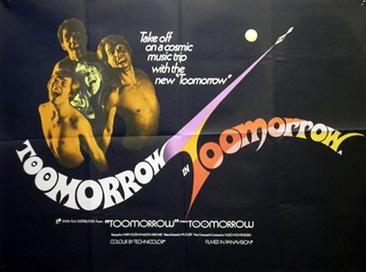
Film Review: Toomorrow (dir by Val Guest)


The 1970ish film Toomorrow tells the story of a group of students who are determined to make their way through art school despite not having much money.  They do what they can to cut down on costs.  For instance, they all live in one big, communal house.  And even though they think that the protestors in the streets are totally groovy and happening in a far out way, they decline to really get involved with any of it because bail’s expensive.

(At least, that’s what I assume is going on in the protest scenes.  This isn’t exactly the most coherent film ever made.)

The students also pay for college by forming their own band!  Calling themselves Toomorrow, they make use of a new instrument called the Tonaliser!  The Tonaliser sends out sonic vibrations that put everyone into a good, dancing mood!  The Tonaliser is so powerful that the vibrations are even felt in outer space.

It turns out that there’s a group of aliens who have all the technology in the world but who have never figured out how to create music.  They really want to learn, though.  Music is the one thing that their society needs.  The aliens, represented by Johnny Williams (played by the great character actor Roy Dotrice, who looks embarrassed to be in this film), abduct Toomorrow so that Toomorrow can teach them how to appreciate music.  Toomorrow has no problem with doing that but they’re going to need help to focus or …. something.  I don’t know.  This movie is impossible to follow.  All I know is that an alien woman goes down to Earth to keep Toomorrow focused and there’s a scene where she’s taken to an adult Swedish movie so that she can learn about human anatomy.  Or something.

Yes, it’s Toomorrow!  A film about hippies that was meant to appeal to hippies but which was definitely made by people who were not hippies themselves.  The film does it best to show off its counter-culture bona fides, what with the commune and the art school and the protests and the band’s lead singer waking up with a different woman every morning and a barely there subplot about a professor having an affair with the member of the band.  But none of it feels very authentic, largely because all of the hippies are very clean-cut and none of the protestors are really protesting anything specific as much as they’re just walking around with signs.  All of the “shocking” counter-culture behavior takes place off-screen.  Randy Newman once described Horse With No Name as being “song about a kid who thinks he’s taken acid” and Toomorrow is a film that was obviously made by that kid’s grandparents.  As for Toomorrow the band, their music is nothing special.  In fact, there’s really not a single memorable song to be found in Toomorrow the film.  The aliens could have just waited a few years and abducted the house band from the Brady Bunch Variety Hour.

You may have noticed that I mentioned that the film was a “1970ish” film.  That’s because Toomorrow didn’t receive an actual theatrical release.  It was produced by Harry Saltzman (who also co-produced the first 9 James Bond films) and Don Kirshner, the music promoter who was responsible for The Monkees.  It was directed by veteran British director Val Guest.  When Saltzman and Kirshner failed to pay Guest and the rest of the crew for their work on the film, Guest sued and, as a result, Toomorrow spent decades held up in litigation.  It was only released on video because everyone who was suing eventually died with the case unresolved.

If Toomorrow is known for anything, it’s for being the film debut of a young Olivia Newton-John.  Olivia played a member of Toomorrow but she doesn’t get to do much, beyond smiling cheerfully while either performing and passing out tea at the commune.  Olivia reportedly had such a terrible time on the set of Toomorrow that she swore she would never make another film and nearly turned down Grease as a result.  That said, Olivia is probably the best thing about Toomorrow.  She’s the only member of the band with any screen presence and probably the only one of them who could have talked the aliens into not blowing up the Earth.

Toomorrow can be viewed on YouTube.  It’s interesting as an example of how much the old film establishment struggled to figure out how to appeal to younger filmgoers in the late 60s and early 70s.  Every moment in the film has been calculated to appeal to “the kids” but it’s precisely because it’s so calculated that the film ultimately fails.  There would be no tomorrow for Toomorrow.

A Blast From The Past: Year 1999 A.D. (dir by Lee Madden)


Produced by the Philco-Ford Corporation in 1967, Year 1999 A.D. is an example of one of my favorite genres, a film that attempts to predict what was then the future but which today is the past!  When this film was released, 1999 was 32 years away.  Now, of course, it’s 23 years in the past.

That said, this film does a better version than most when it comes to predicting the future.  It may have been off by a few years, as much of what it shows was only in its beginning stages in 1999 and only came to be commonplace in the 21st Century, but it gets a lot of things right.  We do shop online.  Remote learning has been a reality for a while now.  There are apps that can do everything that’s shown in the film.  Towards the end of this film, even YouTube makes an appearance.  What the film gets wrong is its assumption that everything in the future would still be as bulky and space-consuming as it was in the film’s present.  The movie got a lot right but it came nowhere close to predicting iPhones and laptops.  It predicted email but it didn’t predict Twitter, which is perhaps why everyone in the movie seems to be so happy.

The film has kind of a strange tone at the beginning.  The scenes on the beach feel oddly melancholy and the music that plays as the mother and son leave the beach made me wonder if they were about to stumble over the remains of the Statue of Liberty.  The movie is supposed to be a celebration of the wonderful future that humanity has waiting for itself but that opening music makes it seem as if maybe technology has gone too far.  Have we sacrificed our souls for comfort?

My friend Mark introduced me to this film.  He’s also pretty confident that Soon-Tek Oh appears in the party scene and I think he may be right.  If nothing else, it certainly sounds like he’s one of the guests speaking to the owner of the house.  The singer at the end was apparently Bobby Capo, a Puerto Rican singer who died of a heart attack in 1989.

As far as vision of the future are concerned, Year 1999 A.D. wasn’t that far off.  Director Lee Madden did a lot of industrial films but he’s best-remembered for directing biker films like Hells Angels ’69 and Angels Unchained.  It’s hard not to notice that there aren’t any bikers in his vision of the future.

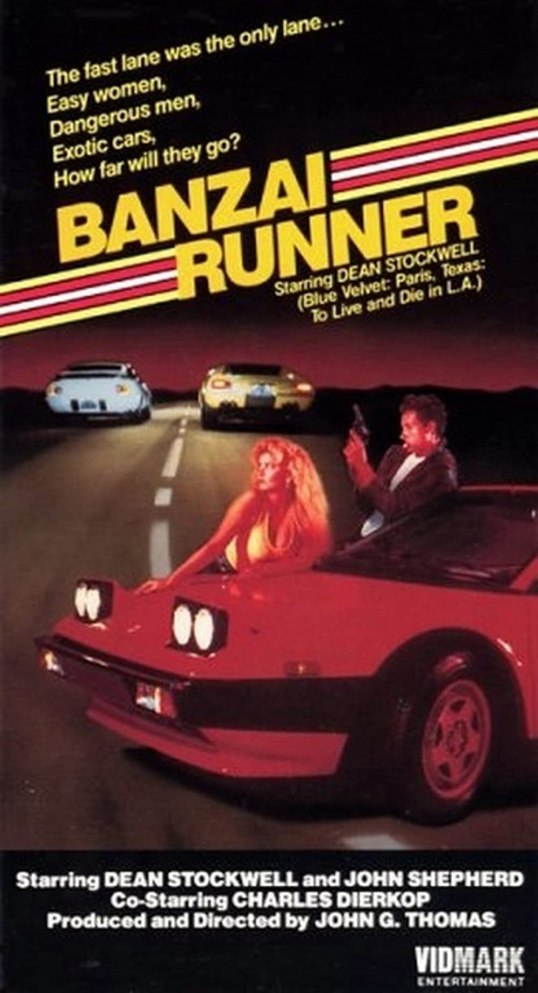
What Lisa Marie Watched Last Night #222: Banzai Runner (dir by John G. Thomas)


Last night, I watched the 1987 film, Banzai Runner!

Why Was I Watching It?

Last night, it was my turn to host the #MondayActionMovie live tweet!  The loyal members of MAM trusted me to find an exciting, action-filled movie with which they could start their week.  I failed.

What Was It About?

Listen, it’s not totally my fault.  I checked with the IMDb.  I checked Wikipedia.  I read the film’s description on YouTube.  They all said that the film starred Dean Stockwell as a cop who goes undercover to bring down a group of wealthy street racers.

And technically, that is what the film’s about but only at the very end.  Before we get around to any of that fun stuff, the film is basically just Highway Patrolman Billy Baxter (Dean Stockwell) driving around the desert and trying to keep his dumbass nephew, Beck (John Shepard), from getting into trouble.  How big of a dumbass is Beck?  He’s so dumb that he lights up a joint while he’s driving and while his uncle — the policeman — is sitting right next to him.  Needless to say, Billy gets upset about that.  (The scene is amusing if — and only if — you know that Dean Stockwell was one of Hollywood’s most prominent hippies.)

Eventually, Billy and Beck do go undercover to take out Syszek (Billy Drago), a wealthy drug dealer who likes to street race but who also does to much cocaine.  In a coincidence that comes out of nowhere, it turns out that Syszek is responsible for the death of Billy’s brother and Beck’s father.  Neither Billy nor Beck really seem to be too upset about it, though.

What Didn’t Work?
(Usually I like to start with what did work but I’m making an exception here.)

It’s an 84 minute film (not counting the end credits).  It takes 60 minutes for Billy to go undercover.  It takes another 5 minutes or so for Billy to actually meet Syszek.  The only reason that anyone is going be watching this film is because they want to see Dean Stockwell and Billy Drago race against each other but that part of the film doesn’t even kick in until the movie is nearly over!  Instead, we get an hour of Billy aimlessly doing his job and Beck complaining about his uncle being too strict.  It’s very slow and dull.

Dean Stockwell was a good actor who gave some wonderfully eccentric performances in his adult years but he’s miscast as Billy.  John Shepherd played Tommy in Friday the 13th: A New Beginning and I’ve always preferred Shepherd’s interpretation of the character over Thom Matthews’s performance in Jason Lives.  Shepherd had an appealing vulnerability in A New Beginning but none of that is present in Banzai Runners.  It doesn’t help that the script portrays Beck as being a combination of every bad boyfriend I had from the sixth grade through my senior year of high school.

What Worked?

I’m a Southern girl and I’m also enough of a country girl that I do have a weakness for fast cars and the people who drive them.  So, I could appreciate the film on that level.  The car chases were fun, I just wish that there had been more of them.  All of those scenes of Billy worrying about paying his mortgage (and yes, that was a huge subplot during the first hour of the film) should have been edited out and replaced with scenes from The Wraith.  Or maybe just the Shangri-Las singing Leader of the Pack.

“Oh my God!  Just like me!” Moments

There’s a scene where the rich daughter of one of the racers announce that she’ll remove a piece of clothing for every mile that Beck goes over 55.  On the one hand, it’s a scene that feels like it was lifted from a Crown International cheerleader film.  On the other hand …. well, like I said, I had a weakness for bad boys who drove fast cars.  So, even in this rather bland film, I still found someone to whom I could relate.  Yay!

Lessons Learned

Never assume that a movie is exciting just because of its name.

The Bad Guys (dir by Pierre Perifel)


I’ve always loved movies about heists, and The Bad Guys hits the mark on so many levels. Based on the Scholastic books by Aaron Blabey, The Bad Guys focuses on a group of thieves known for their dastardly deeds. They also happen to be some of the scariest animals around. We have Mr. Wolf (Sam Rockwell, Moon), the charismatic leader of the group. Mr. Shark (Craig Robinson, This is the End) is a master of disguise. Mr. Snake (Marc Maron, Netflix’s Glow) can slither through any vent and doubles as rope when necessary. Mr. Piranha (Anthony Ramos, In the Heights) is the brute force / muscle of the team. And finally, my favorite is Ms. Tarantula, a.k.a. “Webs” (Awkwafina, Jumanji: The Next Level), who can hack into any computer system. They are the 2nd most wanted thieves in the city (the top spot going to the elusive jewel thief , The Crimson Paw) and Officer Misty Luggins (Alex Bornstein, Amazon’s The Marvelous Mrs. Maisel) is doing her best to apprehend them.

After a cool opening that introduces us to the team, they’re challenged by Mayor Diane Foxington (Zazie Beetz, Deadpool 2) as being off their game. This turns the crew’s attention to Professor Marmalade (Richard Ayoade, The Watch) and his Golden Dolphin as a possible trophy. When their plot fails and they are arrested, Professor Marmalade strikes a deal with the Mayor to help turn The Bad Guys into The Good Guys. Will the team put their thieving ways behind them or are they incapable of change?

Pierre Perifel previously worked on Kung Fu Panda 2 and directed the animated short film Bilby, the latter of which is closer in style to The Bad Guys. It’s almost a comic book style that reminds me of Spider-Man: Into the Spider Verse, mostly. I liked it overall, but there are some moments where it seems like the anthropomorphic characters have better designs to them than their human counterparts. It’s not terrible (It’s not even truly noticeable unless you’re really paying attention), but just a nitpick.

Where The Bad Guys shines is the cast. Each main character has a good match with the voice actor behind it. Robinson’s Shark is a huggable bear at heart. The only one who threw me off in the cast was Ayoade’s Marmalade, who reminded me a lot of Rhys Darby (Jumanji). He’s still great, though, trying to help the group turn over a new leaf. It’s Rockwell and Maron’s performances that are the strongest here, even from the start of the film. Rockwell’s Wolf is charismatic and smooth (and is a great dancer). Maron’s gruff and grumbly, unless the moment brings a guinea pig in view. I couldn’t imagine anyone else for these roles.

Ms. Tarantula (Akwafina) is an expert hacker and a member of The Bad Guys.

The pacing for the film is pretty quick, for a movie that runs an hour and 40 minutes. I would have preferred a few more heists in the film, but the story we are given works. Although the last 3rd of the film is a little over the top and I would have liked to have seen more with the ending, The Bad Guys comes with a number of twists and surprises that had me laughing and cheering on the team. Much of the dialog and style seems like it could have come from films like Tarantino’s Pulp Fiction, Mann’s Thief or Soderbergh’s Out of Sight, but set in such a way that it’s tailored to younger audiences. While the story does have some morals to it, the film never really reaches early Pixar levels of emotion. Only the youngest of fans may want to reach for a tissue or two at some point, if that. I wouldn’t mind seeing this get a sequel at some point.

Daniel Pemberton (Spider-Man: Into the Spider Verse) brings a blues/jazzy tone to the score of The Bad Guys. It almost channels David Holmes’ Ocean’s 11 in some ways, but again, that just the genre. Additionally, tracks like “Brand New Day” by The Heavy, “Good Tonight” by Anthony Ramos, and “Stop Drop Roll” by Can’t Stop Won’t Stop help are great touches to the movie. One nitpick I did have was that the trailer used Billie Eilish’s “Bad Guy” to promote the film, but it wasn’t actually used in the movie. I thought it would have made a perfect fit.

Overall, The Bad Guys is a great little heist film for kids (and adults alike), with a great set of characters. The redemption arc isn’t a heavy hitting one, but it does offer the notion that even the scariest of characters aren’t as bad as they appear.

A Blast From The Past: Name Unknown (dir by Sid Davis)


In this 1964 short film from Sid Davis, a teenage girl has been arrested.  It turns out that her boyfriend was a bank robber.  Even though she didn’t know that he was a criminal when she got together with him, the theme of this film appears to be that she should have known and, as a result of being foolish, she is now the worst person who ever lived.

In other words, this is a typical Sid Davis production.  Sid Davis films were always the most judgmental of all the old educational films.  Sid Davis specialized in using holier-than-thou narrators, who would often say things like, “And now, you’ve ruined your life.”  In this film, the narrator is a judge who is fond of saying that juveniles are “delinquent in good sense.”  As proof, he tells the story of two lovers who were robbed, a babysitter who was murdered, and another girl who was assaulted by a man who asked her out on a date.  In each case, the judge seems angrier with the victims than with the actual criminals.  As for the case of the unknowing girlfriend of the bank robber, the judge has no choice but to sentence the girl to 3 months of hard time at a juvenile detention center.  It’s for her own good because she was delinquent in good sense.

Sid Davis’s film are still popular today, precisely because they are so bizarrely angry and judgmental.  If Sid thought 1964 was a dark time for society, one can only imagine what he would think of 2022!  Watch Name Unknown below and ask yourself, “In this crazy world of ours, is there room for forgiveness?”

The TSL’s Grindhouse: Steele Justice (dir by Robert Boris)


“You don’t recruit him!  You unleash him!”

That’s what they say about John Steele, the man who Martin Kove plays in 1987’s Steele Justice.  John Steele served in Vietnam and he was one of the best and most fearless members of the special forces.  On the final day of the war, he was on the verge of arresting the corrupt General Kwan (Soon-Tek Oh) until Kwan suddenly announced that the war was over and the Americans were leaving.  Steele laughed, shrugged, and turned his back on Kwan and started to walk away.  Was Steele planning on just walking back to America?  Well, regardless, Kwan shot Steele and his friend in the back.  Fortunately, Steele survived.  Steele may be stupid but he’s strong.

Years later, both Steele and Kwan are now living in California.  Kwan is a prominent businessman who is also the secret leader of the Vietnamese mafia.  Naturally, his main henchman is played by Al Leong.  If Al Leong’s not working for you, are you even evil?  John Steele has not been quite as successful.  He was a cop until he got kicked off the force.  Then he got a job transporting horses across California.  Despite his cool guy name, John Steele doesn’t seem to be that good at anything that doesn’t involve killing people.

But then Kwan murders Steele’s best friend and former partner, Lee (Robert Kim).  In fact, Kawn not only murders Lee but he also kills Lee’s entire family.  The only survivor is Lee’s daughter, Cami (Jan Gan Boyd), a piano prodigy who is supposed to be 14 years old even though she’s being played by someone who is in her 20s.  Steele and Lee’s former boss, Bennett (Ronny Cox), gives Steele permission to track down the people responsible for Lee’s death.

John Steele sets out to destroy Kwan.  The film gives us a lot of reasons to be on Steele’s side but it’s hard not to notice that a lot of innocent people end up getting killed as a result of Steele’s vendetta.  Any time that Steele goes anywhere, Kwan’s people attack and a bunch of innocent bystanders get caught in the crossfire.  For example, Steele’s ex, Tracy (Sela Ward), agrees to look after Cami.  It turns out that Tracy is a music video director and, of course, she takes Cami to work with her.  The video shoot turns into a bloodbath, with even the members of the band getting gunned down.  And yet, not even Tracy seems to be particularly disturbed by that.  One might think that Tracy would at least sarcastically say something like, “Hey, John, thanks for getting the band killed before I got paid,” but no.  Tracy just kind of laughs it all off.  At no point does Steele or Bennett or really anyone seem to feel bad about all of the people who get killed as a result of the decision to unleash John Steele.  Those people had hopes and dreams too, you know.

I really like Martin Kove on Cobra Kai.  I love how his portrayal of the over-the-hill and burned-out John Kreese manages to be both intimidating and pathetic at the same time.  I’ve also seen a number of interviews with Kove, in which he’s discussed his career as an exploitation mainstay and he always comes across as being well-spoken and intelligent.  That said, Martin Kove appears to be totally lost in Steele Justice, unsure if he should be playing John Steele as a grim-faced avenger or as a quick-with-a-quip action hero.  Whenever Steele is angry, Kove looks like he’s on the verge of tears.  Whenever Steele makes a joke, Kove smiles like an overage frat boy who, while cleaning out his old storage unit, has just discovered his long lost copy of Bumfights.  It’s a confused performance but, to be honest, no one really comes out of Steele Justice looking good.  This is a film that features a lot of talented actors looking completely and totally clueless as to why they’re there.

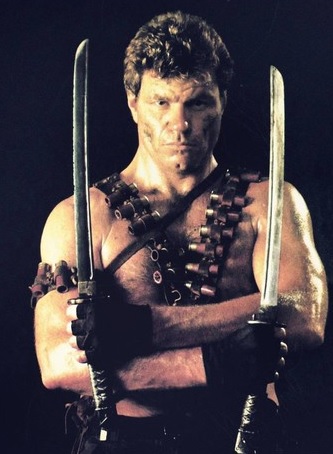
On the plus side, Steele Justice did give this world this totally intimidating shot of Martin Kove, preparing to be get and give justice.  Recruit him?  No, just unleash him!

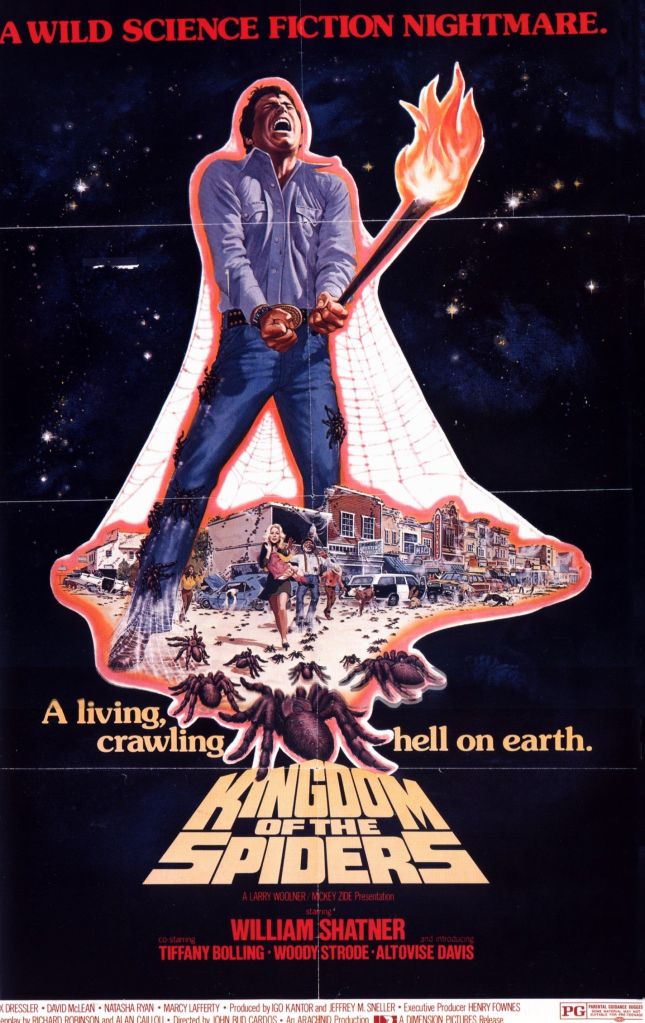
Kingdom of the Spiders (dir by John “Bud” Carlos)


While many celebrated International Cat Day on August 8th, it also happened to be National Tarantula Appreciation Day. As a result, I decided to return to a film that terrified me when I was little (and watched when I was far too young), 1977’s Kingdom of the Spiders.

As a kid growing up near the beginning of cable, movies were regularly during the weekends shown on prime time TV. This consisted of about 5 main channels in New York City: CBS (Channel 2), NBC (Channel 4), ABC (Channel 7), WNYW (Channel 5, which would become Fox in the Mid80s), WWOR (Channel 9), and WPIX (Channel 11). In addition to this, Channel 5, 9, and 11 would have movies playing on weekday afternoons just before the nightly news. I ended up watching Kingdom of the Spiders at my grandmother’s house, from under her bed. I didn’t sleep well for a while after this movie.

I don’t know why she ever owned it, but my Grandmother had this near clear shower curtain with a giant red and black spider on it. The web started from the center and spread out to the edges of the curtain. The image below is the closest approximation I could find to the one she owned. This was the source of my arachnophobia, which caused me to either enter the bathroom with my eyes closed, or use the basement bathroom (which had the rare added chance of seeing actual spiders). She tried to make me see the reality of it once, scooping me up and lifting me in front of the curtain to realize it was just a plastic sheet. My imagination was a little too much, however, and all I saw was something that wanted to cocoon and drink me dry. I screamed and flailed in her arms, and that was the end of that.

The premise for Kingdom of the Spiders is incredibly simple. At first, life is pretty comfortable in Verde Valley, Arizona. You’ve a family of cattle ranchers in the Colby’s (played by Spartacus‘ Woody Strode and Can’t Stop the Music‘s Altovise Davis). However, when a farmer’s cattle begin to fall ill and eventually dies, Dr. Rack Hansen (William Shatner, Miss Congeniality) is brought in to figure out what’s happening. Between heavily flirting with this brother’s widow Terry (Marcy Lafferty, Star Trek: The Motion Picture and Shatner’s wife at the time) and taking care of her daughter, Laura (Natasha Ryan, The Amityville Horror), it’s a surprise Rack has the time to help the Colby’s out.

When he sends in the blood samples to a lab for more research, the diagnosis is spider venom on a highly toxic scale. It’s so toxic that a spider specialist, Diane Ashley (Tiffany Bolling, Open House) is brought in to help. Of course, this springs Rack into action. After they meet, he cuts her off on the road, gives her his best one liner and then picks her up and takes her to his favorite restaurant (in her car, mind you). Rack’em, indeed.

Over lunch, they come to an understanding that DDT might be the cause of their tarantula menace. Having killed off their regular food sources of insects, the spiders have moved on to larger game. A quick visit back to the Colby Ranch confirms their fears. A spider mound is on their farm and the decision is eventually made to burn it down. Burning helps, but little do the humans realize that the spiders had exit strategies of their own. They also had additional mounds that the humans never even noticed.

With time running around out, Rack and Diane eventually decide the answer is more DDT, but the spiders thwart the attempt and decide from that point on, it’s all out war. Can the town survive the assault?

So, the spiders in Kingdom of the Spiders are just tarantulas. While all tarantulas are spiders, not all spiders are tarantulas. We’re not talking about the small house spiders from Frank Marshall’s Arachnophobia. They can be dangerous too, depending on the type. The Brown Recluse in particular has venom that is necrotic and will eat away the flesh around a bite. This movie focuses on the large hairy ones.

From what I’ve read, while most tarantulas have venom, it’s not particularly dangerous to humans. The only real exception to this are the Funnel Web spiders of Australia. They’re super aggressive and their venom can kill. Thankfully, according to a USA Today article, no one on that continent’s been killed by one since 1980. Additionally, some tarantulas only really use their fangs as a last resort. They will usually choose to flick the hairs off their back, which sting the eyes and noses of most predators.

There were about 5000 tarantulas used in the movie, with a mix of real ones for the early close ups and fake models for some of the wider shots. I’ve always wondered if the American Humane Society supervised the film, because it looks looks like a number of them were killed (at least in the last third).

Shatner is pretty much himself here, bringing that style he always does to a role. It’s not the over the top levels of Captain Kirk or Denny Crane, but it’s still fun to watch. Though I haven’t been able to confirm it, I’m told that Tiffany Bolling was one of the few people that wasn’t scared to work with the arachnids and that helped to get her the role. Most of the cast are okay, thought their reactions to spiders might cause one to laugh more than to share in their fear. Granted, I’d probably react the same way as most of them.

There’s one part involving Mrs. Colby with a gun that shares the same musical piece used in David Cronenberg’s Rabid and Scott Sanders’ Black Dynamite. Much like the classic Wilhelm scream, this musical piece seems to pop up in older movies now and then.

Overall, Kingdom of the Spiders is a decent film to unleash upon your Arachnophobic friends to watch them squirm. The spiders may spend more time running away from their prey, but some low to the ground camera shots help to make things more interesting.