Cleaning Out The DVR: The Serial Killer Seduced Me (dir by Dylan Vox)


The Lifetime film, The Serial Killer Seduced Me, tells the story of Chloe (Tess Cline).

Chloe is currently working as a nurse at an assisted living facility but what she truly wants is to be recognized as an artist.  One of her patients, Lillian (Kris Ann Russell), is always encouraging Chloe to pursue her artistic dreams.  In fact, Lillian has quite a collection of art herself.  She gives Chloe the key to her house so that Chloe can get some of her paintings.  When Chloe goes to the house, she finds a painting of a young woman.  What we know but what Chloe doesn’t know is that someone murdered the woman after she posed for the painting.

Speaking of murder, someone smothers Lillian in her sleep.  Chloe is so upset over Lillian’s death that she barely pays attention when her agent, Chase (Allen Williamson), tells her that he needs some of her paintings.  Chloe signs a contract that Chase pushes in front of her.  Later, while Chloe is still in shock over Lillian’s death, she gets a call from Chase informing her that he’s set up a show for her at a local gallery.

Excited, Chloe goes to the gallery and discovers that not only has Chase hung several of her paintings in the gallery but that everyone also seems to like them.  However, the painting that everyone loves appears to be the painting of the woman that Chloe found at Lillian’s house.  Chloe is stunned, especially after a man approaches her and claims to be the husband of the woman in the painting.  The man shouts that the woman was murdered and then he goes outside and promptly gets run over by a car that ignores a stop sign.

Chloe doesn’t know what to do.  She doesn’t want to take credit for the painting but she signed a contract with Chase and Chase, when he finds out that Chloe didn’t actually paint the painting, proceeds to blackmail her.  Chase says that he needs more paintings and that they need to be like the one that everyone liked, the one that Chloe didn’t actually paint.  A trip back to Lillian’s place leads to the discovery of the paintings of several women.  Chloe notices that the paintings are numbered and she deduces that all the women in the paintings have been murdered.

Chase doesn’t care.  He’s got paintings to sell and he want Chloe to sit down for an interview with a journalist named Ariadne (Kristi Murdock).  Chloe, however, is now more concerned with Luke (Ali Zahiri), who is Lillian’s son and who is quite a fan of her art.  Chloe knows that there’s a good chance that Luke might be the murderer but she’s also feeling attracted to him.

Uh-oh!

I enjoyed the Lifetime film, largely because it thoroughly embraced the melodrama in the way that the best Lifetime films often do.  I enjoyed the film’s satiric look at the art world and, even more importantly, Chloe’s outfits were all to die for.  From the minute she showed up with her thigh high boots and her portfolio of pretentious paintings, I knew Chloe was going to be a character to whom I could relate.  The solution to the film’s mystery didn’t really make much sense but …. eh.  I wasn’t expecting it to make any sense so it didn’t really matter.

This film was originally entitled Picture Her Dead, which personally I think was a better and more appropriate title than The Serial Killer Seduced Me.
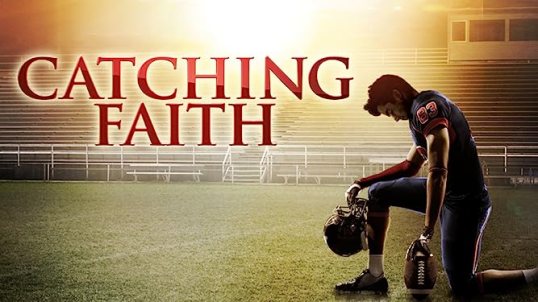
 

October Positivity: Catching Faith (dir by John K.D. Graham)


The 2015 film, Catching Faith, presents us with the following scenario.

You are the mother of a 17 year-old football star.  Your son is the reason why his school’s team is going to make the playoffs.  As a result, he’s the most popular kid in school.  In fact, he’s the most popular kid in the state.  Everyone loves him and you know what?  He’s actually handling it all pretty well.  He still works hard.  He still goes to practice.  He looks after his sister.  He treats you and your husband with respect.  Are his grades great?  Not really but is he passing and he’s certainly doing well enough that he’ll probably be able to get a football scholarship.

But then, you find out that your 17 year-old son went to a party after a game.  And he had a few beers, just as everyone else on the team did.  The police showed up but your son was allowed to leave.  In other words, he didn’t get caught.  He was also smart enough not to try to drive himself home in his intoxicated condition.  When, after a good deal of hesitation on your part, you ask him if he was drinking that night, he doesn’t lie to you.  He admits that he was drinking, as was everyone else on the team.

Do you sit down and have a talk with him, one in which you encourage him not to drink (especially since he’s not 21) while also making it clear that he can still call you if he ever does find himself in a situation where he has had too much?  Do you maybe ground him for a week or two, just so he understands that there are consequences for breaking the rules?

Or….

Do you whip out the rules and regulations book that he was given at the start of the semester and announce that if he doesn’t turn himself into the coach, you’ll do it yourself?  Keep in mind that, by doing this, you’ll be guaranteeing that your son doesn’t play in another regular game for the rest of the season.  You’ll be ruining his chance to impress the college scouts.  The football team will lose its best player and probably won’t win anymore games, which means that the other members of the team will probably lose whatever chance they had to get a football scholarship.  And, of course, your son will become a pariah at the time in his life when it’s really important to have friends?

If you are Alexa (Lorena Seguara York) and John Taylor (Dariush Moslemi), you go with the second option.  You explain that, as Christians, you’re not allowed to lie and you force your son, Beau (Garrett Westton), to confess to his coach (comedian Bill Engvall) that he had one or two beers at a party.  And then, of course, if your Alexa and John, you spend the rest of the school year wondering the entire town now hates you.

Of course, Beau is not the only member of the Taylor family who has to make a choice about being honest.  Alexa is torn over whether or not to tell John that she exchanged the necklace that he gave her for a better one.  Meanwhile, daughter Ravyn (Bethany Peterson) has to decide whether or not to cheat on her Latin exam so that she can be valedictorian and go to MIT.

Seriously, this is a dilemma?  Look, the world’s not going to end if you cheat on a Latin exam.  Who would pick their integrity over attending MIT?  And, for that matter, men are clueless when it comes to jewelry.  I kind of doubt John would have ever noticed that Alexa’s necklace was different from the one that he gave her.

I guess my point here is that this family is obsessed with creating drama where there really doesn’t need to be any.  Just be glad that your son didn’t go to jail and that he’s going to get a football scholarship.  (Seriously, do you want to pay for his college?)  And be happy your daughter is going to MIT.  And be happy with the pretty new necklace!

I wasn’t surprised to discover that it was set in Wisconsin because I can tell you right now that none of this would have ever happened in Texas.  A high school football player getting caught drinking?  That’s just a typical weeknight down here.  This was a deeply silly movie.  Parents, please don’t humiliate your 17 year-olds like this.

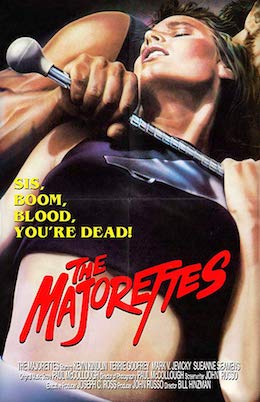
October Hacks: The Majorettes (dir by Bill Hinzman)


1987’s The Majorettes takes place in a small town in Pennsylvania.  It’s the type of town where everyone follows the high school football team, everyone goes to church on Sunday, and everyone admires the baton-twirling high school majorettes, even more so than the cheerleaders.

Unfortunately, it appears that someone is murdering the majorettes, one-by-one.  The first majorette victim is murdered while out on a date with Tommy, the class nerd.  (Poor old Tommy is killed as well.)  Her body is left in a creek.  The second victim is killed while lounging in front of her swimming pool.  The third victim is killed in the shower.  Detective Roland Martell (Cal Hetrick) thinks that the murders are linked to some sort of purification ritual.  Sheriff Braden (Mark V. Jivicky) says that he agrees but he doesn’t really have much time to worry about motives.  Braden’s dismissal of Martell could be due to the fact that Braden is a deeply religious man who we first see observing a creek baptism and singing a gospel song.  Meanwhile, Martell is an agnostic who is having an affair with a teenage girl named Nicole (Jacqueline Bowman).

Who could be the murderer?  Could it be Harry (Harold K. Keller), the slow-witted handyman who is always watching the majorettes while they’re practicing and who peeps on them and takes pictures while they’re changing in the locker room?

Could it be Harry’s mother, Helga (Denise Huot)?  Helga is a nurse who is plotting to murder both majorette Vicky McAlister (Terrie Godfrey) and her grandmother as a part of her plot to inherit the McAlister fortune.  But just because Helga is planning to kill one majorette, that doesn’t necessarily mean that she killed the others.

Or could the murderer be the school’s resident dope dealer, Mace (Tom E. Desrocher)?  Mace spends most of his time hanging out with his gang in their trailer, which is decorated with Confederate flags and 666 graffiti.  Mace was seen with the first victim and quarterback Jeff Holloway (Kevin Kindlin) is pretty sure that Mace was responsible for the murder.  When Jeff goes to the police, Mace decides to go after Jeff.

Anyone of them could be the murderer.  I won’t spoil the killer’s identity, beyond telling you that we learn who the killer is about halfway through the film.  And once the killer is known, The Majorettes goes from being a high school slasher film to being a backwoods action/revenge film, complete with shotguns being fired, vehicles blowing up, and Jeff the clean-cut quarterback suddenly running around with an arsenal of weapons.  Ultimately, The Majorettes feels like 3 different movies in one, with moments of horror balanced with scenes of Lifetime-style melodrama and Cannon-style action.  To be honest, the entire film is a bit silly but there’s enough twists and turns to hold one’s interest.  It’s hard not to enjoy the film’s “just toss it all in” approach to storytelling.

The Majorettes was based on a novel by John Russo, who is also credited as one of the screenwriters on Night of the Living Dead.  The film itself was directed by Bill Hinzman, who played the first zombie to show up in Romero’s classic film.  There’s not much visual flair to Hinzman’s direction but he keeps the action moving and really, that’s the most important thing that one can do with a film like The Majorettes.

The TSL Horror Grindhouse: Creature From Black Lake (dir by Joy N. Houck, Jr.)


It’s Bigfoot time!

1976’s Creature From Black Lake tells the story of two students at the University of Chicago.  Pahoo (Dennis Fimple) and Rives (John David Carson) decide that they want to spend their Spring Break on the Arkansas/Louisiana border, researching the legend that a Bigfoot-like creature that lives in the bayous.  (The creature is obviously based on the legendary Fouke Monster, who was also the subject of the 1972 documentary, The Legend of Boggy Creek.)

Pahoo and Rives head down South, looking to interview anyone who has seen the Creature From Black Lake.  Some people are willing to talk to them and they tell stories involving the Creature causing cars to crash, killing dogs, and attacking fisherman.  The Creature does not sound nice at all.  Still, the majority of the people in town don’t really feel like opening up to two Yankee monster hunters.  They’re worried that Pahoo and Rives are only in town because they want to portray everyone as being a bunch of ignorant rednecks who are scared of things that go bump in the night.

And really, they have every right to be concerned.  I grew up all over the South and the Southwest.  My family briefly lived in Fouke, the home of the Fouke Monster.  (No, I never saw or heard the monster, mostly because the monster doesn’t exist.)  When I was a kid, I lived in both Louisiana and Arkansas, among other states.  From my own personal experience, I can tell you that there is no one more condescending than a Northerner who is visiting the South for the very first time.   “Why is it so hot?”  “Why is everyone down here so polite?”  “Why can’t I find a Wawa!?”  Seriously, it gets old really quickly.  Now, to their credit, Pahoo and Rives are actually pretty polite and considerate when talking to the people who think that they have seen the Creature From Black Lake.  But still, one can understand why the town isn’t exactly thrilled to have them asking about monsters.

Anyway, after interviewing both Jack Elam and Dub Taylor about their experiences with the monster and getting yelled at by the local sheriff (played by Bill Thurman), Pahoo and Rives head out to the local swamp, hoping to find the creature themselves.  That, of course, turns out to be a huge mistake on their part.

Creature From Black Lake is a deliberately-paced film, which is a polite way of saying that it’s a bit slow.  Obviously inspired by The Legend of Boggy Creek, a good deal of the film is taken up with scenes of Pahoo and Rives interviewing people about their encounters with the monster.  That said, the film definitely picks up when Pahoo and Rives head into the swamp themselves and their eventual meeting with the monster is well-directed.  I have to admit that I spent this entire film dreading the moment when it would be revealed that the Monster was actually misunderstood and peaceful and I appreciated that the film did not go that route.  The creature turns out to be no one’s friend and is genuinely menacing.

The cast is full of familiar county character actors, all of whom do a good job bringing their characters to life.  Dennis Fimple and John David Carson are likable as the two students.  This film was also an early credit for cinematographer Dean Cudney and, just as he would later do for John Carpenter, Cudney creates a perfectly ominous atmosphere of isolation.  Creature From Black Lake may start out slow but, ultimately, it’s an effective creature feature.


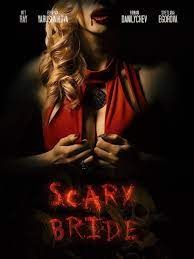
Scary Bride (2020, directed by Dan Grin)


Anthony (Vitt Ray) is a loser living in Minnesota who cannot get over his ex-girlfriend.  He decides to do what his neighbor did and fly over to Russia so he can search for a woman who is desperate to get married.  Anthony’s trip to Russia starts out promising enough, with a meeting with a helpful cab driver and a trip to a dance club where Anthony meets the beautiful Nina (Evgeniya Yarushnikova).  But then Nina turns out to be a witch who literally wants to take way Anthony’s balls.  After putting a curse on him, Nina chases Anthony through Moscow, while Anthony searches for anyone who can remove the curse.

This film’s plot is pretty much a one-joke premise.  Anthony even breaks the fourth wall and says, “Sometimes, it’s better to look for a bride in your own country.”  The movie plays with the stereotype that you can get anything you’re looking for in Moscow, if you know the right people.  (Needless to say, this film was made before Russia’s invasion of Ukraine.)  What’s interesting is the film itself is a Russian film so the humor is less about Russia being a dangerous place and more about how stupid Americans like Anthony are for coming over in search of a bride.  This is a Russian film that tells the rest of the world to stay out of Russia.

Unfortunately, it doesn’t take long for that one-joke premise to get old.  Anthony is not a likable hero.  The witch could have done better.  The version that’s on Tubi is dubbed into English and it is some of the worst voicework that I’ve ever heard, with Anthony in particular getting a deep voice that does not at all go along with his character.  Even though they were supposed to be residents of Minnesota, Anthony’s neighbor is dubbed with a British accent and keeps calling everyone “mate.”  Evgeniya Yarushnikova is beautiful enough that it is easy to believe that any man would fall under her spell but the rest of the movie is just the same joke told over and over again.

October True Crime: Dahmer (dir by David Jacobson)


2002’s Dahmer opens in a chocolate factory.  As the opening credits role, the camera lingers over the machinery effectively pouring, molding, and wrapping chocolate.  Much like the human body, the machines are set to do everything efficiently and automatically.  The only reason anyone works at the factory is to keep an eye on the machines and to make sure that they don’t break down.

A new worker at the factory is introduced to a veteran of the machines, a friendly guy named Jeffrey (Jeremy Renner, in his first starring role).  Jeffrey shows the new guy how the machines work and he flashes a somewhat friendly smile.  He seems like a nice enough human being.

But, of course, we know different.  We know what the title of this film is and, therefore, we know that the smiling man at the factory is also an infamous serial killer and cannibal named Jeffrey Dahmer.  We know enough to be nervous when, in the very next scene, Dahmer is in a department store and asking a young man (Dion Basco) if he wants to come back to Dahmer’s apartment so that Dahmer can take some pictures of him.  The man agrees and we watch as Dahmer drugs the man and then drills into the man’s head.  When the man, in a dazed state, manages to get out of the apartment, the police respond by returning him to Dahmer.

The film flashes back and fourth, between Dahmer’s life as an alcoholic cannibal in Minneapolis and his adolescence as a gay teenager from a dysfunctional family.  In the past, Dahmer steals a mannequin from a department store, tries to hide his homicidal urges from his confused, if well-meaning, father (Bruce Davison), and picks up the hitchhiker who will become his first victim.  In the present, Dahmer invites a man named Rodney (Artel Great) back to his apartment but, instead of automatically killing him, Dahmer instead talks to him about being alienated and shunned by society, almost as if Dahmer is trying to justify his own abhorrent actions to a future victim.  Rodney proves to be a bit more intuitive than Dahmer realized.

In many ways, the structure is similar to Ryan Murphy’s recently Netflix miniseries about Dahmer.  Many of the same incidents are detailed, including the time that Dahmer’s father demanded to see what Dahmer was hiding in a box.  Of course, Dahmer manages to tell the complete story in under two hours while Murphy, for some reason, dragged things out to ten episodes.  If Murphy’s miniseries sometimes came dangerously close to making excuses for Dahmer’s crime, David Jacobson’s film leaves us with no doubt that Jeffrey Dahmer was a monster.  In the film, Dahmer spends his time with Rodney trying to justify his anger and his murderous impulses, just for Rodney to continually shoot him down.  If Murphy’s miniseries often seemed to be too stylized for its own good, Jacobson’s film is directed in a near-documentary fashion, with the grainy and harsh images creating a pervasive atmosphere of evil.  The film may explain the motives behind Dahmer’s crimes but it never attempts to excuse them.

Of course, today, Dahmer is mostly known for being an early film of Jeremy Renner’s.  This was Renner’s first starring role and he received an Independent Spirit nomination for his performance here.  (As well, Kathryn Bigelow cast Renner in The Hurt Locker on the basis of his performance.)  Renner gives a haunting and frightening peformance, playing Dahmer as someone who suspects that his murderous impulses are wrong but who has given up trying to control them.  As played by Renner, Dahmer is friendly and good-looking enough that one can understand why people were willing to go back to his apartment but, at the same time, there’s always something a bit off about him.  Even when he’s surrounded by people, Renner plays Dahmer as someone who knows that he’s destined to be forever alone.

Dahmer is a haunting portrayal of evil.

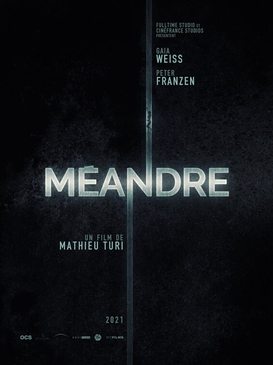
Horror Film Review: Meandre (dir by Mathieu Turi)


The 2020 French film, Meandre, opens with a woman named Lisa (Gaia Weiss) lying in the middle of the road, as if specifically begging someone to drive up and run her over.

When a man named Adam (Peter Franzen) approaches in his car, Lisa makes a last minute decision to get out of the car’s way.  Adam stops the car and offers Lisa a lift to wherever she wants to go.  Lisa accepts his offer and, as they drive through the night, Lisa reveals that today would have been the ninth birthday of her daughter, Nina.  Adam, who has a cross tattooed on his wrist, appears to be sympathetic.  However, then a report comes over the radio about a serial killer who is murdering hitchhikers and who has a cross tattooed on his wrist.  Realizing that Lisa now knows that he’s a murderer, Adam slams down on the brakes and throws Lisa against the dashboard, knocking her out.

When Lisa wakes up …. well, Adam is nowhere to be seen.  In fact, neither is the car.  Now wearing a white, skin-tight uniform, Lisa is in a small room.  She has a device on her wrist.  She has no idea where she is or how she got there.  She appears to be a prisoner but she doesn’t know why or who is holding her in captivity.  Suddenly, a door slides open, revealing a narrow tunnel.

Lisa spends the majority of the movie crawling from one location to another.  It’s never made quite clear just where exactly she is but it’s a place that’s full of tunnels, bobby traps, and the occasional rotting corpse.  Whenever the device on her wrist starts to beep, the viewer knows that something bad is about to happen to Lisa and she’s going to have to either avoid fire or sharp blades or being crushed as the walls of the tunnel suddenly come together.  Eventually, she also has to deal with a bizarre creature that chases her through the tunnels.  Through it all, she thinks that she can hear the voice of her daughter….

For me, Meandre got off to a good start by featuring a main character named Lisa.  Seriously, with a movie like this, it’s very important to be able to relate to the main character and, as soon as I found out that she shared my first name, I was totally on Lisa’s side.  That said, Gaia Weiss gives such a strong performance that even people who are not named Lisa will be rooting for the character.  The viewer sincerely wants Lisa to not only survive the traps but also discover why and where she is being held prisoner.  Meanwhile, Peter Franzen gives an appropriately intimidating performance as Adam (who does make a return appearance to the film after the incident in the car), alternating between being friendly and murderous.

I was not a huge fan of the film’s ending, which felt a bit too obscure and new agey for its own good.  But, ending aside, Meandre is an effective and claustrophobic horror film, featuring an excellent lead performance from Gaia Weiss.

Horror Film Review: The Deeper You Dig (dir by John Adams, Zelda Adams, and Toby Poser)


Released in 2019, The Deeper You Dig tells the story of three people who live in one of those rural states where it never seems to stop snowing.

Kurt (John Adams) is a recluse who lives in a farmhouse and who goes out of his way to avoid contact with the outside world.  It only takes a minute or two of watching him to pick up on the fact that he’s haunted by something that happened in his past and now, he wants to spend his life separated from the rest of the world, except for when he goes out to the local bar.

Living nearby is Ivy (Toby Poser), who was once a legitimate psychic but who now makes her living by doing fake Tarot card readings.  Residing with Ivy is her 14 year-old daughter, Echo (Zelda Adams).  Echo, as one might expect from someone who grew up in less than conventional surroundings, is a bit of a proud eccentric.  She wears black lipstick, she listens to old music, and she enjoys hunting and sledding through the constantly falling snow.  Echo, to be honest, is extremely cool.  When I was 14, I probably would have wanted to hang out with Echo.

Unfortunately, being the coolest girl in town does not always protect you from bad things happening.  (I’ve been the coolest girl in multiple towns so I definitely know what I’m talking about here.)  One night, after he’s gone out to the local bar and had a bit too much to drink, Kurt swerves his car to avoid running over a deer.  The deer survives but, unfortunately, Kurt runs over Echo!  The panicked Kurt decides to bury Echo on his property.

Soon, Kurt is gripped by paranoia.  Despite the fact that he’s buried her, Echo keeps appearing to him and reminding him that he killed her and that she’s going to get her revenge.  He keeps hearing the old music that Echo liked.  Kurt’s attempt to move the body around doesn’t do anything to help the situation.  In fact, if anything, it makes thing worse.  Meanwhile, Ivy is searching for daughter….

The Deeper You Dig takes a few unexpected turns, as Echo goes from simply haunting Kurt to literally starting to possess him and one of the more interesting things about this film is watching the taciturn and middle-aged Kurt start to act like an angry 14 year-old girl.  Playing out in a no-nonsense and no frills style, the film does a good job of keeping you guessing as to whether or not John is truly seeing and being possessed by Echo or if his own guilt is pushing him over the edge.

As you can probably guess by the number of people involved with the last name of Adams, The Deeper You Dig is a family affair.  John Adams and Toby Poser are married and Zelda Adams is their daughter.  (Another daughter who regularly appears in their films was away at college when Deeper You Dig was filmed.)  All three of them collaborated on the film’s direction and the end result is a rather chilly ghost story that plays out at its own deliberate pace but which definitely sticks with you after it ends.

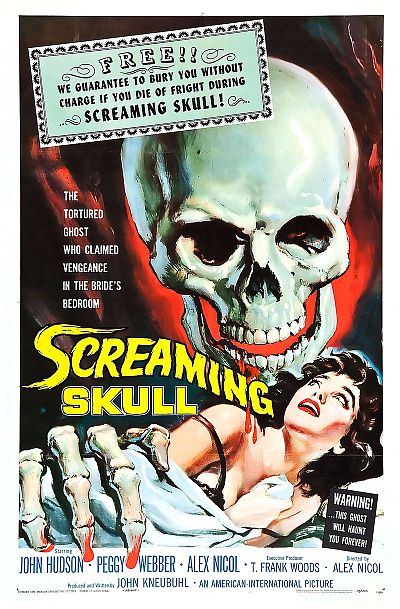
Horror Film Review: The Screaming Skull (dir by Alex Nicol)


1958’s The Screaming Skull opens with a promise.  If you die of fright while watching the climax of this movie, you will be given a free burial.  It’s a nice promise, though I have my doubts as to whether or not it would still be honored 65 years after it was made.  I mean, who exactly would be paying for the burial at this point?  It’s probably a moot point as I don’t think anyone would die of fright while watching the climax of The Screaming Skull.

That’s not to say that The Screaming Skull is a bad movie.  Though the film does not have a great reputation amongst film historians, I actually really enjoyed The Screaming Skull when I watched it a few weeks ago.  It’s an atmospheric and gothic horror film, one that mixes ghosts with hints of paranoia and insanity.  That said, it’s not really a frightening movie, at least not by today’s standards.  I think your heart will be fine while watching The Screaming Skull.

The Screaming Skull tells the story of Jenni (Peggy Webber), who has just recently been released from a mental hospital.  She had a nervous breakdown following the death of her parents in a drowning accident.  The tragedy left Jenni very wealthy but also very emotionally fragile.  She has just married Eric (John Hudson), a young widower whose first wife, Marion, died when she fell into a decorative pond on their estate and drowned.  Jenni fears that she’ll never be able to live up to Eric’s memories of Marion and it doesn’t help that Eric’s handyman, Mickey (played by the film’s director, Alex Nicol), was apparently in love with Marion and is very protective of her memory.  Marion’s portrait still hangs in the house and Jenni immediately sees that Marion looks a lot like her late mother.

Soon, Jenni thinks that she’s hearing screams in the middle of the night and she starts to see skulls almost everywhere that she looks.  Eric insists that Jenni is just letting her imagination get the better of her but Mickey is just as adamant that Marion’s ghost haunts the estate.  Eric even agrees to burn Marion’s portrait but doing so just reveals another skull sitting in the ashes.  Is Marion’s ghost haunting Jenni or is something else happening at the estate?  Who can Jenni trust?

Independently-made, The Screaming Skull is very much a horror film of the late 1950s, which means lots of tight sweaters, pointy brassieres, translucent nightgowns, and shadowy rooms, along with an important supporting character (played by Ross Conway) who just happens to be a minister and whose main job is to assure the audience that everything is going to be alright.  It’s a film that creates an effectively creepy atmosphere and Peggy Webber gives a sympathetic and likable performance in the lead role.  Most viewers will probably be able to guess the big twist within minutes of the film starting but no matter.  This is an enjoyably simple haunted house film and suspense thriller.  The Screaming Skull is not a film that exactly has a sterling reputation but I really enjoyed it.

Even more importantly, I made it through the film without having to take advantage of that free burial service!  I’m proud of myself.

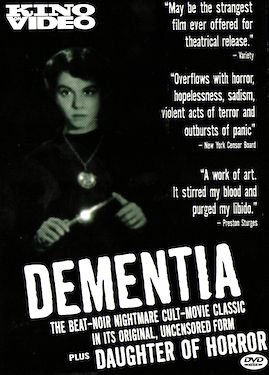
Horror on the Lens: Dementia (dir by John Parker)


Today’s Horror on the Len is 1955’s Dementia, an experimental horror film without dialogue.  The film follows a young woman (Adrienne Barrett) over the course of one surreal and nightmarish night on Los Angeles’s skid row.

Despite an opening endorsement from no less a Hollywood luminary as Preston Sturges, audiences in 1955 were not sure what to make of this dream-like film.  However, it has since been rediscovered and reappreciated by audiences who appreciate the film’s surreal vision.