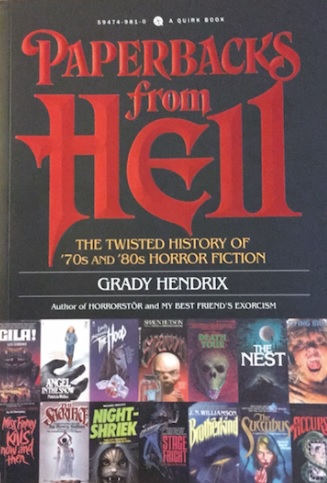
Horror Book Review: Paperbacks From Hell by Grady Hendrix


So, it’s October 1st and you know what that means!

It’s time to put together a Halloween reading list!

(Actually, to be honest, you’re running behind.  You should have started selecting the books for your October reading list way back in July.  Really, what have you been doing all this time?  Well, anyway….)

When it comes to putting together a Halloween reading list, there’s no better place to start than with Grady Hendrix’s Paperbacks From Hell!

First published in 2017, Paperbacks From Hell is a compulsively readable and fun overview of the horror-themed paperbacks that scared readers in the 70s and the 80s.  Every genre of paperback horror is covered, from the demonic possession novels that came out after the success of The Exorcist and The Omen to the “based on a true haunting” ghost novels to the extremely gory and rather unpleasant serial killer stories of the late 80s.  Along with discussing the best sellers of that era, Paperbacks From Hell also includes hundreds of wonderfully sordid and often rather bizarre paperback covers.  Have you ever wandered what a bunch a Nazi dwarves would look like?  Well, just check out the cover of The Little People:
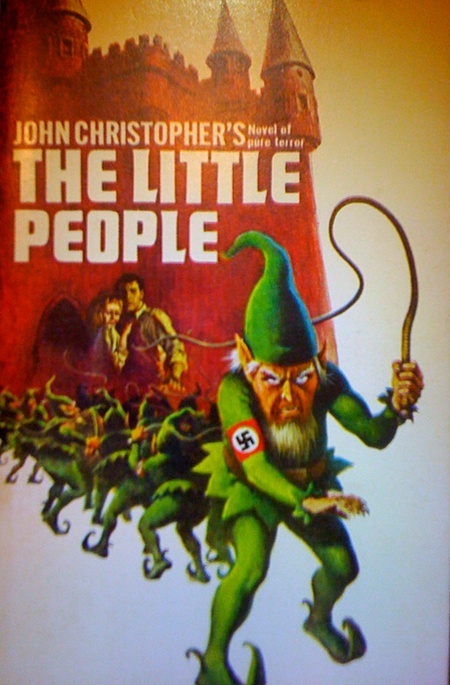
I mean, seriously — AGCK!

Paperbacks From Hell isn’t just a book about scary paperbacks, however.  It’s also a social history.  So many of these books were designed to appeal to whatever was scaring suburbanites at the moment and, as a result, the history of horror paperbacks is also a history of moral panics.  From Satanic cults to dirty music to environmental catastrophe and evil children, there’s a paperback for every one of them and, in all probability, the cover of that papeprback can be found in Paperbacks From Hell.

Paperbacks From Hell is a definite must-have for anyone who loves history and horror.  After I read it, I decided that I would read every single paperback that was mentioned in Paperbacks From Hell.  That turned out to be a bit more difficult than I thought it would be because, sadly, a lot of those classic old paperbacks are out-of-print and being sold for hundreds of dollars on Amazon.  I mean, I would love to read Satan Sublets by Jack Younger but I don’t know if I want to spend four hundred dollars to do so.  That said, even if some of the books that scared our parents and grandparents are no longer readily available, at least we have Paperbacks From Hell.

If you don’t already have a copy of Paperbacks From Hell, order it.  It’s addictive reading at its best.
 

Into the Dark, “Down”, Dir. Daniel Stamm, Review By Case Wright


Down

Happy Horrorthon!!!!

Should some people embrace their creative mediocrity? YES! Yes, they should.  I don’t mean that what they write or direct is bad. It’s simply unoriginal, predictable, with characters who make obviously bad decisions REPEATEDLY, and still are amazingly fun! I never thought I’d get into Lifetime movies until Lisa got me into them. I discovered how fun Hallmark movies are these past few years.  Law & Order embraced its predictability so much that their main sponsor Listerine would break the show down in the Commercials: Body discovery, Wisecrack, Investigation and Arrest, Prosecution, and Verdict. Law & Order lasted 19 years.  Case, what’s your point?  My point is that mediocrity can be fun…a LOT of fun.

Hulu’s “Into the Dark” series is the fun trash that is great to watch and nothing more (accept for the episodes that are hamfisted, political, and preachy) ; it’s like the Jack in the Box Munchie Meals…yeah, they’ll give you a bit of diarrhea, but come on, sometimes you just gotta have a Sriracha Curly Fry Burger.  That’s just science!

“Down” is awesomely bad.  The actors mug, the character decisions are stupid, and it’s great for the elliptical or exercise bike and probably safer to watch as you’re burning those last Lbs.  The plot is simple and doesn’t try to go into a supernatural direction. It’s fun because it never tries.  Jennifer Robbins ( Natalie Martinez) is trapped in an elevator on a holiday weekend with Guy (Matt Luria), BUT is Guy hiding something sinister? Yes…yes, he is and you can tell because he mugs A LOT!

If Lifetime went down the horror route, this would be the premiere.  Guy is in fact Jennifer’s stalker and manipulates her into having sex like the Lifetime movies with the Single Moms and the Predator Next Door.  Lifetime movies are better than “Down” because with Lifetime movies once the heroine realizes she has to fight; it’s to the death.  Here, when Jennifer realizes Guy is a Psycho Killer she doesn’t Run….Run…Away.  In fact, he tries to kill her a lot and then she gets the upper hand, but does she finish him off? Nooooope.  She fails to deliver the Coup de Gras not once, not twice…no, we’re talking six times here when she could’ve finished the movie and literally had a smoke after the 45 minute mark, but 45 minutes of filler was fine for my physical therapy time.

I know that this reads harsh, but these movies have their place; they’re fun.  If the pacing and plot points matched with a Lifetime MOW, it would’ve been that much better, but you can’t have everything, nor should you! Will I review a bunch more of these Into the Dark quasi-episodes? YES, Yes I will!

Happy Horrorthon!

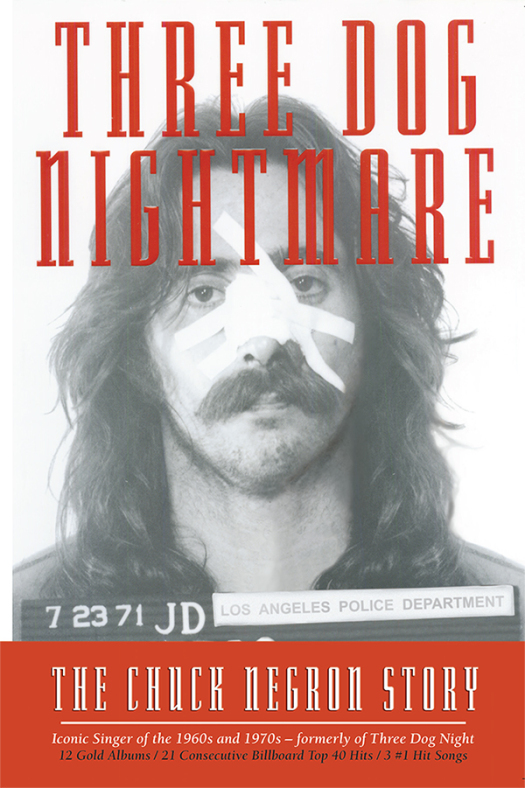
Book Review: THREE DOG NIGHTMARE: The Chuck Negron Story (4th edition; independently published 2017)


gary loggins's avatarcracked rear viewer

From 1969 to 1974, Three Dog Night was one of the biggest rock bands in the world, known for smash hits like “One”, “Eli’s Coming”, “Mama Told Me Not to Come”, “Shambala”, “Black & White”, and of course “Joy to the World”. Their squeaky-clean, family friendly image made them popular with both teens and adults, but behind that image lurked a deep, dark secret – co-lead singer Chuck Negron, the long-haired, mustachioed one, was an unrepentant heroin addict.

THREE DOG NIGHTMARE, first published in 1999 and revised in 2017, tells the harrowing tale of the horrors of drug addiction by the man who lived that nightmare for over twenty years. And ‘nightmare’ it truly was, as Chuck tells his tale of going from the pinnacle of the rock’n’roll universe to a Skid Row junkie, lying, cheating, and stealing his way through life leaving nothing but sorrow and devastation in his…

View original post 318 more words

Book Review: Steve McQueen: Portrait of An American Rebel by Marshall Terrill (1994 edition, Donald I. Fine)


Last night, I watched Tom Horn.

This western was the actor Steve McQueen’s second-to-last movie.  He died a few months after it was released in 1980 and McQueen looks frail throughout most of the movie.  Despite his obvious ill-health, McQueen still gave a strong performance as a real-life former frontier scout and cowboy who was executed for a crime that he probably did not commit.

After I watched the movie, I searched through my collection of film books until I found my copy of Marshall Terrill’s Steve McQueen: Portrait of an American Rebel.  Terrill’s book is one of my favorite actor biographies.  It covers all the details of McQueen’s underrated acting career and his turbulent personal life, including both the time he ran into the Manson Family and his relationship with Ali MacGraw.

Best of all, the book ends with a detailed list of every film that McQueen turned down over the course of his career.  After he appeared in The Towering Inferno, McQueen became very selective when it came to picking his film roles.  He was tired of just doing action movies and he also didn’t want to spend too much time apart from MacGraw.  Directors still wanted to work with McQueen but McQueen didn’t always want to work with him and, as a result, the movies that McQueen turned down make for a truly impressive list.

Here’s just a few of the films that McQueen was offered but turned down:

  • Breakfast at Tiffany’s (The George Peppard role would have been a rare intellectual role for McQueen)
  • Butch Cassidy and the Sundance Kid (McQueen was the first choice for the Sundance Kid but he and Paul Newman could not agree on who would be billed first.  This same issue nearly kept them from working together in The Towering Inferno.)
  • The French Connection (The French Connection was greenlit due to the success of Bullitt so it’s not a surprise that McQueen was offered the role of Popeye Doyle.  McQueen, however, was tired of playing cops.)
  • Dirty Harry (Again, McQueen was tired of playing cops.)
  • The Great Gatsby (This film was originally envisioned as starring McQueen as Gatsby and Ali MacGraw as Daisy, both of whom would have been better cast in the roles than either Robert Redford or Mia Farrow.  As a former juvenile delinquent who became one of the richest men in Hollywood, McQueen was Jay Gatsby.)
  • Jaws (Spielberg considered McQueen for the role of Brody.)
  • The Driver (Ryan O’Neal was cast instead and gave a performance that was clearly influenced by McQueen’s style of cool)
  • A Bridge Too Far (Everyone who was anyone was offered a role in A Bridge Too Far.  McQueen was one of the few actors to turn it down and, as happened so often in his career, the role instead went to Robert Redford.)
  • The Gauntlet (This was originally envisioned as starring McQueen and Barbra Streisand.  It was eventually made with Clint Eastwood and Sondra Locke.)
  • Close Encounters of The Third Kind (McQueen turned down the role of Roy Neary because he didn’t feel that he could convincingly cry on screen.)
  • Sorcerer (William Friedkin later said that the biggest mistake of his career wasn’t fighting harder to get McQueen to star in his remake of The Wages of Fear.)
  • First Blood (McQueen was one of many stars considered for either Rambo or Sheriff Teasle before Sylvester Stallone came aboard.)
  • The Bodyguard (Famously, this was written for McQueen and Diana Ross.  It was eventually made with Kevin Costner and Whitney Houston)
  • The Cannonball Run (After McQueen turned down the project, the script was rewritten to play up comedy over action and Burt Reynolds was cast in the lead role.)
  • For me, the most intriguing project that McQueen turned down was Apocalypse Now.  McQueen was Francis Ford Coppola’s first choice for Capt. Willard but McQueen turned him down because he didn’t want to leave Ali MacGraw alone for the months that would be required to make the film.  Even after being turned down the first time, Coppola offered the role to McQueen twice more, once after firing Harvey Keitel and once after Martin Sheen’s heart attack.  When McQueen again refused to play Willard, Coppola tried to interest McQueen in playing Col. Kurtz.  While I think McQueen would have been a good Willard, I also believe he would have been a great Kurtz.  McQueen would have been more believable as a feared warrior than Marlon Brando.

And that’s just a few of the roles that McQueen turned down!  Terrill’s biography includes a comprehensive list.

Even after his death, McQueen has remained an icon of cool.  Damian Lewis plays him in Quentin Tarantino’s Once Upon A Time In Hollywood.  I’m looking forward to seeing that movie this weekend.  I’m also looking forward to rereading Marshall Terrill’s biography of Steve McQueen.

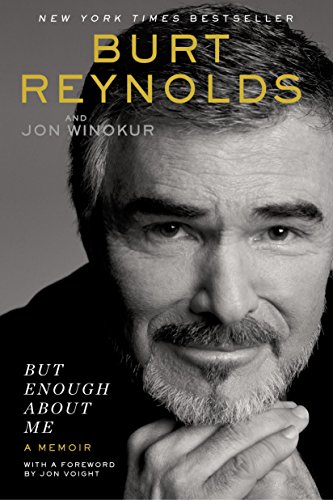
Book Review: BUT ENOUGH ABOUT ME by Burt Reynolds and Jon Winokur (Putnam 2015)


gary loggins's avatarcracked rear viewer

While doing my usual browsing around Barnes & Noble recently, I came across a real bargain – Burt Reynolds‘ 2015 memoir BUT ENOUGH ABOUT ME, for the low, low price of just $6.98! Naturally, being a long time Reynolds fan, I eagerly snapped it up and bought it (and no, Mr. Salesperson, for the umpteenth time, I do not want to join your book club!). Cowritten with Jon Winokur, who also coauthored a 2011 memoir with James Garner, the book is unlike your typical star ‘autobiography’, as Burt looks back on his life and, most importantly, the people who influenced him most, for better or worse.

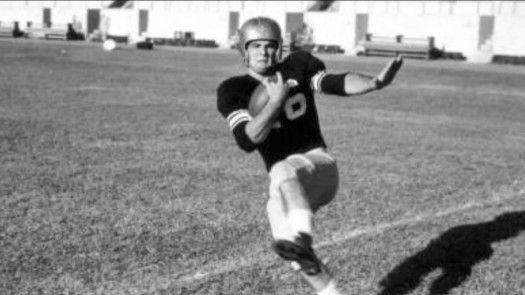
Florida State running back “Buddy” Reynolds, 1954

Burt (who died last September at age 82) was Hollywood’s #1 box office draw from 1978-82, and ranked in the top ten for 12 years, but the man certainly paid his dues to get there. A…

View original post 462 more words

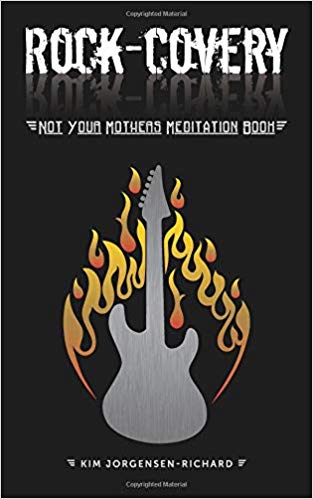
Book Review: ROCK-COVERY – Not Your Mother’s Meditation Guide by Kim Jorgensen-Richard


gary loggins's avatarcracked rear viewer

And now for something a little bit different…


Blogging about classic films and pop culture isn’t my only passion. Full Disclosure: I’ve personally been in recovery from alcohol and all other substances (and trust me, there were a LOT of other substances) for the past 15+ years. For the last ten of those years, I’ve worked in the substance abuse treatment field, helping others find their own pathway to recovery. Along the way, I’ve met a lot of good people in the field who share my passion for helping those who struggle with addiction issues. One of those is Kim Jorgensen-Richard, with whom I once shared an office, and when I started a new job this past January, Kim was working in the same building (in a different program).

Author Kim Jorgensen-Richard

I discovered I wasn’t the only writer in the house: Kim recently achieved a lifelong dream and wrote…

View original post 619 more words

2018 In Review: Lisa’s Top 12 Non-Fiction Books


All day today, I’ve been posting my favorites (and least favorites) of 2018.  If you’ve missed the previous entries …. well, that’s kind of on you.

Anyway, we have now reached the part of our program where I list my top twelve non-fiction books.  There was actually quite a lot of good non-fiction published this year.  The list below is a nice mix of memoirs, politics, and true crime.  Read them all and then be sure to come back here and thank me.

Here’s the list!

  1. The Infernal Library: On Dictators, the Books They Wrote, and Other Catastrophes of Literacy by Daniel Kalder
  2. Room to Dream by David Lynch and Kristine McKenna
  3. Bachelor Nation: Inside the World of America’s Favorite Guilty Pleasure by Amy Kaufman
  4. You’re on an Airplane: A Self-Mythologizing Memoir by Parker Posey
  5. I Am, I Am, I Am: Seventeen Brushes with Death by Maggie O’Farrell
  6. The Art of Horror Movies: An Illustraed History by Stephen Jones
  7. True Indie: Life and Death in Filmmaking by Don Coscarelli 
  8. Time Pieces: A Dublin Memoir by John Banville
  9. Blowing the Bloody Doors Off by Michael Caine
  10. The Contest: The 1968 Election and the War for America’s Soul by Michael Schumacher
  11. I’ll Be Gone in the Dark: One Woman’s Obsessive Search for the Golden State Killer by Michelle McNamara
  12. The Real Lolita: The Kidnapping of Sally Horner and the Novel That Scandalized the World by Sarah Weinman

I’ve got three more topics left to cover: music, television, and my favorite movies of the year.  For now, I need to take a small break and stretch my legs so expect to see the rest of my picks for the best of 2018 later tonight or tomorrow.

(Probably tomorrow, to be absolutely honest.)

Lisa Looks Back At 2018:

  1. Ten Worst Films of 2018
  2. The Best of Lifetime
  3. The Best of SyFy
  4. Lisa’s 10 Favorite Novels of 2018

2018 In Review: Lisa’s Top 10 Novels


Okay, I’ve had dinner and now I’m ready to get back to sharing my picks for the best of 2018!

We’ve now come to my 10 favorite novels of 2018.  I hate to say it but I didn’t read as many new novels as I should have this year.  I read a lot of old James Bond novels and I inherited about a dozen vintage Choose Your Own Adventure Books.  Those kept me pretty busy.

Plus, I also traveled a lot last year and I was also sick for several days.  I’ve always assumed that traveling and having a serious sinus infection would lead to reading more books and not less.  But apparently, it doesn’t work that way.  That sucked.

PLUS — I WASTED AN ENTIRE WEEK TRYING TO MAKE MY WAY THROUGH THAT SEAN PENN NOVEL!  Goddammit….

(Yes, it’s an extremely short novel but it didn’t feel short when I was reading it….)

Anyway, of the 2018 novels that I did read, here’s my top ten! 

  1. The Woman in the Window by A.J. Finn
  2. Need to Know by Karen Cleveland
  3. The Echo Killing by Christi Daugherty
  4. A Duke by Default by Alyssa Cole
  5. Hello Stranger by Lisa Kleypas
  6. Devil’s Day by Andrew Michael Hurley
  7. Wicked and the Wallflowers by Sarah Maclean
  8. Ghost Virus by Graham Masterson
  9. Hating you, Loving You by Crystal Kaswell
  10. The Chalk Man by C.J. Tudor

Up next, my ten favorite non-fiction books of 2018!

Lisa Looks Back at 2018:

  1. Ten Worst Films of 2018
  2. The Best of Lifetime
  3. The Best of SyFy

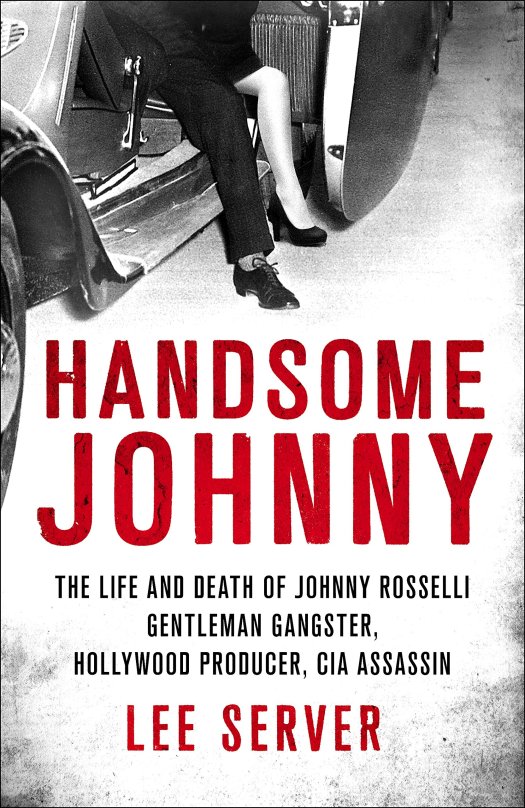
Book Review: HANDSOME JOHNNY, The Life and Death of Johnny Rosselli, Gentleman Gangster, Hollywood Producer, CIA Assassin by Lee Server (St. Martin’s Press 2108)


gary loggins's avatarcracked rear viewer

Ever since THE GODFATHER, I’ve been fascinated by the history of the Mafia in America. I’ve devoured just about every book on the subject, and consider myself a bit of an expert on this clandestine crime cartel. I believe it was while reading Ovid Demaris’s 1980 THE LAST MAFIOSO, a biography of gangster-turned-rat Jimmy “The Weasel” Fratianno, that I first became aware of the man known as Johnny Rosselli. His story captivated my interest, so when I saw a new biography of Rosselli was on the shelves at the local Barnes & Noble, I thought it’d make a great Christmas present… for myself! Naturally, I bought a copy, eager to learn more about this man who played a pivotal role in both the Mafia’s rise and the shadowy underbelly of American life in the 20th Century.

Author Lee Server is someone I’m unfamiliar with, which is strange, because his previously…

View original post 377 more words

Some Things I Liked In 2018


Since I don’t feel comfortable doing a traditional top ten list, I’m just going to list a few things that I liked in 2018.

When it comes to last year’s movies, my two favorite films were both comic book adaptations.  Black Panther and Spider-Man: Into The Spider-Verse both redefined what we traditionally expect from the comic book genre and they worked as both entertainment and as something a little bit deeper.

Among the other films I liked this year, Mission Impossible — Fallout reminded us of just how exciting a good action film can be while Game Night was hands down the best comedy of the year.  Deadpool 2 proved itself to be a worthy sequel while Won’t You Be My Neighbor?, Three Identical Strangers, Free Solo, and Shirkers made this a great year for documentaries.

David Peisner’s Homey Don’t Play That was a fascinating book about the history of In Living Color, examining both the show’s tumultuous history and how it continues to be relevant today.  Also worth reading: Thanks A Lot, Mr. Kibblewhite by Roger Daltrey and Cult City by Daniel J. Flynn.

In a year that seemed to be dominated by adaptations of comic books, it seems appropriate that one of the best comics was about the history of the medium.  Written by Fred Van Lente and illustrated by Ryan Dunlavey and Adam Guzowski, Comics For All was the second installment in their Comic Book History of Comics.  No matter how much you think you may know about comic history, you’ll learn something new from Comics For All.

When it comes to the year’s video games, I’m torn.  Red Dead Redemption II is a totally immersive gaming experience that challenges much of what we’ve come to expect from video games.  On the other hand, Marvel’s Spider-Man is one of the most purely enjoyable games that I’ve ever played.  If I had to pick a best, I’d go with Red Dead Redemption but Spider-Man is the game that I’ll probably end up replaying a month from now.

On television, I continued to enjoy and occasionally be baffled by HBO’s Westworld.  I also enjoyed playing around with Netflix’s Black Mirror: Bandersnatch, an interactive program that introduces you to a likable game designer and then give you the chance to totally mess up his life.

In the States, BBC America televised the the animated restoration of the “lost” Doctor Who serial, Shada.  As an episode of Tom Baker-era Doctor Who, Shada was just as disappointing as many have warned that it would be, an overextended mix of inside jokes about Cambridge.  However, as a piece of Doctor Who history, it was priceless.

Finally, as far as the year in music is concerned, I recommend The Who’s fifth studio album, Who’s Next.  I know Who’s Next came out in 1971 but good music is timeless.