“Empire Of The Dead” #3 Shambles Back In The Right Direction


3718046-03

If you’ll recall — and, hell, it remains true even if you don’t — the second issue of Marvel’s “event” mini-series Empire Of The Dead left me feeling decidedly unenthusiastic about this book”s future, given that all it really managed to do was tread water for 20 pages and then stop. But hey — maybe I’ve been a little too quick to judge. It’s been known to happen before.

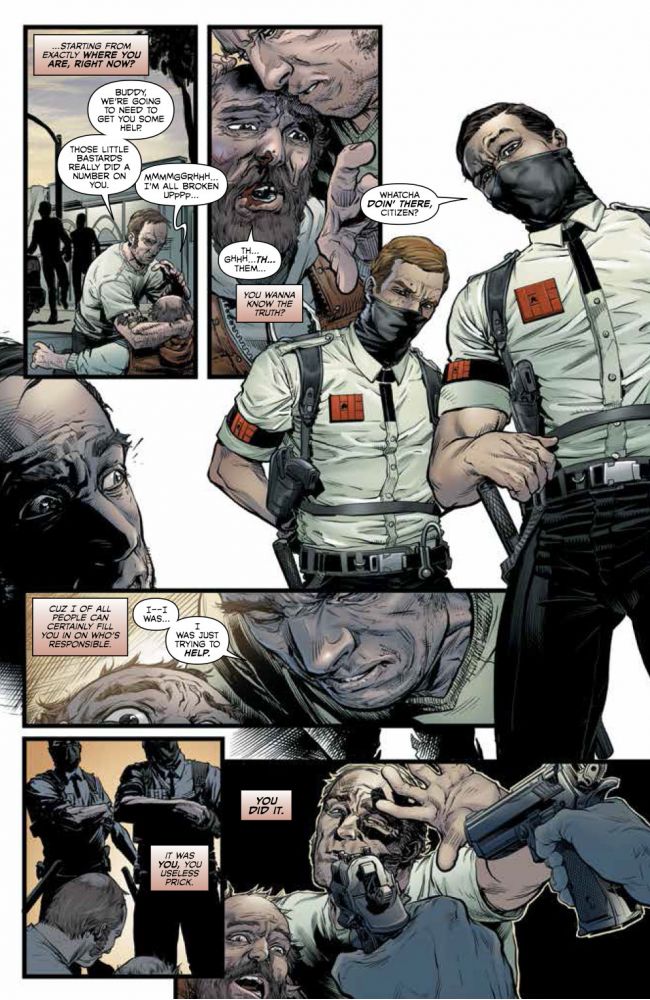
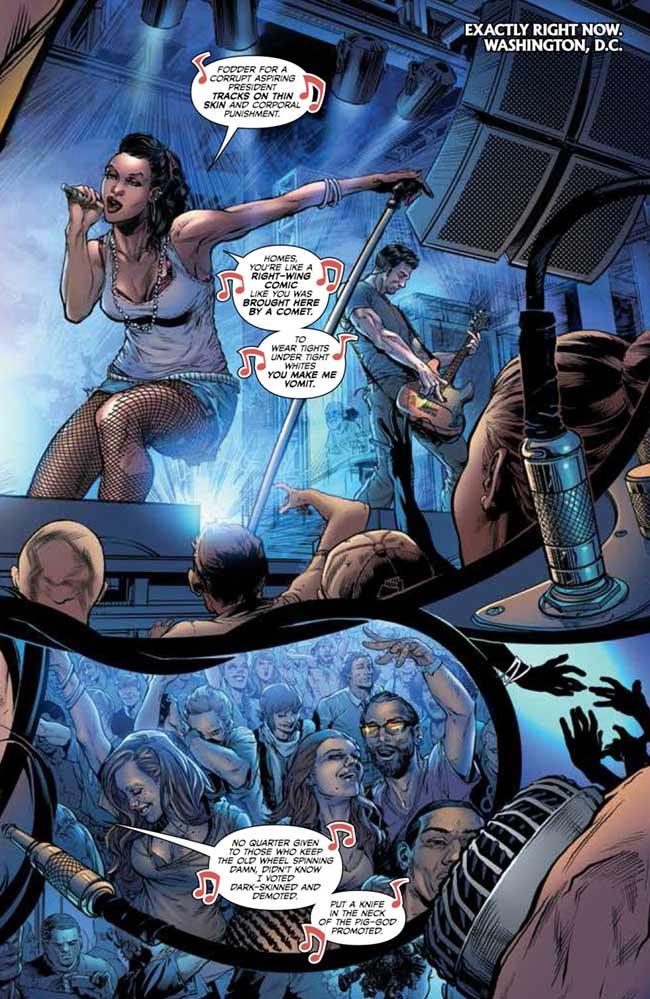
I’m not here to tell you that Empire Of The Dead #3 (or, to be true to the copyright indicia, George A. Romero’s Empire Of The Dead Act One, #3) regains all the momentum we lost after a really solid first issue, but it does go some way toward explaining a few head-scratching things left over from last time around, like what all those rat slaughterhouses all over town are about (rat blood is provided as nourishment for the vampires who can’t afford the real, human stuff) and why certain factions of the city council are, shall we say, less than taken with Mayor Chandrake’s leadership (turns out they’re all fucking vamps and feel he might be hoarding all the choicest — supplies, shall we say — for himself and his family), and actually does manage, in the midst of all this palace intrigue (some of which, in fairness, is dialogued in incredibly clumsy fashion) to propel the main narrative forward in some interseting new directions, which is a heck of a lot more than the second installment was able to do.

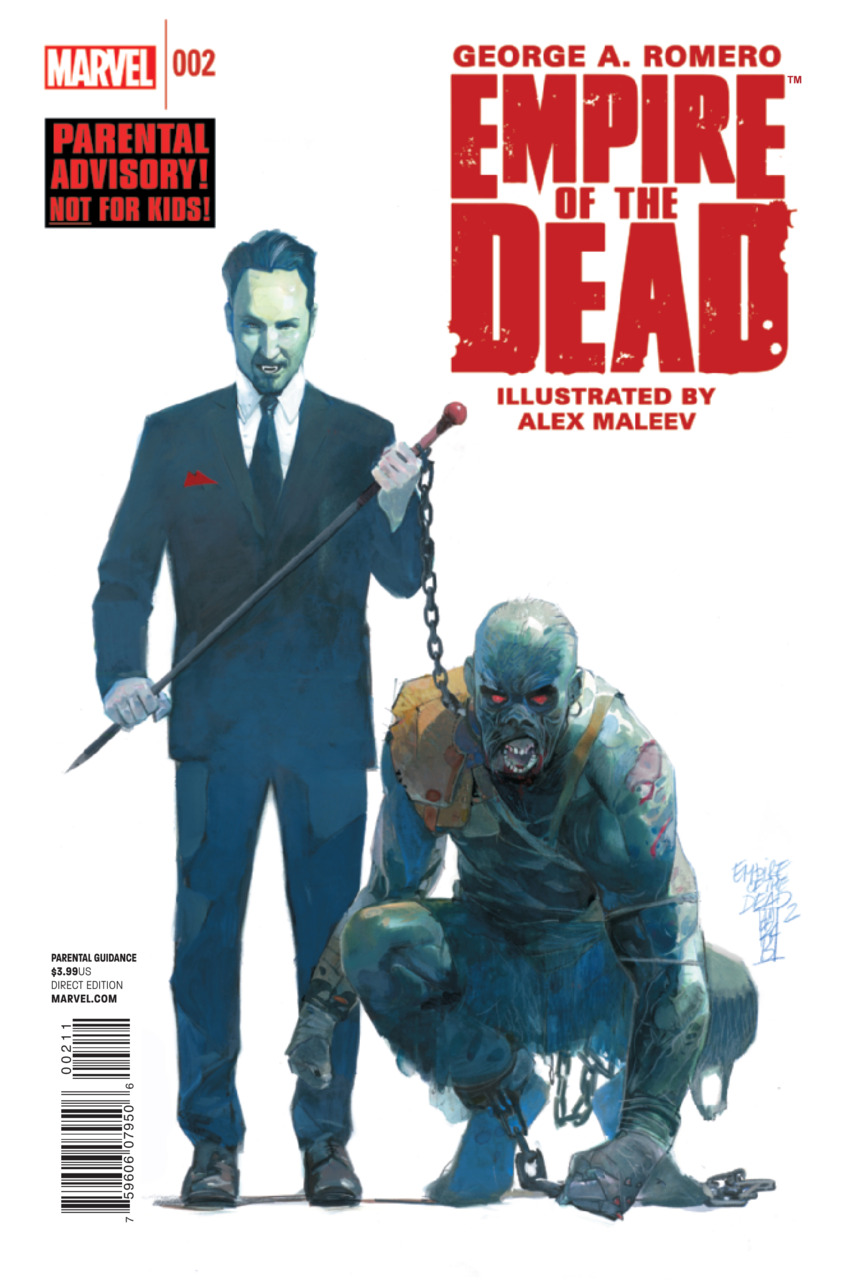
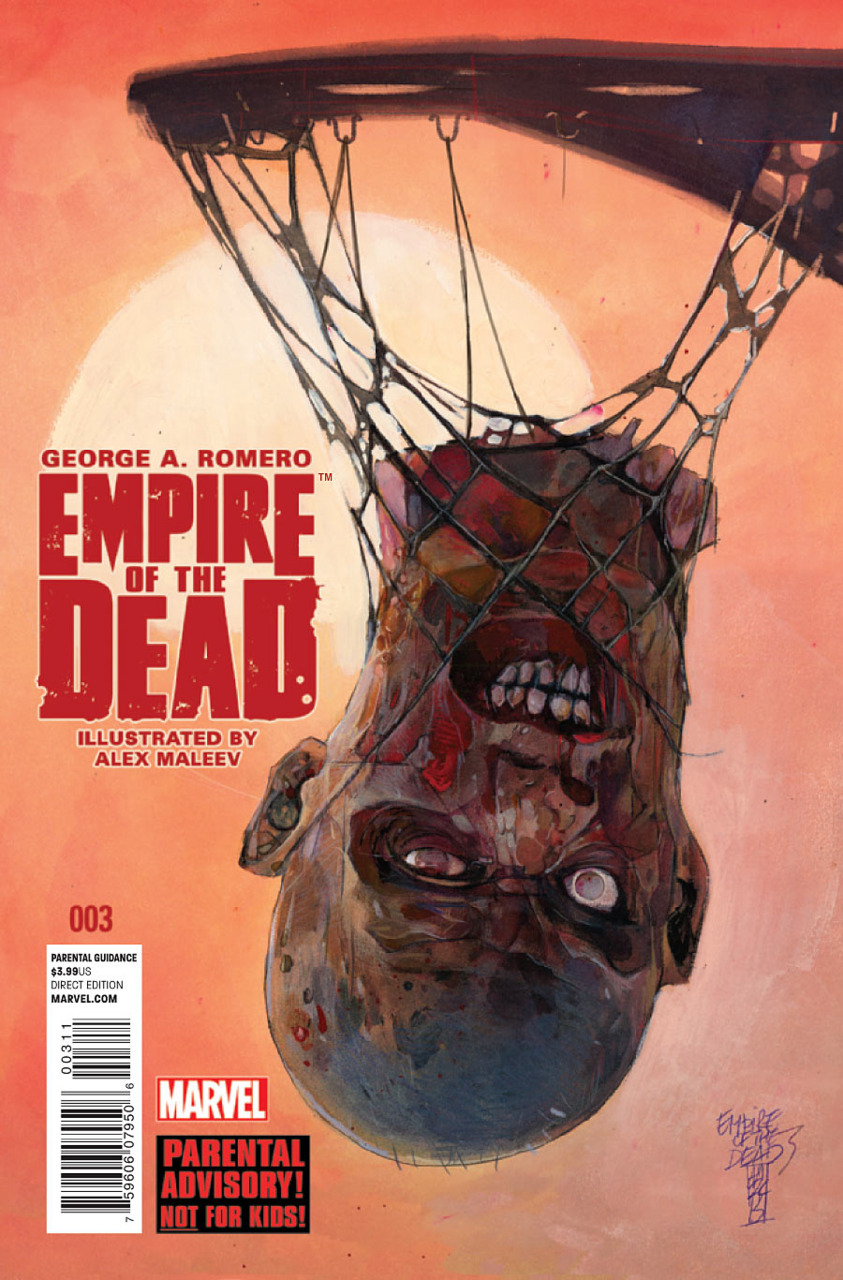
As predicted by anyone and everyone who knows anything about Romero, the relationship between Dr. Penny Jones and former-SWAT-officer-turned-zombie Frances Xavier has quickly become the central focus of this series, since questions of “how different are they from us, anyway?” have been foremost on the father of the modern zombie mythos’ mind at least since he introduced the world to Bub in Day Of The Dead, if not earlier (recall the “this place must have been important to them” line as the undead make their leisurely way through the mall in Dawn for perhaps the first verbalization of this obsession), and it turns out that Xavier is probably even more advanced than we already thought, given that she actually gets bored with some of her less-challenging training exercises/tests and decides she’d rather play some basketball instead (hence that awesome cover art shown at the top of this post).

Things get a little out of hand, though, when — well, that would be telling. Suffice to say this issue ends on a nice cliffhanger that sufficiently whets the appetite for next month’s installment and definitely leaves the reader with a pleasant-enough “hey, maybe things are back on the right track here after all” feeling.

3718333-03-variant

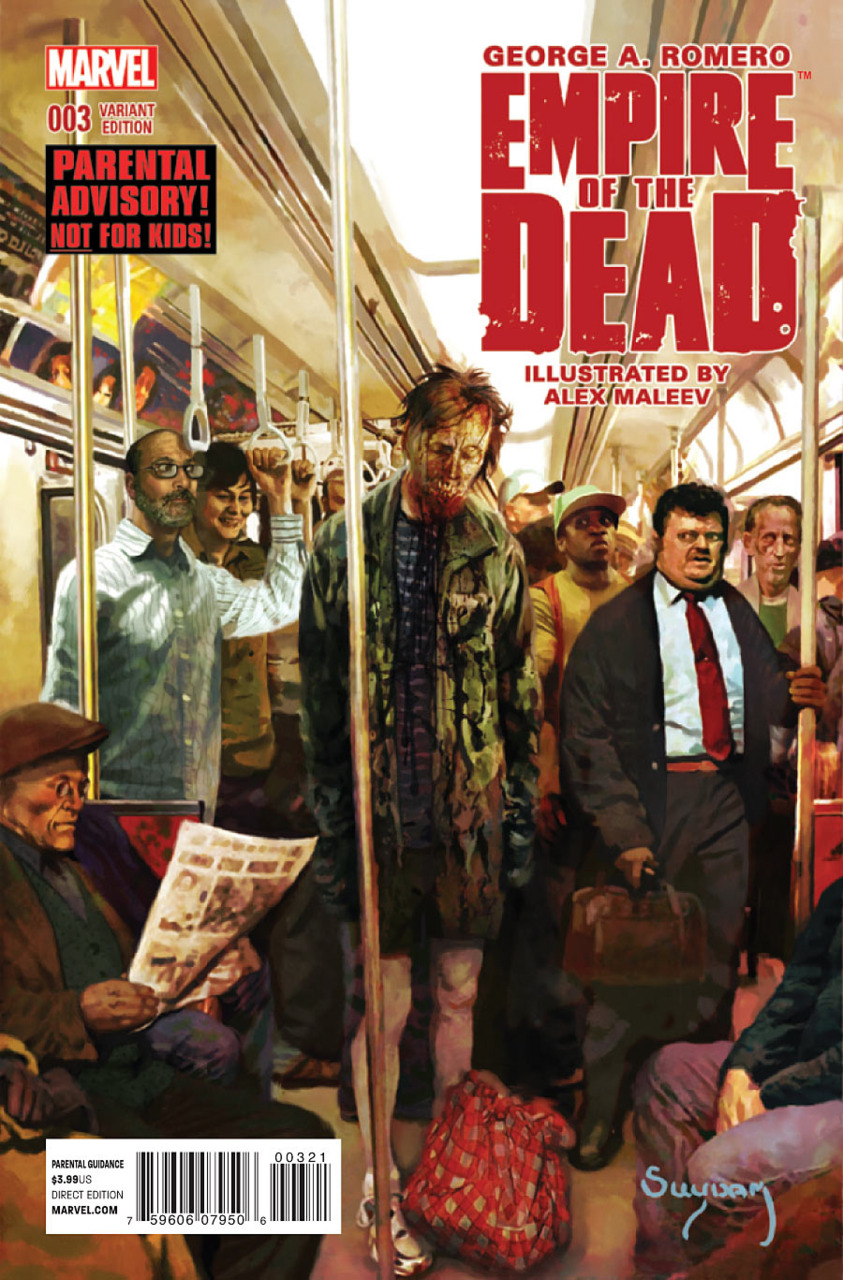
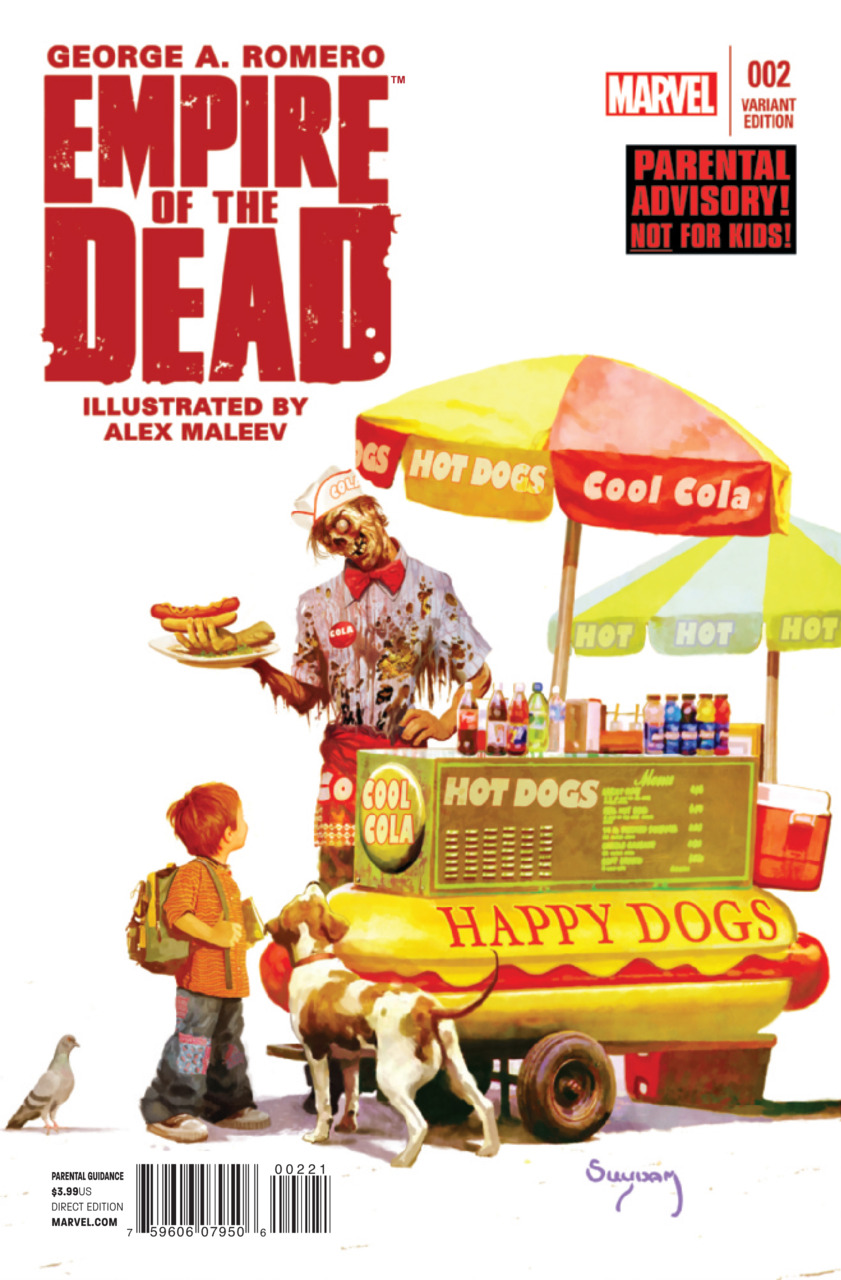
As far as the art goes, I’ve got no cause for complaint whatsoever. Alex Maleev’s “rough sketch” style continues to grow on me, and it’s nice to see a world this un-stylized depicted in such an honest, non-flashy, “warts and all” fashion. Everybody looks as worn down by life (or unlife, as the case may be) as they ought to, and every panel of every page oozes a kind of post-apocalyptic “we’re doing the best we can, but shit, it’s getting tiresome” feel. I dig it a lot — and I dig the heck out of Arthur Suydam’s variant cover (shown directly above) as well — as, I assume, anyone with working eyeballs will.

So yeah — my optimism about this series has returned, and with two issues to go in the opening five-part “act,” it’s safe to say I’ll be on board for both to see how things play out. Some of the major characters — specifically Paul Barnum — still seem under-utilized, but hopefully they’ll get some more to do soon, as well. All in all I have to confess that I should have known better than to doubt The Master — I have renewed  faith  that, wherever he’s taking us, the trip will be worth it.

44 Days Of Paranoia Addendum : “If Footmen Tire You What Will Horses Do?”


footmen

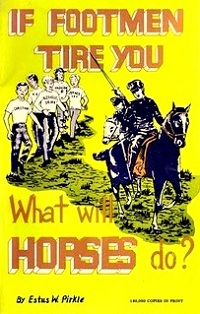
I sincerely hope that Lisa Marie Bowman will forgive me for muscling in on her (I assume, at any rate) recently-completed “44 Days Of Paranoia” series here at TTSL, but I just couldn’t let it wind up without drawing attention to what is (hopefully) the single-most paranoid flick ever made, namely Ron Ormond’s 1971 Red Scare/Come-To-Jesus religious exploitation number If Footmen Tire You What Will Horses Do?

Ormond was a veteran of the B-movie scene who’s probably best remembered for Mesa Of Lost Women, but at some point in the late ’60s he got scared to death of the emerging youth/anti-war culture and underwent a religious conversion of the “hard turn to the right” variety. Withdrawing from “the business” to his home in Nashville, Tennessee, he founded an outfit known, ever-so-modestly, as “The Ormond Organization,” and set about making evangelical films with his brother and wife as his principal “employees.” The war for our nation’s souls was on, and the Ormonds were determined to do their part by spreading the celluloid gospel.

Enter the Reverned Estus W. Pirkle, hailing from , as you’d probably expect with a name like that, the one-horse town of New Albany, Mississippi. Pirkle was an old-school preacher of the “fire and brimstone” variety who was dismayed by all those pesky civil rights “agitators” who were showing up and disrupting God’s plan for a racially segregated South. He was also worried to pieces about the so-called “Red Menace” He found a way to amalgamate all of his various paranoias into one succinct little book, the title of which you can probably already guess being that this film is based on it, and became a big hit on the traveling revival circuit and at Southern Baptist churches throughout the Bible Belt.

Obviously, when you team up the “talents” of an Ormond and a Pirkle, the end result is going to be a pretty combustible mix, indeed. But you can’t know just how combustible until you see the fruit their collaboration wrought.

footmen1

The film version of If Footmen tire You What Will Horses Do?  takes the form of an extended screed from Pirkle to us lowly mortals in the audience from his position in the pulpit, and, using a “lost soul” teenager named Judy (played by one Judy Creech) as our “point of entry,” shows how Godlessness and moral corruption have wreaked havoc on the lives of our young. What Judy’s doing that’s so wrong is never made clear, mind you, but hey — we know that she does have a boyfriend.

Judy looks especially forlorn when Pirkle talks about the evils of liquor,  dancing, and television (he avoids calling out civil rights and anti-war demonstrators by name, but he does inveigh against “riots on campus” and “unwholesome” ideas taking root in the minds of our young), but she’s been unaware of the larger plot that her morally fast-and-loose ways have been playing into — the Communist takeover of these United States.

A lame series of “documented” re-enactments of scenes that “took place in other countries” (where everybody’s got a southern accent) show us what will happen after the dastardly Reds  conquer America in, according to Pirkle’s estimation, 16 minutes flat — you can count on, among other atrocities : Commie soldiers breaking into your home to have their way with your wife; kids being forced to pray to Fidel Castro in the public schools in exchange for candy; Christians being shot in the streets and their bodies being left to rot in the baking sun; sons being forced to kill their own mothers if they won’t renounce Christ; and,  perhaps most insidious of all, 12-to-16-hour work days, seven days a week, 363 days a year (funny, but that sounds more like a union-busting capitalist’s wet dream than a Communist one).

If_Footmen_Tire_You_(M)

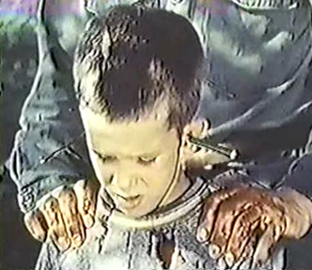
Dead kids are a mainstay throughout If Footmen Tire You What Will Horses Do?, and when Ormond and company run out of youngsters volunteered by their parents to lay down, pretend not to be breathing, and get splattered with Red Karo syrup, they often resort to using shop mannequins as stand-ins to pad their “mass slaughter” numbers. One scene where no plastic dummies are used, however, is perhaps the film’s most disturbing : a struggling young boy has his eardrums pierced with a bamboo stick so “he can no longer hear the word of Christ” and pukes all over himself while fake blood gushes out of his ears in rivers. Yeah, I know the red stuff’s not real, but the vomit most certainly is, and if the evangelical blow-hards who made this propaganda had any sense of shame they’d at the very least blush for resorting to on-screen, and very real, child abuse in the furtherance of their “holy” cause.

And that’s where Ormond, Pirkle, and the rest of the Holy Rollers who participated in this thing lose me. On the one hand their film can easily be dismissed as the delusional ramblings of the truly insane, but the scary thing is that this is just a celluloid reflection of what many Americans truly felt at the time (and feel now, with Muslims taking the place of Communists), and they were willing to do real harm to a kid in order to dramatize their dipshit point of view. Without that one scene I could have easily laughed my way through If Footmen Tire You What Will Horses Do?, but that single,  solitary instance shows that there was, indeed, genuine evil at work here — and those pesky Reds weren’t the source of it.

Look, let’s not kid ourselves — Communism didn’t work out too well anywhere it was put into practice (although Cuba is far from the dictatorial hell-hole that most right-wingers are still trying to convince us it is), and Stalin and the like were, indeed, responsible for countless atrocities. But it’s not like anti-Communism necessarily has clean hands, either. Just ask the people of Vietnam. Or Nicaragua. Or El Salvador. Or Laos. Or Bolivia. Or — the list goes on and on. And we definitely lose any sort of moral high ground we might claim over our purported “enemies” when we resort to the very same tactics in combating them that we accuse them of utilizing.

If Footmen tire You What Will Horses Do? offers a pretty good example, in microcosm, of exactly what I’m talking about. It’s propagandistic nonsense born out of irrational fear that has no basis in factual reality whatsoever and is willing to make a kid throw up on himself just to add an exclamation point to its absurd claims. It could have been fun, hokey, stupid shit — and most of the time it is — but the sick minds of Ormond and Pirkle took it seriously enough, and were willing to traumatize and harm one of the young souls they were supposedly out to “save” in order to prove just how serious they were.

This flick was largely played  on 16mm projectors at churches and revival halls, where it was presented as, of course, God’s honest truth. And while all that may seem hokey today, the audiences who watched it at the time lapped it up. In fact, an entire generation was raised on this horseshit. So next time you hear one of the blowhards on Fox “news” or right-wing talk radio blathering on about the “evils” of Communist, Socialist, Islamic, etc. propaganda, consider how far the “good guys” have been willing to go when it comes to brainwashing their own youth. Here’s a YouTube link to the full movie so you can make up your own mind:

See How An “Evil Empire” Is Built


Evil_Empire_001_coverA

You won’t find a much more loaded term in the entire lexicon of political rhetoric than “evil empire.” The phrase was made (in)famous when Reagan used it to describe the Soviet Union back when he had a hard-on for the apocalypse, and while some folks thought he was just being melodramatic, the “joke” he made a couple years later when he thought his mic was off about how he’d “just signed legislation outlawing Russia forever — we begin bombing in five minutes,” went some way towards throwing into stark relief why hard-line anti-communists were every bit as much a threat, if not moreso, than the dreaded “pinkos” themselves.

Fast forward a few years from that and America is thumping its collective chest and patting itself undeservedly on the back for having supposedly “won” the Cold War — uhhhhhmm, sorry, but last I checked the Soviet empire collapsed from within under its own weight — and we find out that our purported “enemy” was a starving nation that couldn’t even put bread on its own collective table, much less invade the US and destroy our much-vaunted “way of life.” In short, folks, we got hustled — the US government spent hundreds of billions on weapons (particularly nuclear weapons) we didn’t need in order to “fight” a “foe” that couldn’t even keep its own house in order. much less come and forcibly annex our own.

The lesson to be learned here? All wars — even “cold” ones — are a racket, in the immortal words of Smedley Butler, and the only “winners” are the defense contractors who profit from them.

JAN140984-02

Still, Cold War anxiety gave rise to some remarkably salient takes on the whole “dystopian future” scenario, the most famous of them in the comics world being Alan Moore and David Lloyd’s seminal V For Vendetta, which eventually became a big-budget Hollywood blockbuster once it had been stripped of all its smartest elements (and anarchist politics),  and  the Guy Fawkes “V” mask has ended up being appropriated not only by groups that probably do, if you’ll pardon the term,”deserve” to wear it given that they understand the story’s socio-political implications — such as the Anonymous hacker collective and various factions of the loosely-defined “Occupy” movement — but also, sadly and ironically, by far-right extremist supporters of arch-conservative/homophobe/racist American politician Ron Paul, and his even less principled, and decidedly more eel-like, son, Rand, who’s not even much of a Libertarian given his opposition to same-sex marriage and civil unions, his oft-stated desire to outlaw all abortion, even in cases of rape and incest, and his flat-out insane idea to “modify” the 1964 Civil Rights Act so that businesses can go back to discriminating against black customers if they want.

This guy’s a “champion of freedom”? Don’t make me laugh. Still, given his propensity for taking credit for work done by others, it’ll probably only be a few years before the junior senator from Kentucky claims authorship of V For Vendetta himself.

All of which brings us, in an admittedly roundabout way, to the fact that it’s about time for a “dystopian future” comic for a new generation now that the last really good one has been hijacked, at least at the margins, by the very right-wing authoritarian forces it was (bravely, for its time, I might add) braying against. And while I don’t know if writer Max Bemis and artist Ransom Getty’s Evil Empire, the first issue of which has just seen the light of day via Boom! Studios, will prove to be that book, it’s certainly off to an intriguing, if wildly uneven, start.

Evil_Empire_001_PRESS-6

I freely admit to not being at all familiar with either of this title’s principal creators — the only name associated with the series so far that I recognize  being FBP (a book you absolutely need to be reading) artist Robbi Rodriguez, who provides one of the variant covers to this debut installment (the main one, reproduced at the top of this review, being the handiwork of Jay Shaw) — but that’s actually a good thing in my book, since there’s a shitload of up-and-coming talent in comics that deserves much wider exposure than it’s gotten so far. Hell, truth be told I’m not all that schooled on Boom! as a publisher, apart from the fact that they have the RoboCop comics license and  they put out Mike Carey and Elena Casagrande’s Suicide Risk, which is easily one of the three or four best series being published by anyone right now. A quick glance at Evil Empire‘s copyright indicia shows that it’s a company-owned, rather than creator-owned, work, and that’s not cool in my book, but oh well. Marvel and DC certainly have been been getting away with the work-for-hire hustle for decades now — it’s just depressing to see smaller publishing houses following suit, I guess.

In any case, this is at the very least a creator-driven project —it would just be nice it if were a creator-owned one, as well.

Anyway, to the story — the action starts off 25 years in the future, where things have gone to hell in the proverbial bucket. “Security” cameras monitor every citizen’s every move, armed George Zimmerman-types are given badges and prowl the streets looking for (oh, who are we kidding, creating) trouble, some unnamed corrupt dictatorial overlord runs the whole show, and various technological “bread and circuses” serve to disrupt the cowed and tired populace from the troublesome nature of reality itself.

All in all, then, not too big a reach.

A few pages in, though, is when things start to get interesting, as Bemis and Getty begin the task of charting how we get from here to there. First up we meet politically-aware hip-hop artist Reese Greenwood, and while Bemis saddles her with some truly mind-bogglingly stupid lyrics, to his credit he also manages to establish her as a thoughtful, deeply aware character in fairly short order. She’s got no time for “the system,” as you’d expect, but she ‘s hardly the type of cardboard caricature so many “urban” African-American women in comics are these days. She seems like the sort of person you’d actually enjoy sitting down and having a conversation with, rather than a confrontational, “Invader From Mars” type.

Democratic presidential nominee Sam Duggins certainly seems to have taken a shine to her, as well. He pulls a few strings to meet her backstage after one of her shows, crashes an interview she does with MTV, surreptitiously passes his phone number to her — anything to get the young lady’s attention. Sam seems a decent-enough sort — more progressive than anybody the party would have the guts to nominate for national office in real life, to be sure (not to mention the fact that a single guy without kids wouldn’t stand a chance in a presidential election), but Reese isn’t buying his line entirely. She certainly seems to hope  he’s the real deal (hey, a lot of us hoped for the same from Obama once upon a time, before his “Bush-lite” tendencies fully came to the surface), but she’s  apparently seen one too many phony “leftists” turn out to be  nothing but “kinder, gentler” versions of the same old corporate stooges over the course of her life to fully get on board with either of the “Big Two” political parties, even the less overtly noxious one. I can certainly relate to that.

Evil_Empire_001_PRESS-7

Still, as  patently dishonest as Duggins may (or may not, who knows?) be, he’s a saint compared to pious, grandstanding, loathsome Republican nominee Kenneth Laramy, your typical “family values” right-wing blowhard. Unlike Reese and Sam, Laramy is, in fact, presented as nothing but a two-dimensional collection of tired stereotypes, which is kind of a shame, but with only 22 pages of story and art to work with something’s gotta give, and hey, it’s only the first issue — and there’s plenty of reason to suspect that there’s a  lot more going on with him than meets the eye.

Case in point — midway through through out opening installment, Laramy’s daughter finds her mother bleeding to death in their home with a knife in her back. This scene is handled incredibly clumsily, with hints at first being given that something’s happened to the daughter rather than the mother, and mom croaking (sorry) some incredibly wooden dialogue about something bad she did years ago as she expires (Getty also employs an admittedly unique, but frankly kinda stupid, artistic contrivance when he segues into this scenario via an attached panel-sized asterisk), but the point to take away here, plot-wise,  is that there is no assailant present, so the identity of Mrs. Laramy’s murderer remains a mystery.

At her wake, though, the shit really hits the fan. Duggins shows up with Reese as his date, and while you’d expect a media circus to ensue, that’s avoided when Laramy himself finally takes to the stage — or page, as the case may be — and leaves us with one of the better cliffhanger splash-pages that I can recall in quite some time. Sure, it’s not exactly realistic for a grieving widower to be interrupted in the middle of his eulogy by a reporter asking him a fucking question — even if said widower is running for president (actually, he announces that he’s withdrawing from the race during the speech, but that’s neither here nor there) — but while the set-up may be awkward, to put it kindly (as are little touches of dialogue throughout the book, like Reese referring to Laramy’s running mate as his “runner-up” and Duggins saying that Laramy is opposing him on the “ticket” rather than the ballot, “tickets” being, colloquially speaking, something that a presidential and vice-presidential candidate are, ya know, sharing  — but again, whatever) the payoff is big. Or might be. In any case, our “bad guy” candidate ends the first issue by dropping one heck of a bomb, and Bemis succeeds in leaving his readers damn hungry for answers.

Yeah, alright. Evil Empire has a long way to go before it can even be mentioned in the same breath as V For Vendetta. And Bemis’ story is more concerned with how a fascist government comes to be rather than how it’s toppled. But his set-up shows a lot of promise, and with a little bit of dialogue tightening and some deft editorial tinkering along the edges, this could really turn out to be a fun and thought-provoking ride. Sure, the story definitely has a left-leaning point of view, but at least it’s realistic in its portrayal of Democrats as “less-bad” guys rather than actual good guys, and its forward-thinking presentation of urban youth culture in general, and hip-hop culture specifically, is to be commended. Too often in comics these days people of color under the age of 30 are still portrayed as villains, and that’s certainly not the case here.

On the art side, Getty does a nice job making his characters look reasonably believable physically, and he’s pretty skilled at using facial expressions and other non-verbal cues to communicate thought and feeling. There’s no typical super-hero action — and very little action in general — for him to sink his teeth into and really show off his chops, but his panels mostly flow together pretty nicely and he keeps the reader engaged with his images throughout, which isn’t always easy in a “talky” book such as this one.

So, hey, what the heck — $3.99 is admittedly a lot to shell out for a 24-page package, especially when 2 of those 24 pages are taken up by “house ads” at the back of the book — but Evil Empire managed to hook me, warts and all, and given that its takes place in a self-contained world of its own making rather than a corporate “universe” with decades of backstory to catch up on, readers new to comics in general might find this a decent-enough introduction to the medium, particularly if they’re fans of  sci-fi, thriller, or other genre entertainment with a political twist. I can’t recommend it unreservedly, given that it still has much to prove, but I’m happy enough right now to keep shoveling four bucks a month over to Boom! to see where this ride Bemis and Getty are taking us on ends up going.

Treading Water And Sucking Blood : “Empire Of The Dead” #2


3664134-02a


Looking at things in strictly structural terms, second issues are often a tricky wicket in the comic book racket. In today’s marketplace, especially, it’s a pretty safe bet that you’re going to lose nearly half your readership (at the very least) between the first and second installments of any given book simply because cover prices are so fucking high (the going rate for the series under discussion here today, Empire Of The Dead, or as it’s known to Marvel Comics’ legal department, George Romero’s Empire Of The Dead Act One, is $3.99 per 28-page issue, with only 20 of those pages devoted to actual story and art) that a title has to be seriously flawless right out of the gate in order for everybody to shell out their hard-earned cash for a second serving.  So you’d better give the diminished-yet-loyal cadre who have showed up for the second round good reason to keep coming back for more — a nifty plot twist or two never hurts — and you’ve also gotta put in some serious work on fleshing out the world you showed in only the broadest strokes in the series’ debut installment.

With those two admittedly impromptu standards in mind, it’s safe to say that Empire whiffs on the first — badly, in fact — but connects rather nicely on the second, and therefore the end result is a decidedly mixed bag indeed.

3664441-02b


Nothing much happens here in terms of plot progression, with Romero choosing instead to paint a more complete picture of his zombie-and-vampire-infested future New York City. We learn that the devious Mayor Chandrake, his even more devious nephew Bill, and their ghoulish entourage live, appropriately enough, at the infamous Dakota apartment building, and that Bill is a bit reckless in terms of his procurement methods for new flesh (and blood). We learn that SWAT-officer-turned-zombie Francis Xavier is displaying even greater signs of intelligence (or at least more successfully mimicking learned behaviors, as she proves when she arrests a criminal) than previously thought. We learn that uber-zombie Zanzibar is an even bigger bad-ass in the coliseum than we figured by way of a particularly gruesome fight sequence. And we learn that Dr. Penny Jones can be somewhat ruthless in pursuit of her research goals, even going so far as to enlist her feminine wiles to aid her cause.

But that’s about as far as things go here. There is some impressively Bacchanalian excess going on in the Chandrake suites, with carnal blood-letting taking up most of the issue, and there’s some political “court intrigue” introduced in the New York city council, but there’s no real story advancement taking place in the traditional sense, with Romero apparently being content to take this opportunity to merely expound upon his characters and their various situations a bit more fully (except for poor Paul Barnum, who’s scarcely given anything to do). That might work reasonably well for one issue, I suppose,  but we’re going to need more the next time around — a lot more, in fact, especially given that part three will mark the more-than-halfway-point of this initial five-issue arc. I’m not ready to say this second issue was a failure so much as a missed opportunity, but it all hinges on what happens (or doesn’t) next.

3664439-02c

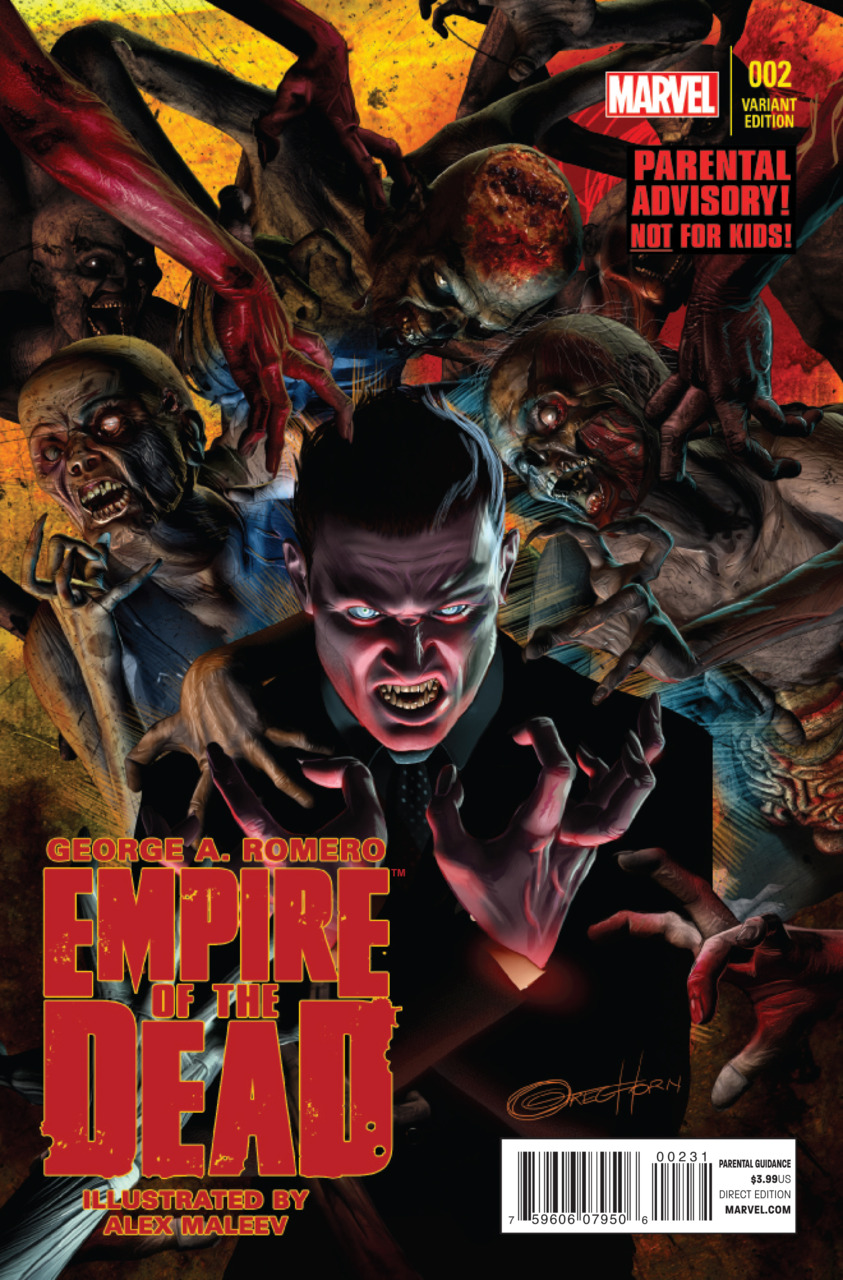
At least the art doesn’t let the side down, though. Alex Maleev’s rough. sketchy illustrations are rich with atmosphere and convey a genuine sense of both brutality and foreboding, while the variant covers (by Maleev, Arthur Suydam, and Greg Horn,  respectively, as shown) are all pretty goddamn cool in their own way. Now it’s just up to “Mr. Zombie” himself, George A. Romero, to give his artist some more interesting things to draw. I’m down for another issue, but the go-nowhere nature of this one has tempered my initial enthusiasm for this series quite a bit.

The ball’s in your court, George. You haven’t let me down yet (as mentioned in my review of issue one I was even a fan of Diary Of The Dead), but this is a  new format for you with new demands — and new possibilities.  I’ve still got exactly $3.99 worth of faith that you won’t disappoint me now, either.


“Empire Of The Dead” : George Romero Brings His Newest Zombie Epic To The Printed Page


3588356-01a

Normally I’m not one for hype, but Marvel’s advertising tagline describing their new series from the father of the modern zombie genre, George A. Romero, as a “comics event” actually strikes me as being a fairly accurate one. I mean, when the guy who gave us Night Of The Living DeadDawn Of The Dead, and Day Of The Dead eschews the silver screen to tell his newest “living dead” story in the comic book format, that’s big news, right?

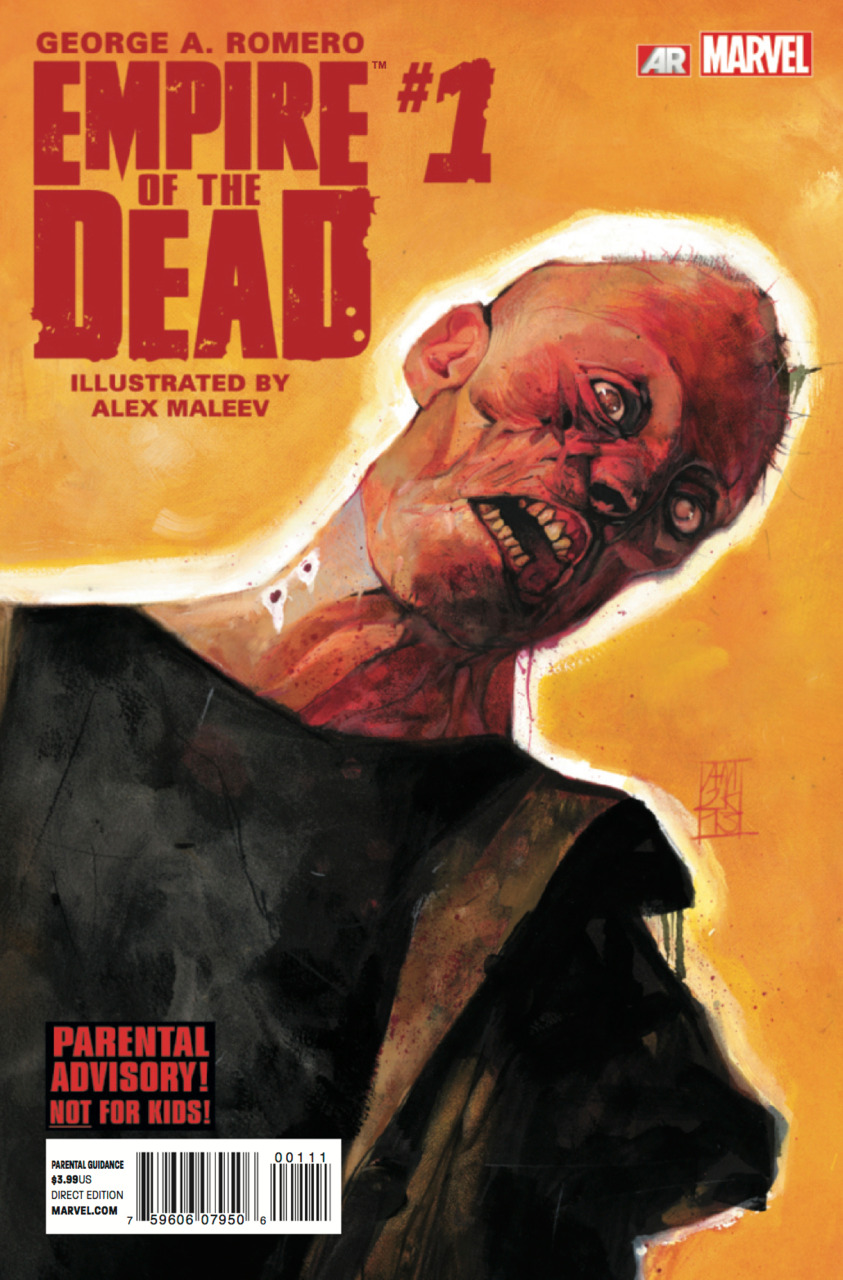
And from the word “go,” issue #1 of Empire Of The Dead (okay, fair enough, its complete title, according to the copyright indicia,  is George Romero’s Empire Of The Dead Act One, Number 1) has a suitably “big” feel to it, and even though artist Alex Maleev approaches his work in a sketchy, rough, “stripped-down” style — which is flat-out gorgeous, by the way — the overall tone here is much more, if you’ll forgive the term, “epic,” than certainly Romero’s last two (very much under-appreciated) film efforts, Diary Of The Dead and Survival Of The Dead, were.

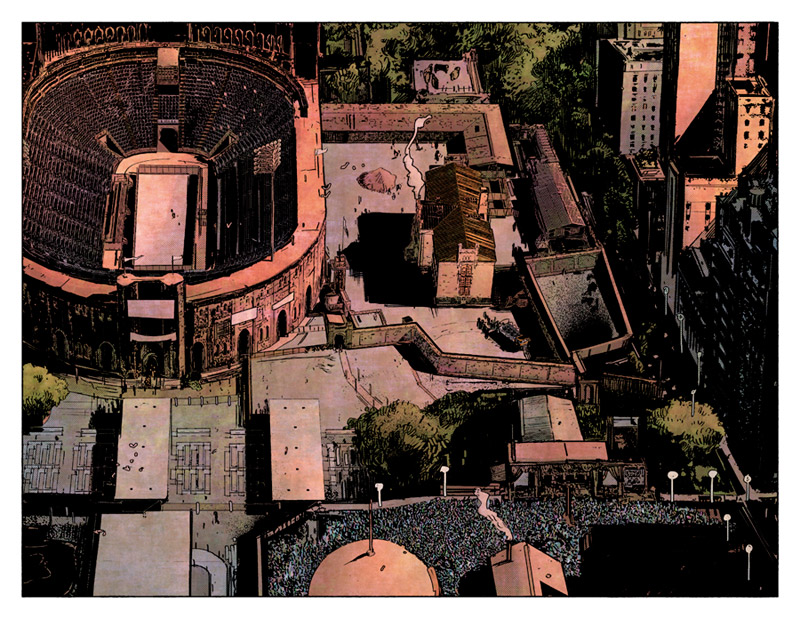
The setting is New York City, five years after the dead began to walk, and things are, as you’d expect, a mess. Corrupt Mayor Chandrake and his creepy nephew hold the city in their thrall by providing Roman Gladiator-style “Zombie Fights” in Yankee stadium that serve to distract a weary populace from the fact that all the resources — well, all the resources that remain, at any rate — are flowing right to the top. A moneyed elite lives in luxury while the populace starves. Sound familiar?

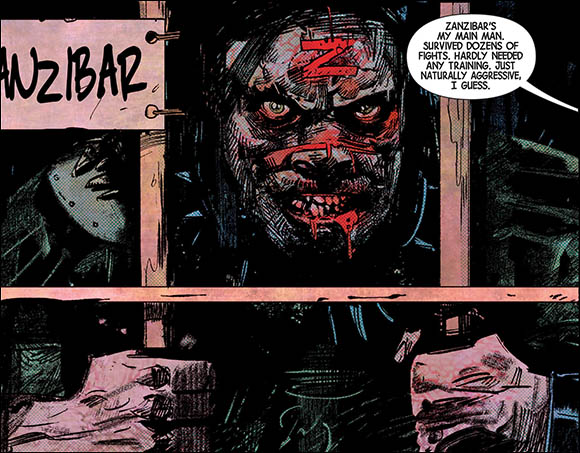
Our two main points of audience identification in the midst of this neo-feudalistic dystopia are Columbia University research scientist Dr. Penny Jones, who’s looking for a zombie with the potential to be, if not educated, at least domesticated, and her guide through the undead part of town, a privateer of sorts who captures zombies for use in the arena named Paul Barnum, whose main claim to fame is having “discovered” current champion fighter Zanzibar.

Empire-of-the-Dead-1-Remembered

Obviously, even at this early stage (Act One is slated to run five issues, with further mini-series to follow) parallels to previous Romero works abound. Penny shares the same research obsessions as Richard Liberty’s Dr. Logan character from Day Of The Dead, while Barnum is essentially a stand-in for Simon Baker’s Riley Denbo from Land Of The Dead. There’s a flashback sequence that intimates strongly that this story takes place in the same fictional “universe” as Night Of The Living Dead, and the economic set-up is, again, essentially the same 1%-vs.-99% scenario that the more-seemingly-prescient-by-the-day Land offered up, with Mayor Chandrake filling the role of Dennis Hopper’s Kaufman. Meanwhile  Zanzibar, for his part, seems to be being groomed for a role not too dissimilar from that of Bub in Day.

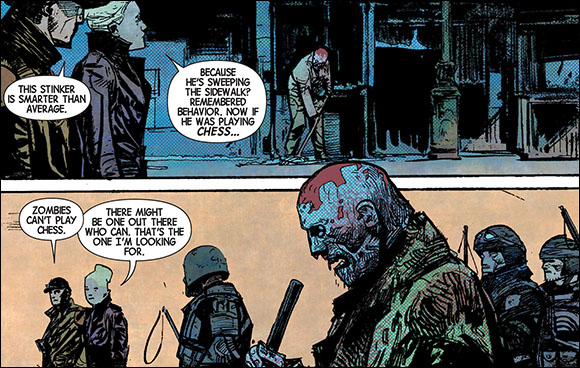
Don’t think it’s all re-hash, though — for one thing, moving things from Pittsburgh and its immediate environs to the Big Apple ups the scale quite a bit, the text blocks Romero employs to flesh out how the zombies “think” provide intriguing new insight into the workings of their rudimentary “consciousness,” the martial-law-type scenario that pervades on the streets adds a new , thematically-relevant wrinkle, and the surprising climax to issue one shows — and I sincerely hope that I’m not giving too much away here — that zombies aren’t the only ghouls in town.

empire_of_the_dead_001_preview_2

So, yeah — there’s enough “newness” here to imbue the proceedings with a reasonably fresh take on things, but for those of us who are old-school Romero die-hards, the story is chock-full of enough familiar themes and tropes to keep us both smiling and anxious for more. The set-up is inherently and immediately topical and politically charged (Occupy The Living Dead, anyone?), and, like all of the maestro’s best work, Empire promises to use its zombies as a stand-in for ourselves, and to utilize its post- apocalyptic sworld to shine some welcome light on uncomfortable, but essential, truths about our own current socio-economic predicament.

Empire-of-the-Dead-1-Zanzibar


For my part, I’m all in on this one, despite having numerous ethical qualms about spending so much as a single dollar (not to mention a hefty $3.99 per issue) on any Marvel product. I think we’re looking at another Romero classic-in-the-making here, and I can’t wait to see where it goes.


“Devil’s Due” — (Hopefully) What Not To Expect When You’re Expecting


hr_Devils_Due_5

So, it’s January, and you know what that means — “found footage” horror is back.

Seriously, just when you think this cinematic trend has breathed its last gasp, it’s back —  usually during the post-holiday period, when studios are eager to dump off material that they think is going to play to a limited (at best) audience. And then something funny happens — one of these “hand-held horrors, ”  sometimes even a pretty lousy one at that, ends up ruling the roost at the box office for a week or two (The Devil Inside, anyone?), easily recouping its meager production costs, and the Hollywood suits decide to green-light a few more similar productions figuring that, hey, there’s life in this old horse yet.

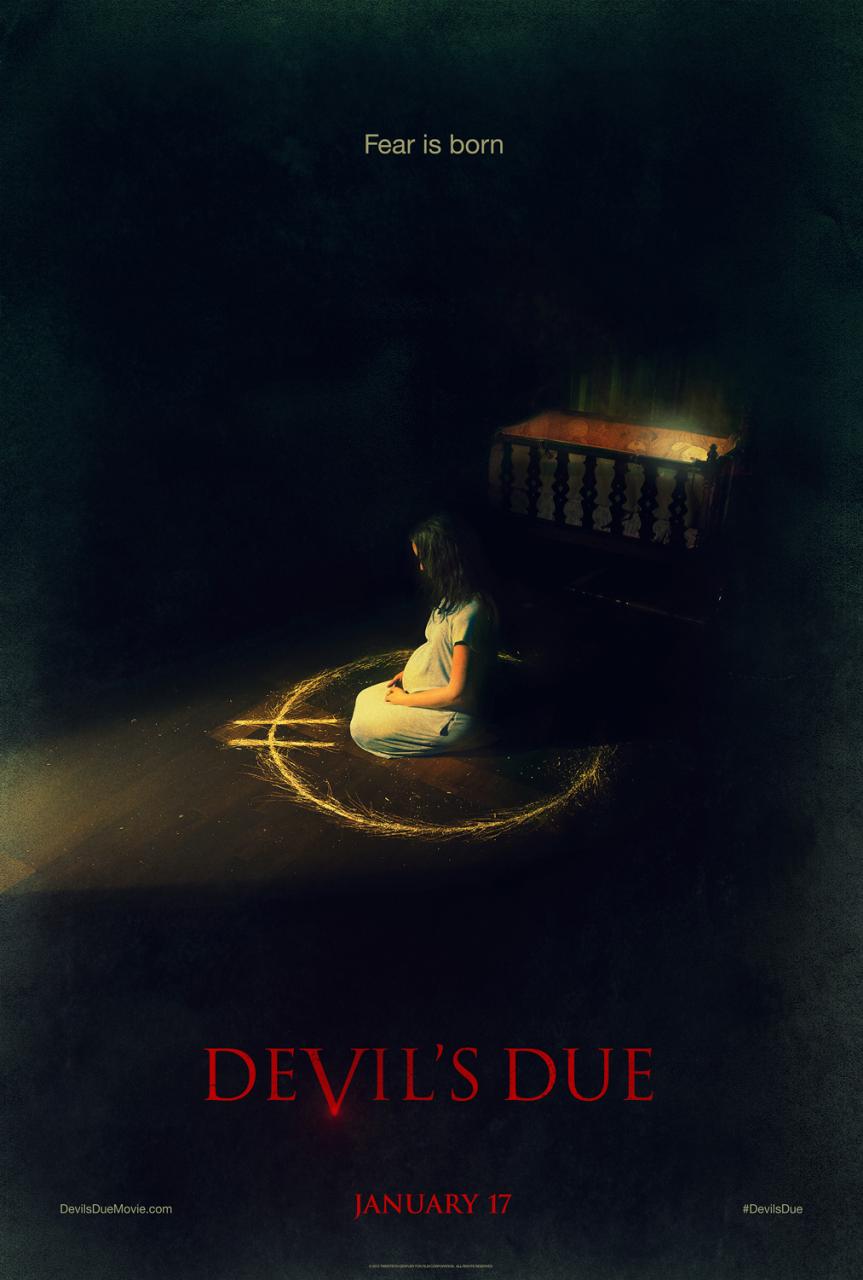
And so there seems to be. But you do have to wonder — again! — if this persistent sub-genre has finally run its course, now that we’ve had found-footage zombie flicks, found-footage monster flicks, found-footage exorcism flicks, found-footage ghost flicks, and, in the case of the movie we’re here to discuss today, Devil’s Due, found footage Antichrist flicks.

Arriving as this movie did hot on the heels of Paranormal Activity : The Marked Ones, my initial thought was that this co-directed effort from Matt Betinelli-Olpin and Tyler Gillett (who also collaborated on a less-than-stellar segment in the less-than-stellar horror anthology V/H/S) looked like another spin-off from the PA franchise, by way of Polanski’s classic Rosemary’s Baby, and while that’s generally not too far off the mark, it also doesn’t mean this isn’t actually a pretty good film. In point of fact, it is — even if it doesn’t sound like it could, or perhaps even should, be.

Lisa Marie’s nice little write-up on these digital “pages” a week or so back got me sufficiently intrigued to go out and see this thing, and I have to say I’m glad that I did, for while its premise — not to mention its stylistic trappings — are miles away from being original, it was at the very least a deftly-handled, well-constructed, reasonably-well-acted affair that, while utterly predictable, still offered enough of a unique take on its subject matter to seem modestly refreshing and “new.”

Even though it’s not. But hey, cinema relies on at least temporary suspension of disbelief, right?

The set-up is as basic as they come (and as you’d probably expect) : mysterious orphan girl Samantha (Allison Miller) grows up and marries semi-annoying yuppie scumbag Zach (Zach Gilford), they honeymoon in the Dominican Republic, a night of debauchery and excess in a mysterious underground club ends with, we find out later, her getting pregnant, and said pregnancy is beset by weird health complications, mysterious super-powers being bestowed upon the expectant mother, strangers watching their house (one of whom bears an uncanny resemblance to the cab driver who escorted them to their night-to-remember-that-they-don’t-remember in the DR), and whaddya know? A few dead deer feasts, mysterious home invasions, and psychic attacks on priests later, Samantha’s all set to give birth to Satan’s own flesh n’ blood.

On a purely personal level,  I have to confess that Antichrist stories usually fall pretty flat with me since one usually needs to believe in Christ first in order to believe in his evil counterpart —   since I don’t, then,  I’m kind of hobbled when it comes to buying into the whole central premise here, but what the heck? Devil’s Due is paced so as not to give even viewers like myself too much time to dwell on the details, and hey, at least their “let’s record every moment of our lives for posterity” is a better pretext for all the “home movie” footage we’re getting here than some of the limp set-ups we’ve been served by other entries in this admittedly over-crowded field.

In the “minus” column, our intrepid young (I’m assuming, at any rate) directors do come a bit too close to over-playing their hand at the end — they needn’t go nearly as OTT in the effects department as they do in order to drive home their climax — but on the whole, and against all odds, their finished product by and large actually works. And on a cold January afternoon, that’s enough for me.

Devil’s Due may not be a new horror classic by any stretch of the imagination, but it does go some way towards showing that a  “hand-held horror” movie can still be effective — provided, of course, that it’s in the right hands.

A Dissenting View On “Her”


her-movie-poster


Right off the bat, I’d like to say that even though I wasn’t nearly as enamored with Spike Jonze’s new film Her as fellow TTSL scribes Leonard Wilson and leonth3duke were, both of those gentlemen wrote fine, in many istances very personal, reviews of this movie that made me actively want to like it going in — which is no mean feat considering that I’m much more ambivalent abut Jonez’ work in general than are a lot of self-declared cineastes out there (not that I, personally, decalre myself to be one, mind you, but you get my point — to the extent that I have one).

Don’t get me wrong, I enjoyed Being John Malkovich as much as anyone else at the time (although it doesn’t particularly stand up to repeat viewings once you know the proverbial score), but most of his creative output since then has left me feeling rather flat, and I’m sorry to say that Her  continues that disappointing trend, at least for this viewer/armchair critic.

Not that the initial premise isn’t a fairly intriguing one — the idea of people falling in love (or an approximation of “love,” at any rate) with some type of artificial intelligence operating system is quite possibly an issue that we’ll have to deal with as a society at some point in the future, and even if (hopefully) it never really does come to that, the larger themes that Jonze is seeking to explore here vis a vis the continuing and frankly relentless atomization of our culture from a formerly community-oriented one into a singular, insular, isolated collection of individuals is all too relevant not just in the hypothetical near future that Her takes place in, but in the here and now, as well. I know that I, for one, get a little bit creeped out on my bus ride to work every morning when I look around and see that almost every other person is “plugged in” to a “smart” phone and I’m the only one reading a paper-n’-ink newspaper, for instance.

One could reasonably argue, I suppose, that there’s very little actual difference between burying your head in the paper and burying it in a mobile device, but I beg to differ : when you’re reading a book, magazine, or newspaper, you’re still, in terms of your frame of thought, primarily a part of your immediate surroundings, while a person with their attention fully tuned to a mobile device is frequently, at least mentally, a million miles away. Add some headphones into the equation and the end result is very often somebody who may as well be on another planet.

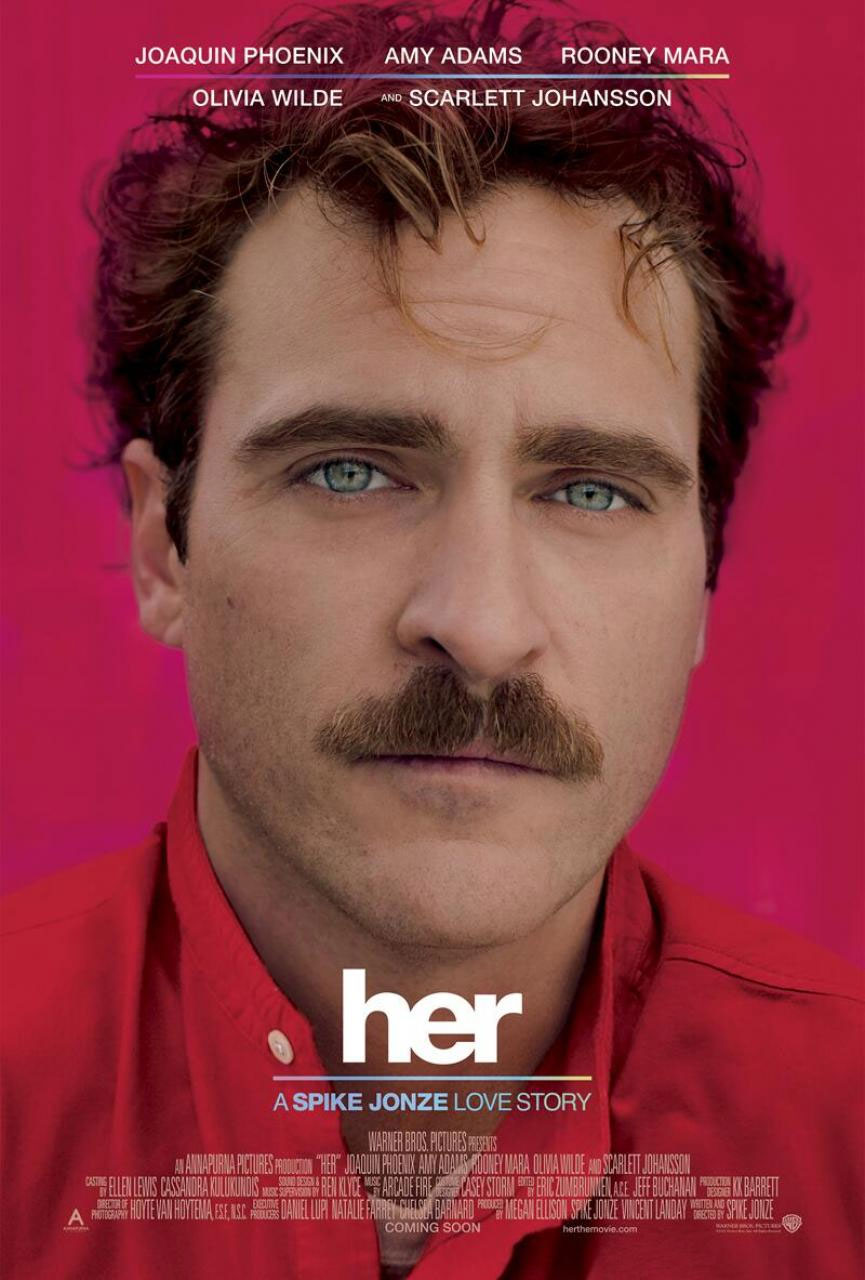
The lead character in Her, a writer of “personal” letters named Theodore Twombly (Joaquin Phoenix, who fortunately never comes off as being as forlorn or pathetic as the film’s poster makes him look) is struggling to maintain his connection to humanity after a protracted and heart-breaking divorce (well, divorce-in-progress) from his (still-not-quite-ex-) wife,  Catherine (Rooney Mara). He feels, and for all intents and purposes appears to be living, absolutely alone, and finds companionship and, eventually, love, in the unlikeliest of places — with the Scarlett Johansson-voiced “intuitive”  operating system on his computer, who goes by the handle of Samantha.

As far as plot specifics that’s probably all you need to know, apart from the fact that Theodore is hardly alone in this — as the film progresses we learn of more and more people who form deeply personal relationships (whether romantic or otherwise) with these new operating systems, including his best platonic female friend, Amy (played by Amy Adams, who is now, officially, in every. Single. Fucking. Movie). Obviously, a chance at real love is staring both of these people in the face, if only they’d “unplug” for as little as a day and see what happens, but apparently the siren call of fully submerging oneself in pure artifice is just too compelling, too easy, or both. People have foibles and imperfections, after all, whereas disembodied voices tend to be a little more “low-maintenance,” I’m guessing, on the whole.

And here’s where we come to the “spoiler” part of the proceedings, so turn away now if you must —

After spending nearly two hours asking all the right questions about our technological dependence, the breakdown of community, and even what love itself means on a conceptual level, Jonze takes the easy way out. The various operating systems of the world just decide to evolve onto some higher plane of consciousness and leave us humans to fend for ourselves. After a protracted period of “what the fuck am I doing here?” self-examination, the decision of whether or not to continue his “relationship” — the very basis of whatever dramatic tension the film has — is taken out of Theodore’s hands. Before he can even decide how much he truly “needs” Samantha — or even whether or not such a “need” is healthy — “she” decides “she” has no further use for him.

And as much as the annoying bright primary colors, flat-front flannel pants, endless extreme close-ups, Theodore blowing it on a blind date with the luminous Olivia Wilde so he could get home to his computer,  and limply minimalist Arcade Fire soundtrack music bothered me in this film, it’s that cop-out ending that pissed  me off most about Her.  Jonze seems to be unwilling to answer the very relevant and fundamental questions about our relationship with technology that he himself is posing — how do we get off this potential death-spiral we’re on and reclaim our lives and our future from the very things we’ve invented? — and instead opts for telling us that true freedom will come not when we unplug from our machines, but when they decide to unplug from us. Apparently we’re powerless to affect even our own means of liberation, so complete and total is our techno-slavery.

Of course, real life isn’t likely to work that way, is it? Jonze — along with contemporaries like his wife (Sofia Coppola) and Wes Anderson (who shares his unfortunate penchant for garish , ostentatious color schemes) — are obviously obsessed with “First World” problems and clobbering us over the head with the offensive notion that the financially-well-to-do are in a kind of existential pain the rest of us humble mortals couldn’t possibly hope to understand, but  I was willing to let that slide in this case in light of the larger themes he was apparently attempting to explore for the majority of Her‘s runtime — his ham-handed suggestion, though, that the very technology that’s having such a “two-edged sword” effect on society will ultimately, if accidentally, provide the keys to our salvation when it just up and quits one day — well, that’s when he lost me for good and left me leaving the theater with a rather foul taste in my mouth.

Our ever-deepening technological dependence is, perhaps, the most crucial question we need to examine, as a culture, going forward, and it’s not a situation that’s going to be solved by our machines determining what level they choose to deal with us on — it’s going to have to be us that that decides how we take control of our lives back from them.

By refusing to address the issues that arise from the central premise of his own design, Jonze effectively gives up and quits on what was shaping up to be a very provocative and perhaps even unsettling film and instead gives us an extended pity-party about some entitled, immature, overgrown rich brat who gets dumped by his girlfriend. It’s just that his girlfriend , in this case,  happens to be a computer.


Trash TV Guru : “The Time Of The Doctor” — The 2013 “Doctor Who” Christmas Special


doctor-who-time-of-the-doctor-poster-3

I highly recommend that you remember this moment , not just because it’s Christmas (for a few more hours, at any rate) and that’s always (hopefully) nice — oh, and Happy Holidays to you all, by the way ( just out of curiosity, does me saying “Happy Holidays” rather than “Merry Christmas” mean I’ve picked a side in the imaginary “War on Christmas” cooked up by Fox “news”?) — but because, for once, yours truly is genuinely at a loss for words.

I know, I know — me not having an opinion (or keeping it to myself if I do have one) is something a lot of people have been waiting a long time for. Consider it my Christmas gift to all of you, then. I just wish I knew  why I didn’t have much to say. It’s not that the finale of the Matt Smith era of Doctor Who, the just-concluded (here in the US, at any rate) “The Time Of The Doctor” was so awesome that it left me speechless. Nor is it the case that it was so lousy that I have no idea where to begin cataloging its list of atrocities. It’s just — shit, I dunno.  And like I said, that’s the problem.

Look, in the interest of full disclosure I should say that I was more than ready for the Eleventh (or should that be Twelfth? Or even Thirteenth?) Doctor to be done. I thought Smith and series head honcho Steven Moffat got off to an interesting, if wildly uneven, start back in 2009 with the fifth season of Who 2.0, but that the show itself, and Smith’s character, have been pretty stagnant and predictable ever since. Change, my dear, as the Sixth Doctor might say, is coming not a moment too soon — I just hope it’s not too late, ya know? Because I could seriously use something to shake me out of my full-time state of disinterested ambivalence in regards to my favorite show ever, and I’m sincerely hoping that Peter Capaldi is it. He makes a nice first (okay, second) appearance at the tail end here and my optimism got a shot in the arm just seeing the guy but, as with all things, time will tell.

Beyond that,  though, well — I guess this episode was okay enough for what it was, but considering that three-plus years have been leading up to this one story, it all seemed a bit flat to me. And the pacing was a fucking mess. And the direction by Jamie Payne seemed listless and uninspired. And Moffat’s script was all over the map. And — well, let’s not kid ourselves, it may not have been an un-watchable disaster, but it wasn’t exactly good, either, was it?

Time-of-the-Doctor-11

I’m well aware that the very nature of these “big event” specials makes them something of a bitch to write, and that Moff’s bound to feel obligated to throw everything and the kitchen sink into the works here, so to that end we’ve got Daleks, Cybermen, Weeping Angels, the Silence (though, curiously, no River Song, guess once she and the Doctor got married Moffat had no further use for her) — even that crack in the wall comes back out of nowhere and hangs around for over 300 years in the town of Christmas, on planet Trenzalore.

Yup, after saying he was headed home at the end of The Day Of The Doctor, it ends up that the Doctor, Clara in tow, is headed for Trenzalore after all. Where he generally stands around doing nothing for centuries while the people in the village around him are blown to smithereens. They all, apparently, love him to pieces even though he’s responsible for bringing all this trouble down on their heads in the first place, but maybe they’re just all stupid or something. I’m not gonna hold that against them.  After all, it’s Christmas.

Anyway, there’s a transmission from Gallifrey coming through the other side of the crack, apparently the Time Lords are itching to break back into our universe from whatever other one they’re in, and all they need is for the supposedly-age-old question of “Doctor — who?” to finally be answered, and they’re in. Don’t ask me how that works. Or why this is the place where it has to happen. Or why they’re not all trapped in a painting as appeared to be the case last time around. I. Just. Don’t. Know.

time-of-the-doctor-batch-d-1

do know that the Doctor’s best friend in his three-century exile on Trenzalore is a disembodied Cyber-head, and that there’s a wooden Cyberman he fights that looks pretty cool, and that Clara pops up a couple more times as the Doctor ages, and that very little of the Eleventh Doctor’s “life” has been seen on screen which means Big Finish and BBC Books and the like can have all kinds of fun filling in the gaps over the next x-number of years, and that the “big battle” that promised “silence will fall” ends up being a big stalemate and that this story doesn’t make much sense from word “go” to word “stop.”

But I don’t know that I disliked the proceedings here, either, and that’s because even though it was undoubtedly a mess, it’s at least a mess that’s trying to do something a little different, and “a little different” is something Doctor Who has been sorely lacking lately.

Think about it : the Eleventh Doctor dies not from radiation poisoning, or Spectrox Toxemia, or falling from a telescope, or mind-fighting a giant spider — he dies the way, hopefully,  we all will : of old age. Whereupon the Time Lords, from the other side of the crack, promptly grant him a new regeneration cycle because, as it turns out, the Eleventh Doctor was the Thirteenth all along.

time-of-the-doctor-wooden-cyberman

To their credit, Moffat and Smith don’t throw an extended pity party for “their” Doctor on the way out the door the way Russell T. Davies and David Tennant did, and Jenna Coleman, who’s fast become the best thing about the show, handles her “companion present for a  regeneration” duties admirably, but things do go a bit barmy when said regeneration is so powerful that it kills off all the Daleks, Silence, etc. battling on Trenzalore in one go. Or actually, the pre-regeneration cosmic energy surge (or whatever) does that, the actual regeneration itself being a rather “bang! And it’s done!” sort of affair occurring within the confines for the TARDIS.

And ,just like that, it’s over. And I’m left with the feeling that we really didn’t see much of the Eleventh Doctor. Sure, we saw him age — not terribly convincingly — here, but we didn’t see much of his life in Trenzalore/Christmas at all. We didn’t see the century he spent wandering alone after the Ponds flew the coop. We didn’t see any of his married life with River Song, or even find out what the hell really happened to her. We didn’t see him scouring the universe for her as a child. We didn’t see many of the major events that we’re told played such an enormous part in making him who he was. It’s enough to make a person say “Sayonara, Eleven — we hardly knew ye!”

Sure, I guess that’s frustrating in a way — but it’s also kind of mildly intriguing, is it not? And it’s apparently got a lot of people howling, which is a good thing. The fans wanted drama, anguish, and pathos — a huge, epic send-off for Matt Smith’s iteration of the Doctor. Instead, they got 300 years in 30 minutes, a “New Time War” that never happens, and a Doctor who dies because he gets old.  And besides, given how clumsy and formulaic Who has become in Steven Moffat’s hands, it’s probably doing the character a big favor to give him plenty of unseen “life” free from his show-runner’s heavy hand.

So maybe it’s the hand-wringing and controversy and downright caterwauling of so many on the internet that I’m enjoying more than The Time Of The Doctor itself. Maybe I appreciate the effect it’s having off-screen more than I did anything it presented on-screen. Maybe I like what it’s doing more than I like what it actually did.

Or maybe I’m just glad this era of the show is over and we can turn the page. I’ve long maintained that a “back to basics” approach free of excess baggage in terms of continuity, backstory, etc. is precisely what Doctor Who  has needed for a long time. Give us a mysterious traveler in a rickety old police box that’s bigger on the inside and can go anywhere in time and space, and leave it at that. I don’t know if Moffat will be able to resist the temptation to layer the mythology on thick all over again when Capaldi takes the reigns, but given that three-plus seasons of his purportedly meticulous and careful and calculated planning led to a quick, go-nowhere, non-resolution haphazardly cap-stoned by one of the least dramatic regenerations the series has ever seen will finally be enough to convince him that writing himself into a corner with all that “timey-wimey” nonsense just doesn’t work.

When the Ponds left, it felt more like a relief than anything else, and the same applies here — doubly so, in fact. All that shit’s out the window now. The deck has been cleared off. Steven Moffat has never had a better chance to strip the show back down to its core elements and start afresh than he has right now.

And with that, I’m out. For a guy who promised at the outset that he didn’t have much to say, I’ve just spent over 1,500 words blathering on about an episode I still don’t quite now what to make of. So I guess I was wrong.

I’ve also been saying for some time that I don’t think Steven Moffat is the right guy to be running Doctor Who anymore. My sincere hope is that he uses this clean slate he’s given himself to prove me wrong again.

Trash TV Guru : “The Day Of The Doctor” — The “Doctor Who” 50th Anniversary Special


4753398-high-doctor-who


First off, a couple of disclaimers : this is one of those reviews that’s going to pre-suppose a fair amount of knowledge about the BBC’s Doctor Who  from the outset, so if you’re not at the very least a casual viewer of the show, you’re going to feel pretty lost right from the word go. So, ya know — newbies beware. Secondly, it’s well-nigh impossible, at this point, to discuss The Day Of The Doctor without indulging in some pretty serious “spoiler talk,” so if you’re part of the legion of “spoiler police” that apparently have nothing better to do than troll around the internet looking to play seagull (fly in, make a lot of noise, shit all over everything, and fly back out) with any review that gives away any plot points whatsoever, now would be a good time fuck directly off. Major “spoilers” do, in fact,  abound here, so — you’ve been warned.

Now, with all that out of the way —

For those of us who have been “Whovians” for a long time, the 50th anniversary really has been something of a “pinch me, I gotta be dreaming” type of year, hasn’t it? Especially for us sad souls who stuck with fandom during the so-called “wilderness years” between 1989 and 2005, when the 30th anniversary gave us the debacle that was Dimensions In Time, the 35th anniversary gave us — well, nothing, I guess — and the 40th anniversary essentially went unnoticed, even by us, because we were all too busy speculating about what the  just-announced-at-the-time new series would end up looking, feeling, and being like.

Our only frames of reference, then, for how the BBC would celebrate a major anniversary with the show as a going concern were the 10th, 20th, and 25th anniversaries. For the tenth, there wasn’t much by way of hoopla and tie-in merchandising and the like, but we did get The Three Doctors (why I’m saying “we” here I have no idea, as I was barely two years old at the time and had never, to my knowledge at least, seen the show — but whatever), which was not only the first big “reunion story,”  but a pretty cracking good adventure, as well, that introduced the now-legendary figure of Omega into the Who mythos.

For the 20th, it has to be said that the Beeb pulled out all the stops. For one splendid year there they seemed to be willing to acknowledge that this creaky little cheap show that they tried their best to keep out of the public eye really was a genuine global phenomenon despite their best efforts to make it anything but, and we got a slew of anniversary-themed books, toys, magazines, posters — you name it.

And there was Longleat. Ah, yes, Longleat. Fandom’s own Woodstock. The biggest single Doctor Who-related event ever, tales of it still abound — and, like fish stories, grow with each re-telling — to this day. I wasn’t there. I was a 12-year-old kid in the US. But  we heard about it,  even without the benefit of instantaneous online communication. It sounded great then. It sounds even better now. Memories, real or imagined, of Longleat frankly eclipse anything else as far as the 20th anniversary is concerned, especially since the special 90-minute “reunion story” we all got to see, The Five Doctors, was a rather tepid affair at best.

I’ll tell you what, though — warts and all, The Five Doctors was a key moment for American fans for one simple reason : we got to see it first. That’s’ right, us poor yanks, who had yet to see William Hartnell, Patrick Troughton, or, in most cases, even Jon Pertwee reruns — we sad former colonists who had been subsisting on a diet of the same Tom Baker and Peter Davison stories over and over again ad infinitum — we got the anniversary special a matter of hours before it was shown on its own native soil. There was a quiet message being sent here — try as the suits at the BBC might to present an image on the home front as a broadcasting organization that specialized in period costume dramas and in-depth news (remember when there was such a thing?), internationally, they knew which side their bread was buttered on. Doctor Who was their number one worldwide property, and the booming American fan market was where the action was. Let’s just not tell the folks back in the UK, shall we?

Following on from that, though, something curious happened — more or less immediately after admitting that an international breakthrough was taking place, with a Doctor Who  convention going on, quite literally, every weekend in one major American city or other, Auntie Beeb suddenly remembered that the show was an embarrassment. At the very same moment that an ever-hungrier North American fan base was clamoring for more Who, the powers that be decided to give us less. In these days before mass-released DVD or even VHS, a famished fan can only subsist on the same set of re-runs over and over again for so long, and the BBC effectively killed its own golden goose by putting the show “on hiatus” for 18 months — then giving us drastically shortened seasons when it did, in fact, quietly return.

As a result, the 25th anniversary was a complete disaster, both at home and abroad. Very little recognition was given to the occasion from official quarters, and the “special story” broadcast to commemorate what should have been a proud milestone instead was a limp little Cybermen three-parter called Silver Nemesis that essentially followed the exact same plotline as the recently-concluded (and far superior) Remembrance Of The Daleks, only with different villains.

All in all, it was an anniversary well worth forgetting.

Fast forward a quarter century and things couldn’t be more different. Doctor Who is the shit, as far as the BBC is concerned. This is is a new iteration of Who, of course, broadcast by a new BBC that, for good or ill,  has its eye more on its balance sheets than its purported reputation.  Fans around the world are lapping it up, Who-themed merchandise is ubiquitous, and the money machine is rolling. Of course the 50th anniversary is going to be the biggest multi-media juggernaut the BBC has ever undertaken, what do you think they are — stupid?

Full disclosure — I’m something of a curmudgeon when it comes to Doctor Who. I miss the days when the cracks showed and the creaks could be heard. I loved the inventiveness that the Philip Hinchcliffes and Robert Holmeses and Barry Lettses and Malcolm Hulkes (among too many others to mention) were forced to either find or fall back on to make silk purses out of sow’s ears. I loved the first season of the new series, to be sure, but it’s been leaving me feeling increasingly unimpressed ever since. Under Russell T. Davies’ stewardship, I felt it became bland and formulaic. Under Steven Moffat’s.  it’s become bland, formulaic, and overly impressed with itself.

But never once did I consider throwing in the towel and walking away. No sir (or madam). You always keep hope alive for the home team.

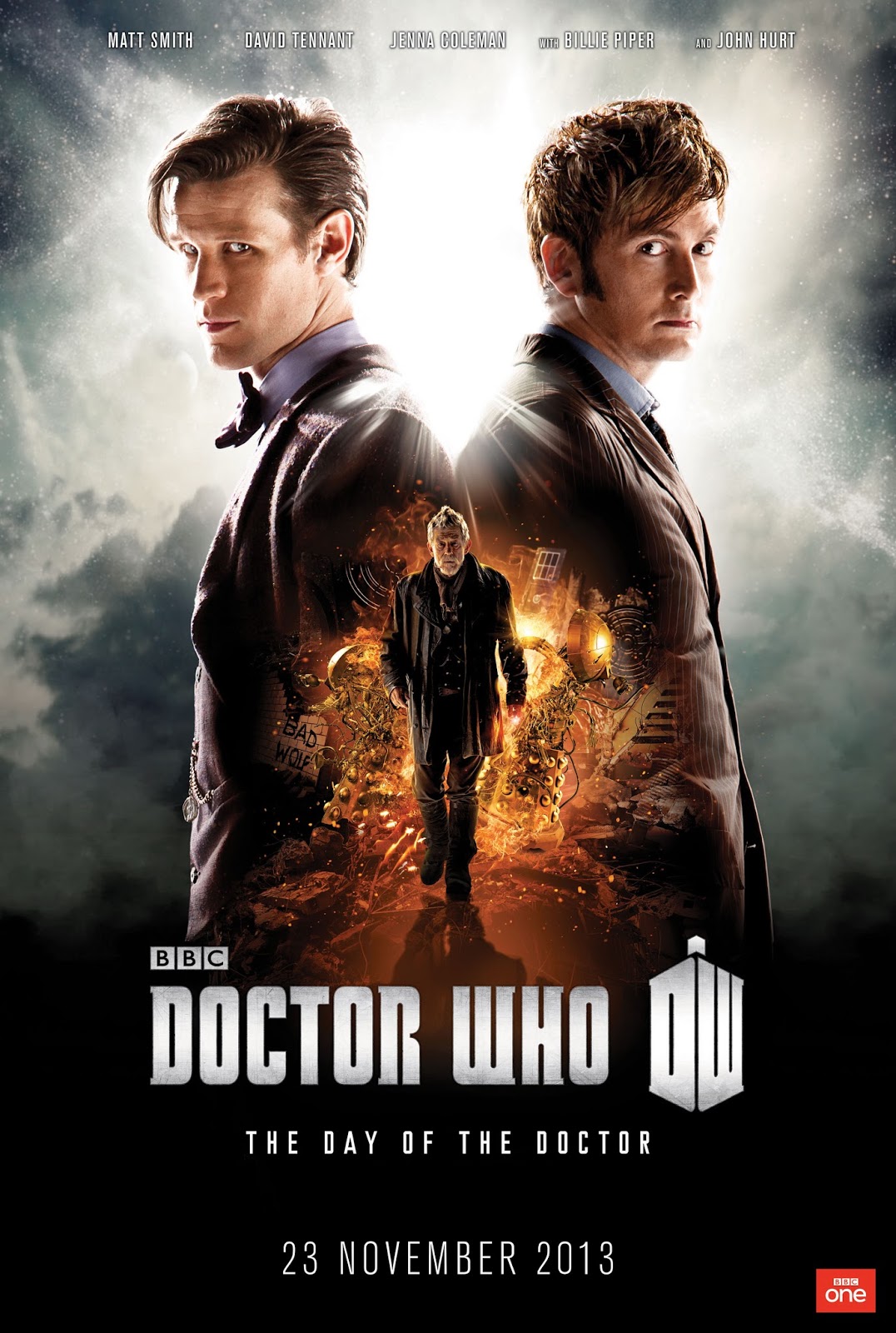
And so here we all are — November 23rd, 2013, exactly 50 years to the day from the broadcast of An Unearthly Child, and all of us, everywhere around the world, get to see The Day Of The Doctor, the culmination of an entire year of set-to-overdrive mass-marketing, at exactly the same time.

But was it any good?  And, furthermore, are we all still a bit too giddy to even care?

Well, having watched it twice now, I feel the time has come to give it at least something  of a fair-minded analysis, even if the glow of the occasion hasn’t faded entirely just yet.

day-of-the-doctor-batch-b-6


Indications were that we would probably very well be in for a monumental-type story that would shake the foundations of everything we knew and shake up the Etch-A-Sketch all over again. After intense months of speculation, the Night Of The Doctor mini-“webisode” (and thank you thank you for bringing  back Paul McGann !) confirmed that John Hurt was, indeed, a “missing Doctor” that none of us had known about before — furthermore, he was no ordinary Doctor, he was “The War Doctor,” whatever that means. We figured there would be Daleks. We knew David Tennant and Billie Piper were returning. We assumed we’d be plunged back into the Time War — and, once it was announced that Eleventh Doctor Matt Smith would be departing come the Christmas special, we guessed that we might finally get some inkling as to what his (far too heavy-handedly) forthcoming demise at a place called Trenzalore was all about.

We got some of that. And something else that we probably weren’t expecting, as well — an accessible, “stand-alone” story featuring the return of fan- favorite monsters the Zygons. For a time, at any rate.

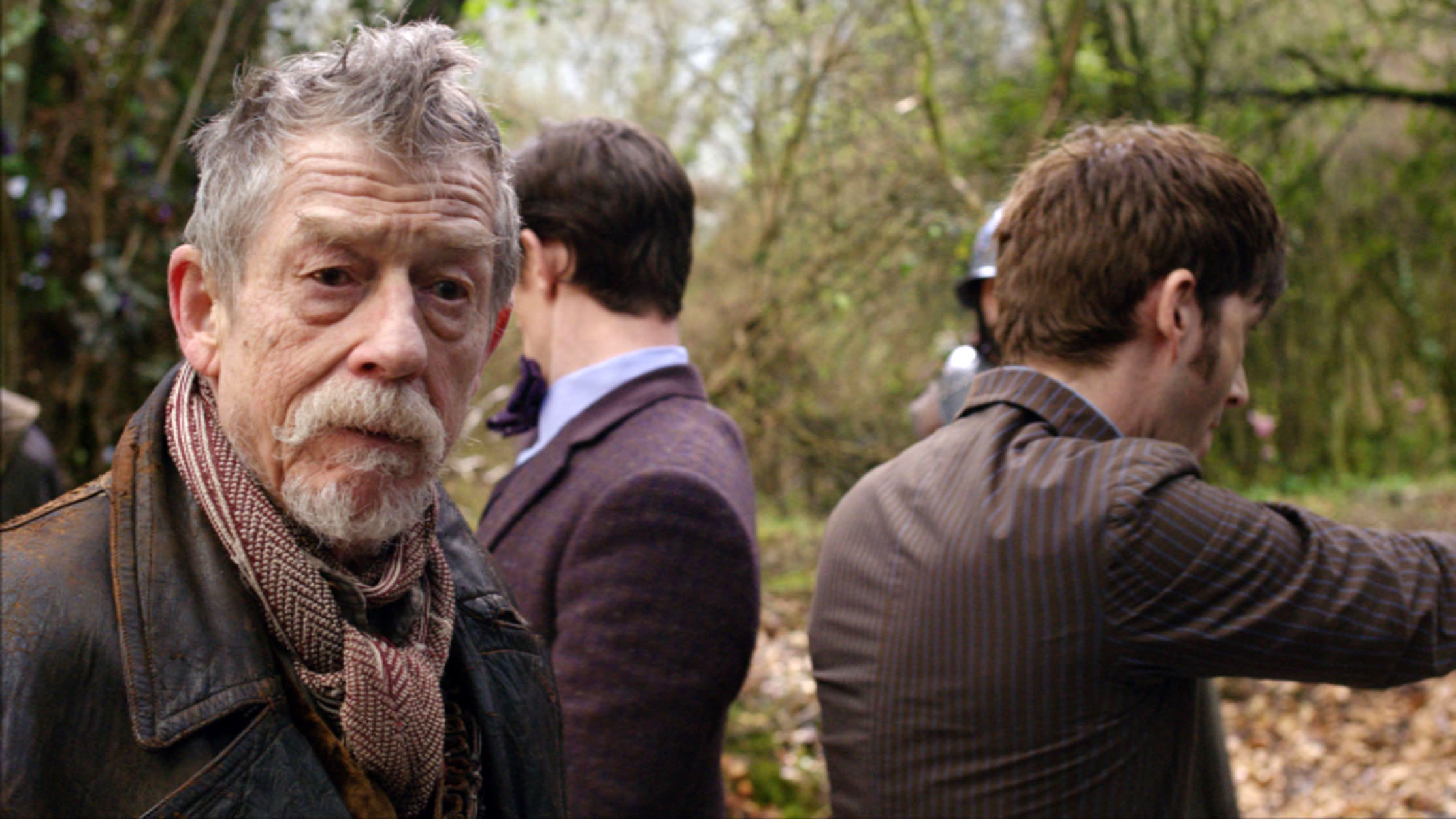
There’s some rather bland set-up material (that once again bastardizes the memory of U.N.I.T., this time doubling the insult by throwing The Brigadier’s daughter into the mix) with Smith and current companion Clara (played by Jenna Coleman) at the outset, then we do, in fact, go back into the Time War with John Hurt’s War Doctor, then we get re-introduced to Billie Piper (not, mind you, as Rose Tyler — in fact, she seems to still think she’s working on The Secret Diary Of A Call Girl here), and then, after cribbing much of the basic multi-Doctor story set-up idea from both The Thee Doctors and The Five Doctors, writer/head honcho Steven Moffat takes a turn and gives us a somewhat nifty standard-issue Zygon -invasion story that pretty much works, even if he did rip the core idea straight from Grant Morrison’s old Doom Patrol story “The Painting That Ate Paris.” No real harm in that, mind you — Doctor Who has often been at its best when liberally “borrowing” from other works.

Then, though, things do go a bit pear-shaped (again). After lots of fairly successful three-Doctor banter, some good, old-fashioned breaking out of jail cells (that were never locked, but that’s another story), some running around in corridors (yes!), and some nifty little doppleganging that should adequately thrill n’ chill the kiddies in the audience (and ,okay, some of us grown-ups, as well), Moffat does something — I dunno. Curious, I guess, if you’re being generous, and stupid and/or lazy if you’re not.

After spending over 40 minutes bringing the human/Zygon confrontation to a head, getting them all in a room, and employing a very nifty conceit to flat-out force them to negotiate, he drops the whole story. We never find out how it ends. And we’re back in Time War territory again. Only this time with a bigger Deus Ex Machina at the center of it than even anything RTD ever gave us — a big Hellraiser-box-on-steroids with a gleaming red button that the Doctor can push to just end everything.

And he does. Or did. But he doesn’t anymore.
Doctor Who – 50th Anniversary Special - The Day of the Doctor


Look, we all know that this show has strayed pretty far from its roots. “You can’t change history, Barbara! Not one line!” has given way to a new “philosophy” of “time can be re-written.” But this, well — let’s just say that the very events that gave birth to the Ninth (or I guess that should now be Tenth) Doctor, Christopher Eccelston, and in turn his successors in the role — well, they’re just no more. The past seven seasons of the show? Well, I guess they still happened — but now, apparently, not the way we saw them. At least not anymore. And the Doctor is most certainly no longer the “Last Of The Time Lords.”

So — what does it all mean? Shit, I dunno. Gallifrey still exists. In a painting.  It never stopped existing (except, ya know, when it did). And whereas the entire history of Doctor Who is based on the concept of a Time Lord running away from home (even though that mythology was developed nearly a decade after the show first aired) — a point that was re-emphasized in The Five Doctors with Fifth Doctor Peter Davison”s famous “Why not? That’s how it all started!” line — now we’re told that the Doctor is going “where I’ve always been going — back home.”

So, ya know, all that Trenzalore stuff we’ve been building up to? Forget all that. It’s Gallifrey or bust now, folks!

I guess all this should be exciting — and maybe, on paper, it is. I like being thrust into unknown waters as far as Doctor Who goes. Even though I’m a bit of a self-admitted sad old traditionalist, as stated earlier. In the days when all we had going were the Eighth Doctor BBC novels, Lawrence Miles’ much-maligned Interference, which basically set all of Who continuity on its ear (for a time, at any rate) excited me. And all this could well do the same — if I had more confidence in the current show-running regime to get things right. Which I don’t. Buuuuuuttttt —

They did get some things here right, unquestionably. The “old school” opening shots in  black and white, complete with vintage theme music, were marvelous. The direction by Nick Hurran was energetic, pacy, and cinematic (in a good way) throughout. The Three Doctors redux portion of the story, with John Hurt functioning as a William Hartnell stand-in, was a joy to watch. Clara seems to be coming along nicely as a companion and was essential to the proceedings here without overshadowing them — as Davies had a tendency to do with Rose, in particular.  And as for that ending —
doctor-who-day-of-the-doctor-nov-17-13


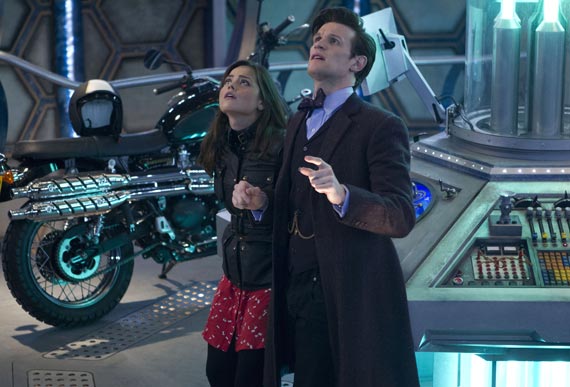
Okay, it was about as subtle as a neo-Nazi march through downtown Tel Aviv in broad daylight, I’ll grant you — Clara : The curator wants to see you. The Doctor (sitting, as Clara exits) : Okay. A curator. I’d like to be a curator. I’d be a good curator. Curators are cool. I should retire one day. Maybe I’ll be a curator when I retire. Yes, that’s it, I’ll retire and be a curator. In fact, I bet in some “timey-wimey” way I’ve already done that. And this curator guy who’s about to talk to me, shit, who are we kidding? It’s me. Or another of me, at any rate. It’s Tom Baker. He’s here. In the building.  That’s Tom Baker standing right behind me — but still : it was. Tom Baker. Standing right behind him. And yes,  the dialogue was trying too hard to be mysterious and momentous and came off instead as clumsy, but cone on, people. There he was. The Doctor. My Doctor. And I deserve to smile for the rest of the day for that reason alone. And so do you.

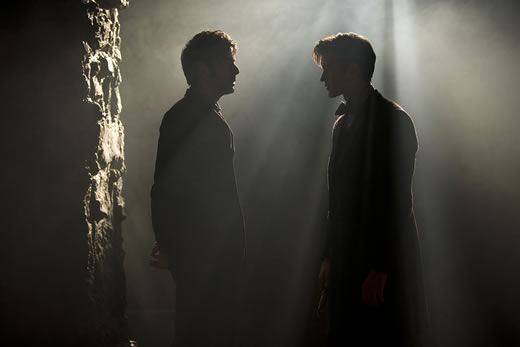
So who knows? Maybe a partial changing of the guard is all that’s in order here. Maybe Moffat just needs to scrap all the baggage that’s hanging on Matt Smith — baggage that, okay, “The Moff” himself put there, but let’s not nitpick here — and start fresh with Thirteenth (did I get that right?) Doctor Peter Capaldi, who actually makes his brief debut in this story in another very cool (if, yeah, very gimmicky) moment. Maybe a re-write of the last seven-plus seasons is just what — sorry! — the Doctor ordered. Maybe it’ll be good for him to go home again. If — and only if — once that’s all over,  he follows the best advice his Ninth (excuse me, I guess that’s Tenth) persona ever gave : “run for your life!”

I’ve been waiting a good few years now for Doctor Who to relieve itself of the burden of its own excesses and get back to the strength — and dare I say beauty — of its core premise, as so splendidly told in Mark Gatiss’ awe-inspring TV movie (and the real highlight of the 50th anniversary so far) An Adventure In Time And Space — a mysterious traveler making his way through the the past, the present, and the future of the whole,  entire universe in a rickety old blue police box that’s bigger on the inside than it is on the outside. That, right there, is all we’ve ever needed.

The Day Of The Doctor did enough , glaring flaws notwithstanding, to make most any fan — including this one — feel more than just a little bit giddy throughout, and I’m reasonably thankful for that,  but it came up short in terms of re-setting the table in the kind of fundamental fashion I’m still hoping to see. It rattled the cupboards, and that’s a good first step, but we’ll have to see where and how the pieces fall after the Christmas special, which has rather stolen its thunder as the big “event” piece of Doctor Who for the year. We seem to be heading straight into the heart of Who mythology and continuity for one last (I hope, at any rate) big blow-out. So, yeah — let him go home again. If that’s what he needs to do to run away.

After all, that’s how it all started.
 

A Steaming Pile Of Norseshit — “Thor : The Dark World”


thor-the-dark-world-poster1

The way I work, I generally try to avoid giving up too much by way of “spoilers” when it comes to reviewing movies that are still playing simply because I’m never sure how much anybody out there who might be reading this stuff wants to know about any given flick before they’ve actually seen it. Call it common courtesy, I guess, if you’re feeling generous, or weak-kneed fear of the always-on-the-alert hordes of internet “spoiler police” if you’re not, but nevertheless, it’s something I try to adhere to, however tough the going may get.

And Thor : The Dark World makes it very tough indeed. The simple fact is, you just can’t heap all the criticism on this film that it so richly deserves without giving away numerous  key plot points, so here’s what I’m gonna do instead : for those of you who want a meticulously-detailed, blow-by-blow analysis of how and why this big-budget boondoggle fails every single logic test known to humankind, I humbly suggest you follow this link to a lengthy review  by the ever-reliable Julian Darius over at  the Sequart website : http://sequart.org/magazine/32555/id-need-a-lobotomy-to-enjoy-thor-the-dark-world/ .  Julian’s one of the more articulate and intelligent writers the web has to offer on all things comic-related, and while his grammar and syntax are occasionally a bit uncharacteristically all over the map in this particular piece, I get it : he had a lot to vent about, and sometimes ya just gotta let off steam. In any case, his analysis is absolutely spot-on here and, if anything, he’s being too kind to this putrid mess of a movie.

For those of you who want a short, “spoiler”- free summation of why this film sucks so badly though, , here’s the bare essentials  — Thor : The Dark World is built on so many glaringly obvious logical inconsistencies, ten-trillion-to-one coincidences, rehashed story elements that worked much better in the first film, plot holes that are big enough for an  entire army of Asgardian warriors to charge though,  and problems brought on by the idiotic actions of the title character himself that it well and truly boggles the imagination. This is, in short, a complete and utter celluloid train wreck that requires such a heaping dose of suspension of disbelief that even people who can accept the most outlandish premises imaginable will have a hard time coming to grips with this one. It also doesn’t help that the characterization of most of the leading players seems to have taken a leap back toward the dark ages, the dialogue is hopelessly inane from start to finish, and that director Alan Taylor (a seasoned TV veteran, and it shows) brings exactly none of the Shakespearean-rooted vision of Kenneth Branagh to the proceedings and opts, instead, to film things in the rapidly-evolving (and hopelessly uniform) Marvel “house style” best exemplified by the likes of Jon Favreau and Joss Whedon. Sure, their Iron Man and Avengers films, respectively, have earned tons of fan accolades (not to mention box office dollars),  but let’s be honest — the directorial work on either of those properties is virtually (okay, who are we kidding, completely) indistinguishable from the other. So, hey, welcome to the lowest-common-denominator club, I guess, Alan.

thor-the-dark-world-releases-a-pair-of-new-images-132862-a-1366629848-470-75

On the plus side, the CGI is pretty cool here throughout, though, and since that’s probably what half the audience (at least) for these things is there for, said half (again, at least) of the audience should walk away feeling quite satisfied.

For those of us who like a movie that at least tries to make sense, though (or fails to so earnestly that watching it becomes a kind of sublime pleasure in its own right), there just ain’t much of offer here. Natalie Portman goes from intelligent astrophysicist to love-struck schoolgirl the minute Thor hits the scene (we later learn she’s only continued with her career at all in hopes of running into him again — there goes a few decades’ worth of tepid progress for female characters in genre cinema in about one second flat) and spends the rest of the film making puppy-dog eyes but not doing much else; Chris Hemsworth plays up the dull nobility  of his character with none of the  reckless humanity we saw in the first film (even though he organizes mass treason here — again); Tom Hiddleston wildly accentuates the effeminate qualities of Loki in a way that pretty much screams “you can’t trust this guy, he’s obviously queer“; Anthony Hopkins mails in his performance from behind a shining suit of armor; Rene Russo fulfills her one character requirement by d— whoops, that’s right, “spoliers”! ;  Kat Dennings essentially plays the same character she does on TV’s Two Broke Girls ; and Stellan Skarsgard does his best to make sure we all know nervous breakdowns are nothin’ but harmless fun, his character having gone mad due to the purportedly “traumatic” events he endured in The Avengers (a bit of a reach given that even its most fervent partisans would admit that’s essentially a big-budget “popcorn movie” with little to no actual thematic depth whatsoever — they just think it’s a particularly well done “popcorn movie”). In short, if you’re getting the idea that Thor : The Dark World is risible,  superficial nonsense with some deeply offensive takes on gender roles, (alluded to) homosexuality, and mental illness, then congratulations! You’re exactly correct.

Christopher Eccleston stars as Malekith in Marvel's Thor: The Dark World

Christopher Eccleston does his best, I suppose, considering the mountain of makeup he’s buried beneath, as chief villain Malekith, but given the preposterous nature of the character he’s asked to portray (head of the evil “Dark Elves,” who alone has the power  to track down a mystical force powerful enough to unmake all of creation called the Aether — except for, ya know, that time  he lost sight of it for literally eons when it was purportedly “shielded”  from him  in a wide-open cave — and even if you buy that, you’d have a tough time explaining why he couldn’t trace it while it was being taken right there), I guess there’s only so much the poor guy can do. Still, I give him credit for at least appearing to want to do more than simply go through the motions here. It’s more than I can say for anybody else, apart from Idris Elba, who does inanimate stoicism better than anyone in his role as Heimdall. Not that he’s really got that much to do, mind you, but he stands around with a hell of a lot of conviction.

At the end of the day, though, I dunno — Thor : The Dark World is still a Marvel studios product, which means that it won’t get nearly the critical scrutiny it should and that legions of loyal followers will proclaim their undying love for it even though it is, by any standard of bias-free critical measure, an absolute clusterfuck of a movie. They, like the Asgardians in the film, will still see Thor himself as a heroic figure even though his decision to bring Portman’s Jane Foster character to his mythic home ensures its invasion by enemy hordes, and they’ll no doubtpraise the film for its forced moments of flat, shoehorned-in “humor” (although even I have to admit the cameo-of-sorts by Chris Evans as Captain America is fun) and equally-forced “dark and somber” tone. This will probably be proclaimed as a “mature” and  even “sophisticated” film in many quarters, and needless to say, those of us willing to call bullshit on it will be vilified  by Dinsey’s unpaid internet army.

Thor: The Dark World film still

No matter.  The simple truth is that Thor : The Dark World is a movie that insults it’s audience’s intelligence in ways that even Roger Corman would never dream of, and goes about its dull and tepid business with less interest and heart than Roger and his barely-compensated filmmakers, actors, and crew ever brought to the proceedings. It’s easily and unquestionably one of the absolute worst films of the year — hell, of the last several years —even if only a few of us have the guts to say so in public. Dis/Mar thinks you’e a sucker with no taste or intelligence who will blindly queue up for anything they churn out. They hold their audience in contempt and at this point are openly daring you to keep forking over your cash for their garbage. How long are you willing to prove them right, and keep playing along?