I will be taking a small break from my Retro Television Reviews so that I can celebrate my birthday this weekend and enjoy a little mini-vacation. This feature will return on Monday, November 17th, with reviews of Miami Vice and CHiPs!
I will be taking a small break from my Retro Television Reviews so that I can celebrate my birthday this weekend and enjoy a little mini-vacation. This feature will return on Monday, November 17th, with reviews of Miami Vice and CHiPs!
In Alan J. Pakula’s 1974 film The Parallax View, Warren Beatty plays a seedy journalist who goes undercover to investigate the links between the mysterious Parallax Corporation and a series of recent political assassinations. In the film’s most famous sequence, Beatty — pretending to be a job applicant (read: potential assassin) for the Parallax Corporation — is shown an orientation film that has been designed to test whether or not he’s a suitable applicant. The montage is shown in its entirety, without once cutting away to show us Beatty’s reaction. The implication, of course, is that what’s important isn’t how Beatty reacts to the montage but how the viewers sitting out in the audience react.
So, at the risk of furthering the conspiracy, here’s that montage.
4 Shots From 4 Films is just what it says it is, 4 shots from 4 of our favorite films. As opposed to the reviews and recaps that we usually post, 4 Shots From 4 Films is all about letting the visuals do the talking.
I love giallo!
4 Shots From 4 Giallo Films
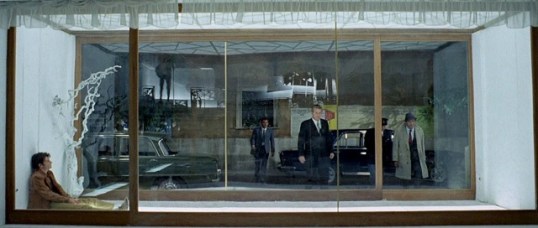
The Bird With The Crystal Plumage (1970, dir by Dario Argento)

Hatchet For The Honeymoon (1970, dir by Mario Bava)
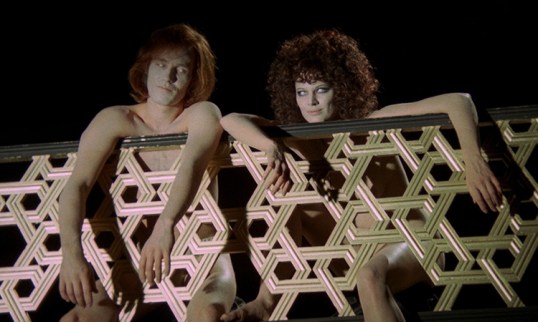
A Lizard In A Woman’s Skin (1971, dir by Lucio Fulci)
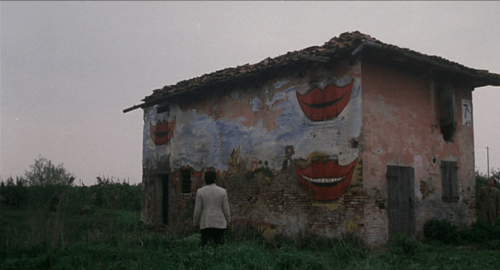
The House With Laughing Windows (1976, directed by Pupi Avati)
As some of our regular readers undoubtedly know, I am involved in a few weekly watch parties. On Twitter, I host #FridayNightFlix every Friday and I co-host #ScarySocial on Saturday. On Mastodon, I am one of the five hosts of #MondayActionMovie! Every week, we get together. We watch a movie. We tweet our way through it.
Tonight, at 10 pm et, I will be hosting #FridayNightFlix! The movie? 1985’s Legend!
If you want to join us this Friday, just hop onto twitter, find Legend on Prime, start the movie at 10 pm et, and use the #FridayNightFlix hashtag! I’ll be there happily tweeting. It’s a friendly group and welcoming of newcomers so don’t be shy.
See you there!
Let’s end the week by rocking.
Enjoy!
Welcome to Late Night Retro Television Reviews, a feature where we review some of our favorite and least favorite shows of the past! On Thursdays, I will be reviewing Highway to Heaven, which aired on NBC from 1984 to 1989. The entire show is currently streaming on Tubi and several other services!
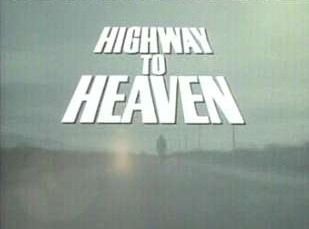
This week, Mark finally gets the stuff.
Episode 4.21 “A Dolphin Song For Lee: Part One”
(Dir by Michael Landon, March 9th, 1988)
After he complains for the hundredth time about not having “the stuff,” Mark finally gets the boss’s attention in this episode. Suddenly, Mark is the one who doesn’t need to eat, who knows where to go for the assignment, and who instinctively realizes that the young woman they’ve been assigned to help — Lee (Bess Meyer) — desperately needs a bone marrow transplant. Meanwhile, Jonathan becomes human yet again.
That’s not a bad idea for a story, though it’s hard not to notice that this is the second time that Jonathan’s gone from being an angel to being mortal during season four. One would think that either Jonathan or Mark would have noted this fact but neither one does. Maintaining continuity has not been season four’s strong point.
As for the story itself, it’s pretty simple but then again, it’s only Part 1 of a two-parter. Lee refuses to get the bone marrow transplant because she fears her parents won’t be able to afford it. Using “the stuff,” Mark essentially commands a local news producer to do a story on Lee and her need for a transplant. In a scene that feels like a fantasy today, we see people apparently all across the country watching the news story on Lee. One guy in a bar yells at everyone to be quiet so he can hear the story. It feels incredibly dated and almost too earnest for its own good, if just because it’s hard to imagine people actually sitting around the TV and watching a network newscast nowadays. (It’s also hard not to wonder if Mark essentially zapping the producer and taking over his mind is a good example of what the Boss wants done with the stuff. That’s not something that Jonathan has ever done, even though it would have made things a lot simpler.)
People across the country donate money so that Lee can get her operation. Lee’s cancer goes into remission but the “To Be Continued” announcement at the end of the episode feels a bit ominous. If Lee’s going to be okay, why does the story need to be coninuted?
We’ll find out next week!
In honor of Ethan Hawke’s birthday, here is the wonderfully romantic Ferris wheel scene from 1995’s Before Sunrise. Director Richard Lnklater considered this scene to be an homage to The Third Man.
Welcome to Retro Television Reviews, a feature where we review some of our favorite and least favorite shows of the past! On Thursdays, I will be reviewing Decoy, which aired in Syndication in 1957 and 1958. The show can be viewed on Tubi!
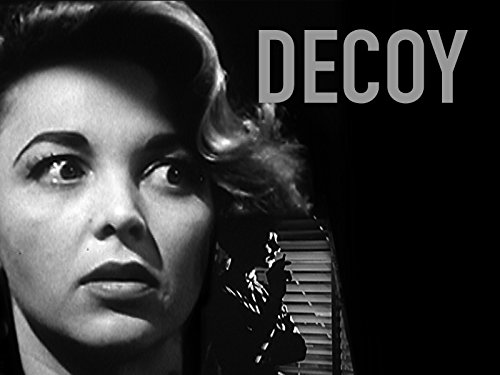
This week’s episode is really, really good!
Episode 1.11 “Two Days To Kill”
(Dir by Stuart Rosenberg, originally aired on December 23rd, 1957)
Selma Richmond (played by a young Diane Ladd!) is the girlfriend of gangster Johnny Troy (Michael Strong). Johnny is about to go on trial and Selma’s testimony about his crimes is the key piece of evidence against him. Knowing that Johnny wants Selma dead, the police put her up in an apartment. Casey is assigned to protect her.
At first, Casey and Selma seem to become unlikely friends. Selma is flighty and obsessed with Hollywood. Even though she’s testifying against him, she claims that Johnny is just misunderstood. Casey, taking some sympathy on her, tells Selma about the man that she loved. For the first time, we learn something about Casey’s background. We learn that her husband was a cop and he died in a shoot out. It’s a surprising moment and one that’s poignantly played by Beverly Garland. (The camera closes in on her face while she slowly smokes a cigarette.) Not only does it help us understand why Casey sometimes to seems to be emotionally detached but it also shows the friendship between the two women. Casey doesn’t open up for many people but she does for Selma.
However, that friendship ends when Selma realizes that Johnny will be facing the death penalty. Selma manages to sneak a letter Johnny, letting him know where she’s being held. Johnny shows up at the apartment, carrying a knife. Casey is waiting for him with her gun drawn. During the stand-off, Johnny tells Selma that he loves her and Selma believes it. The Johnny uses his foot to unplug the apartment’s lamp. In the darkness, he lunges at Selma and Casey opens fire, killing Johnny. Selma’s response is to shout, “I bet you’re glad you killed him!”
This was an outstanding episode. Director Stuart Rosenberg, taking over from Teddy Sallis, makes good use of the gritty New York locations. Each scene is lit like a film noir, with Johnny literally emerging from the shadows at one point. Rosenberg also gets excellent performances from both Ladd and Garland. This was a strong episode and the best of the series so far.
4 Shots From 4 Films is just what it says it is, 4 shots from 4 of our favorite films. As opposed to the reviews and recaps that we usually post, 4 Shots From 4 Films is all about letting the visuals do the talking.
All of the scenes below come from films that were made and released between the introduction of sound in the late 1920s and the adoption of the infamous Hays Production Code in 1934. This was truly an exciting time for film as an art form. Not only were filmmakers intoxicated with discovering what they could accomplish through the medium but they were also unhindered by censorship or regulation. The end result was some of the most visually imaginative and narratively daring films to ever be released by the major American studios.
There’s a reason why film lovers continue to eagerly seek out pre-code films. And if you want to experience what made the pre-Code era so memorable, you could not do any worse than to start with the four films featured in this post.
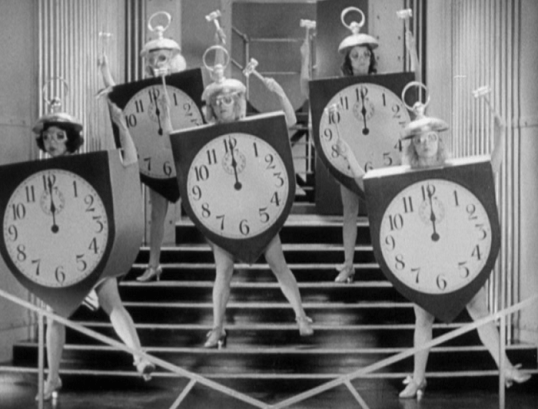
Madam Satan (1930, dir by Cecil B. DeMille)
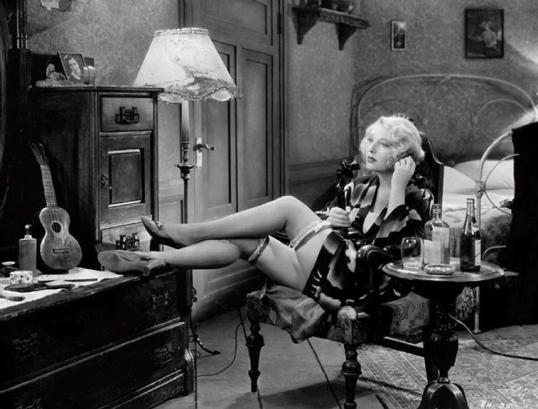
Safe in Hell (1931, dir by William Wellman)
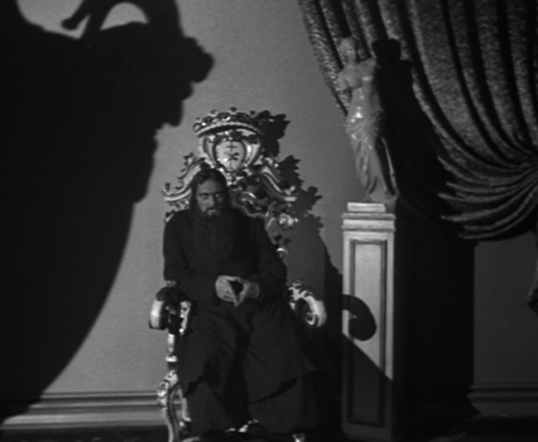
Rasputin and the Empress (1932, dir by Richard Boleslawski)
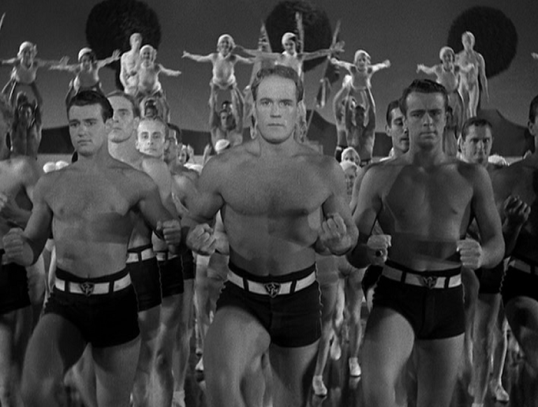
Search For Beauty (1934, dir by Erle C. Kenton)
This music video brings a little October to November.
Enjoy!
 Through the Shattered Lens