As I sit here writing this, Jolie is very much a respectable figure, one who doesn’t appear in as many movies she once did. When she does act, it’s almost always in the type of big and rather glossy films that inevitably seem to be destined to be described as potential Oscar contenders. She’s so identified with the work that she does for UNHCR that it can be argued that she’s even better known now as a human rights activist than as an actor. (On Wikipedia, her career is listed as being “actress, director, humanitarian.”) Angelina Jolie has made the move from acting to directing and even though none of her directorial efforts have been especially memorable, they still tend to get a lot of attention because she’s Angelina Jolie. Angelina Jolie is definitely a part of the establishment and, let me make this very clear, there’s nothing wrong with that! She’s still a good actress. She seems to be far more sincere about her activism than many of her fellow Hollywood performers. Personally, I think the efforts to get her to run for political office have been a little over-the-top (and they seem to have died down after an attempted presidential draft in 2016) but again, she’s earned her success and she deserves it.
That said, it can sometimes be surprising to remember that, before she became so acceptable, Angelina Jolie was Hollywood’s wild child, the estranged daughter of Jon Voight who talked openly about being bisexual, using drugs, struggling with her mental health, and playing with knives in bed. This was the Jolie who, long before she married Brad Pitt, was married to Billy Bob Thornton and used to carry around a vial of his blood. This was the Angelia Jolie who had tattoos at a time when that actually meant something and who went out of her way to let everyone know that she was a badass who wasn’t going to let anyone push her around. This was the Angelina Jolie who was dangerous and unpredictable and who wore her wild reputation like an empowering badge of honor.
That’s the Angelina Jolie who starred in Gia.
Made for HBO in 1998, Gia was a biopic in which Jolie played Gia Carangi, one of the first supermodels. The film followed Gia, from her unhappy childhood (represented by Mercedes Ruehl as Gia’s mother) to her early modeling days when she was represented by the famous Wilhelmina Cooper (Faye Dunaway) to her struggles with heroin and cocaine to her eventual AIDS-related death. During the course of her short life, Gia falls in love with a photographer’s assistant named Linda (Elizabeth Mitchell) but, as much as Linda tries to help her, Gia simply cannot escape her demons.
That Gia is a fairly conventional biopic is not a shock, considering that it was directed by the reliably banal Michael Cristofer. He starts the film with people talking about their memories of Gia and he doesn’t get anymore imaginative from there. That the film works and is memorable is almost totally due to performances of Elizabeth Mitchell and Angelina Jolie, both of whom give such sincere and honest performances that they make you truly care about Gia and Linda. Jolie, in particular, portrays Gia as being an uninhibited and impulsive agent of chaos, one who follows her immediate desires and who makes no apology for who she is and what she does. There’s a lot of physical nudity in this film but the important thing is that Jolie allows Gia’s soul to be naked as well. There’s nothing hidden when it comes either the character or Jolie’s empathetic and passionate performance.
Jolie won an Emmy for her performance in Gia and her work in this film led to her being cast in 2000’s Girl, Interrupted, the film for which she would win the Oscar for Best Supporting Actress. Since then, Jolie’s become, as I said at the start of this review, very much a member of America’s cultural establishment. My hope, though, is that someday, someone will give Jolie a role that will remind viewers of who she was before she became respectable. I think she still has the talent to take audiences by surprise.
Bruce Dern is a favorite actor of mine. He’s one of those performers who, over the course of his very long career, has appeared in all sorts of different and occasionally odd films, sometimes as a lead but most often as a character actor. He appeared in biker films, westerns, literary adaptations, and Oscar-winners. He killed John Wayne in TheCowboys. He introduced Peter Fonda to acid in TheTrip. (Dern, for his part, has said that he the only person on the set of that film who has never done acid.) He captured the trauma of Vietnam in Coming Home. He played one of the great hyperactive cops in The Driver. He came close to playing Tom Hagen in The Godfather and was the original choice for the attorney who was eventually played by Jack Nicholson in Easy Rider.
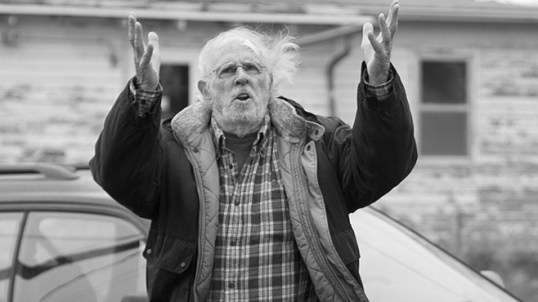
In 2013’s Nebraska, he broke my heart.
In Nebraska, Dern plays Woody Grant, an elderly man who is convinced that he’s won a million-dollar sweepstakes. Everyone around him, including his wife (June Squibb) and his oldest son (Bob Odenkirk), realizes that the sweepstakes is a scam and that Woody has actually won nothing. But Woody is convinced that a million dollars is waiting for him. All he has to do is somehow make it from Montana to Nebraska. At first, Woody attempts to walk along the interstate. When that doesn’t work and the police end up arresting him and sending him home, his youngest son, David (Will Forte), agrees to drive Woody down to Lincoln, Nebraska. David knows that there’s not any money waiting for Woody but, unlike his mother and his older brother, David hasn’t given up on the idea of connecting with his father.
Nebraska is a road movie, with the majority of the film following David and Woody as the drive through rural and smalltown America. They stop off in Woody’s former hometown, where they meet Woody’s brother (Rance Howard) and also Woody’s former business partner, a bully named Ed (Stacy Keach). Ed is convinced that Woody stole money from him. Woody blames Ed for the loss of his air compressor. Their anger has simmered for years and, at first, it’s tempting to assume that it’s simply one of those grudge matches that old men seem to have a weakness for. But Ed turns out to truly be a rotten human being and Woody …. well, Woody his own problems but at least he’s not as bad as Ed.
Before I say anything else, I want to praise the entire cast. June Squibb, Bob Odernkirk, Stacy Keach, Rance Howard, Melinda Simonsen (who has a small role as a receptionist in Lincoln), they all bring their characters to memorable life. Will Forte is the heart of the film, trying to keep his family together and standing up for his father when it matters. If you only know Will Forte as MacGruber, you need to see Nebraska. That said, this film is dominated by Bruce Dern’s poignant, sad, and often very funny performance as Woody Grant. Woody is a flawed character and Dern wisely doesn’t try to sentimentalize or downplay any of those flaws. He drinks too much, he neglected his family when he was younger, he holds a grudge, and he’s incredibly stubborn. But, as played by Dern, you just can’t help but like Woody and hope that he finds some sort of happiness. Even though the viewer, like everyone else in Woody’s life, knows that the sweepstakes is a scam, it’s still hard not to spend the film hoping that Woody will prove everyone wrong when he makes it to Nebraska.
Nebraska was nominated for Best Picture while both Bruce Dern and June Squibb picked up acting nominations. That year, the Best Picture race was dominated by 12YearsASlave. Matthew McConaughey won Best Actor for DallasBuyersClub while Lupita Nyong’o won Best Supporting Actress for 12 Years A Slave. Alexander Payne lost Best Director to Gravity’sAlfonso Cuaron. Gravity also won the Oscar for Best Cinematography, defeating Nebraska’s gorgeous black-and-white imagery.
Oscars or not, Nebraska is a wonderful, late career showcase for the great Bruce Dern.
Today, the Shattered Lens wishes a happy birthday to Shane Kippel!
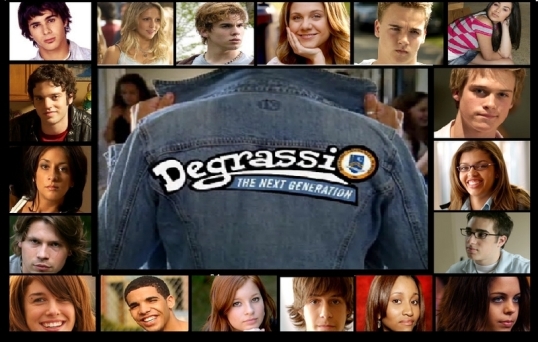
Shane Kippel, as I’m sure I don’t have to tell you, played Spinner Mason on Degrassi: The Next Generation. He started out as the school bully but, by the time the third season began, he was pretty much the heart of the ensemble. How cool was Shane Kippel? He was so cool that Spinner ended up getting held back three times just so there would be an excuse to keep Kippel on the show!
(“What type of idiot fails his own language!?” Spinner once said when confronted with his grade in English. Oh, Spinner!)
Today’s song of the day features Shane Kippel on drums. From Degrassi, here is Downtown Sasquatch with Dust!
(The other members of the band are Jake Epstein on vocals, Aubrey Graham on guitar, and Adamo Ruggiero on bass.)
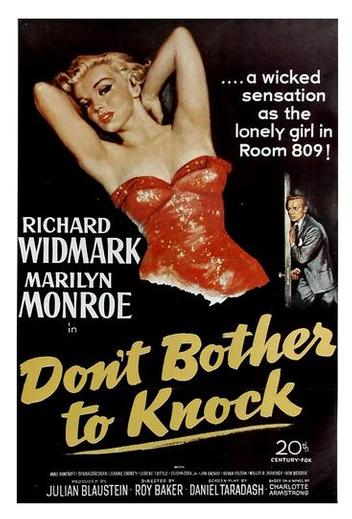
For Marilyn Monroe’s birthday, I’m going to share a scene from one of her earlier films, 1952’s Don’t Bother To Knock. In this film, Marilyn plays an unstable woman who is staying at a hotel. Her cousin (played by Elisha Cook, Jr.) gets her job as a babysitter but is shocked to find out that Marilyn has been trying on her employer’s clothes. After getting admonished by her cousin and pretending to be sorry, she proceeds to then summon another gust (played by Richard Widmark) over to her room.
It’s a simple scene but it’s wonderfully played by Monroe. This was one of her first truly dramatic roles and she does a good job with it.
From Don’t Bother To Knock, here is a scene that I love:
4 Or More Shots From 4 Or More Films is just what it says it is, 4 shots from 4 of our favorite films. As opposed to the reviews and recaps that we usually post, 4 Shots From 4 Films lets the visuals do the talking!
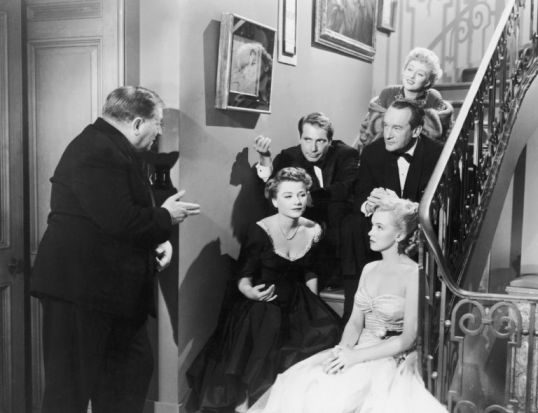
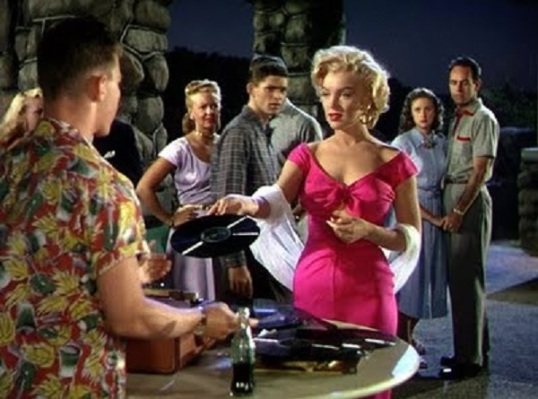
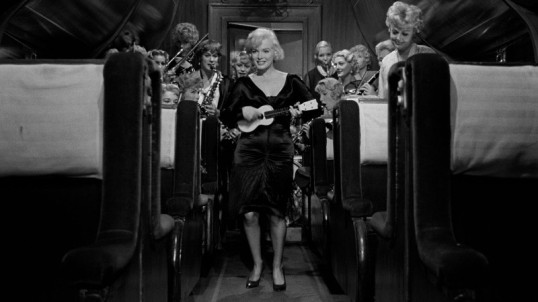
Marilyn Monroe would have been 99 years old today. Sixty years after her mysterious death, Marilyn Monroe continues to intrigue film lovers and conspiracy theorists alike. Her legacy is such that, ever since her death, directors have been trying to recreate her life with biopics and actresses have been trying to recapture Marilyn’s magic.
It’s not easy to for them to do because Marilyn Monroe was an original and not someone whose talent and charisma can be easily duplicated. Needless to say, it’s time for….
4 Shots From 4 Marilyn Monroe Films
All About Eve (1950, dir by Joseph L. Mankiewicz, DP: Milton R. Krassner)
Niagara (1953, dir by Henry Hathaway, DP: Joseph MacDonald)
Some Like It Hot (1959, dir by Billy Wilder, DP: Charles Lang)
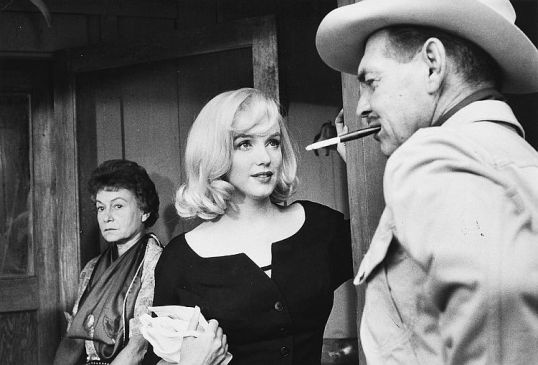
The Misfits (1961, dir by John Huston, DP: Russell Metty)
 Through the Shattered Lens