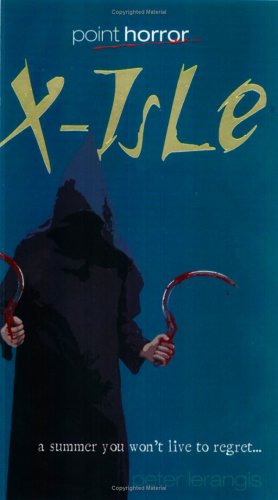
Horror Book Review: X-Isle By Peter Lerangis


X-Isle!?

Is this a book about an island that is populated by the twenty or so people who actually refer to twitter by it’s “new” name of X?

No, actually, it’s not.  X-Isle was published in 2002, in the days before social media and ever-present phones.  X-Isle is a slasher story, one in which a group of good-looking teens end up hanging out at the exclusive Spinnaker Lodge, a luxury resort on an isolated island.  It’s like that island that Kim Kardashian took all of her friends and employees to during the COVID epidemic?  Remember that?  Everyone else was locked inside or wandering around triple-masked while Kim went to an island and then scolded everyone else for not taking proper precautions.

(Sorry to get off topic there but seriously, the COVID era was messed up in ways that people are still struggling to full comprehend.)

Reading X-Isle, I found myself wandering if you really could write an effective, non-ironic, old school slasher story nowadays.  The whole key to the slasher genre is that people have to be isolated and there has to be no way of reaching out for help.  Every slasher movie now has to come up with some extended to reason to explain why no one can call the police.  Whenever a horror movie starts with someone saying, “Give me your phone, you’ll get it back after the weekend,” I roll my eyes a little just because it’s become such a cliche.  At this point, I imagine even Camp Crystal Lake has free wi-fi.  It’s easy to imagine a camp counselor tweeting out, “Help!  There’s a murderer at Crystal Lake!” and someone replying, “Whatever, Jussie.”

X-Isle gets off to a good start with a collection inner-office dossiers that introduce us to the main characters.  What the memo reveals is that the main requirement to work at the resort is a handsome face or a good body.  Once the story kicks in, we meet our group of potential victims and, unfortunately, none of them really live up to all the hype in the introduction.  We spend a good deal of time with Carter, a womanizer who, at one point, feels the need to tell us that he’s not psychotic despite the fact that his behavior is often manipulative and narcissistic.  When you actually have to tell people that you’re not a psycho, you probably are. Of course, in this book, Carter is one of the heroes.

Someone is killing guests and employees.  It’s a YA book so we don’t actually see the kills but the aftermath is described in properly grisly fashion.  The reveal of who the killer was doesn’t make much sense but, given that the book ends with a cliffhanger, that was perhaps deliberate.

Anyway, I’ve always kind of enjoyed the slasher genre, even with all of its cliches and its issues towards anyone who shows the slightest spark of independence.  X-Isle was a fast and entertaining read.  None of the characters were particularly likable which made it a lot less stressful to read about them being put in danger.  In the end, the main lesson is to stay away from mysterious islands.  That’s probably good advice.
Join #MondayMania For Sleepwalking In Suburbia!


Hi, everyone!  Tonight, on twitter, I will be hosting one of my favorite films for #MondayMania!  Join us for Sleepwalking in Suburbia!

You can find the movie on Tubi and then you can join us on twitter at 9 pm central time!  (That’s 10 pm for you folks on the East Coast.)  See you then!

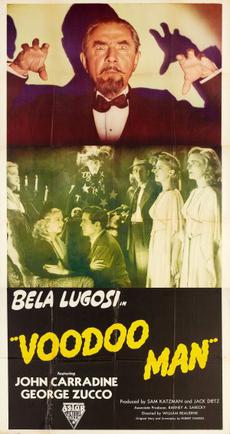
Horror Film Review: Voodoo Man (dir by William Beaudine)


In 1944’s Voodoo Man, Michael Ames stars as Ralph, a screenwriter who has been asked to write a treatment based on the real case of several “girl motorists” who have disappeared in the surrounding area.  Ralph turns down the assignment because he’s busy planning his wedding to Betty (Wanda McKay).  However, when Betty’s maid of honor, Stella (Louise Currie), vanishes, Ralph and Betty set out to investigate.  As Ralph puts it, he’s become a part of the story that he earlier rejected.

What has happened to Stella and all of the other women?  They’ve been abducted by Toby (John Carradine) and Grego (Pat McKee), two lunkheads who work for Dr. Marlowe (Bela Lugosi).  Dr. Marlowe lives in an isolated mansion where he is cared for by his loyal housekeeper (Mici Goty).  Twenty-two years ago, Dr. Marlowe’s wife, Evelyn (Ellen Hall), died but Marlowe has been able to keep her body in a sort of suspended animation ever since.  Marlowe is kidnapping women because, through the use of voodoo and mad science, he hopes to take their “will to live” and transfers it into Evelyn.  Helping Marlowe out is a voodoo priest named Nicholas (George Zucco).

Lugosi, Carradine, and Zucco!  Obviously, the main appeal of Voodoo Man is that it brings together three great names in horror. Even if the story doesn’t really make much sense (and it doesn’t), the film gets a lot of mileage out of the combination of Lugosi, Carradine, and Zucco.  While Lugosi does seem to be a bit bored with his role, Carradine and Zucco really throw themselves into their characters.  John Carradine, in particular, seems to be having the time of his life as he shuffles around the mansion and replies, “Yes, master,” to every command from Dr. Marlowe.  It’s the type of entertaining performance that could only be delivered by a trained Shakespearean slumming in a low-budget, B-grade horror film.  As for Zucco, he plays Nicholas with a certain amount of ruthless erudition.  Zucco is playing the Boris Karloff role here and he definitely seems to understand what that means.

As for the film itself, it has its moments.  Legend has it that director William Beaudine’s nickname was “One Shot” because he was usually only willing to do one take of each scene.  As a result, he filmed quickly and he didn’t spend a lot of money and that was probably a good thing for a production like Voodoo Man.  It also meant that if someone flubbed a line or bumped into a piece of furniture, that take would still be the one that showed up in the film.  My favorite moment of Voodoo Man was when the local sheriff (Henry Hall) referred to Dr. Marlowe as being “Dr. Martin,” and Bela Lugosi, who appeared to be struggling not to laugh, quickly said, “It’s Marlowe.”  The sheriff corrected himself.  That’s the type of fun you don’t get in movies made by people who do more than one take.

Voodoo Man has a quick 61-minute running time.  To enjoy it, it probably helps to already be a fan of low-budget, B-horror films from the 40s.  Lugosi, Carradine, and Zucco are combination that deserves to be seen.

Monday Live Tweet Alert: Join Us For Satan’s School For Girls!


As some of our regular readers undoubtedly know, I am involved in hosting a few weekly live tweets on twitter and occasionally Mastodon.  I host #FridayNightFlix every Friday, I co-host #ScarySocial on Saturday, and I am one of the five hosts of Mastodon’s #MondayActionMovie!  Every week, we get together.  We watch a movie.  We snark our way through it.

Tonight, for #MondayActionMovie, the film will be 1973’s Satan’s School For Girls! I picked it so you know it’ll be good.

It should make for a night of fun viewing and I invite all of you to join in.  If you want to join the live tweets, just hop onto Mastodon, find the movie on YouTube, hit play at 8 pm et, and use the #MondayActionMovie hashtag!  The  watch party community is a friendly group and welcoming of newcomers so don’t be shy.   

See you soon!

Horror On The Lens: Baffled! (dir by Philip Leacock)


This is a film that I share every year for Horrorthon and can you blame me?  Check out this pitch: Leonard Nimoy is a race car driver who can see into the future and who uses his powers to solve crimes!

Seriously, if that’s not enough to get you to watch the 1973 made-for-TV movie Baffled!, then I don’t know what is.  In the film, Nimoy takes a break from racing so that he and a parapsychologist (played by Susan Hampshire) can solve the mystery of the visions that Nimoy is having of a woman in a mansion.  This movie was meant to serve as a pilot and I guess if the series had been picked up, Nimoy would have had weekly visions.  Of course, the movie didn’t lead to a series but Baffled! is still fun in a 70s television sort of way.  Thanks to use of what I like to call “slo mo of doom,” a few of Nimoy’s visions are creepy and the whole thing ends with the promise of future adventures that were sadly never to be.  And it’s a shame because I’ve always wondered what was going on with that couple at the airport!

Enjoy Baffled!  Can you solve the mystery before Leonard?


October Positivity: Nothing Is Impossible (dir by Matt Shapira)


With apologies to Brad Crain, I’ve never been a basketball fan.

I’m not really a team sports fan in general but basketball truly gets on my nerves.  My main issue, of course, is that all the squeaky shoes make it difficult for me to watch a game.  The constant squeaking is headache-inducing.  My other problem with basketball is that people who like basketball tend to really, really, really like it, to the extent that they can’t handle the fact that some of us don’t really care.  Finally, I get tired of being expected to pay attention to whatever it is the coaches say after the game.  How many times have I come online to see breathless stories about a basketball coach giving his thoughts on current events?  Like seriously, who cares?  Why would I care what a coach thinks about tariffs?  Why are we even asking basketball coaches for their opinions?  Aren’t basketball coaches just supposed to yell at people until they get kicked out of the game?  I’ve seen Hoosiers, which I will acknowledge is a very good movie despite my feelings about the game.  Gene Hackman was constantly getting kicked off the court and everyone loved him for it.  Temper tantrums, that’s what we need from basketball coaches.  We don’t need to know your thoughts on the cost of bread.

What’s the point of all this?  Before I talk about 2022’s Nothing Is Impossible, I thought you deserved to know my own bias against the game.  Nothing is Impossible is a movie that loves basketball.

Nothing is impossible?  Try telling that to former basketball-star-turned-high-school-janitor Scott Beck (David A.R. White).  Scott, we’re told, could have been a star in the NBA but it didn’t pan out.  Instead, Scott works as a janitor and volunteers as an assistant high school coach.  While NBA players and their coaches are answering questions about who they voted for in the last election, Scott is looking after his alcoholic father and regretting the fact that he left Ryan Aikins (Nadja Bjorlin) at the altar.

Ryan is now the owner of a basketball team and, when the team announces that it will be holding live tryouts for anyone who wants to try to make the team, Scott finds himself tempted to try to achieve his dream of playing in the NBA.  Can Scott do it?  Can he still compete at a competitive level?  Actually, could he ever compete at a competitive level?  Listen, I know this is a PureFlix film and David A.R. White can probably appear in any one of their films that he wants to because he’s one of the founders of the company but White is never particularly convincing as someone who could make a professional basketball team.  He’s not particularly tall.  He doesn’t come across as being particularly athletic.  He’s middle-aged.  Nothing is impossible the title tells us but the idea of an unathletic, middle-aged, 5’10 white guy dunking on a bunch of NBA superstars truly tests that claim.

The important thing, of course, is that Scott and Ryan discover that they’re still in love and White and Bjorlin manage to generate enough romantic chemistry to make a believable couple.  The other important thing is that Steven Bauer shows up as a heartless executive.  It’s always nice to see Bauer destroying dreams.  Otherwise, the film did not change my opinion about basketball.

Seriously, those shoes are just too damn squeaky….

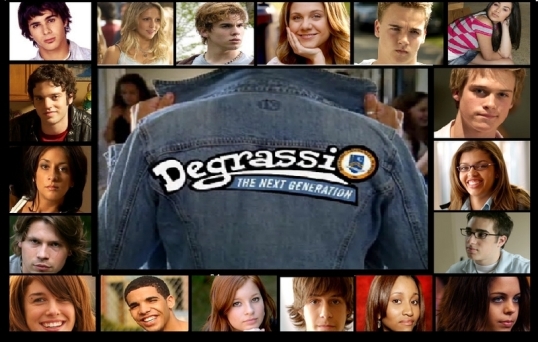
Late Night Retro Television Review: Degrassi: The Next Generation 1.8 “Secrets & Lies”


Welcome to Late Night Retro Television Reviews, a feature where we review some of our favorite and least favorite shows of the past!  On Sunday, I will be reviewing the Canadian series, Degrassi: The Next Generation, which aired from 2001 to 2015!  The series can be streamed on YouTube and Tubi.

This week, Ashley learns her father’s secret.

Episode 1.8 “Secrets & Lies”

(Dir by Bruce McDonald, originally aired on May 6th, 2002)

This is a landmark episode of Degrassi: The Next Generation for two reasons.

First off, it’s the first episode to establish that Liberty has a crush on J.T.  Liberty’s unrequited crush was one of the show’s early storyline and, to be honest, it was frequently one of the more annoying storylines.  Liberty was always a rather flat character and she and J.T. never really made much sense as a couple.  (Yes, they did eventually become a couple.)  Of course, watching this episode today, all I can think about is the fact that, in the far future, J.T. is going to die in Liberty’s arms after being stabbed in the back by a student from a rival high school.  Much as with Degrassi High, knowing what the future holds adds a layer of poignance to these early episodes that they otherwise wouldn’t have.

As for this episode, J.T. tries to get Liberty to leave him alone by pretending to be gay.  He gets this idea after Toby informs him that Ashley’s father, the dashing Robert Kerwin (Andrew Gillies), has come out of the closet.

The majority of this episode deals with Ashley struggling to accept that her father is gay.  Again, this is another storyline that becomes far more poignant if you already know that Robert is eventually going to marry his partner Christopher and Ashley’s boyfriend is going to have a mental breakdown at the wedding.

This episode actually did a very good job of realistically portraying Ashley’s initial reaction to learning that her father’s gay.  Ashley is confused and, as she was still hoping that her parents would eventually get back together, she feels betrayed.  It’s an honest reaction and probably not the sort of thing you would ever see on television today, where our idealized protagonists almost always have the right response from the start.  The fact that the show deals honestly with Ashley’s emotions makes her eventual acceptance of her father’s sexuality all the more poignant.

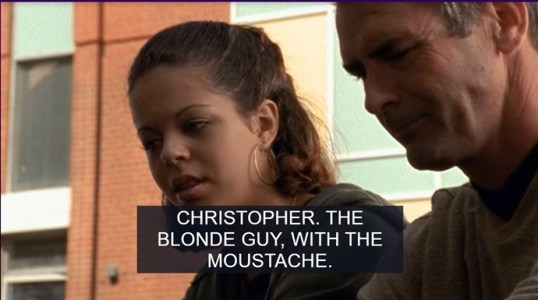
This episode deals very sensitively deals with Robert’s coming out and Andrew Gillies and Melissa McIntyre both deserve a lot of credit for their performances.  (Remember, this episode aired in 2002, at a time when gay characters were almost always portrayed as either being comedy relief or helpless victims.)  I do have to admit that there is one rather clunky line in this episode.  It comes when Ashley asks Robert if he has a boyfriend and Robert tells her about his partner, Christopher.  Ashley’s next line (and Melissa McIntyre’s overdramatic delivery of it) always makes me laugh despite myself:

Aside from that line and all of the cringey stuff involving J.T. and Liberty (and, admittedly, that is a lot to overlook), this was a sensitive and well-handled episode.

October Hacks: Popeye The Slayer Man (dir by Robert Michael Ryan)


“You’re a monster!” a terrified woman shouts at the hulking, murderous figure who haunts the local abandoned cannery.

“I yam what I yam,” the Sailor Man (Jason Robert Stephens) replies before presumably killing her in some grotesque way.

The Sailor Man haunts the cannery.  Some believe him to be a ghost be actually, he’s just a former sailor who has been mutated after eating too much contaminated spinach.  Now, he is freakishly strong and can literally rip people into pieces with his hands.  Running into the Sailor Man means that you will soon be seeing disconnected limbs, compound fractures, and split open heads.  The Sailor Man’s motives aren’t always easy to figure out but, if you smell the burning of his pipe, you should probably run.  With those gigantic arms and his permanent sour expression, the Sailor Man can pretty much do whatever he feels like doing.  Shooting him or stabbing him won’t stop him.  He’s hooked on the spinach.

Popeye The Slayer Man is one of three Popeye-themed slasher movies to be released in the wake of Popeye moving into the public domain.  In this one, Dexter (Sean Michael Conway), a film student, decides that he wants to make a documentary about the Sailor Man legend so he and his friends break into the cannery.  Almost everyone is killed in a bloody way and it’s hard not to notice that no one seems to be that upset about it.  Dexter comes across the dead body of someone who was previously described as being his best friend since the Second Grade and he barely seems to care.  Instead, he just lifts up his camera and films.  I’m tempted to think that this was meant to be a satire on the callousness of aspiring documentarians but I might be giving the film too much credit.  Who knows?

Obviously, you can’t take a film like this too seriously.  In almost every room in the cannery, there’s at least a handful of empty spinach tins.  To be honest, I actually think the film didn’t go far enough.  Sure, Popeye’s killing people and there’s a character named Olivia (Elena Juliano) but where’s Bluto?  Popeye is presented as a largely silent killer which, again, seems like a missed opportunity.  Popeye is also presented as being rather random in his kills.  He allows one person to survive for reasons that are incredibly unclear, beyond the fact that I guess the filmmakers felt that the character in question was too sympathetic to suffer the same bloody death as nearly everyone else in the film.

Other than the killer being Popeye, this is pretty much a standard low-budget slasher.  I will admit that I kind of appreciated that is was pretty straight-forward about its intentions.  Unlike a lot of recent slasher films, it never came across as if it was apologizing for being what it was and there’s definitely something to be said for that.  The film embraces the philosophy of “I yam what I yam.”  The Sailor Man would be proud.

Horror on TV: Hammer House Of Horror #4: Growing Pains (dir by Francis Megahy)


In the fourth episode of Hammer House of Horror, Gary Bond plays a scientist whose son dies after eating some toxic proteins that just happened to be lying around the lab.  The scientist’s wife (Barbara Kellerman) goes down to the local orphanage to collect a new son but this new kid turns out to be more than a little creepy.

This bizarre episode originally aired, in the UK, on October 4th, 1980.  A quick warning: This episode does feature some dead rabbits.  I like rabbits so that bothered me a bit, even though it made sense in the context of the story.

The TSL Horror Grindhouse: The Undertaker (dir by Franco Steffanino)


In 1988’s The Undertaker, a small college town is rocked by a serious of viscous, sexually-charged murders.  While the professors and the students deal with their own dramas on campus, the bodies are piling up at the local funeral home.  Who could the murderer be?

Well, Joe Spinell’s in the film.  That really should be the only clue you need.

Spinell plays Roscoe, the town undertaker who has issues with his mother, cries at random, talks to dead bodies, watches movies featuring sacrifices, and occasionally performs what appears to be some sort of a ritual with his victims.  This film was Spinell’s final film and he gives a performance that alternates between being perfunctory and being fully committed.  On the one hand, there are plenty of scenes where Spinell appears to be making up his lines as he goes along,  In the scenes in which he appears in his office, it’s appears that Spinell is literally reading his lines off of the papers on top of his desk.  Then there are other scenes where Spinell suddenly seems to wake up and he flashes the unhinged intensity that made him such a fascinating character actor.  In the 70s and 80s, there were many actors who frequently played dangerous people.  Spinell was the only one who really came across like he might have actually killed someone on the way to the set.  Spinell was in poor health for most of his life and he also struggled with drug addiction.  In The Undertaker, he doesn’t always look particularly healthy.  Even by Joe Spinell standards, he sweats a lot.  And yet, in those scenes were actually commits himself to the character, we see the genius that made him so unforgettable.

As for the film itself, it’s basically Maniac but without the New York grit that made that film memorable.  Instead, it takes place in a small town and Spinell, with his rough accent and his button man mustache, seems so out-of-place that the film at times starts to feel like an accidental satire.  Roscoe is obviously guilty from the first moment that we see him and yet no one else can seem to figure that out.  Only his nephew suspect Roscoe but that problem is quickly taken care of.  Whenever anyone dies, their body is brought to Rosco’s funeral home.  Roscoe puts on his black suit, plasters down his hair, and tries to look somber.  Roscoe spends a good deal of the film talking to himself.  When a victim runs away from Roscoe, Spinell looks at a nearby dead body and shrugs as if saying, “What can you do, huh?”

If you’re into gore, this film has a lot of it and, for the most part, it’s pretty effective.  In the 80s, even the cheapest of productions still found money to splurge on blood and flayed skin effects.  If you’re looking for suspense or a coherent story, this film doesn’t really have that to offer.  It does, however, offer up Joe Spinell in his final performance, sometimes bored and yet sometimes brilliant.