Horror Scenes I Love: Friday the 13th Part II


Today is a significant day for fans of Friday the 13th Part II.  Today is the birthday of both Warrington Gillette and Tom McBride.  Gillette was one of two actors to play Jason Voorhees in that film (he plays Jason without the mask while stuntman Steve Daskewisz played Jason whenever he was wearing a mask) and he is 65 years old today.  Tom McBride, who passed away in 1995, played Mark, whose death was one of the films most shocking moments.  Today, he would have been 72 years old.

Today’s scene that I love comes from Friday the 13th Part II, which I think is a genuinely underrated horror film.  Whenever I see this scene, I roll my eyes at Vicki (Lauren-Marie Taylor) running outside in her underwear just to look for something in her car but then I remember all of the times that I’ve done the exact same thing and I realize that I probably wouldn’t survive a horror film.

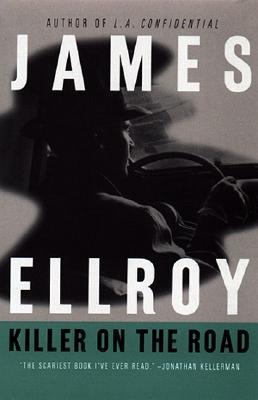
Horror Novel Review: Killer On The Road by James Ellroy


First published in 1986 and considerably shorter than the typical James Ellroy novel, Killer On The Road takes the form of the memoirs of Martin Plunkett, a child genius who grew up to be a prolific serial killer.

The book starts with Plunkett already serving a life sentence at Sing Sing.  He’s a killer who is now off the road and his memoirs are less about his plans and more about his own struggle to understand how he became the killer that he became.  There are plenty of possible explanations, going all the way back to his dysfunctional childhood and the trauma of his parent’s divorce.  He may be brilliant but he spends all of his time wishing that he could turn invisible like a comic book character and spy on people in their homes.  He comes to idolize Charles Manson but is disappointed when, while in prison, he meets the actual Manson and discovers that he’s just a rambling loser.  The book is written in Plunkett’s own words and, in typical sociopath fashion, he thinks very highly of himself but careful readers will look between the lines and see someone who is just as confused by what he became as everyone else.  For all of his intelligence and his nonstop speculation about the human condition, Plunkett ultimately seems like an empty vessel.  Plunkett’s years on the road are full of unexpected detours.  A meeting with a cop definitely do not go the way that anyone would probably expect it to go.  Even though the story is narrated Plunkett, people like FBI agent Dusenberg come across as fully developed characters as well.

It’s a disturbing and sad but compulsively readable book.  It may have been written before Ellroy developed his signature style but it stills shows his strengths as a storyteller.  Interestingly enough, Ellroy later stated in My Dark Places that he based Martin Plunkett’s dysfunctional youth on his own, which definitely leaves one happy that James Ellroy discovered writing as an outlet for his emotions.  Unlike Martin Plunkett, James Ellroy went on to become one of the best writers of our current era.

October True Crime: In Broad Daylight (dir by James Steven Sadwith)


On July 10th, 1981, Kenneth Rex McElroy was gunned down in Skidmore, Oklahoma.  He was shot while sitting in his truck.  Over 40 bullets were fired into the truck but only two actually hit McElroy.  His fourth wife, Trena (who Kenneth first met when she was 12 and he was 35), was sitting beside him at the time but was not hit by any bullets.  McElroy was 47 years old when he was gunned down in broad daylight.  There were reportedly 46 witnesses who saw the shooting occurred.  When interrogated by the police, not a single one said that they saw anything.  Quite a few did mention that Ken McElroy had gotten exactly what he deserved.

Ken McElroy was a high dropout, a barely literate career criminal who rustled cattle, burned down houses, raped his fourth wife when she was just 12, and then killed her family’s dogs in order to intimidate them into not pressing charges against him.  He was known as the town bully, a surly man who had 17 children with 6 different women and who would shoot anyone who disagreed with him.  Whenever he was charged with a crime, he would intimidate the witnesses into not testifying against him.  In 1980. he got angry at a store owner after one of his kids was accused of shoplifting candy.  McElroy shot the man and was put on trial for attempted murder.  For once, he was convicted but he was freed on bail while awaiting appeal.  When it become apparent that McElroy would not be going to prison for a while, the citizens of Skidmore….

Well, I should probably chose my words carefully.  The truth of the matter is that no one has even been charged with or convicted of killing Ken McElroy.  It is known that several citizens did have a meeting a few night before McElroy’s death and that they discussed what they could best do to keep McElroy from hurting anyone else.  It’s also knoqn that, a week before he was shot, McElroy walked into the local bar with his rifle and dared anyone who wanted him dead to come get him.  Does that mean that a group of concerned citizens took it upon themselves to dispense vigilante justice?  That’s what Trena always claimed but again, no one was every charged, indicted, or convicted.  The death of Ken McElroy remains officially unsolved.

Perhaps that’s why the names were changed for the 1991 made-for-television movie In Broad Daylight.  Brian Denney may be playing a character named Len Rowan but, for anyone familiar with the case, it’s obvious that he’s playing Ken McElroy just as Marcia Gay Harden is obviously playing Tena McElroy, even if her character is called Adina.  The film doesn’t change the name of the town and it doesn’t change the circumstances that led to McElroy’s death.  W watch as McElroy intimidates the owners of a grocery store (played by Cloris Leachman and John Anderson) and even attempts to bully the local police (represented here by Chris Cooper).  The film features a gun-toting crowd surrounding Len Rowan’s vehicle but it’s shot in such a way that their faces are blurry.

In Broad Daylight was filmed in Texas and it definitely captures both the beauty and the potential danger that comes with living in a rural community.  Everyone in town knows everyone else.  There’s a strong sense of community but, because the community is so small and isolated, it’s easy for a man like Len Rowan to bully the entire town.  Some of the actors lean a bit too hard into their country accents.  (Lord protect us from Yankees trying to sound Southern.)  But the main members of the supporting cast  — Cloris Leachman, John Anderson, Chris Cooper, Marcia Gay Harden — all give convincing performances.  As for Brian Dennehy, he’s absolutely horrifying as the astoundingly cruel Len Rowan.  Dennehy plays Len as being a man who might not exactly intelligent (the real Ken McElroy dropped out of school early) but who is positively brilliant at intimidating people.  Dennehy plays Rowan as if he has a death wish.  All of his threats and his speeches make it clear that he’s just daring someone to shoot him.  Even when he realizes he’s about to get shot while sitting in his truck, he sit there and accepts the inevitable.  Perhaps even he was getting sick of dealing with himself.

After watching In Broad Daylight, it’s easy to understand why no one came forward as a witness.  By his own actions, Ken McErloy was destined to die violently.  A few people just decided to speed things up a little.  Who knows who?

Horror Song of the Day: Demon by Claudio Simonetti


Demons (1985, dir by Lamberto Bava)

For today’s horror song of the day, we have Demon, a track from the soundtrack for the 1985 film, Demons.  This song was composed and performed by Claudio Simonetti, who is best known as the keyboardist of Goblin.

The music video, incidentally, was directed by Michele Soavi, who also appeared in Demons as the mysterious masked man handing out free movie tickets.

4 Shots From 4 Horror Films: 1930s Part 2


This October, I’m going to be doing something a little bit different with my contribution to 4 Shots From 4 Films.  I’m going to be taking a little chronological tour of the history of horror cinema, moving from decade to decade.

Today, we continue with the 1930s.

4 Shots From 4 Horror Films

La Llorona (1933, dir by Ramon Peon)

La Llorona (1933, dir by Ramon Peon)

The Invisible Man (1934, dir by James Whale)

The Invisible Man (1933, dir by James Whale)

Maniac (1934, dir by Dwain Esper)

Maniac (1934, dir by Dwain Esper)

The Bride of Frankenstein (1935, dir by James Whale)

The Bride of Frankenstein (1935, dir by James Whale)

Horror Film Review: The Pit (dir by Lew Lehman)


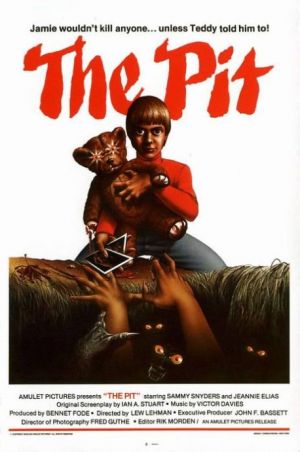
The 1981 Canadian film, The Pit, tells the story of a creepy little jerk named Jamie Benjamin (Sammy Snyders).

Now, admittedly, Jamie is only twelve years old and, usually, I make allowances for bad behavior from people who aren’t old or mature enough to know better.  But there’s just something off about Jamie.  He comes across as creepy from the first minute he shows up, with his intense stare and his blonde bowl cut.  He spends a lot of time in the woods, where he has discovered a hole in the ground.  The hole is full of hungry creates that Jamie calls Trogs.  Jamie regularly takes raw meat to the hole and tosses it in.  Unlike all of the kids at school and his own parents, the Trogs are always happy to see Jamie.

It may sound like a bad idea to give meat to a bunch of monsters that you just happened to find in the woods but Teddy thinks it’s a good idea.  Teddy is Jamie’s teddy bear.  Teddy talks.  Teddy has all sorts of ideas for how Jamie can get back at everyone who has ever made fun of him or left him feeling insecure.  Why not just toss them into the pit?  Is Teddy real or is he just in Jamie’s mind?  The film tries go for some ambiguity.  That said, the Trogs are definitely real so it’s not that difficult to go from accepting the idea of carnivorous monsters to buying into a talking teddy bear.

Jamie is entering puberty and his hormones are going crazy.  When his parents leave for a trip, they hire a psychology student named Sandy O’Reilly (Jeannie Elias) to keep an eye on Jamie.  Jamie develops a crush and soon becomes obsessed with Sandy.  Jamie is the type of kid who pretends to drop something just so he can look up Sandy’s skirt.  (Bad Jamie!)  Despite Jamie’s crush on Sandy, he still steals money from her so that he can buy raw meat for the Trogs.  When he can’t get any more meat, he starts tempting real people out to the woods and pushing them in.  When he tells Sandy about the Trogs, she doesn’t believe him.  He takes her to the pit and that’s when things really start to get bad….

The Pit is an odd little film, one that never quite settles on a tone.  In the original script, the Trogs and Teddy’s advice were all meant to be in Jamie’s head and Jamie himself was only meant to be 9 years old.  The horror elements were meant to be products of Jamie’s disturbed imagination and one can still see elements of that in the completed film.  However, director Lew Lehman decided to make Jamie older, to leave no doubt that the Trogs were real, and to add a small amount of humor.  As such, The Pit is a film that veers from being a horror film to being a somewhat depressing coming-of-age film to a somewhat mean-spirited comedy.  Sammy’s behavior, which might have been understandable for a 9 year old, becomes even more creepy now that he’s a twelve year-old who still takes orders from a teddy bear.

It’s a confused film but Sammy Snyders gives one of the best creepy kid performances of all time and there’s something undeniably satisfying about the ending.  As Jamie discovers, he’s not the only kid with a pit and teddy bear can only protect him for so long.

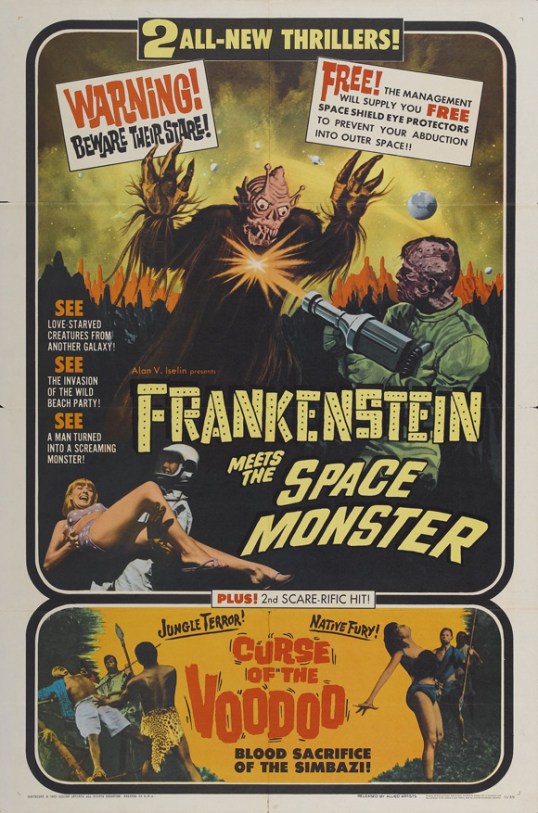
Horror Film Review: Frankenstein Meets The Space Monster (dir by Robert Gaffney)


Despite the title, 1965’s Frankenstein Meets The Space Monster is not actually about Frankenstein or his monster.

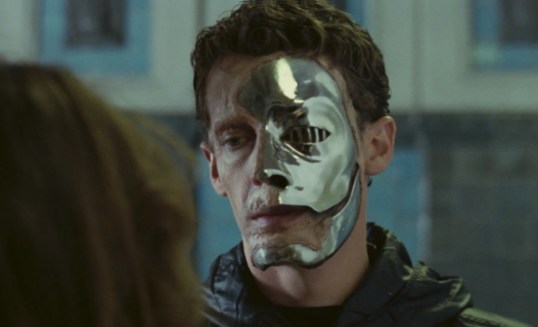
Instead, the Frankenstein of the title is Frank Saunders (Robert Reilly), an astronaut who happens to be an android.  Frank was created by Dr. Adam Steele (James Karen, in one of his first film roles).  Frank is designed so that he can go into space without making any of the mistakes that a human astronaut might make.  He’s the next stage in the space program!  With Frank sitting in a rocket, America will have rightfully conquered the Moon in no-time flat!

(Don’t waste my time with any of the international treaty crap.  I don’t care how many other countries go to the Moon, it belongs to America because we landed their first.  It’s the 51st State and someday, we’ll probably end up moving the federal government to the moon.  Hopefully, we’ll just leave it there.)

Unfortunately, no sooner has Frank gone into space then he gets shot down by the Martians.  Frank crashes in Puerto Rico and, with his face horrifically disfigured, starts to malfunction,  Soon, he’s creating chaos all over the island and it’s up to Dr. Adam Steele — what a name! — to put a stop to it.  However, before Frank is deactivated, he needs to meet the Space Monster (a mutant named Mull) and defeat the Martians.

Why are the Martians on Earth?  According to a short, pointy-eared dwarf Martian named Dr. Nadir (Lou Cutell), an atomic war has led to the death of all the women on Mars.  Personally, I think Dr. Nadir is lying because he came to Earth with a Martian woman named Princess Marcuzan (Marilyn Hanold).  I think it’s more a case of almost all of the Martian women faking their own deaths so that they could get out of having to talk to Dr. Nadir.  Seriously, Dr. Nadir is a little creep.  Add to that, his Martian name actually sounds like an insult in English.  Personally, I think he should come up with a new name if he wants people to listen to him.  I would suggest calling himself Adam Steele but that name is already taken.

Soon, Martians are abducting bikini-clad women off of beaches in Puerto Rico.  Can the Martians be stopped?  Can Frank be restored?  Will James Karen go on to have a distinguished career as a beloved character actor?  Spoiler alert: the answer to the third question is yes.  Indeed, one of the joys of this film is getting to see James Karen in a rare leading role.  He commits to giving as good performance, even though the film itself is pretty silly.

Another joy of this film is the soundtrack, which is surprisingly good for a film of this budget and caliber.  Just try to get That’s The Way It’s Got To Be out of your head!  (In the film, this song plays as Frank prepares to go into space.)

That’s the way it’s got to be!

As for Frankenstein Meets The Space Monster …. I just can’t help it.  I like the damn thing.  It’s just so ludicrous and silly that it’s impossible for me not to enjoy.  The film’s producers decided that they didn’t just want a robot terrorizing an island.  They also wanted Martians and a mutant, as well!  And we’re all better off for it.


Horror On The Lens; Robot Monster (dir by Phil Tucker)


Oh my God, I love this movie!

In this 1953 film, a gorilla wearing a diving helmet uses the Calcinator Death Ray to wipe out almost all human life on Earth.  Only 8 people survive, among them a professor, his family, and Roy (future Eurospy star, George Nader).  Ro-Man (George Barrows) is hounded by his superior to track down and destroy the survivors.  Ro-Man does his best, though the humans prove to be …. well, they’re not really that resourceful.  In fact, they’re pretty dumb.  But Ro-Man is pretty dumb himself.

Regularly (and incorrectly) cited as being one of the worst films ever made, Robot Monster is an enjoyably absurd hybrid of horror and science fiction.  Earth is destroyed through a combination of bad lighting effects and stock footage and the arguments between Ro-Man and his superior have to be heard to be believed.  Robot Monster is actually a bit more self-aware than a lot of people realize.  This is a low-budget Z-movie that realizes that it’s a low-budget Z-movie and which cheerfully embraces its identity.  Robot Monster is a personal favorite and it’s a bit of Halloween tradition around these parts.

And now, enjoy Robot Monster in all of its black-and-white glory!


What Lisa Watched Last Night #229: Sleepwalking In Suburbia (dir by Alex Wright)


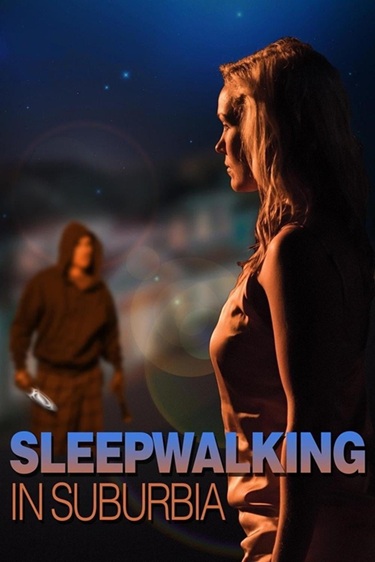
Last night, I watched the classic 2017 Lifetime film, Sleepwalking In Suburbia.
Why Was I Watching It?

I was watching it as a part of the #MondayMania watch party!  We’ve been watching the Stalked By My Doctor films and Sleepwalking In Suburbia, along with being a stand-alone film, leads into the fourth Stalked By Doctor film.  While I watched, I realized that I hadn’t reviewed this film yet so I decided to get on it.

What Was It About?

Michelle Miller (Emillie Ullerup) has a nice house in the suburbs and a successful husband (Giles Panton) but she also has a sleepwalking problem.  At night, she’ll get out of bed, leave the house, and, while in trance, go inside someone else’s house and either have sex in the living room or join them in bed.  She’s been diagnosed with “sexsomia.”

One sleepwalking incident leads to her having sex with her neighbor, Luke (Carlo Marks).  Now, every time that Luke sees Michelle, he’s like, “When are you coming by again?” and Michelle is like, “What are you even talking about, weirdo?”

Michelle’s pregnant!  Her husband is all excited but is he the father or is it Luke?  And when Luke’s wife seemingly vanishes, Michelle suspects that there might be murder in suburbia as well!

What Worked?

What worked?  The entire movie, that’s what worked!  Seriously, this was one of the greatest Lifetime films ever made.  It embraced the melodrama.  The plot featured twist after implausible twist.  The performances were enjoyably over-the-top and I defy anyone not to smile when the kindly doctor announces that Michelle has “sexsomia.”

Here’s the thing: sexsomia is a real thing.  Now, if you look it up on Wikipedia, it redirects to “sleep sex” but this is a Lifetime film and it’s obvious that it was understood that “sexsomia” just sounds better than “sleep sex.”  Was this film a realistic portrayal of sexsomia?  Who knows and who cares?

The title was absolutely brilliant.  Anytime you see the word “suburbia” in the title of a Lifetime movie, you know you’re about to see something special.  And I have to say that the film made the suburbs look very nice.  All the houses were big and well-decorated. No one in the Lifetime universe lives in a small house (unless they’re living in a trailer parker, which does happen on occasion.)  That’s the way things should be.

Emillie Ullerup gave a great performance as Michelle.  Her intense sleepwalking stare was one of the thing that made this film so entertaining.  Giles Panton and Carlo Marks also gave good performance as two of the men in her life in her waking and sleeping life.  The scene where Panton, as Michlle’s husband, reveals that he wants to handcuff Michelle in bed so that she won’t leave is both horrifying and slightly funny.  “Not kinky!” her husband assures her.

Finally, the film ended with one of those out-there twists that Lifetime is known for.  Seriously, when you’re in a Lifetime film, trust no one!  The film’s ending was also open-ended enough that it allowed Michelle to return for Stalked By My Doctor: A Sleepwalker’s Nightmare.

What Did Not Work?

It all worked!  This is a film that relentlessly and unapologetically embraced the melodrama in the best Lifetime tradition!  When I talk about the best Lifetime films being self-aware without being too in-your-face about it, this is the type of film that I’m talking about.

“Oh my God!  Just like me!” Moments

Wandering around in your night clothes in the middle of the night?  Hey, I’ve been there!  Of course, in my case, I was actually awake and I was checking on a cat.  I have never broken into a house while just wearing a slip.  I usually at least put on a robe before doing something like that.

Lessons Learned

Lock the door before you go to sleep.  And the windows!
October Positivity: Leap (dir by Chris Tempel)


Parkour!

Parkour was quite a thing for a while, though I’m not sure if it’s as big a deal now as it used to be.  Back in the day, YouTube was full of videos of people jumping off of roofs, skipping up walls, jumping over tables, and rolling around in the dirt.  The main thing I remember about parkour was that, whenever anyone jumped over a bench, everyone watching had to go, “Whoa!  HE JUMPED OVER A BENCH!”  I also remember that the Divergent films were an attempt to present parkour as the key to surviving a dystopian future.

2010’s Leap opens with a college student spotting a guy named Shane (Alexander J. Bonda) leaping over a railing on campus.  When Shane is asked what he’s doing, Shane replies, “Parkour.  It’s from France.”

Now, really, that should have been a red flag right there.  It’s from FRANCE!  You know, the same France that surrendered to the Nazis and then spent years whitewashing the activities of the Vichy government?  French is a beautiful language and the country has given us some of the greatest films ever made.  Actually, to be honest, I love visiting France but still, when it comes to self-defense, they’re perhaps not the the best role model.

Soon, Shane is teaching a group of college students how to do parkour.  There’s a lot of parkour in this movie and, for the most part, it’s scored to some of the mellowest heavy metal out there.  When Shane’s students invite him to Bible Study, it upsets Shane’s girlfriend, Crystal (Chelsea Raugast).  When Shane and his students decide to build a Christian outreach program around parkour, they start getting threatening letters.  “Who could be threatening us?” one of the student asks.  “Atheists,” comes the reply.  Soon, Crystal is chasing Shane across campus and the two of them get to show off their parkour skills.

I really do have to mention the chase scene because it goes on for several minutes and it really doesn’t make much sense.  (Crystal, who is apparently looking to kill Shane, drops her gun just so she can chase him.)  What’s funny about it is that, even while running for his life, Shane still has to show off his parkour skills.  For instance, when he sees a picnic table in front of him, he doesn’t simply run around it.  Instead, he jumps on top of it and then rolls off.  It reminded me a bit of the classic 80s action film Gymkata, in which a city in Eastern Europe was full of random pommel horses so that the gymnast hero could show off his moves while fighting the bad guys.

Leap was made for $200 and the cast was largely made up of volunteers.   I have a weakness for low budget passion projects and I was willing to cut this film a bit of slack but then I reached the Bible Study scene where a youth minister explained that HIV was God’s way of punishing the nonbelievers for failing to follow him and that was such an icky statement that I can’t overlook it.  The film ends with the end times approaching and the promise of a sequel.  Can parkour defeat the Beast?  We’ll find out, I guess.