Music Video of the Day: Sabotage by the Beastie Boys (1994, directed by Spike Jonze)


Today’s music video of the day is my personal pick for the greatest music video of all time, Sabotage by the Beastie Boys!

This song was actually inspired by the band’s frustration with a sound engineer who the band felt was trying to rush them through their recording sessions.  The feeling was that he was deliberately “sabotaging” them and the band expressed their frustrations in an instrumental track.  It wasn’t until two weeks before the track was actually to be recorded that the Beastie Boys came up with the lyrics for the song.

The video, famously, features the Beastie Boys as three cops on a 70s cop show, pursuing and apparently murdering Sir Stewart Wallace.  This video is usually held up as an example of director Spike Jonze’s love of kitsch but the 70s cop show theme was actually first suggested by Adam Horowitz.

Believe it or not, this video was controversial when it was first released because it was considered by some to be too violent.  MTV actually demanded three cuts before they would accept it.  They demanded that the knife fight be shortened and that shots of bodies being tossed out of a car and over a bridge be taken out of the video.  Of course, in both shots, the body was obviously a dummy so I’m not sure what MTV was freaking out about.

Sabotage received five nominations at the MTV Music Video Awards and, amazingly, it lost every one of them.  Even best direction was won by Jake Scott, who did the video for R.E.M’s Everybody Hurts.  While Michael Stipe was accepting the best direction award, Adam Yauch rushed the stage (while dressed as Nathaniel Hornblower) and protested the snubbing of Sabotage.  
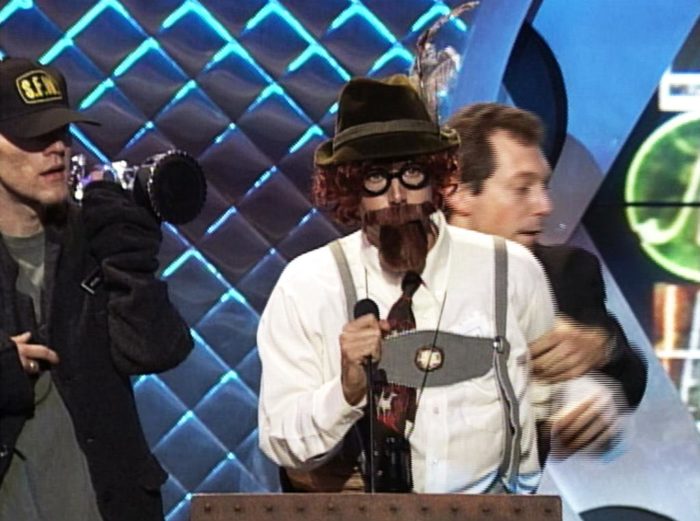
This was actually the first time in the history of the VMAs that someone rushed the stage to protest a win.  Kanye West, of course, later made this a famous move but Adam Yauch did it first.  (My favorite thing about the picture above is the look on Michael Stipe’s face.)

The MTV Music Video Awards may not have appreciated Sabotage but the rest of the world certainly did.  It not only remains one of the signature tunes of the 90s but, if you believe Star Trek, it’s also the song that inspired Jim Kirk to grow up, join Starfleet, and put the safety of everyone under his command at risk at least once a week.

Enjoy!
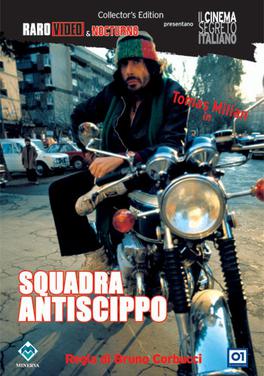
The Cop in Blue Jeans (1976, directed by Bruno Corbucci)


Nico Giraldi (Tomas Milian) was once one of Rome’s top thieves.  He stole handbags and briefcases and he sold them through a network of underground sellers.  Now that Nico has grown up, he’s turned over a new leaf.  Though he still bristles at authority and is just as quick to break the rules, Nico is now a member of the Rome police, assigned to the anti-mugging squad.  He’s a tough cop who has no problem beating the Hell out of a mugger after he captures him.  However, Nico knows that arresting the muggers is only half the job.  To Nico, the real enemies are the sellers who employ the muggers.  Nico wants the men at the top of the criminal food chain, men like the mysterious Baron (Guido Mannari) and the sadistic American crime boss, Richard Russo (Jack Palance).

It’s not just his background that’s unconventional.  Dressing like a slob and sporting an unkempt beard, Nico is a strong contrast to his more conventional co-workers.  Nico even carries a mouse named Captain Spaulding in his front shirt pocket.  The ladies, of course, love Nico.  His girlfriend (played by the beautiful Maria Rosaria Omaggio) is a literary agent who is hoping the publish a manuscript that is being smuggled out of Russia.  The Russians try to sabotage her efforts by switching a briefcase.  It’s a pretty good thing that Nico still remembers how to pull off the perfect mugging.

Though Nico is obviously based on Al Pacino’s performance in Serpico, The Cop in Blue Jeans has little in common with Sidney Lumet’s classic.  Instead, The Cop in Blue Jeans is a mix of action and comedy.  The action comes from Nico’s attempts to capture the members of Russo’s gangs and Russo killing anyone who displeases him.  (A scene in which Russo has a man suffocated in a car is far stronger than anything you would ever see in an American comedy.)  The comedy comes from Nico being such a slob that even his fellow police officers often attempt to arrest him.  Nico insults everyone and everyone insults Nico.  It’s actually not that funny but I liked how every fight turned into an elaborate brawl and Tomas Milian, who was always well-cast as scruffy iconoclasts, gives a good performance as Nico.  Add to that, it’s always entertaining to see Jack Palance play the bad guy, even if this was clearly just a film that he did to pick up a paycheck.

The Cop in Blue Jeans was a big hit in Italy and, coming out a time when Milian’s career was struggling after his early Spaghetti Western successes, it helped to revive his career.  Milian went on to play Nico in ten sequels before then establishing himself as a character actor.  (The role that most modern audiences know him from is as the corrupt Mexican general in Traffic.)  Milian died in 2017 and today would have been his 87th birthday.  The Cop in Blue Jeans features him at his best and shows why he was a star for such a long time.

Music Video Of The Day: Doom and Gloom by The Rolling Stones (2012, directed by Jonas Akerlund)


“The song sounds a lot different than the title. The theme is that Mick is talking to a girl saying, ‘All I hear from you is doom and gloom – let’s go party, let’s go dance.’ It’s an uptempo tune.”

— Organist Chuck Leavell on Doom and Gloom

“At first I said, Hey Mick, ‘Doom and Gloom’ is a kind of weird title for a 50-year celebration, you know? But you know what the Stones are like, it’s always against the grain. But he came up with it and it’s a great track and a really quite ‘funny’ song, actually – there are some great lyrics.”

— Keith Richards on Doom and Gloom

Also according to Keith, Doom and Gloom was one of the quickest recordings that the Rolling Stones ever did.  It only took three takes to lay down the track.  Richards credits that to the chemistry that the Stones have when they’re playing together.  As Keith puts it, the only problem when it comes to recording a new Rolling Stones song is finding a time when everyone can actually get together.

As for the video, it was filmed in a warehouse in Paris and it was directed by Jonas Akerlund, a prolific video director who is best-known for his work with Madonna.  The video stars Noomi Rapace, the Swedish actress who starred in the original Girl With The Dragon Tattoo trilogy and who later appeared in Prometheus.

One thing about the Stones: they don’t quit.  The band has existed for nearly six decades and they’re still making music that demands to be played loud.

Enjoy!

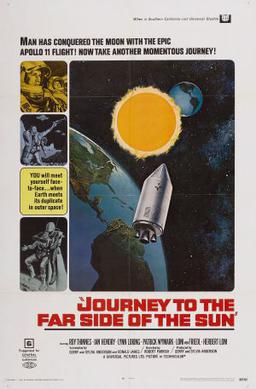
Journey to the Far Side of the Sun (1969, directed by Robert Parrish)


In the year 2069, the European Space Exploration Council discovers that there is a planet on the other side of the Sun, one that orbits the same path as the Earth.  Unfortunately, a spy transmits this information to the communists so America and Europe team up to make sure that they reach the planet before the Russians!

(Remember, production started on this movie in 1967, when America and Soviet Union were still competing to see who would be the first to land on the moon.  Of course, by the time Journey to the Far Side of the Sun was released in 1969, America had already landed on the moon and the Russian space program was no longer taken seriously.)

Two astronauts are assigned to a manned mission to explore the new planet.  Glenn Ross (Roy Thinnes) is American.  John Kane (Ian Hendry) is British.  After spending three weeks in suspended animation, Ross and Kane awaken to discover themselves orbiting a planet that appears to have much the same atmosphere as Earth.  When their ship crashes into the planet, Kane is fatally injured and Ross is retrieved by a human rescue team!  He’s told that the ship crashed in Mongolia.  Kane and Ross were orbiting Earth all along!

Or were they?  Even though Ross is reunited with his wife and debriefed by Jason Webb (Patrick Wymark), the head of the mission, he soon discovers that things are different.  People who were once right-handed are now left-handed and text is now written from right-to-left instead of left-to-right.  People drive on the wrong side of the road and, after Ross makes love to his wife, she feels like something was different about him.  Ross realizes that he’s on a counter-Earth!

It’s an intriguing premise but, unfortunately, Journey to the Far Side of the Sun doesn’t do much with it.  It’s not as if Ross has landed on the Bizarro world, where people say, “Bad Bye” and root for the bad guys at the movies.  Instead, it’s just a world where right-handed people are now left-handed and everyone drives on the opposite side of the road.  Ross theorizes that everything that happens on Earth also happens on Counter-Earth, which means that the other Ross is on Earth, realizing the exact same thing that the first Ross is realizing but who cares because there’s not really any major differences between the two Earths.  Maybe if Counter-Earth had an alternate history where Rome never fell or the Germans won World War II, the movie would be more interesting or at least more like an old episode of Star Trek.  Instead, the movie is all about Ross trying to convince the people on Counter-Earth that he didn’t intentionally abort the mission and that he should be given a chance to return to his Earth.   It’s the driest possible way to approach an interesting premise.

I will say that Journey to the Far Side of the Sun also has one of the strangest endings that I’ve ever seen.  I won’t spoil it here, other than to say that I wonder if the ending was written before or after 2001 made confusing conclusions cool again.

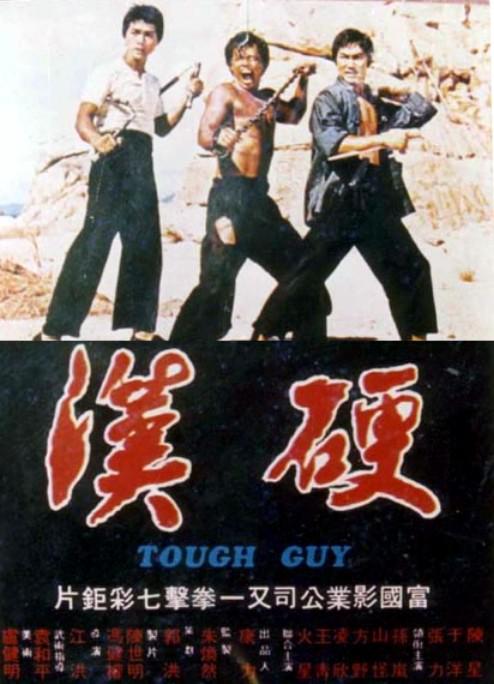
Tough Guy (1972, directed by Joseph Kong Hung)


Chen Xing and Cheung Lik are two cops who have been assigned to take down a drug lord.  In order to infiltrate the criminal gang, Chen Xing goes undercover as a prisoner.  When he escapes from the prison, he does so with another member of the gang.  While Cheung Lik pretends to be a simple villager so that he can keep an eye on his partner, Chen joins the gang and immediately shocks everyone with his fighting abilities.  What sets Chen apart from other martial artists is his ability to kill his opponents just by grabbing their foreheads and smashing their skulls.  That impresses everyone who sees it.  However, when the drug lord finds out that Chen is actually an undercover cop, he captures and tortures him.  Will Chen be able to escape in time to have a climatic fight in a mud pit with the drug lord’s main enforcer?

One of my favorite martial arts films, Tough Guy is known by several titles.  When it was released in the West, it was apparently retitled — and I am not kidding — Kung Fu The Head Crusher.  When it was subsequently released on video, it was called Revenge of the Dragon, probably to try to fool people into thinking that it was a Bruce Lee film or, at the very least, that it starred Bruce Li or some other Bruceploitation star.

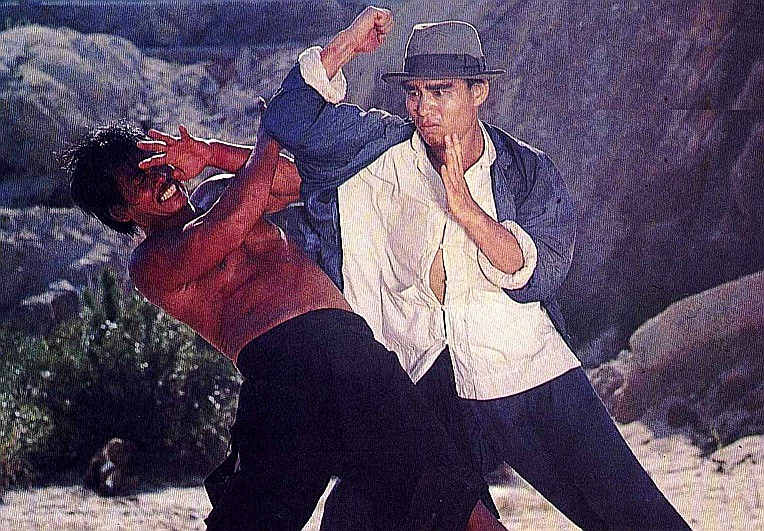
Whatever it’s title, Tough Guy is an often brutal film, featuring some of the most exciting fight scenes that I’ve ever seen.  What Chen Xing and Cheung Lik lacked in screen charisma, they made up for in skill and relentlessness.  When Chen Xing gets in the middle of things and starts trading blows with his adversaries, it’s like watching a wild animal suddenly go on the attack.  He doesn’t stop moving until no one’s left standing and he even manages to make the whole skull crushing thing look credible.  He’s matched by Cheung Lik, who may not have as big a role as Chen Xing but who still proves himself to be a formidable fighter.  The fights themselves are expertly choreographed and largely filmed in close-up.  There’s no cheating the camera or anything else that martial arts films sometimes did to make their stars look more skilled than they actually were.  Another thing that I appreciated is that, when Chen and Cheung have to fight multiple opponents, the bad guys usually attack all at once, as a group, instead of everyone standing around waiting for their turn to get in their punches.

There’s little intentional humor to be found in Tough Guy and there’s even less discussion of the philosophy behind the martial arts.  Instead, this is a tough and violent crime movie that wastes no time in getting down to business.

One final note: While watching Tough Guy, be sure to pay attention to the film’s score.  If it sounds familiar, that’s because it was lifted nearly note-for-note from Ennio Morricone’s score for Once Upon A Time In The West.

Music Video Of The Day: It Must Be Love by Madness (1981, directed by Chris Gabrin)


“In the pool, I had these lead weights on. I thought I was gonna die. The hire guitar got bent so we got a hairdryer and sent it back. They said, ‘The neck’s like a banana.’ So we had to buy it.”

— Guitarist Chris Gabrin on performing under water in the video for Madness’s It Must Be Love

In America, this song and video was released as Madness’s follow-up to their first (and, to date, only) hit in the United States, Our House.  Unfortunately, for the band’s U.S. popularity, the video was heavily influenced by the very British Ealing comedies and it was not immediately appreciated by audiences across the Atlantic.  I think if the video were released today, at a time when more people are aware of international cinema and appreciation of British comedy is now a mainstream phenomena as opposed to just the kids in the computer lab talking about Monty Python, it would be better received in the States.

In the U.S., It Must Be Love peaked at #33.  As with most of Madness’s song, It Must Be Love was far more successful in the UK, where it has twice reached the UK Top 10, once when it was originally released and then when it was re-released in 1992.

Obviously, the British have always been better about appreciating a bit of madness than the Americans.

Enjoy!

Bolo (1977, directed by Bolo Yeung)


The plot of Bolo is almost indescribable but I shall give it a try.

As far as I can tell, the film is supposed to take place during the final days of the Ching Dynasty in China.  The sheriff of a tiny rural village has been beheaded by gangster so the decision is made to have all of the local prisoners pull straws, with the two winners getting to leave the prison and become the town’s new law enforcement officers.  The winners are the hulking but well-meaning Bolo (Bolo Yeung, for once playing a good guy) and Ma (Jason Piao Pai).  Ma is a con artist while Bolo is in prison for killing his wife because he hadn’t seen her before their arranged marriage and was horrified to discover how ugly she was.  (Ha ha, I guess?)  Bolo and Ma are told not to try to escape and are then sent on their way to the village.

After a visit to the local brothel ends in a fight, Bolo gets down to trying to clean up the village.  That’s not going to be easy because almost everyone in the village is a gangster and the village’s mayor would rather appoint the local pimp as the new sheriff.  Bolo, however, starts to get results so the mayor plots to poison Bolo.  That doesn’t work but he does frame Bolo for a crime that he didn’t commit which leads to Bolo and Ma committing a real crime.  Bolo also falls in love with a 7 foot woman.

Bolo is like a Kung Fu version of the type comedic spaghetti westerns that Bud Spencer and Terrence Hill used to make in the 70s, with the exception that it’s far more incoherent than anything that ever starred Spencer and Hill.  Friends become enemies and enemies become friends and back again with shocking regularity in Bolo and, though there’s many fights, it’s rarely clear why anyone’s fighting.  A typical scene features a woman asking Bolo to watch her baby and then stabbing him in the stomach when he makes a face about the baby’s dirty diaper.  A wounded Bolo staggers into a doctor’s office, where the doctor bandages him up and then the two of them have a fight, during which time the bandage falls off and we discover that Bolo is apparently no longer wounded.

The film is also a comedy but it’s difficult for me to judge how effective it might have been because 1) I saw a poorly dubbed version and 2) much of the humor appeared to be very specific to China and Chinese culture.  For instance, there’s a lengthy scene where Ma and a woman play something called “the numbers game.”  The film presents it as being a big deal and I think it was meant to be comedic but I have to admit that I have no idea what they were doing.  To me, it seemed like they were just shouting out random numbers while holding up their hands.  To everyone else in the movie, it appeared to mean something else.  So, I won’t judge the film’s comedy beyond saying that Belo Yeung, who also directed as well as starred, appeared to have a gift for physical comedy that he didn’t get a chance to show off in his other films, mostly because he was usually cast as a villain.  There’s also a scene where a grocer attacks someone with a cucumber and that’s funny just because cucumber’s are funny.

Even if it’s never clear why anyone’s fighting and the sound effects often don’t match the actions of the combatants, some of the fight scenes are exciting.  That’s really the main reason why anyone’s going to watch something like Bolo and in that case, the movie doesn’t disappoint.  The fights are cool.  It’s just too bad that the plot keeps getting in the way.

Music Video of the Day: Fine Time by New Order (1988, directed by Richard Heslop)


“My car had been towed away and I had to remind myself to go and pay the fine. I just wrote “Fine Time” on this piece of paper to remind myself to go get it and thought, that’s a good title.”

— New Order’s Steve Morris on Fine Time

That’s a good story but what does Steve’s car getting towed have to do with a kid having a weird Christmas dream?  Probably nothing.  It is a New Order song, after all.  One of the great things about New Order is that everything about them, from their name to their songs to the videos, is open to several hundred interpretations.  It’s hard to know what the future may hold but one thing can be said for certain.  People will still be arguing about what Blue Monday is about.  And when they get tired to arguing about Blue Monday, they can talk about this video.

I guess the kid is dreaming.  But what’s going on with the dog?  Is the dog barking at his master’s dream?  Is it actually safe to allow that dog to sleep in a bed with a child?  Is it a good idea to tie a dog to a bed?  I don’t know.

Richard Heslop also directed videos for Ace of Base but we won’t hold it against him.

Enjoy!

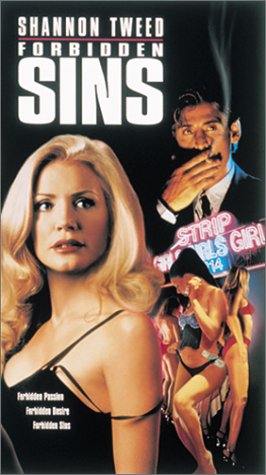
Cinemax Friday: Forbidden Sins (1999, directed by Robert Angelo)


There’s been a murder!  A stripper named Virginia Hill (Kristen Pierce) has been found dead and the evidence suggests that she died as the result of sadomasochistic sex play gone wrong.  Lead detective John Doherty (Myles O’Brien) immediately suspects that the murderer is David Mulholland (Corin Timbrook).  Mulholland is a millionaire who owns the club where Virginia used to dance.  He has a reputation for being into some kinky stuff.  (A cashier at the local adult bookstore swears that Mulholland only buys BDSM-related magazines.)  Detective Doherty is convinced that Mulholland not only killed Virginia but that he’s killed before.  For this detective, this case is personal.

It’s about to get a lot more personal because, after he’s arrested, Mulholland hires Maureen Doherty (Shannon Tweed) to defend him in court.  Maureen is John’s ex-wife and she knows firsthand how obsessive her former husband is.  For reasons that she can’t fully explain, Maureen feels that Mulholland has been set up.  Working with Virginia’s best friend, Molly Malone (Amy Lindsay), Maureen sets out to prove that Mulholland is innocent.  But is he?

Yes, it’s yet another remake of Jagged Edge, with Shannon Tweed more than capably stepping into the Glenn Close role.  The chance to see Shannon Tweed play a high-powered attorney is the main reason to see Forbidden Sins and she does a pretty good job with the role.  Among the stars of the Skinemax era, Tweed was one of the more talented and she was always as credible delivering dialogue as she was disrobing.  Other than Tweed, the rest of the cast is okay but nothing special.  For instance, one reason why Jagged Edge worked was because Jeff Bridges kept you guessing.  In this film, the same cannot be said of Corin Timbrook.  The script and the direction are all pretty much standard for what you would expect from a 90s direct-to-video sexploitation flick and, again, the main thing that elevates this film above others of its type is the conviction that Shannon Tweed brings to her role.

For those who are only watching this film for the nudity (and, to be honest, that’s probably going to be the majority of the people who go to the trouble to track down something called Forbidden Sins), Shannon Tweed has one scene while Amy Lindsay has several.

My favorite thing about Forbidden Sins is that the murdered stripper was named after Bugsy Siegel’s girlfriend.  My second favorite thing about Forbidden Sins is that the working title was apparently Forbidden By Law.  That’s one way to describe murder, I guess.

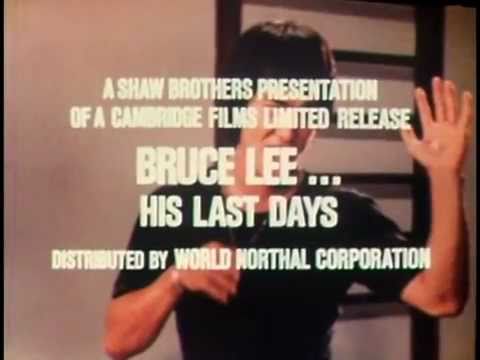
Bruce Lee: His Last Days, His Last Nights (1976, directed by John Law Ma)


Also known as Bruce Lee & I, this films stars Betty Ting Pei as herself.  At the time that the film was made, Betty was one of the most vilified women in the world.  An actress who was best known for appearing in softcore sexploitation, Betty was a “friend” of Bruce Lee’s.  It was while visiting Betty in her apartment that Bruce announced that he had a terrible headache.  Betty gave Bruce Equagesic, a powerful type of aspirin, to help him deal with his headache.  Bruce then fell asleep and, as we all know, never woke up.

Not surprisingly, after Bruce’s death, Betty was at the subject of a lot of unfavorable speculation and unsavory rumors.  Some Bruce fans accused her of poisoning Bruce, either accidentally or on the orders of the organized crime figures who wanted to take over Bruce’s career.  There was also speculation as to the nature of Bruce’s relationship with Betty.  Bruce was married and had two children and, after he died, he was recast as almost a saintly figure.  Betty’s claim that she was Bruce’s mistress did not fit in with that new reputation.

Bruce Lee: His Last Days, His Last Nights opens with Bruce (played by Danny Lee, who later won a critical respect by appearing in several John Woo films) filming a fight scene before then going to Betty’s apartment where, after the first of the movie’s many sex scenes, Bruce ends up dead in Betty’s bed.  With both the press and even people in the streets accusing Betty of being evil, Betty goes to a bar and, while drowning her sorrows, tells the bartender about her life with Bruce Lee.

In Betty’s telling, she knew and loved Bruce long before he became a star.  She met him when she was just an innocent schoolgirl and he saved her from some thugs in the streets.  Later, they both met again while pursuing their film careers and they became lovers.  Betty felt guilty about carrying on an affair with a married man but Bruce didn’t care.  Bruce mostly cared about smoking weed, getting into fights, and getting laid.

This is one of the stranger Bruceploitation films.  Most Bruceploitation films presented Bruce as being a real-life super hero who was either killed by his enemies or who faked his death so he could protect his family.  This one presents Bruce as essentially being a petulant and cocky asshole who didn’t really care about anyone but himself.  Some of that may be because the film was produced by the Shaw Brothers, with whom Bruce famously refused to work with early in his career.  (It’s rumored, though, that Bruce was thinking of leaving Golden Harvest for the Shaw Brothers at the time of his death.)  The other reason why Bruce comes across as being so unlikable in this movie is that it’s told from the point of view of Betty, who was often accused of having corrupted Bruce and of not being worthy of him.  This film makes the argument that Bruce was not worthy of Betty.

Once you get past all of the controversy about how this film presents Bruce Lee and his relationship with Betty Ting Pei, it’s still not a very good movie.  It’s too slow and they’re aren’t enough big fights.  (When Bruce does fight, it’s usually to protect Betty from an unwanted admirer.)  Bruce does don the yellow track suit but it’s just so he can debate philosophy with Betty.  We expect more from our Bruceploitation films.