Game Review: Bogeyman (2018, Elizabeth Smyth)


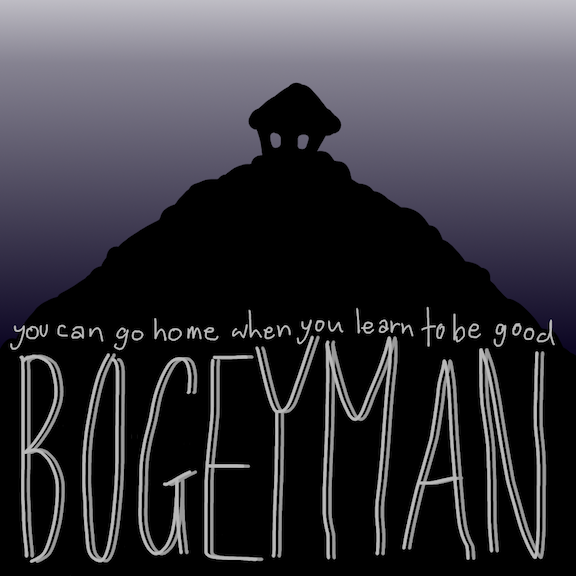
In this interactive fiction game, you are put in the role of a child who, after having what you believe to be a nightmare about being abducted, wakes up to discover that you actually have been abducted.  You are now one of several children, living in an isolated mountain cabin and subject to the unpredictable and often cruel whims of your abductor.  Escape seems impossible and survival is going to mean making some truly grim choices.

Bogeyman starts out with a dark premise and then it just gets progressively more dark from there.  Whenever you think that the story can’t get any more unsettling, it does.  It’s not a game where you always get as many choices as you would like.  Often, you have to decide between doing a bad thing or doing an even worse thing.  It’s also not a short game but it grabs your interest from the very first line and I played all the way to the end because, after spending just a few minutes experiencing life in that cabin, I had to know how it would all end.

Bogeyman is a Twine game and it actually makes good use of the format.  White text slowly appears against a black background while subtle but spooky music plays in the background.  Your choices are in all caps, highlighting the desperation of your situation.  There are a few graphics but most of the game takes place in your head.  The game does such a good job of describing the cabin and the situation that you feel like you’re there.

Well-written and carefully put together, Bogeyman is an IF game that sticks with you.  You can experience it here.


Anguish (1987, directed by Bigas Luna)


John Pressman (Michael Lerner) is a mentally unbalanced, middle-aged, diabetic mama’s boy who is losing his eyesight.  When his mother (Zelda Rubinstein) orders John to go out and collect healthy eyes, it leads to John going on a rampage that eventually brings him to a movie theater.  After he barricades everyone inside, he starts to pick off the patrons one-by-one, removing their eyes with a scalpel.

Meanwhile, in another theater, an audience watches John’s rampage on the big screen.  Is the story of John Pressman just a movie?  Maybe.  But in the audience, people start to react strangely.  A woman breaks down in tears.  When John Pressman starts to kill people in his movie, a man in the audience starts to kill people in the real theater.  When the mother in the movie-within-a-movie sends her son out to get eyes, is she after the eyes of the people in her movie or the people watching in the audience?  Has the madman in the audience been possessed by the movie or is he just another spree killer, an ever-present threat in both the movies and the real world?  And how will his rampage be stopped?

Anguish is a clever, multi-layered Spanish horror film.  Watching the film, it’s important to remember that it was produced in the middle of a worldwide moral panic about whether or not people could experience violent movies without becoming violent themselves.  At first, it seems like the film is saying that horror movies are a bad influence but then there’s a twist ending that turns the entire premise on its head.  As the movie peels away layer after layer of plot, you’ll find yourself wondering what’s real and what’s just a movie.

An unheralded horror classic, Anguish is two good movies in one.  Obviously, the film about John Pressman and his crazy mother is considerably more cheesy than the one about the madman in the “real” world but both films are full of atmosphere, suspense, and a some surprisingly grisly violence.  The movie-within-a-movie also features Michael Lerner and Zelda Rubinstein, two actors who just seem like they were destined to play a henpecked son and his crazy mother.  Lerner is one of the best character actors around and Anguish gives him a rare leading role.  Lerner makes the most of it, carefully cutting out eyeballs while his mother’s voice echoes in his head.

Anguish is a good head trip of a film.  It’s long been rumored that Anguish contains subliminal images and sounds that are designed to make the people watching feel nervous.  I don’t know if that’s true, though the film does open with the following classic warning:

During the film you are about to see, you will be subject to subliminal messages and mild hypnosis.

This will cause you no physical harm or lasting effect, but if for any reason you lose control or feel that your mind is leaving your body — leave the auditorium immediately.

Luckily, Anguish is available on DVD and Blu-ray so you can watch it in the safety of your own home.

Game Review: Spring 2020 (2020, Philip J. Rhoades)


Click to Enlarge

In this existential, sequester-inspired horror film, you start in a room.  You cannot leave the room.  There is something appears to be food in the room.  You can do two things.  As the game puts it, “You can only eat or wait.”

The game’s not lying about that, either.  I tried all sorts of tricks to see if maybe I could fool the game into letting me do something else.  I tried to look at the food.  I tried to get the food.  I tried to go north.  I tried to go east.  I tried to go west.  I tried to go south.  I tried to examine the room.  I tried them all.  Just to be told, “You can only eat or wait.”

So, during one game, I ate.  During the next game, I waited.  I did both of those for several turns and things did not go well for me at all.  This is a game that you cannot win but it also captures the way many people feel about 2020.  This is the year when no one wins so why not play a game where no one wins?  It’s a simple game but it captures the mood of the year.

If you want to play this game, you can download it from here.  

Just remember, you only eat or wait.

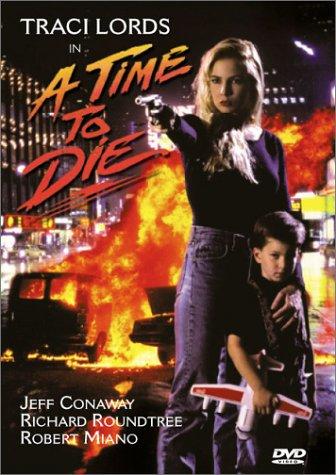
A Time To Die (1991, directed by Charles T. Kanganis)


Jackie (Traci Lords) is a single mom and a photographer who loses custody of her son when she’s framed for cocaine possession by a corrupt cop named Eddie Martin (Robert Miano).  Jackie is released from jail early, on the condition that she do 400 hours of community service.  Specifically, she is ordered to take pictures of the LAPD doing a good job and not killing people.  Captain Ralph Phibbs (Richard Roundtree) makes it very clear that she is to take only positive pictures of the LAPD or she could go back to jail and end up never seeing her son again.

However, even while doing community service, Jackie’s a rebel.  She decides to follow around Eddie and get pictures of him engaged in the same type of corruption that got her sent to prison.  Jackie manages to get Eddie on film murdering a pimp but, instead of going to the authorities, she wants to use the picture to blackmail Eddie into clearing her name.  Eddie, who has a cocaine problem, doesn’t respond well to being blackmailed and he decides to get the negatives and kill Jackie, not necessarily in that order.

While Eddie’s trying to kill Jackie, Frank (Jeff Conaway), another cop, is trying to maneuver his way into Jackie’s bed.  At first, Jackie doesn’t trust Frank because he’s a cop but then Frank takes her on a date to a domestic disturbance call and soon, she’s falling for him.  Frank, though, might not be as trustworthy as he seems.

This is one of the many direct-to-video thrillers in which Traci Lords appeared in the years immediately following her forced retirement from the adult film industry.  As was often the case with her 90s films, Lords is the best thing about A Time To Die.  In this film, Traci Lords again shows that she was a good actress.  Unfortunately, because of her past, she never got the type of roles that she really deserved.  In A Time To Die, she is believably tough and she makes the clunkiest dialogue credible.  Unfortunately, the other members of the cast don’t try anywhere near as hard as Lords does to bring some sort of reality to their stereotypical roles.  Conaway and Miano both sleepwalk through their roles while Richard Roundtree is reduced to getting mad and doing a lot of shouting.  Though the plot is sometimes predictable and it doesn’t take a psychic to know that Eddie is eventually going to go after Jackie’s son, the story is still interesting enough to hold your attention while your watching the movie.

A Time To Die is an occasionally interesting B-thriller that is elevated by the efforts of Traci Lords.

Fist Fighter (1989, directed by Frank Zuniga)


C.J. Thunderbird (played by Jorge Rivero) is a former professional fighter who is now a miner living in Arizona.  Two years ago, Thunderbird’s best friend was killed by a fighter named Rhino (Matthias Hues).  Thunderbird swore vengeance and, when he gets a telegram informing him that Rhino has been spotted in Bolivia, Thunderbird heads down to South America, looking to settle things once and for all.  With the help of a down-on-his-luck trainer named Punchy (Edward Albert), Thunderbird nearly defeats Rhino in the ring but the fight is suddenly stopped by the local police, all of whom are paid off by local drug dealer, Billy Vance (Mike Connors).  Rhino works for Vance and Vance doesn’t want his most fearsome goon to be shown up in public.  Thunderbird and Puchy soon find themselves in one of those prisons where the inmates are forced to take part in underground cage matches.  Thunderbird’s only chance of survival and perhaps escape depends upon defeating yet another fighter, the Beast (Gus Rethwisch).

The coolest thing about Fist Fighter is that it’s called Fist Fighter.  It sounds like a title for a movie that someone made up but instead, it’s very, very real.  The 2nd coolest thing about Fist Fighter is that the hero is named Thunderbird.  I think this was Thunderbird’s only film adventure.  If Fist Fighter had made more money, it could have led to a Thunderbird franchise.  Jorge Rivero wasn’t much of an actor but he’s good in the fight scenes and Edward Albert overacts to such an extent that he easily makes up for Rivero’s inability to actually show emotion.  I also liked Mike Connors as the smug villain.  Brenda Bakker plays Billy Vance’s mistress.  Of course, she ends up falling for Thunderbird.

Fist Fighter is dumb but entertaining.  If Rivero’s role has been played by Jean-Claude Van Damme or Dolph Lundgren, two action stars who could actually act as well as convincingly fight, Fist Fighter would probably be a cult classic.  As it is, it’s one of the more entertaining of the many rip-offs of Bloodsport.

Valdez is Coming (1971, directed by Edwin Sherin)


Based on a western short story from the great Elmore Leonard, Valdez is Coming takes place in a small town on the border between the U.S. and Mexico.  Wealthy Frank Tanner (Jon Cypher, who later played Chief Fletcher Daniels on Hill Street Blues) claims that he’s spotted the man who murdered a friend of his.  Tanner and his gunmen have the man and his wife pinned down in a cabin.  The man is African-American while his wife is Native American and Tanner’s use of racial slurs quickly confirms that there’s more to his animosity towards the couple than just a desire to see justice done for his dead friend.

Because the sheriff is out of town, Mexican constable Bob Valdez (Burt Lancaster) is summoned to the scene of the stand-off.  Saying that he needs to see proof that the man is who Tanner claims he is, Valdez goes down to the cabin and manages to calm the man and his wife down.  However, one of Tanner’s gunmen, R.L. Davis (Richard Jordan), opens fire on the cabin while Valdez is talking.  Thinking that he’s been betrayed, the man opens fire on Valdez and Valdez is forced to kill the man in self-defense.

Feeling guilty about the man’s death (and also suspecting that the man was innocent of the crimes for which Tanner accused him), Valdez starts a collection for the dead man’s widow.  When he asks Tanner to donate $100, Tanner responds by having Valdez tied to a wooden cross (symbolism alert!) and sent into the desert.  Valdez nearly dies before he’s set free by a conscience-stricken Davis.

Still determined to get justice for the man that he killed, Valdez sets out after Tanner and his men.  Valdez kidnaps Tanner’s young bride, Gay Erin (Susan Clark), and lets Tanner know that he can either pay the $100 or he can die like a coward.

An American attempt to capture the feel of a Spaghetti western, Valdez is Coming has an interesting plot.  I liked the fact that, even after nearly being crucified, Valdez was still more concerned with making Tanner pay his fair share and getting justice for the people Tanner had hurt than with getting any sort of personal revenge.  The supporting characters also have more depth than is typical for a film like this.  Gay Erin is not as innocent as she first appears to be and R.L. Davis may work for Tanner but he’s still has enough personal integrity not to leave Valdez to die in the desert.

Unfortunately, the movie itself is slow and ponderous.  A big problem is that Burt Lancaster is miscast as Bob Valdez.  Valdez is a Mexican constable who has served in the U.S. Calvary.  Because he’s Mexican, the man in the shed is willing to briefly trust him.  Tanner continually underestimates and refuses to negotiate with Valdez because Valdez is a quiet and reserved Mexican.  Almost everything that happens in the film is in some way connected to Tanner’s refusal to negotiate with Valdez because Vadez is a Mexican.  Burt Lancaster is in absolutely no way Mexican and the unfortunate decision to have him wear brownface makeup only serves as a reminder of how miscast he is in the lead role.  The movie also concludes with the type of ambiguous ending that was very popular in the 70s but which is frustrating to watch today.  After 90 minutes of Valdez demanding that Tanner either die like a coward or pay $100, it’s frustrating that the film leaves it as an open question as to what eventually happened.

Valdez is Coming had the potential to be a western classic but it was done in by miscasting and questionable directing.  It’ll best be appreciated by western completists.

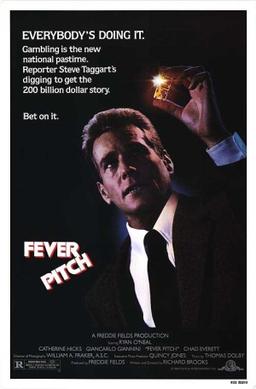
Fever Pitch (1985, directed by Richard Brooks)


It takes a great director to come up with a movie as bad as Fever Pitch and, in his day, Richard Brooks was a great director.  Among Brooks’s films as a director you’ll find titles like Blackboard Jungle, Cat on a Hot Tin Roof, Elmer Gantry, The Professionals, and In Cold Blood.  These were all films that took risks and broke new ground and which were willing to defy the conventions of the time.  Brooks was a director who told hard-boiled stories that dealt honestly with real-life issues.

Unfortunately, as often happens with great filmmakers, Brooks struggled to remain relevant as he got older.  Hollywood’s sensibility eventually caught up with Brooks’s sensibility and then moved past it.  While Brooks remained an interesting director, his final films often seemed to be the work of a grumpy old man who just wanted all those young people to stay off his lawn.

Fever Pitch, Brooks’s final film, stars Ryan O’Neal as Steve Taggart.  Taggart is a sports writer for The Los Angeles Herald Examiner.  He’s been writing a series of stories about a compulsive gambler named Mr. Green.  The stories are so popular that his editor (John Saxon) has no problem giving Taggart $10,000 so that Taggart can then give the money to Mr. Green so that Mr. Green can continue to gamble.  What anyone, especially the editor of a major newspaper, should be able to figure out is that Mr. Green is actually Steve Taggart.

Taggart takes the money to Las Vegas, where he hits the casinos while also researching the root causes of gambling.  On the one hand, Brooks includes a lot of scenes of Taggart listening to real people explain the history and the dangers of gambling, often in the most didactic ways possible.  (Hank Greenspun, the legendary publisher of The Las Vegas Sun, appears as himself and shows why he became a publisher and not an actor.)  On other other hand, MGM not only produced the film but allowed it to be filmed at the MGM Grand Resort & Casino in Las Vegas.  Fever Pitch is anti-gambling film that also doubles as a commercial for a casino.  It’s like an anti-smoking film that gives everyone in the audience a free pack of Camels.

Steve hooks up with an unbelievable wholesome prostitute played by Catherine Hicks.  He also has to deal with several shady characters, including a veteran gambler named Charlie (Giancarlo Giannini) ad a debt collector named The Hat (played by William Smith).  Taggart is obsessed with gambling but he doesn’t seem to be very good at it, as he keeps getting beat up and threatened.  Eventually, he goes to a Gamblers Anonymous meeting and he seems to be ready to admit that he has a problem and that it’s keeping him from being a good father to his daughter.  That might seem like the ideal place for the movie to end but instead, Taggart has to try his luck with just one last slot machine.

Fever Pitch is doomed from the minute Ryan O’Neal starts his narration.  Nothing about O’Neal suggests that he could be capable of writing a hard-hitting expose about the life of a compulsive gambler.  In this film, he doesn’t even come across like he would be capable of reading it. O’Neal is too passive of an actor to be a convincing gambler and his wooden performance clashes with Brooks’s attempts to create a hyperkinetic feel to the Vegas scenes.  While everyone in the film is lecturing him about the dangers of gambling, O’Neal sit there with same blank look on his face.

A critical and a commercial failure, Fever Pitch was Brooks’s final film.  He died seven years later, leaving behind a legacy of important movies that cannot be tarnished even by something like Fever Pitch.
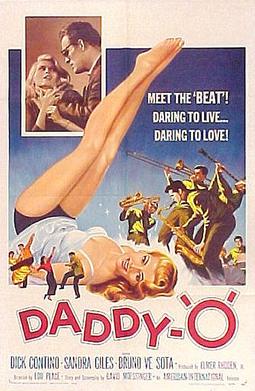
Daddy-O (1958, directed by Lou Place)


Like Elvis before him, Phil Sandifer (Dick Contino, who played a mean accordion back in the day) is a truck driver who wants to be a rock and roll star.  He’s also a street racer who has just fallen in love with Jana (Sandra Giles), the one woman fast enough to run him off the road.  However, before Phil can pursue either Jana or rock and roll fame, he has to investigate the mysterious death of his friend, Sonny.  Someone drove Sonny off the side of the road and the police aren’t willing to investigate.  Instead, they’re more interested in giving Phil a hard time, taking away his license and making it impossible for him to do his thing.

Working with Jana, Phil goes undercover as Daddy-O, the world’s greatest rock and roller.  He gets a job singing at a club owned by the shady Sidney Chillas (Bruno VeSota), the man who Phil believes was responsible for the death of Sonny.  Phil investigates and also finds time to sing a deathless song called Rock Candy Baby.

Today, Daddy-O is probably best known for being featured on Mystery Science Theater 3000.  In fact, I didn’t even mention Phil’s strange habit of hiking his pants nearly halfway up his chest just because Joel and the Bots pretty much said everything that needed to be said about that when they watched the show.  The same can be said of the song Rock Candy Baby, which is both terrible and insanely catchy.

Beyond the pants and Contino’s performance of Rock Candy Baby, Daddy-O is a typical delinquent youth B-movie.  Contino was best known as an accordionist but this film tries to rebrand him as a rock and roller.  He was 28 when he starred in Daddy-O but Contino looked closer to 40 and his discomfort in obvious in every scene.  Far more convincing are Sandra Giles and Bruno VeSota.  Sandra Giles has the right look to be convincing as a 50s bad girl who actually isn’t that bad while Bruno VeSota specialized in playing crooked club owners.

Daddy-O is mostly interesting as an example of how filmmakers tried to reach teenagers in the early days of rock and roll.  Contino was not a rock and roller and he looks plainly uncomfortable trying to be one but it was 1958 and Elvis was everywhere.  Of course, Elvis would have known better than to have called himself Daddy-O.  That’s totally squaresville.

Cinemax Friday: Young Nurses In Love (1987, directed by Chuck Vincent)


Chuck Vincent was widely considered to be one of the best directors to work in the adult film industry during the Golden Age of Porn.  As a director, he put as much emphasis on characterization and plot as he did on getting the so-called money shots.  One of his adult films, Roommates, even got a favorable write-up in The New York Times.

Unfortunately, Vincent was less successful when he tried to move over into mainstream filmmaking.  Vincent directed B-movies, most of which went straight to video.  The majority of them were either dumb sex comedies or erotic thrillers and they often featured porn stars in “straight” roles.  Though the majority of Vincent’s mainstream films were adequately put together, they never got the attention that his adult films did.  In the adult film industry, Vincent was an artist but, when it came to mainstream films, he was viewed as just being another competent director who churned out B-movies.  One of the few places where Vincent’s movies were appreciated was on late night Cinemax.

Young Nurses In Love is  typical example of Vincent’s mainstream work.  It takes place at Hoover Hospital, where the doctors are all rich and strange and the nurses all wear the tightest uniforms around.  The plot, as it is, involves a sperm bank where sperm from some of the most brilliant people in history is being stored.  Nurse Ellis Smith (Jeanne Marie) is an agent of the KGB who has gotten a job at the hospital so she can steal that sperm and the Russians can use it to create supercommunists.  Dr. Reilly (Alan Fisler) is also a CIA agent and he hopes to use his “bedside” manner to convince Nurse Smith to turn against her employers.  Can he do the trick?

Young Nurses In Love is meant to be a satire of medical soap operas.  (It was advertised as being a sequel to Garry Marshall’s Young Doctors In Love, though Marshall himself was in no way involved with the production.)  While Dr. Reilly is trying to save the super sperm, the rest of the hospital staff get caught up in their own softcore dramas.  There’s a mafia subplot.  There’s plenty of nurses trying to land a rich doctor husband subplots.  Jamie Gillis, Annie Sprinkle, and Veronica Hart all have small roles.  The humor is frequently forced.  Instead of letting the jokes develop naturally, Young Nurses In Love just piles one incident on top or another without much comedic rhyme or reason.  With the exception of Jamie Gillis, none of the actors seem to have a natural talent for comedy and the stiff delivery of their “funny” lines will probably inspire more groans than laughs.  For all the attempts to be racy, this R-rated film is mild enough to qualify as a PG-13 today.

This was one of Chuck Vincent’s lesser mainstream films.  For a better Chuck Vincent-directed comedy, check out Student Affairs.

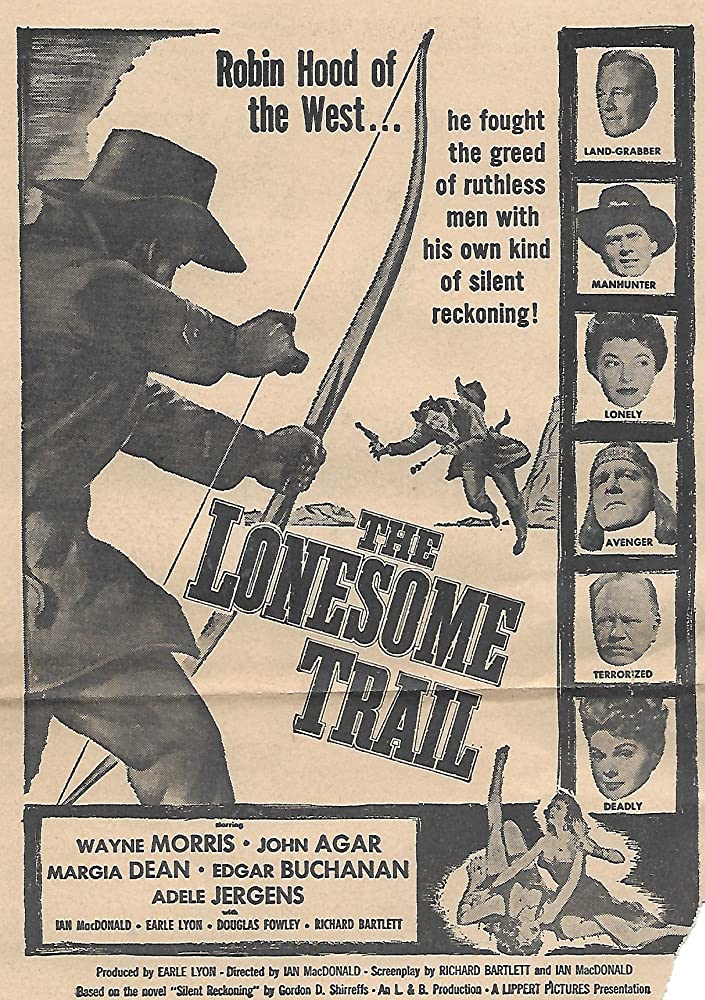
The Lonesome Trail (1955, directed by Richard Bartlett)


Returning home from the Civil War, Johnny Rush (John Agar) discovers that his family’s land has been confiscated by corrupt rancher Hal Brecker (Earle Lyon, who co-wrote the script).  With the aid of corrupt Sheriff Baker (played by Richard Bartlett, who also directed the film), Brecker has taken over the entire town.  Honest ranchers like Charley Bonesteel (Douglas Fowley) are giving up their land and heading out of town.  Meanwhile, Dan Wells (Edgar Buchanan) has managed to hold onto his land by offering up his daughter, Pat (Margia Dean), as Brecker’s bride.  Since Johnny’s in love with Pat, he’s not happy about this development.

Johnny wants to take on Brecker but the local bartender, Dandy Don (Wayne Morris), talks him out of it.  Realizing that there’s nothing he can do alone, Johnny tries to leave town but, as he rides out, he’s ambushed by Baker.  Though Johnny survives the ambush, his shooting hand is injured.  Fortunately, Indian Chief Gonaga (Ian MacDonald, the script’s other writer) and Charley are on hand to teach Johnny how to fight with a bow and arrow.  Johnny goes on to become an old west Robin Hood, using his newly learned archery skills to fight the greedy land grabbers and protect the poor land-owners.

The Lonesome Trail is a low-budget, grade Z western that is slightly saved by the novelty of seeing John Agar fighting off the bad guys with a bow and arrow.  The film is clearly set up to be a western version of the Robin Hood saga, complete with a corrupt sheriff, a greedy landlord, and an archer who has just returned from war.  Errol Flynn and Olivia de Havilland could have really made something out of this story back in 1938.  Unfortunately, to say that John Agar is no Errol Flynn is putting it lightly.  There’s nothing “merry” about John Agar’s performance.  He looks genuinely miserable in the majority of this scenes.  Agar is just as stiff as usual but the bow and arrow is just enough of a twist to make his confrontations with Brecker’s men more interesting than the typical gunfights that usually wrapped these films up.  Otherwise, this is another forgettable Robert Lippert-produced western, though old pro Edgar Buchanan does give a good performance as a man desperate enough to offer up his daughter in order to keep his land.