October Positivity: The Moment After (dir by Wes Llewellyn)


1999’s The Moment After opens with the world in a panic.  Millions of people have suddenly vanished into thin air, leaving only their clothes and their loved ones behind.  On a news program, three expects are brought in to discuss what might have happened.  A New Age-y woman argues that “Mother Earth” is eliminating overpopulation.  A wild-eyed man argues that people have been abducted by UFOs.  And finally, a man with a neatly trimmed beard argues that it’s the rapture.  The bearded man is dismissed as being a crank.

Two FBI agents — Adam Riley (David A.R. White) and Charles Baker (Kevin Downes) — are assigned to investigate the disappearances.  Charles is himself shaken because he knew a few people who disappeared.  As they drive around the city and talk to people, they hear the same story.  People who went to church regularly and were Christian vanished while their less faithful loved ones watched.  Adam comes to suspect that there might be something to the Rapture Theory.  Charles, bitter because his wife recently suffered a miscarriage, has no time for it.

As often happens in a crisis, the government grows heavy-handed and sinister.  The President announced that he’s going to follow the lead of Europe and “suggest” that everyone get a chip implanted in their hand.  Charles gets the chip without hesitation.  Adam keeps finding excuses to put it off, even though he’s mandated to get one as a federal employee.  With the country turning into an authoritarian dystopia, Charles and Adam are assigned to track down a renegade preacher (Brad Heller), who is telling his followers not to get chipped.

Stories about the end time have always been popular when it comes to faith-based films.  A lot of that is because the Book of Revelations is written in such a way that there’s a lot of different ways that one can interpret it.  As a result, it’s always interesting to see how “the mark of the Beast,” will be represented in these films.  Sometimes, it’s a tattoo.  Sometimes, it’s an invisible mark that only demons can see.  In this one, it’s a chip that works as a credit card.  And while it’s easy to scoff at this film’s conspiracy theories and the shots of people staring at their palms, some of us still remember how, during the COVID lockdowns, there were more than a few people in positions of influence who argued that the citizenry shouldn’t be allowed in stores or restaurants or anywhere else unless they could show proof they had gotten the vaccine and kept up with the boosters.  There were even some who said that the National Guard should go door-to-door and force the shot on people.  (For the record, I did get the vaccine but, when I started hearing about monthly boosters and all that other stuff, I decided that one shot was more than enough for me.)  There is definitely an authoritarian impulse out there, one that comes out whenever there’s a crisis.  One reason why films like this one continue to find an audience is because real-life governments often behave like the dictatorship portrayed in The Moment After.  Of course, in the movie, everyone can at least say they were influenced by the Devil.  In real life, it just comes down to pettiness and a need to tell other people what to do.

As for The Moment After, it’s a low-budget but fairly well-done thriller, one that keeps the preaching to a minimum and doesn’t feature a lot of the problematic elements that one tends to find in movies like this.  White and Downes both give effective performances.  It avoids the histrionics that tend to define a lot of other apocalyptic films.  This is not a film that’s going to convert anyone but it does a good enough job creating an atmosphere of paranoia and growing dread that it works as a thriller.
Late Night Retro Television Review: 1st & Ten 2.1 “The Rookies”


Welcome to Late Night Retro Television Reviews, a feature where we review some of our favorite and least favorite shows of the past! On Wednesdays, I will be reviewing 1st and Ten, which aired in syndication from 1984 to 1991. The entire series is streaming on Tubi.

This week, the 2nd season begins!

Episode 2.1 “The Rookies”

(Dir by Bruce Seth Green, originally aired on August 25th, 1986)

It’s time for another season of Bulls football and …. hey, where did everyone go?

As soon as the opening credits for the first episode of the second season started, I noticed that there were quite a few people missing.  Delta Burke, Reid Shelton, Prince Hughes, and Cliff Frazier were all listed.  However, not listed were Geoffrey Scott, Sam Scarber, Clayton Landey, Ruta Lee, Marshall R. Teague, Michael V. Gazzo, and Robert Miranda.  That’s the majority of the cast!

Instead of Geoffrey Scott’s veteran quarterback Bob Dorsey, we now have Jason Beghe as rookie quarterback Tom Yinessa.  We now have Stan Kamber as assistant coach Fred Griner.  We now have Marcus Allen as rookie running back Rick Lambert.  And, as the veteran running back T.D. Parker, we have …. O.J. SIMPSON!

Oh yeah, this isn’t going to be awkward.

O.J, only appears for a few minutes in this episode.  As T.D. Parker, he talks to his wife about how much he loves playing football and how he feels that he has one more season left in him as the Bulls’s starting running back.  Uhmm …. I thought Carl Witherspoon was the Bulls’s running back.  All last season, Carl was the Bulls’s running back.  What the Hell is T.D. Parker talking about?  Is he delusional?  Maybe he’s a crazed fan who just thinks that he was the running back last year.  All of that said, T.D. does come across as being a very nice guy and definitely someone who you can trust to slash his way through all of the ego and hype surrounding professional football.

(Probably not coincidentally, the other Bulls assistant coach is played by A.C. Cowlings, who was a friend of O.J.’s.  Remember A.C?)

Anyway, this episode deals with rookie training camp.  While the veterans get a week off, rookies like Tom Yinessa try out for the Bulls.  Yinessa played football in the Army and the only reason he’s being given a tryout is because “Captain Pete” is a friend of Denardo’s.  Denardo is shocked to discover that Yinessa is a good quarterback but he’s already got two veteran quarterbacks and Diana has signed a deal to bring in a third.  Denardo is forced to cut Yinessa.  Yinessa smashes the mirror in Denardo’s office and says that he’s done Denardo a favor because now Denardo won’t have to face what’s he done.  Okay, weirdo….

Yinessa returns to his job at the auto yard and Bulls football continues!  While hotshot rookie Rick Lambert continues to ask for more money before he’ll even show up at training camp, Diana is informed that the players are threating to strike if the League institutes mandatory drug testing.  Diana says a strike will bankrupt the team.  Why are the Bulls always on the verge of going bankrupt?  Diana needs to hire better people to look after the books.

Here’s my prediction for the rest of the season!  Yinessa will be back because he’s in the opening credits.  And, whatever problems may come up, O.J. Simpson will always cut right to the heart of the matter.

As for this particular episode, it got the job done.  It re-introduced us to the team and, even more importantly, it seemed to signal that all of the nonsense from the first season — the Mafia, Diana’s ex-husband and all the rest of it — was over with.  The show is ready to move on so let’s give it more of a chance than Coach Denardo gave Tom Yinessa.

A Horror Blast From The Past: Suspense (dir by Lois Weber and Phillips Smalley)


Suspense is a ten-minute blast from the past that comes to us all the way from 1913.

In this film, the Woman (played by Lois Weber) and her baby are menaced by the Tramp (Sam Kaufman), a sinister figure who cuts her phone lines and breaks into her home.  While the Woman tries to protect herself, the Husband (Val Paul) rushes home to save his wife.

Suspense was one of the first thrillers and it introduced many elements that are still used to today, including the cut phone lines and the isolated location.  This was also one of the first films to use the split screen as a narrative technique.  There are many modern horror films that owe a debt to Suspense, whether the filmmakers realize it or not.

Suspense was written and directed by Lois Weber, who is widely acknowledged as being America’s first female filmmaker.

Toronto Has Won Game 3 Of The ALCS


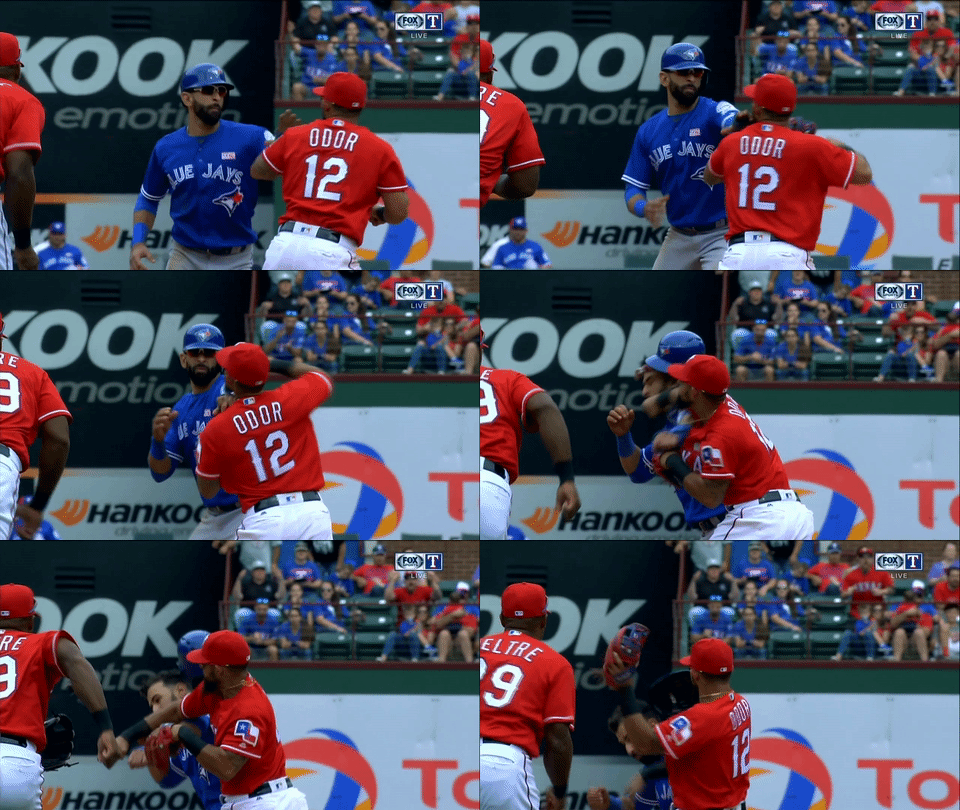
I don’t like the Blue Jays and the last thing I want is to see them win any games during the ALCS but, as a baseball fan, I have to give credit where credit is due.  And, as a Rangers fan, I have to share this GIF of Rougned Odor flattening Jose Bautista.

A 13-4 victory over the Mariners cannot be ignored and the Blue Jays got it at the exact time they needed it.  They’re still down in the series, 2-1.  But they’ve proven that they’re not out of this.

I’m depending on you, Mariners.  Don’t let me down!

Horror on TV: Hammer House of Horror #13: The Mark of Satan (dir by Don Leaver)


Tonight, we have the final episode of Hammer House of Horror and it is a macabre one indeed!  A morgue attendant (Peter McEnery) becomes obsessed with both the number nine and a recently deceased neurosurgeon who died after trying to drill a hole in his own head in an attempt to let out all of his evil thoughts.  McEnery finds himself becoming consumed by disturbing thoughts as well.  Is he going mad or is he somehow seeing what no one else can see?  This episode is effectively creepy and not for the squeamish.

It originally aired on December 6th, 1980.


The TSL Horror Grindhouse: The Dunwich Horror (dir by Daniel Haller)


Look at me/I’m Sandra Dee….

First released in the groovy and psychedelic year of 1970, The Dunwich Horror stars Sandra Dee as Nancy, an somewhat innocent grad student at Massachusetts’s Miskatonic University.  When the mysterious Wilbur Wheatley (Dean Stockwell) comes to the university and asks to take a look at a very rare book called The Necronomicon, Nancy agrees.  She does so even though there’s only one edition of The Necronomicon in existence and it’s supposed to be protected at all costs.  Maybe it’s Wilbur’s hypnotic eyes that convince Nancy to allow him to see and manhandle the book.  Prof. Henry Armitage (Ed Begley) is not happy to see Wilbur reading the book and he warns Nancy that the Wheatleys are no good.

Nancy still agrees to give Wilbur a ride back to his hometown of Dunwich.  She finds herself enchanted by the mysterious Wilbur and she’s intrigued as to why so many people in the town seem to hate Wilbur and his father (Sam Jaffe).  Soon, she is staying at Wilbur’s mansion and has apparently forgotten about actually returning to Miskatonic.  She has fallen under Wilbur’s spell and it soon becomes clear that Wilbur has sinister plans of his own.  It’s time to start chanting about the Old Ones and the eldritch powers while naked cultists run along the beach and Nancy writhes on an altar.  We are in Lovecraft county!

Actually, it’s tempting to wonder just how exactly H.P. Lovecraft would have felt about this adaptation of his short story.  On the one hand, it captures the chilly New England atmosphere of Lovecraft’s work and it features references to such Lovecraft mainstays as Miskatonic University, the Necronomicon, and the Old Ones.  As was often the case with Lovecraft’s stories, the main characters are students and academics.  At the same time, this is very much a film of the late 60s/early 70s.  That means that there are random naked hippies, odd camera angles, and frequent use of the zoom lens.  The film makes frequent use of solarization and other psychedelic effects that were all the rage in 1970.  Lovecraft may have been an unconventional thinker but I’m still not sure he would have appreciated seeing his fearsome cult transformed into a bunch of body-painting hippies.

Really, the true pleasure of The Dunwich Horror is watching a very earnest Sandra Dee act opposite a very stoned Dean Stockwell.  Stockwell was a charter member of the Hollywood counterculture, a friend of Dennis Hopper’s who had gone from being a top Hollywood child actor to playing hippie gurus in numerous AIP films.  As for Sandra Dee, one gets the feeling that this film was an attempt to change her square image.  When Wilbur tells Nancy that her nightmares sound like they’re sexual in origin and then explores her feelings about sex, Nancy replies, “I like sex,” and it’s obviously meant to be a moment that will make the audience say, “Hey, she’s one of us!”  But Sandra Dee delivers the line so hesitantly that it actually has the opposite effect.  Stockwell rather smoothely slips into the role of the eccentric Wilbur.  Wilbur is meant to be an outsider and one gets the feeling that’s how Stockwell viewed himself in 1970.  Sandra Dee, meanwhile, seems to be trying really hard to convince the viewer that she’s not the same actress who played Gidget and starred in A Summer Place, even though she clearly is.  It creates an oddly fascinating chemistry between the two of them.  Evil Wilbur actually comes across as being more honest than virtuous Nancy.

Executive produced by Roger Corman, The Dunwich Horror is an undeniably campy film but, if you’re a fan of the early 70s grindhouse and drive-in scene, it’s just silly enough to be entertaining.  Even when the film itself descends into nonsense, Stockwell’s bizarre charisma keeps things watchable and there are a few memorable supporting performances.  (Talia Shire has a small but memorable roll as a nurse.)  It’s a film that stays true to the spirit of Lovecraft, despite all of the hippies.

October Hacks: The Unnamable (dir by Jean-Paul Ouellette)


1988’s The Unnamable takes place in the type of small, superstitious town that H.P. Lovecraft made famous in his stories.  (The Unnamable is loosely based on Lovecraft’s work.)

The students at Miskatonic University are fascinated by the stories that surround the old Winthrop place, a mansion where, 100 years ago, Joshua Winthrop’s wife supposedly gave birth to a hideous monster that proceeded to kill Joshua and all of his servants.  It is said that the mansion is still haunted, perhaps by the ghost of Joshua or maybe by the monster itself!  The students regularly dare each other to stay at the old Winthrop Place.  Joel (Mark Parra) accepts the dare and vanishes, worrying his friends Howard Damon (Charles Klausmeyer) and Randolph Carter (Mark Kinsey Stephenson).  While Howard is a skeptic about the supernatural, Carter is a dedicated student and he’s obsessed with what might be found within the Winthrop house.

Meanwhile, two frat boys (Eben Ham and Blane Wheatley) convince Wendy (Laura Albert) and Tanya (Alexandra Durrell) to come hang out with them for the night in the Winthrop House.  The frat boys claim that it’s an annual initiation that all new students go through.  For the most part, the frat boys just want to get laid.  One of them even drapes a sweater over his shoulders.  Since when has anyone wearing a sweater that way turned out to be a good guy?

Of course, it turns out that Winthrop House is haunted and soon, heads are rolling (literally) and blood is being spilled.  While the frat boys and the girls fight for their lives, Howard and Carter break into the mansion to see if they can find their missing friend Joel.  Of course, Carter is immediately distracted by the mansion’s collection of ancient texts and hidden tunnels.  Howard, on the other hand, just wants to save Wendy’s life and prove that he’s as good as any sweater-draping frat boy.

The Unnamable is fairly low-budget affair, one that mixes the slasher genre with Lovecraft’s chilly horror.  It works surprisingly well.  The house is a wonderfully atmospheric location.  The monster, when it finally makes its appearance, is frightening and very Lovecraftian.  In fact, the monster feels as if could have wandered over from Stuart Gordon’s Castle Freak.  (The Unnamable probably would never have been made if not for the success of Gordon’s Re-Animator.)  The gore is plentiful and, at times, disturbingly convincing.  The main thing that makes The Unnamable work as well as it does is that the cast is surprisingly game and they attack their stereotypical roles with a likable enthusiasm.  Nobody coasts on the fact that the film is just a “horror movie” or just as “slasher flick.”  The characters may not have much depth but the cast still does a good job of bringing them to life (and death).  I especially liked the performance of Mark Kinsey Stephenson as Randolph Carter.  Randolph Carter, of course, is a name that should be familiar to most Lovecraft readers and Stephenson is a delight as he ignore the chaos around him so that he can check out the mansion’s library.  While the film definitely takes some liberties with Lovecraft, Stephenson is still the ideal Carter.

The Unnamable was an enjoyably macabre surprise.

Doctor Who — The Deadly Assassin (1976, directed by David Maloney)


Having had a vison of the President of the Time Lords being assassinated, the Doctor returns to his home planet to prevent it from happening.  Instead, he ends up framed for the crime.  The Doctor insists that he is innocent and then announces that he will be a candidate for the presidency.  Under Time Lord law, a candidate for president cannot be prosecuted for any crimes in the run up to the election.

The Doctor’s investigation leads him into the Matrix, a virtual reality world that is the collection of all the Time Lords’s consciousnesses.  He discovers that the assassination was actually masterminded by The Master (Peter Pratt, replacing the late Roger Delgado).    Having used up all of his previous regenerations, The Master is now a decaying skeletal figure who can barely speaks and wears a black hood.  12 lifetimes of evil appear to have caught up with him.  The Master’s plan is steal the black hole nucleus that was captured by the first Time Lod, Rassilon (sorry, Omega!), and use it to give himself a new set of generations.  Doing so will also destroy Gallifrey.

This was an important serial for many reasons.  It was the first serial to feature The Doctor on his own, with no other companions.  Having a companion usually gave the Doctor a chance to explain things that might seem strange or alien to the audience at home.  For The Deadly Assassin, we learn that Gallifrey has a BBC-like television service that provides coverage of political events and helpfully explains what is happening even though the audience of Time Lords would presumably already know.  The Doctor also spends a good deal of time talking to himself.  Normally, that could have been awkward but Tom Baker was a great talker and very good at handling solo conversations.  This serial also fully introduced us to Time Lord politics and featured the first appearance of the Doctor’s former teacher, Borusa (Angus MacKay).  Finally, and most importantly, it featured the return of the show’s greatest villain, The Master.  The Master hadn’t been seen since Roger Delgado’s tragic death in 1973.

The Deadly Assassin was one of the more violent of the Doctor Who stories.  The President was assassinated.  Time Lord anchorman Runcible (Hugh Walters) ended up with a dagger in his back.  The Master’s ally, Chancellor Goth (Bernard Horsfall), attempted to drown the Doctor in The Matrix.  After receiving outraged letters from parents, the BBC actually edited out the scene of Goth holding the Doctor’s head underwater from rebroadcasts.  The Deadly Assassin was also one of the scarier serials of the classic era.  The Master was truly a frightening figure with his raspy voice and his burned-out, skeletal appearance.

I’ve always liked The Deadly Assassin.  It features a genuinely interesting story and Tom Baker gives one of his best performances.  (Baker had specifically asked to do one serial without a companion.)  The serial’s cynical view of politics almost made it ahead of its time.  The Deadly Assassin ends with The Doctor being told that he’s won the election and that he is now President of the Time Lords.  He’s also told that it’s far too early for him to even think of resigning.  Of course, the Doctor makes a run for his TARDIS.

Doctor Who — The Hand of Fear (1976, directed by Lennie Mayne)


The TARDIS materializes in a quarry and, for once, it’s an actual Earth quarry and not just an alien plant that looks like a quarry.  An explosion both knocks Sarah Jane Smith out and also exposes a fossilized hand that has been hidden away under the rocks for centuries.   The hand belongs to an executed alien was criminal named Kastrian Eldrad (Stephen Thorne, playing yet another Doctor Who baddie).  When the hand is found, it starts to search for sources of radiation so that it can fully regenerate back into its original form and then seek revenge on its home planet.

The Hand of Fear would have been a standard Doctor Who adventure, except that it ended with Sarah Jane (Elisabeth Sladen) announcing that she can no longer handle the death, violence, and occasional mind control that goes along with being the Doctor’s companion.  She asks the Doctor (Tom Baker) to return her to South Croydon.  The Doctor reluctantly agrees.  While Sarah is packing her things, The Doctor suddenly gets a telepathic message telling him to come to his home planet of Gallifrey and he realizes that, even if Sarah wasn’t leaving, he would not be able to take her with him.  When The Doctor tells Sarah this, it upsets Sarah.  Even though she impulsively decided to go home, it’s obvious that it’s not really what she wants.  When The Doctor drops her off on Earth, she tells him not to forget her and we know that he never will.  As the Doctor dematerializes, Sarah looks around and sees that she’s on Earth and probably in England  but nowhere close to South Croydon.Plenty of companions had come and gone before this episode but none of them had quite the impact of Sarah Janes Smith.  Sarah was one of the few companions to actually be viewed as being an equal of the Doctor.  Even though she spent a lot of time doing typical companion things like being menaced by aliens and asking the Doctor to explain things, Sarah Jane still always projected a determination and inner strength that made her more than worthy to be traveling through time and space.  Even dressing like Andy Pandy during her final appearance couldn’t diminish Sarah Janes Smith as a character.

Elisabeth Sladen had the perfect rapport with both Jon Pertwee and Tom Baker.  Sladen and Baker were apparently close enough that they improvised their final goodbye and the emotions in that scene feel very real.  For viewers like me, who were introduced to Doctor Who by PBS airing the Fourth Doctor’s adventures, Sarah Jane was the first companion that we met and her suddenly leaving came as a shock.  She just seemed as if she was meant to be a part of the TARDIS crew forever.

Sarah Jane Smith would return, of course.  There was K-9 and Company in 1981.  There were the Sarah Jane Adventures, which ran from 2007 to 2011.  Sadly, the wonderful Elisabeth Sladen passed away in 2011.  For many of us, it felt like losing a valued a childhood friend.

Call Girl Of Cthulhu (2014, directed by Chris LaMartina)


I guess it was inevitable that a movie would be made with that title.

Carter Wilcox (David Phillip Carollo) is a virgin artist who draws pictures of ancient symbols for the one-eyed Professor Edna Curwen (Helenmary Ball) and who meets and falls in love with a call girl/stripper named Riley (Melissa LaMartina).  Because Riley has got an octopus-shaped birthmark on her ass, she gets kidnapped by a cult who tries to turn her into the bride of Cthulhu.

You pretty much know what you’re going to get when it comes to this movie and it pretty much delivers.  There’s plenty of nudity, blood, juvenile humor, and references to the work of H.P. Lovecraft.  The pacing is abysmal and the acting is terrible but surprisingly, the gore was disgustingly realistic and the special effects were not awful.  The tentacled monster was probably about as convincing as it could be in a film like this.  You can tell where the most of the money in the budget went.

The actors playing Carter and Riley are forgettable and chemistry-free.  The one good performance came from Dave Gamble as the smug cult leader.  Never allow yourself to get too smug when dealing with the Great Old Ones.