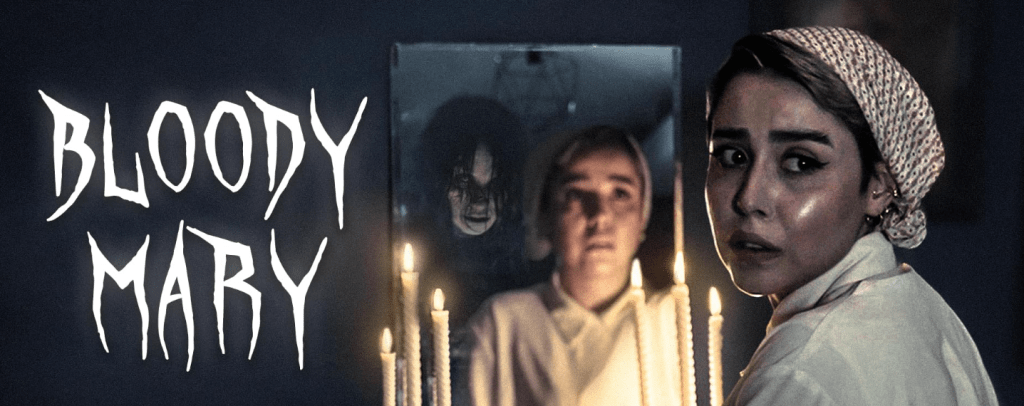
Happy Horrorthon! I’m writing this in July because I enjoy it, not this particular short- this short is garbage trash. It got 1.2 Million views and I’m certain at least 3 of those views were On Purpose! Mustafa Nohekhan should be featured on the Real Men of Genius ad campaign. Here’s to you Mr. Super Low-Budget Horror Film Maker [sung]. It’s hard to make a movie when all you have is your iPhone, Party City makeup, and some leftover jello for blood from your Sunday picnic, but you showed them- YOU SHOWED THEM ALL! Here’s to you – God of the bloody goop and unpaid crew. Mr. Super Low-Budget Horror Film Maker because when your critics said that this film couldn’t and shouldn’t be done. You responded, “I can do it!” They responded, “But why?”
This short does have a beginning, middle, and an end. The protagonist, an actress, says bloody mary in a mirror and is killed by “Mary” between takes. The acting is worthy of the finest 7th grade home movies. It has a we’ve got an iPhone let’s make a movie vibe. If you don’t want to take my word for it and wish to watch this piece of cinema- Here is the link:
I have Jeff to thank for introducing me to the British ska band Madness. The first Madness song that he played for me was Our House, which was the band’s biggest hit in America. I liked the song, so much that I found myself humming it incessantly after first listening to it. Perhaps to get to me hum something else, Jeff then sent me a playlist including Night Boat To Cairo, The Prince, One Step Beyond, It Must Have Been Love, Michael Caine, Driving In My Car, Grey Day, and a host of other songs. It was not only my introduction to Madness but also my introduction to two-tone ska in general. I was quickly hooked.
Here in America, Madness is often incorrectly described as being a one hit wonder. While it is true that Our House was Madness’s biggest hit in America, it’s also true that, ever since the late 70s, Madness had been hugely successful in their native UK, spending 214 weeks on the UK Singles Charts and essentially becoming a bit of a cultural institution. They’ve had 16 singles reach the UK top ten and, somewhat charmingly, the band that formed in 1976 is still largely together.
Ever since the Beatles made A Hard Day’s Night, it’s been almost a rule that almost any successful British band should make a movie. 1981’s Take It Or Leave It is the Madness movie. Admittedly, it’s not a film with a great reputation. The members of the band have themselves described the film as being a bit amateurish and, as I watched the film, I couldn’t help but notice that lead singer Suggs always seemed to be struggling not to look straight at the camera when delivering his lines. Watching the film, it was obvious that the members of Madness were better musicians than actors. It’s interesting to consider that one of the things that makes Madness such an amazing band is that every member comes across as being a star. Watching them perform in their music videos, you get the feeling that you’re watching a group of seven extroverts having the time of their lives. And yet, even though the film’s director also directed the majority of the band’s videos, the members of the band still seemed to be unsure how to play themselves in Take It Or Leave It. It wasn’t just Suggs looking at the camera. It was also the other members of the band, often looking down at the floor when they had to deliver their lines or speaking so softly that it was a struggle to actually hear what they were saying.
The film attempts to tell the story of Madness, from the early days of Chris Foreman, Lee Thompson, and Mike Barson playing in a living room to the full band heading out on their international tour. Along the way, there’s arguments about the band’s musical direction, frequent personnel changes, and Suggs becoming the lead singer, leaving, and then becoming the singer again. The drama is all very lowkey. It’s perhaps a bit too lowkey. A scene where one of the members of the band attacks a drummer seems to come out of nowhere because the members of the band all just come across as being too mellow and friendly to really attack anyone.
Here’s the thing, though. None of that mattered. The members of the band were all so likable that it really didn’t matter that they weren’t particularly good actors. The scenes of the band performing were full of so much energy and joy that it more than made up for the parts of the film that dragged. Watching the band perform One Step Beyond in a pub, it’s impossible not to get pulled into the excitement. Even the use of slow motion during a performance of Night Boat To Cairo works because it allows us to watch a group of young men who are obviously having the best night of their lives. It’s moments like those that make life worth it. It’s moments like those that make you love a band like Madness.
In the end, Take It Or Leave It is a film that will best be appreciated by people who already like the band. It may not work as a drama but, as a celebration of music and performance, it’s the nutsiest sound around.
Odin was one of the many hair metal bands that tried to make it big in the 80s. They were a part of the same L.A. scene that launched everyone from Poison to Guns ‘N’ Roses to Mötley Crüe. Today, they are probably best-remembered for being prominently featured in the 1988 documentary, The Decline of Western Civilization Part II: The Metal Years. While bands like Poison and RATT and musicians like Ozzy Osbourne appeared in the documentary as battle-weary veterans, Odin was meant to represent the up-and-coming band that was on the verge of breaking through. This video came out a few years before Odin was featured in Decline.
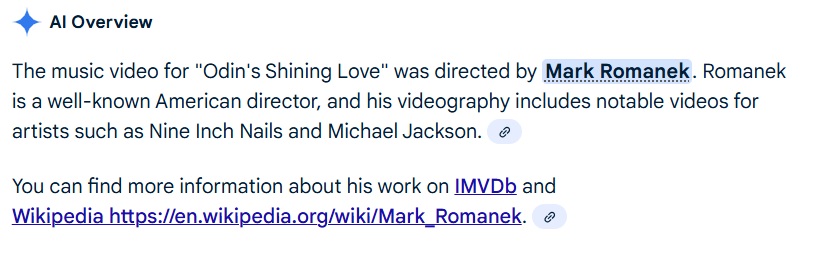
Who directed this video? I’m not sure. I even resorted to asking Google A.I. Google A.I. replied with:
Mark Romanek is a pretty well-known director so if he started out his career directing videos for Odin, that would be a pretty big deal. However, every list of credits that I could find for Romanek online listed neither Odin nor this video. The video was released in 1985. Both Wikipedia and the IMDb list Romanek’s first music video as being 1986’s Sweet Bird of Truth by The The. I could be wrong but I’m 99.9% certain that Mark Romanek did not direct this video.
Odin never did break through and broke up shortly after the release of the documentary. (They may have gotten more screentime then most of the veterans but what most people remembered from that movie was Ozzy making breakfast and Chris Holmes drinking beer.) Maybe one reason they didn’t really break through is because, according to this video, their drummer could blow people up just by looking at them. It’s not a good idea to blow up your own fans.

 Through the Shattered Lens