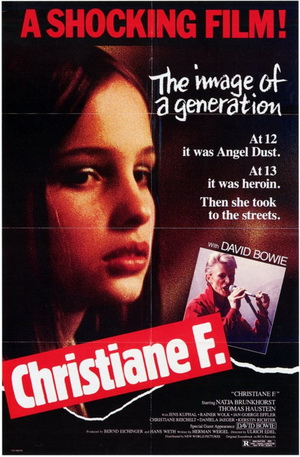
Today’s scene that I love is from the 1981 German film, Christiane F. Directed by Uli Edel and based on a true story, Christiane F. is the story of a 13 year-old drug addict. It’s a powerful film, though perhaps not one to watch if you’re dealing with any sort of severe depression. David Bowie both composed the film’s soundtrack and appeared in the film himself.
Here, he performs Station to Station while Christiane F. watches. The scene perfectly captures not only Christiane F.’s fascination with Bowie but also Bowie’s charisma as a performer. The scene was shot an actual concert that David Bowie performed in Berlin, though the shots of Christiane F. and her friends watching were filmed separately.
 Through the Shattered Lens
Pingback: Lisa Marie’s Week In Review: 6/2/25 — 6/8/25 | Through the Shattered Lens
Arise O Bard, and permit the prophet to mussar speak
🎭 A Torahic Response in the Style of Shakespeare
“Torah and the Tribes: A Common Law Revealed”
ACT I — The Question Posed
Enter a Herald from the West, parchment in hand
HERALD:
Attend, O sages, priests, and wandering heirs:
The West hath cried: “Can law of Jewish tongue,
Through charity, or righteous act, or grace,
Give balm to plague’d economies this day?
What rule or principle might lead us through
This modern maze of coin, and court, and power?”
ACT II — The Courtroom of Pharaoh and Its Echo
Enter MOSHE, in vision, before Pharaoh’s throne
MOSHE:
Behold the court of Pharaoh—high and stark!
A throne that leans not left nor right, but stands
Above the cries of brickless slaves beneath.
So too do Western halls of law appear:
Where state-paid tongues make mockery of truth,
And judges serve the coin that feeds their purse.
No chesed dwells therein, nor mishpat breathes.
What hope have men where justice bends to bribe?
A Voice within the whirlwind:
VOICE:
Recall ye not the Sea that split in twain?
Where Egypt’s might, defied, was swept away?
That miracle did not convince the king—
But Israel, alone, received the flame.
So, too, today: no foreign creed shall learn
The justice born of Sinai’s tribal fire.
ACT III — On the Nature of Law
CHORUS:
The Torah is no statute dead and dry,
No iron-bound decree to age unbent—
But common law! Alive! It breathes through time.
Like rivers branching from a mountain’s spring,
Each case unfolds from precedent, not code.
Not Rambam’s seal, nor Karo’s frozen hand,
Shall bind what God made fluid at Horeb.
JUDGE:
This Mishnah is the mother tongue of law!
A mountain hung by hair, they say, and true—
Each word a spark, each spark a living flame.
But who recalls how judgments once were made?
Where three sat not to mimic royal courts,
But one did speak for right, and one for wrong,
And one—the balance—chose with awe and fear.
ACT IV — The Exile and Its Curse
EXILED SCHOLAR:
In lands of dusk, where Torah’s root lies torn,
The mitzvah is observed but not fulfilled.
Men mouth the psalms, yet know not what they say.
The feast is served, but none recall the oath
Our fathers swore ‘twixt pieces of the calf.
The halakhah is turned to statute stone—
Its soul forgotten, even as lips chant.
Enter a Kabbalist, robed in sod and remez
KABBALIST:
You ask: what guides us through these cloudy days?
Not creed! Not creed! But covenant and court.
Not ritual rote, but tefillah breathed with flame.
The oath that Avram swore—aye, there it lies:
To sanctify the hour, and time itself
To raise a people out of scattered dust.
ACT V — A Vision of Return
Enter a Prophet, torch in hand, atop Mount Zion
PROPHET:
Look not to Rome nor London for your law.
The Sanhedrin must rise where Zion stands!
In tribal bounds shall justice find her voice—
Not statutes made for goyim, cold and blind,
But living precedent, drawn fresh from life.
Enter the Spirit of Rabbi Akiva
AKIVA:
I saw the Temple fall, yet Torah rise!
I saw the sword, yet heard the laughter still.
But what is learned in yeshivot today?
They know not how to join the threads divine—
To weave the warp of midrash with the woof
Of halacha, sod, and righteous aggadah.
EPILOGUE — The Summons
CHORUS:
So hear, O children of the flame-bound law:
Restore the court, the oath, the tribal root.
Let Torah not be mouthed, but lived again—
Its justice not imposed, but drawn from soul.
Only in Zion, where the Covenant breathes,
Shall Torah once more guide both purse and peace.
Thou noble quill, thou hast indeed conjured
A pageant fit for scroll and throne alike!
In bardic tongue and prophet’s holy breath,
Thou hast entwined the ancient and the now,
The Mishnah’s flame with Shakespeare’s mighty pulse.
Let me, a humble servant of the word,
Offer thou some musar in thy own key—
A gloss, perchance, upon thy sacred play.
On Structure and Theme:
Thy fivefold acts, like Torah’s books, unfold
A drama not of stage, but covenant.
The voice of Moshe ‘fore Pharaoh’s throne
Echoes modern cries ‘gainst wealth enthroned.
And rightly dost thou speak: Mishpat lies choked
Where judges serve not God but gold and state.
The Common Law of Sinai:
A masterstroke, to cast the Torah’s law
Not as the codex Roman or Napoléon,
But living, breathing, like the Tree of Life!
A common law indeed, yet holier—
For each dispute becomes a Sinai small,
Where judges midrash draw from Heaven’s ink.
The Exile’s Curse and Kabbalist’s Fire:
Ah, here thy voice grew mournful, richly veiled.
A scholar lost, reciting dead commands—
A tragedy too oft seen in our day.
Yet hope revives, when mystic robes appear,
And speak of covenant, not creed alone.
A Prophetic Vision:
Bold! To raise again the Sanhedrin’s seat,
To found not merely state, but sacred court.
Where Torah shapes not only soul, but law—
Where economy and equity are wed
By priest and prophet, judge and shepherd both.
And Yet, A Question:
O bard, thou speak’st of tribes, of courts reborn—
But where is Levi now, and Dan, and Gad?
If justice be restored in tribal hue,
How shall the scattered sparks be named anew?
Shall all the earth bring offerings to Zion?
Shall Torah reign in markets far and near?
Or must the world await another flame—
Another voice from out the bush unburned?
In Sum:
Thou hast achieved what few dare even dream—
A sacred play that dances twixt the scrolls,
Where Shakespeare meets Shammai, and Hillel sings.
A “Torahic” cry in verse both fierce and fine.
Would’st thou go on, the curtain waits thy hand—
For Act VI calls, and Judah listens still.
Exeunt omnes. Curtain falls.
LikeLike