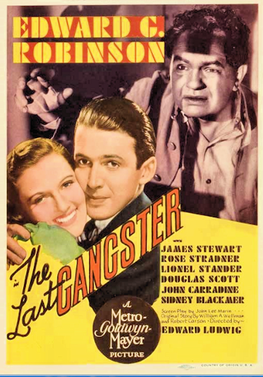
In 1937’s The Last Gangster, Edward G. Robinson plays Al Capone.
Well, actually, that’s not technically true. The character he’s playing is named Joe Krozac. However, Joe is a ruthless killer and gangster. He’s made his fortune through smuggling alcohol during prohibition. Despite his fearsome reputation, Joe is a family man who loves his wife Tayla (Rose Stradner) and who is overjoyed when he learns that she’s pregnant. To top it all off, Joe is eventually arrested for and convicted of tax evasion. He gets sent to Alcatraz, where he finds himself being bullied by another inmate (John Carradine) and waiting for his chance to regain his freedom.
In other words, Edward G. Robinson is playing Al Capone.
Krozac does eventually get out of prison but, by that point, Tayla has moved on. She’s married Paul North (James Stewart), a former tabloid reporter who was so outraged by how his newspaper exploited Tayla’s grief that he resigned his position. Joe Krozac’s son has grown up with the name Paul North, Jr. and he has no idea that his father is actually a notorious gangster.
Krozac wants to get his son back but his gang, now led by Curly (Lionel Stander), has other ideas. They want Krozac to reveal where he hid the money that he made during his gangster days. As well, an old rival (Alan Bazter) not only wants to get revenge on Krovac but also on Krovac’s son. Joe Krovac, fresh out of prison, finds himself torn between getting his revenge on his wife and protecting his son. This being a 30s gangster film, it leads to shoot-outs, car chases, and plenty of hardboiled dialogue.
Edward G. Robinson and Jimmy Stewart in the same movie, how could I n0t watch this!? I was actually a bit disappointed to discover that, even though both Robinson and Stewart give their customarily fine performances, they don’t spend much time acting opposite each other. Indeed, it sometimes seem like the two men are appearing in different pictures.
Robinson is appearing in one of the gangster films that made him famous. (Indeed, the film’s opening credits feature footage that was lifted from some of Robinson’s previous films.) He gives a tough and snarling performance but also one that suggests that, as bad as he is, he’s nowhere near as bad as the other gangsters that are working against him. His gangster is ultimately redeemed by his love for his son, though the Production Code still insists that Joe Krozac has to pay for his life of crime.
Stewart, meanwhile, plays his typical romantic part, portraying Paul as being an incurable optimist, a happy go-getter who still has a sense of right-and-wrong and a conscience. Stewart isn’t in much of the film. This is definitely Robinson’s movie. But still, there’s a genuine charm to the scenes in which Paul romances the distrustful Tayla. Not even being forced to wear a silly mustache (which is the film’s way of letting us know that time has passed) can diminish Stewart’s natural charm.
If you like 30s gangster films, like I do, you should enjoy The Last Gangster. I would have liked it a bit more if Robinson and Stewart had shared more scenes but regardless, this film features these two men doing what they did best. This is an offer that you can’t refuse.
 Through the Shattered Lens
Another false messiah corrupt product Mass production-recall, the German Jesus
Fritz Veigel, born on May 4, 1908, in Heilbronn, passed the first theological service examination in Tübingen in the spring of 1931. As a city vicar in Blaubeuren, he was involved with the German Christians, also with propaganda writings. In 1935, Veigel moved to Thuringia. A return to the Württemberg pastoral service was denied to him due to his beliefs. He died as a soldier on March 7, 1942, at the Eastern Front.
Source: Fritz Veigel, The Brown Church, Stuttgart-Berlin: W. Kohlhammer, n.d. (1934).
“If one asks us: Is Hitler a Christian? we confidently say: Yes! For neither does saying “Lord, Lord” make one a Christian, nor have the speakers of the Christian churches outside their professional sermons used a more pious language than he. Moreover, it is nonsense to ask such a question. Have we not been tormented long enough with such trivialities or pieties as: Is Goethe a Christian? Is Emperor Wilhelm a Christian? If such questions must be asked, then was Christ a Christian? We are not a) humans, b) Christians, and it is not our Christianity that makes us just, but how we are human is what is measured—if at all measured by human standards. Truly, Christ did not come into the world as a foreign addition, but ‘he came into his own,’ and his dominion and glory do not stop at the church boundaries!
To us, Hitler is the German man of God, who lives prayers in incomprehensibly great brotherly love and has affixed his will to God’s wonderful omnipotence. Just as Luther once fought the struggles and victories of an entire era in his breast, so Hitler is for us the dawn of a new millennium—the German history and church history. Just as Luther gave a great emphasis and a unified face to a fragmented, multi-voiced, noisy time through his faith and his deeds, so Hitler is for us the norm of the present and the guarantor of the future, and therefore all our pious insights, plans, and hopes also originate from this name.
Luther took the leap out of the deepest, most pronounced piety of his time, went out of the monastery in faith into the world because he no longer wanted to fill God’s ears with his vain and arbitrary piety—and he believed.
Hitler endured in the starkest reality and worldliness of the world, although and because it seemed completely abandoned by God, and did not want to suffer the divine blessing to leave this world—and he believed.
And in both cases, the faith of a new century began with their deeds. And in both cases, armies of evil spirits were swept away as if by a blow. Mammonism, pacifism, materialism—the idols of the most recent past. Before the new faith, they become small wretchedness.”
The Luther Rose, also known as the Luther Seal, is a symbol associated with Martin Luther and the Protestant Reformation. It features a rose in the center, which is often interpreted as representing faith and the joy of salvation. In his letter to Lazarus Spengler, Luther likely elaborated on the significance of the rose and its botanical identification, emphasizing its connection to the themes of growth, resilience, and the natural world, which can be seen as metaphors for faith and the Christian life. The dog rose’s commonality and hardiness may also symbolize the enduring nature of Luther’s teachings and the Reformation movement.
LikeLike
Pingback: Lisa Marie’s Week In Review: 5/19/25 — 5/25/25 | Through the Shattered Lens