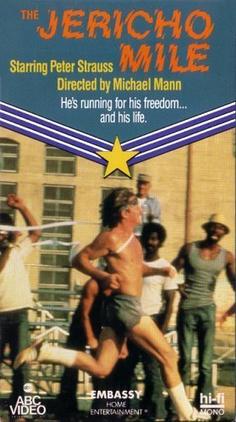
Made For TV Movie Review: The Jericho Mile (dir by Michael Mann)


1979’s The Jericho Mile tells the story of Larry Murphy (Peter Strauss).

Larry is serving a life sentence at Folsom Prison, convicted a crime that he admits to having committed.  Larry murdered his father, specifically to protect his stepsister from being raped.  Larry feels no guilt for his crime and, at the same time, he’s willing to quietly serve his sentence.  He’s a loner, avoiding the rival racial factions in the prison.  (Brian Dennehy leads the Aryans while Roger E. Moseley leads the black prisoners and Miguel Pinero is the head of the Mexican Mafia.)  Larry just wants to spend his time running around the prison yard.

When Dr. Bill Janowski (Geoffrey Lewis) sees how fast Larry can run, he arranges for a local track coach, Jerry Beloit (Ed Lauter), to come up to the prison with a few potential Olympians so that they can race Larry.  Larry manages to outrun all of them.  Jerry becomes convinced that Larry could qualify for the Olympics, if only he had a regulation track to run on.  The Warden, knowing good publicity when he sees it, assigns the inmates to build the track but doing so means dealing with Folsom’s highly charged racial politics.  No matter how fast Larry can run and no matter how inspiring it would be for Larry to go from serving a life sentence to competing in the Olympics, Folsom is still a prison and Larry is still a prisoner.  And while the guards may have the guns and may be the only ones who are allowed to go home at the end of the game, it’s the prison gangs who have all the power.  When the Aryans go on strike and refuse to work on the track, it puts Larry’s chances in jeopardy.

Of course, Larry’s chances are already in jeopardy just because of who he is.  Larry is a prisoner who refuses to show remorse.  While other prisoners embrace religion or politics and try to convince outsiders that they’ve either reformed or been wrongly convicted, Larry just wants to run.  Running is when he’s free.  (The film’s title refers to the Walls of Jericho coming down.)  And, for the other inmates, watching Larry run is a reminder that there are many ways once can escape from the drudgery of being locked away.

The Jericho Mile is a tough and rather cynical prison film, one that manages to combine downbeat social drama with a uplifting sports story.  You’ll want to cheer Larry while he’s running, even if you secretly suspect that he’s ultimately chasing something that will never happen.  Making his directorial debut, Michael Mann shot the film on location at Folsom and the cast is full of actual prisoners, all of whom bring some much need authenticity to the film’s story.  Mann never lets us forget that this is a film about people in a very dangerous situation and, even at its most inspiring, the film leaves you feeling as if violence could break out at any moment.  Peter Strauss, who usually played somewhat more refined characters, is totally believable as the taciturn Larry and character actors like Dennehy and Mosely skillfully blend in with the actual prisoners in the cast.  The Jericho Mile is a portrait of crime, punishment, and dreams.  It’s a movie that will stay with you.


Icarus File No. 22: Revolution (dir by Hugh Hudson)


1985’s Revolution opens on July 4th, 1776.  The Declaration of Independence has just been published.  The streets are full of people celebrating.  A statue of King George is pulled down.  In her carriage, the wealthy Mrs. McConnahay (Joan Plowright) turns up her nose to the enthusiastic rebels, including the fanatical Liberty Woman (Annie Lennox).  Mrs. McConnahay’s daughter, Daisy (Nastassja Kinski) is intrigued by this idea of freedom and equality.

Fur trader Tom Dobbs sails his boat into Hudson Harbor.  Tom is Scottish, illiterate, and very much a man of the 18th Century.  However, he’s played by Al Pacino, who was none of those things.  After Revolution was released to desultory reviews, Pacino took four years off from the movies and watching this film, one can see why.  Pacino is miscast as Dobbs and, as a result, he gives the type of truly bad performance that can only be given by a great actor.  Unable to disguise the fact that he had the accent of a modern-day New Yorker, Pacino resorts to mumbling the majority of his lines.  Tasked with playing a character who has no idea how to deal with the history-making events in which he finds himself, Pacino alternates between a blank look and with bulging his eyes like a madman, proving that it’s far more difficult to play an uneducated character than an educated one.  Why cast Pacino, who can be one of our most exciting actors, as a character who can barely speak and who has neither the intensity of Michael Corleone or the subversive wit of Tony Montana?  Due to Pacino and Kinski having zero chemistry, the scenes where Tom falls in love with Daisy are almost painful to watch.

The film follows Tom as he and his son, Ned (Simon Owen when the film begins, Dexter Fletcher by the time the action moves to Valley Forge), as they find themselves conscripted into the Revolutionary Army.  Eventually, Ned is abducted into the British army and serves as a drummer boy under the sadistic watch of Sgt. Major Peasy (Donald Sutherland).  The idea behind the film isn’t a bad one.  It attempts to portray the American Revolution through the eyes of the average citizen.  Instead of focusing on the Founding Fathers, Revolution tries to tell the story of the everyday people who found themselves in the middle of the war.  Tom loses his boat and (temporarily) he loses his son.  Fortunately, this is one of those films where people are constantly running into each other by chance, regardless of whether it makes any sense or not.  Daisy goes from seeing Tom in New York to randomly coming across him in a field to eventually finding him in Valley Forge.  It’s not because she’s specifically looking for him.  Instead, he just happens to be there.

Why does Revolution fail?  A lot of it comes down to Pacino’s performance, though Pacino certainly isn’t the only talented actor to give a not-quite good performance in Revolution.  (Donald Sutherland has never been more wasted in a film.)  The script is full of dialogue like, “My mouth belongs where I place it.”  (Pacino gets stuck with that one.)  Hugh Hudson directs in a leaden manner.  Towards the end of the film, there is one brilliant sequence where Tom wanders through the streets of New York and, for a few minutes, the film comes to like with a spontaneity that was previously lacking.  Unfortunately, it’s just one sequence in a very long movie,

To be honest, we could use some good films about the American Revolution and I’m not talking about elitist nonsense like Hamilton.  No taxation without representation.  It’s still a good message for us all.

Previous Icarus Files:

  1. Cloud Atlas
  2. Maximum Overdrive
  3. Glass
  4. Captive State
  5. Mother!
  6. The Man Who Killed Don Quixote
  7. Last Days
  8. Plan 9 From Outer Space
  9. The Last Movie
  10. 88
  11. The Bonfire of the Vanities
  12. Birdemic
  13. Birdemic 2: The Resurrection 
  14. Last Exit To Brooklyn
  15. Glen or Glenda
  16. The Assassination of Trotsky
  17. Che!
  18. Brewster McCloud
  19. American Traitor: The Trial of Axis Sally
  20. Tough Guys Don’t Dance
  21. Reach Me

Music Video of the Day: Love & Money by Luvcat (2025, dir by Ollie Bradley-Baker and Luvcat)


It’s Tax Day!  Bleh.  Normally, I’d say don’t pay them because it only encourages them to ask for more but I don’t want to get anyone in trouble.  Here’s a song about the moon, love, movies, and money!

Enjoy!