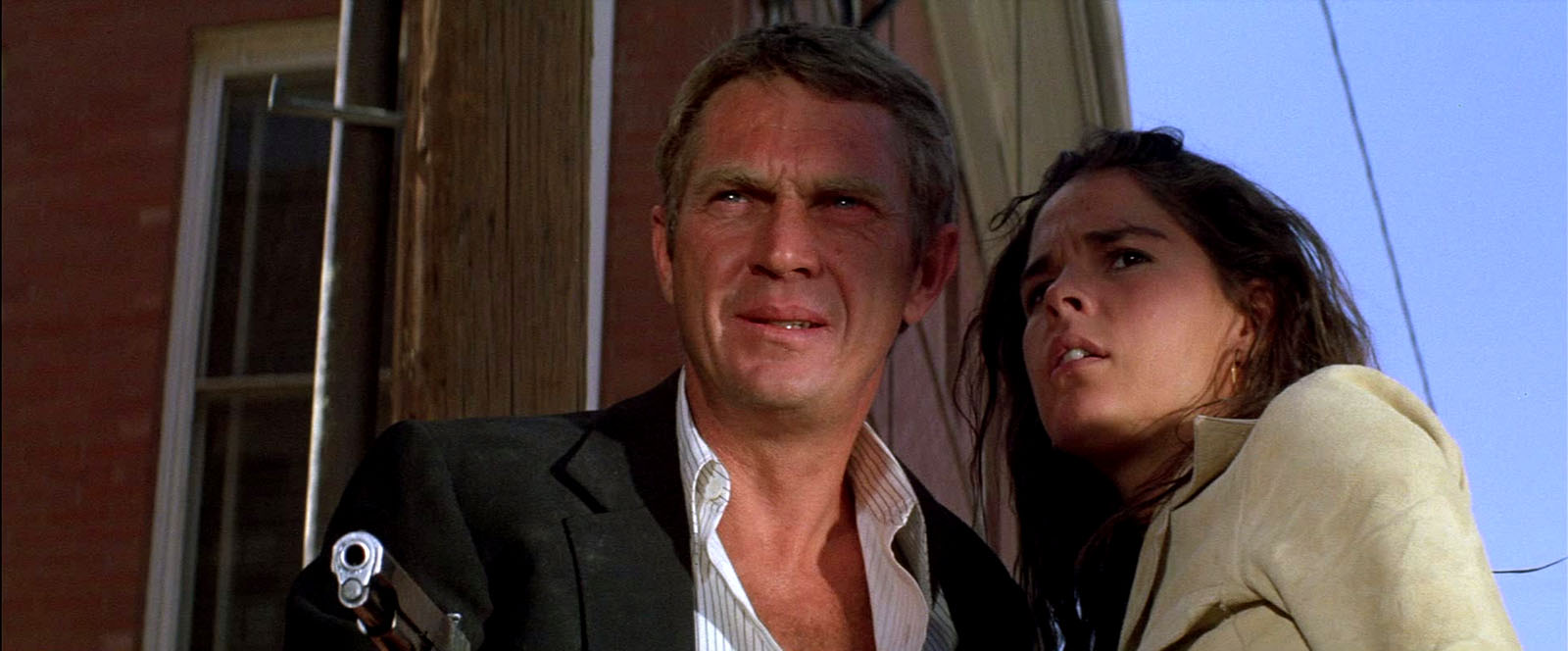
Doc McCoy (Steve McQueen) is doing a ten-year sentence in a Texas state prison when he’s offered a chance at parole. The only condition that Jack Benyon (Ben Johnson) gives Doc is that, once out of prison, Doc is going to have to plan and carry out a bank robbery with two other criminals, Frank (Bo Hopkins) and Rudy (Al Lettieri). Desperate for his freedom and to be reunited with his wife, Carol (Ali MacGraw), Doc agrees. On the outside, Doc carries out the robbery but it turns out that no one can be trusted. With everyone double-crossing everyone else, Doc and Carol head for the border, pursued by the police, Rudy, and Benyon’s brother, Cully (Roy Jenson).
Based on a novel by Jim Thompson, The Getaway is a fast-paced and violent heist film. It was on this film that Ali MacGraw and Steve McQueen first met and famously fell for each other. Married to producer Robert Evans, Ali MacGraw left him for McQueen. Their very real chemistry gives the film its forward momentum and it is so palpable that it doesn’t matter that the stunningly beautiful Ali MacGraw couldn’t really act. Steve McQueen, on the other hand, is at his coolest in The Getaway. McQueen was an actor who didn’t need much dialogue to say a lot and The Getaway features him at his tough and ruthless best. Doc is not one of the good guys. He’s a bad guy but not as bad as Rudy, Frank, Jack, and Cully.
As was typical of Peckinpah, The Getaway is full of small moments and details that make the movie’s world come to life. While Doc and Carol flee across Texas, Rudy has a twisted loves story of his own with Fran (Sally Struthers, in a role that will surprise anyone who only knows her as Gloria Stivic). Jack Dodson plays Fran’s kindly husband and gives a performance that reminds us of the human cost of crime. Slim Pickens has a wonderful cameo as an old cowboy whose truck is hijakced by Jack and Carol. Those who thought of Peckinpah as just being a director of violent thrillers often overlooked the moments of humanity that regularly emerged amongst all the bloodshed.
The Getaway was not given the critical acclaim it deserved when it was released but today, it’s regularly recognized as a career best for both Sam Peckinpah and Steve McQueen.
Today is Kesley Grammer’s 70th birthday. In order to celebrate this event, here is an amazing 8-second scene from one of my favorite films, 2020’s Money Plane!
Charles Bronson starred in four movies and one TV show in 1958. Two of those movies were produced by Harold Knox, written by Louis Vittes, and directed by Gene Fowler, Jr. The first of the two films was SHOWDOWN AT BOOT HILL, an excellent low budget western that featured Bronson as a bounty hunter with a chip on his shoulder and love in his heart. The second film was GANG WAR.
In GANG WAR, Charles Bronson plays Alan Avery, a high school teacher in Los Angeles who’s walking home one night and happens to witness a gangland killing. He calls the police to report the murder, but he doesn’t want to get any further involved so he doesn’t give them his name. Avery was on his way home from a trip to the pharmacy where he had picked up a prescription for his pregnant wife (Gloria Henry) who is suffering from migraines. In the stress of the moment, he left the pharmacy sack in the phone booth and the police are able to track him down to his home. After being pressed by the police, Avery reluctantly agrees to testify. He’s a great witness as he’s able to give the police a description of the car and its license plate number. His information leads to the arrest of Joe Reno, the second in command to mobster Maxie Meadows (John Doucette). Maxie sends his attorney Bryce Barker (Kent Taylor) over to the police station to see Captain Finch. Finch happens to be on Maxie’s payroll, and he immediately tells Barker about the witness. He even leaks it to the press so they can run a story revealing Avery’s name and address. Maxie would prefer to buy Avery’s silence, but he also wants a little insurance, so he sends his punch drunk henchman Chester over to slap around Avery’s wife. This order is akin to asking Lennie Small from OF MICE AND MEN to go play with some puppies. Simple-minded Chester proceeds to kill Mrs. Avery. When Avery comes home and finds his wife dead, he heads directly to Maxie’s house to kill him. The cab driver who took Avery to Maxie’s place just happened to see his gun, so he called the cops. Just before Avery can squeeze off a kill shot, the police show up and arrest him. Pissed that Avery was able to get so close to killing him, Meadows puts an actual hit out on him this time. Will the high school teacher be able to survive his battle against the mob?!!
(Note: The analysis below ventures into spoiler territory for both GANG WAR and SHOWDOWN AT BOOT HILL. You may want to watch these films prior to reading the rest of the review.)
As a lifelong fan of Charles Bronson, I really appreciate his work with director Gene Fowler, Jr. in 1958. Fowler recognized Bronson’s charismatic screen presence, but he also recognized something deeper in the legendary icon… his heart. SHOWDOWN AT BOOT HILL seemed to be giving us Bronson as a typical western hero, only to reverse course and turn Bronson into a romantic lead who would choose to throw down his guns so he could establish roots in a community and spend his life with the woman he loves. In a similar way, GANG WAR seems to be setting Bronson up to be a vigilante, not much different than the type of character he would be portraying throughout the 70’s and 80’s. But when 70’s and 80’s Bronson would be pulling his trigger, Fowler presents a more thoughtful Bronson who recognizes that the best revenge can sometimes be in letting someone live with the consequences of their own decisions. This allows him to lower his gun, walk away and continue his life free of the guilt and the legal consequences that would undoubtedly come with taking another person’s life. This decision honors his wife’s legacy much more than murder and a lifetime in jail ever would.
There are many good performances in this little gem. Bronson may not have been a “star” when this film was made, but there is no doubt that he was ready. He simply commands every frame that he appears in from the beginning to the end. John Doucette and Kent Taylor are also memorable as the gangster and his paid off lawyer, respectively. Doucette’s Maxie Meadows is certainly a stereotype of the gangsters in TV’s and movies at the time, but he plays the part well, saving his very best for his last moments of the film. Kent Taylor has the movie’s best story arc. When we meet him, he’s an alcoholic who can’t stand what he’s allowed himself to become, yet he continues to run every time Maxie calls. It’s a strong moment when he decides he won’t do it anymore. And Jennifer Holden is simply gorgeous as Marie, Maxie’s woman. Speaking of nice scenery, it was also fun seeing a Los Angeles that included landmarks like the Capitol Records Building and the old Nickodell Restaurant. So much of the action in GANG WAR takes place against these iconic backdrops, and for a guy who’s never been to LA, seeing these places again almost makes me feel like a resident.
Overall, while GANG WAR does feel like an old fashioned 50’s movie, it has plenty of things to recommend it, not the least of which is an excellent performance from a young Charles Bronson. At a 75 minute run time, it’s definitely worth a viewing.
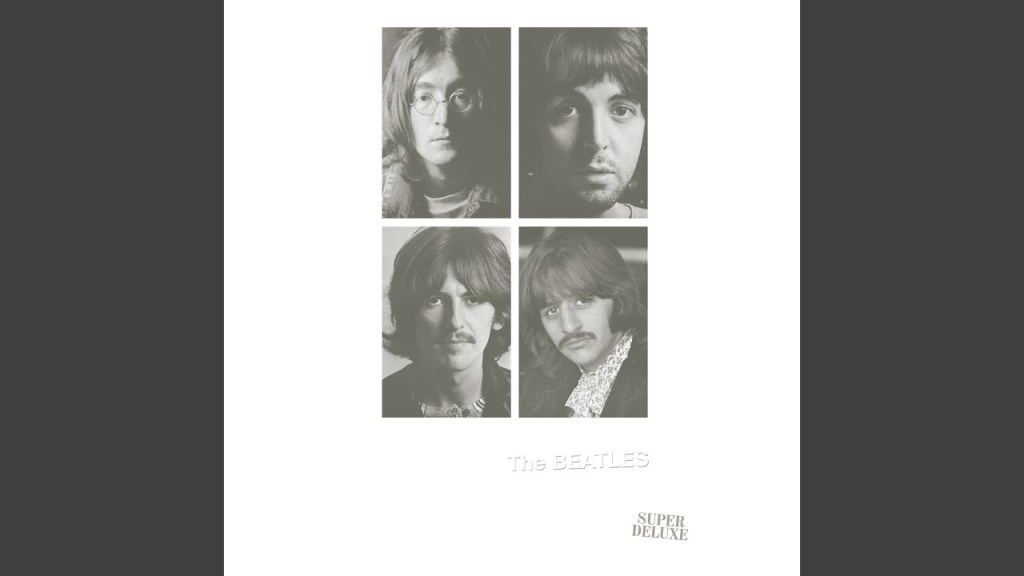
Continuing our series of greatest guitar solo series, I present “While My Guitar Gently Weeps” by The Beatles.
The song was written by George Harrison and was composed at a time after the band had just returned from a trip and stay in India to study Transcendental Meditation. Harrison, inspired by his stay in India, re-discovered his passion for the guitar and began to write songs with it as his main instrument. Thus begins an era of The Beatles and George Harrison as a maturing songwriter than made a huge contribution to the band becoming more than just the global rock phenomena pre-1968 and one where the group began to release songs and albums that reflected their new world views.
Yet, as great as the song has become since its release on November 22, 1968, it’s also well-remembered as the song that began a series of collaborations between George Harrison and Eric Clapton (a close friend) who plays lead guitar on the song. It is Clapton’s lead guitar work on “While My Guitar Gently Weeps” that has mesmerized listeners throughout the decades.
Clapton plays two guitar solos, the first occurring during first bridge section of the song, and the second the song’s outro. Both solos accentuates and focuses on the song’s lyrical tradition styling where the musical instrument provides the emotions that propel the song.
The outro guitar solo has also reached a new level of immortality in 2004 when Harrison was posthumously inducted into the Rock and Roll Hall of Fame. The collaboration of artists that included Tom Petty, Jeff Lynne, Steve Winwood, Marc Mann, Dhani Harrison, Prince, Steve Ferrone, Scott Thurston, Jeff Young, and Jim Capaldi. It was Prince’s extended performance of the outro solo that’s become legendary.
While My Guitar Gently Weeps
I look at you all, see the love there that’s sleeping
While my guitar gently weeps I look at the floor and I see it needs sweeping Still my guitar gently weeps
I don’t know why nobody told you how to unfold your love I don’t know how someone controlled you They bought and sold you
I look at the world and I notice it’s turning While my guitar gently weeps With every mistake we must surely be learning Still my guitar gently weeps
[guitar solo]
I don’t know how you were diverted You were perverted too I don’t know how you were inverted No-one alerted you
I look at you all, see the love there that’s sleeping While my guitar gently weeps Look at you all…… Still my guitar gently weeps
I look at you all, see the love there that’s sleeping While my guitar gently weeps I look at the floor and I see it needs sweeping Still my guitar gently weeps
I don’t know why nobody told you how to unfold your love I don’t know how someone controlled you They bought and sold you
I look at the world and I notice it’s turning While my guitar gently weeps With every mistake we must surely be learning Still my guitar gently weeps
I don’t know how you were diverted You were perverted too I don’t know how you were inverted No-one alerted you
I look at you all, see the love there that’s sleeping While my guitar gently weeps Look at you all…… Still my guitar gently weeps
4 Or More Shots From 4 Or More Films is just what it says it is, 4 shots from 4 of our favorite films. As opposed to the reviews and recaps that we usually post, 4 Shots From 4 Films lets the visuals do the talking!
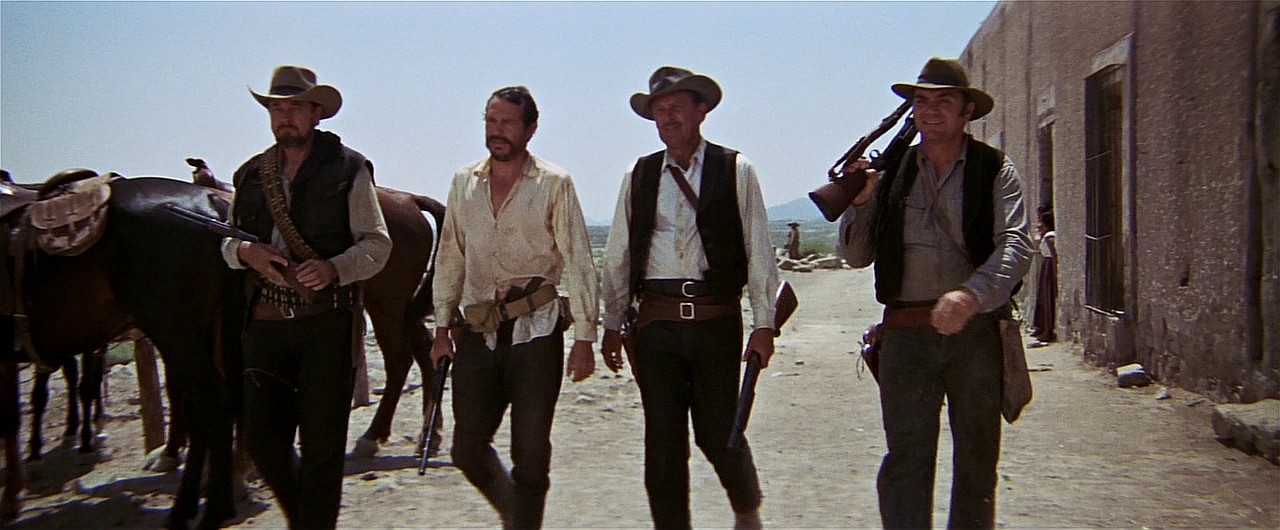
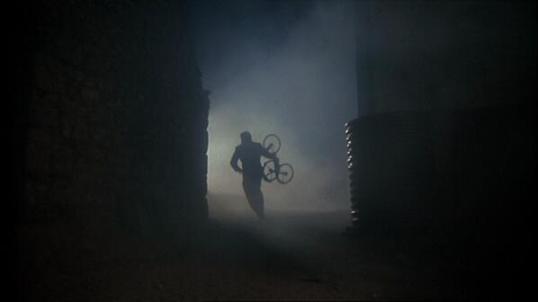
Today would have been Sam Peckinpah’s 100th birthday. Here are 4 shots from 4 of my favorite Peckinpah films.
4 Shots From 4 Sam Peckinpah Films
The Wild Bunch (1969, directed by Sam Peckinpah, Cinematography by Lucien Ballard)
Straw Dogs (1971, directed by Sam Peckinpah, Cinematography by John Coquillon)
The Getaway (1972, directed by Sam Peckinpah, Cinematography by Lucien Ballard)
Bring Me The Head of Alfredo Garcia (1974, directed by Sam Peckinpah, Cinematography by Alex Phillips, Jr.)
As some of our regular readers undoubtedly know, I am involved in a few weekly live tweets on Twitter and Mastodon. I host #FridayNightFlix every Friday, I co-host #ScarySocial on Saturday, and I am one of the five hosts of #MondayActionMovie! Every week, we get together. We watch a movie. We tweet our way through it.
Tonight, at 10 pm et, #FridayNightFlix presents John Carpenter’s Big Trouble In Little China!
If you want to join us this Friday, just hop onto twitter, start the movie at 10 pm et, and use the #FridayNightFlix hashtag! It’s a friendly group and welcoming of newcomers so don’t be shy.
Big Trouble In Little China is available on Prime! See you there!
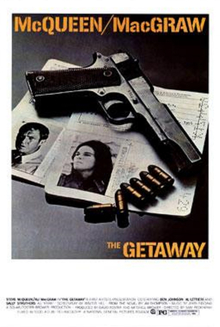 Doc McCoy (Steve McQueen) is doing a ten-year sentence in a Texas state prison when he’s offered a chance at parole. The only condition that Jack Benyon (Ben Johnson) gives Doc is that, once out of prison, Doc is going to have to plan and carry out a bank robbery with two other criminals, Frank (Bo Hopkins) and Rudy (Al Lettieri). Desperate for his freedom and to be reunited with his wife, Carol (Ali MacGraw), Doc agrees. On the outside, Doc carries out the robbery but it turns out that no one can be trusted. With everyone double-crossing everyone else, Doc and Carol head for the border, pursued by the police, Rudy, and Benyon’s brother, Cully (Roy Jenson).

 Through the Shattered Lens