Late Night Retro Television Review: Degrassi Junior High 3.16 “Bye-Bye Junior High”


Welcome to Late Night Retro Television Reviews, a feature where we review some of our favorite and least favorite shows of the past!  On Sunday, I will be reviewing the Canadian series, Degrassi Junior High, which aired on CBC and PBS from 1987 to 1989!  The series can be streamed on YouTube!
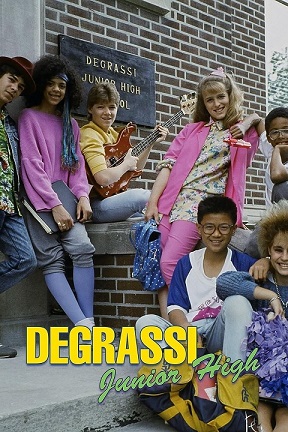
This week, Degrassi Junior High comes to an end!

Episode 3.16 “Bye-Bye, Junior High”

(Dir by Kit Hood, originally aired on February 27th, 1989)

The school year is ending and things are looking fairly positive for the majority of the students at Degrassi Junior High.

The ninth graders are looking forward to finally getting to enroll at the local high school next year.  The eighth graders are looking forward to finally being at the top of DJHS’s social hierarchy.  The teachers are happy because they’ve given their final exams and almost every student has done well.

Even Wheels!  Even though he skipped most of the year and spent a lot of time in detention due to his behavioral issues, Wheels manages to get passing grades.  Of course, his grades still aren’t that impressive.  Wheels just scrapes by.  However, his homeroom teacher says that everyone knows that Wheels has had a difficult year and the important thing is that Wheels showed improvement when he finally did come back to school.  In other words, Wheels will be moving on to the 10th Grade.

Spike, who has not been allowed to attend school in person, struggles on her final exams.  But Ms. Avery (Michelle Goodeve) talks Spike into taking some correspondence courses over the summer so that Spike can move on to the 10th Grade and take part in Canada’s version of the gifted program.

As for Joey, he gets two A’s and several B’s.  Unfortunately, he gets one C, in French.  (Seriously, how do you live in Canada and not know French?)  Joey’s parents told him that, if he got a single C, he would not be allowed to go to the last dance of the year, the all-important Graduation Dance.  Fortunately, Joey’s parents reconsider this rather harsh deal and they allow Joey to go to the dance with Caitlin.  Caitlin gets to wear a really pretty dress and Joey finally attends a dance without bringing his keyboard.

Even Shane shows up for the Graduation Dance!  Of course, he’s using a walker and has obviously suffered severe brain damage from falling off that bridge but hey, at least he’s not dead.

It’s the most positive episode of Degrassi ever …. until the school burns down.

Yep, you read that correctly.  This episode ends with Degrassi Junior High burning down.  Throughout the episode, the fire alarm keeps accidentally going off and we hear the principal making announcements about how there’s some sort of electrical short in the boiler room.  Well, during the school dance, a fire breaks out in the boiler room and this time, the fire alarm has a good reason for going off!

Degrassi Junior High ends with the students and teachers standing outside and watching as their beloved school goes up in flames.  Never has the cheerful Degrassi Junior High theme music felt more awkward than when it plays over images of flames exploding out of a school.

Why did Degrassi Junior High end like this?  As longtime fans of this franchise know, schools are always burning down in Toronto.  In this episode, we watch as Degrassi Junior High burns down in 1989.  We watch this with the knowledge that, 20 years later, Lakehurst High School is going to burn down and send all of its students to Degrassi Community School.  Though Degrassi Community School never actually burned down, it did see its share of fires.  Whenever this show needed an excuse to bring in a bunch of new transfer students, a school would burn down.

(In this case, DJHS burned down so that all of the incoming ninth graders, like Joey and Caitlin, would be able to attend the high school with Wheels, Lucy, Snake, and the rest of DJHS’s final graduating class, therefore keeping the cast together for Degrassi High.)

This was a good finale for Degrassi Junior High.  It was nice to see everyone happy and this episode certainly did capture the way that I always felt at the end of any school year.  Even the school burning down brought a nice bit of finality to everything.

Next week, we start Degrassi High!
 

Lisa Marie’s Week In Review: 11/4/24 — 11/10/24


Yesterday was my birthday!  It’s hard to believe that another year has passed.  This year was a difficult one for me, as our readers know.  Hopefully, 2025 will be much better.  I’m currently making and writing out my plans for what I want to accomplish in 2025.  Or, at the very least, I’m trying to!  Right now, I’m kind of exhausted so the majority of my planning and list-making might have to wait until tomorrow.

Here’s my slightly condensed week in review!

Films I Watched:

  1. Dark Star (1974)
  2. Days of Thunder (1990)
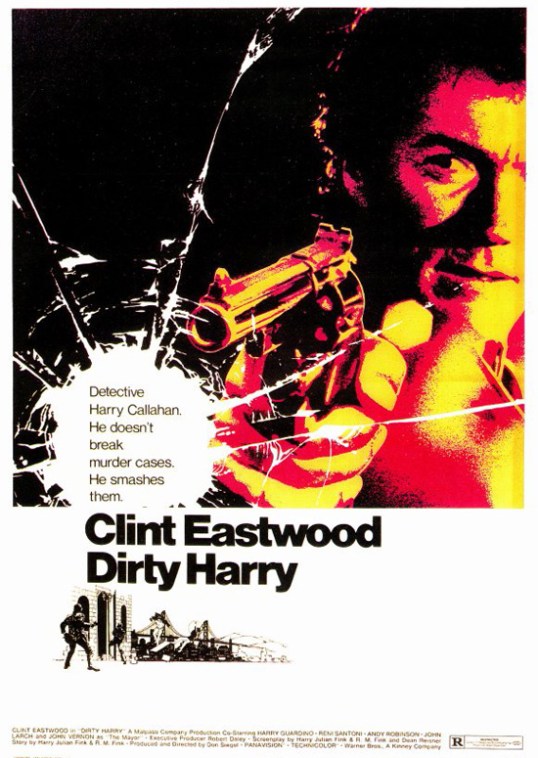
  3. Dirty Harry (1971)
  4. The French Connection (1971)
  5. The Last Picture Show (1971)
  6. The Lincoln Conspiracy (1977)
  7. Longstreet (1971)
  8. One False Movie (1991)
  9. Pretty Woman (1990)
  10. Revolt (2017)
  11. Santana: Live At US Festival 82 (2018)
  12. The Secret Life of the Cruise (2018)
  13. Ten To Midnight (1983)
  14. The Thing (1982)

Television Shows I Watched:

  1. 2024 Presidential Election Coverage
  2. American Sports Story: Aaron Hernandez
  3. Bar Rescue
  4. Baywatch Nights
  5. Check It Out!
  6. CHiPs
  7. Degrassi Junior High
  8. Dragnet
  9. Fantasy Island
  10. Friday the 13th: The Series
  11. Good Times
  12. Hell’s Kitchen
  13. Highway to Heaven
  14. Homicide: Life On The Street
  15. King of the Hill
  16. The Love Boat
  17. Malibu CA
  18. The Megyn Kelly Show
  19. Miami Vice
  20. Monsters
  21. St. Elsewhere
  22. TV 2000
  23. Welcome Back, Kotter

Books I Read:

  1. Breeding Clinic (2024) by Alexis Osborne

Music To Which I Listened:

  1. Adi Ulmansky
  2. Avril Lavigne
  3. Big Data
  4. Britney Spears
  5. Brookyln Michelle
  6. Cathy Rankin
  7. Chemical Brothers
  8. Clint Mansell
  9. Kid Rock
  10. Lynard Skynard
  11. Madness
  12. Malory
  13. Night Tapes
  14. Saint Motel
  15. Santana
  16. Talking Heads
  17. Viola Odette Harlow
  18. X
  19. Zedd

Live Tweets:

  1. Revolt
  2. One False Move
  3. Dark Star
  4. The Thing

News From Last Week:

  1. Actor Tony Todd Dies At 69
  2. Quincy Jones Dies At 91

Links From Last Week:

  1. Tater’s Week in Review 11/8/24
  2. Why Was “Juror #2” Buried? The Mystery Of Clint Eastwood’s “Secret” Movie!
  3. November 9, 2024

Click here for last week!

Retro Television Review: Homicide: Life On The Street 1.6 “Three Men And Adena”


Welcome to Retro Television Reviews, a feature where we review some of our favorite and least favorite shows of the past!  On Sundays, I will be reviewing Homicide: Life On The Street, which aired from 1993 to 1999, on NBC!  It  can be viewed on Peacock.

This week, we finally meet the arraber.

Episode 1.6 “Three Men and Adena”

(Dir by Martin Campbell, originally aired on March 3rd, 1995)

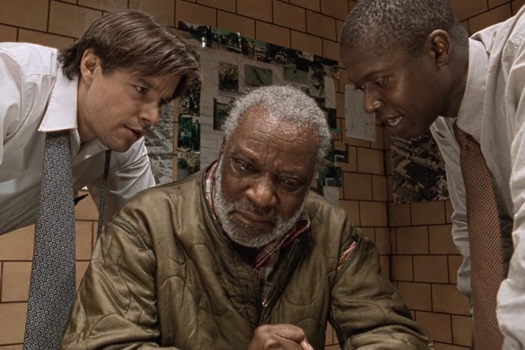
This week’s episode opens with Tim Bayliss and Frank Pembleton preparing to interrogate Risley Tucker (Moses Gunn).  Tucker is the arraber who Bayliss believes is responsible for murdering Adena Watson.  Adena used to work for Tucker, helping him take care of his horse before her mother told Adena that she didn’t want her spending so much time with Tucker.  As Tucker himself puts it, people tend to view arrabers (men who sell fruits and vegetables from a horse-drawn carriage) as being nomads.  As Tucker himself is a recovering alcoholic who was previously charged with (but not convicted of) statutory rape, it’s understandable why Adena’s mother didn’t want her spending time alone with him.  It’s also easy to understand why Bayliss is convinced that Tucker is guilty.  Pembleton, meanwhile,  is not as convinced.

Bayliss and Pembleton have already brought Tucker down to the station three times and interrogated him.  Giardello also points out that Tucker has been interviewed a total of 10 times about the case and, if he’s not charged after his latest interrogation, he’ll have grounds for a harassment suit.  Bayliss and Pembleton have fourteen hours to interrogate Tucker one final time and try to get a confession out of him.  After fourteen hours, they have to either arrest Tucker or send him home.  Giardello says that regardless of what happens, Bayliss has to go back into the regular rotation after this interrogation.  Bayliss’s time of exclusively investigating the Watson case is coming to an end.

Tucker arrives at the station and Bayliss and Pembleton get to work, trying to manipulate him into slipping up and confessing.

Considering how much they initially disliked each other, it’s interesting to watch how smoothly Bayliss and Pembleton work together in this episode.  Bayliss takes on the role of the “bad cop,” flat out accusing Tucker of killing Adena and shoving what little evidence they have in Tucker’s face.  At first, Pembleton plays the “good cop,” asking Tucker about what it’s like to be an arraber before moving on to discussing Tucker’s alcoholism.  Tucker says that he hasn’t had a drink in sixteen months.  Even when Pembleton asks if it’s possible that he slipped up and had a drink and blacked out on the night that Adena died, Tucker insists that he hasn’t touched a drop in sixteen months.

Bayliss and Pembleton work well together but Tucker remains adamant that he did not kill Adena.  Even when Bayliss threatens to press Tucker’s face against a hot pipe, Tucker swears he didn’t kill Adena.  Even when Pembleton gets Tucker to admit that he had feelings for Adena, Tucker says he didn’t kill Adena.  Tucker defiantly demands to take a polygraph and he passes it.  Bayliss, knowing that polygraphs are inadmissible in court and are hardly reliable arbiters of the truth, tells him that he failed.  At one point, the emotionally exhausted Tucker says that he’s not even sure if he’s innocent or not anymore.  That’s as close as Tucker comes to confessing.

As the interrogation wears on, Tucker starts to fight back and it’s somewhat jolting to realize that he’s been aware of how Bayliss and Pembleton have been manipulating him from the start.  He accuses Pembleton of thinking that he’s better than other black people.  He accuses Bayliss of having a dark side, pointing out that Bayliss was prepared to torture him to get a confession to a crime that Tucker insists he didn’t do.  It’s obvious that, in both cases, Tucker has correctly read both men.  Pembleton and Bayliss react by ganging up on Tucker, bombarding him with questions.  Tucker breaks down and starts to cry but, as time runs out, he continues to insist that he didn’t kill Adena Watson.

In the end, Tucker ends up sitting in the break room, watching television and waiting for someone to take him home.  Bayliss packs up all of the evidence in the Watson case, knowing that he failed to get the confession that he needed.  Despite not getting the confession, Bayliss has finally won Pembleton’s respect.  Pembleton tells Bayliss that he now believes Tucker is guilty.  Bayliss admits that he’s no longer as sure as he once was.

It says something about the strength of this episode that I’m not fully convinced of Tucker’s guilt as well.  When the episode started, I was sure that the arraber was guilty.  By the time it ended, my feelings were a bit more mixed.  For all of the emotional turmoil that Tucker went through over the course of the interrogation, he remained adamant that he didn’t kill Adena Watson.  Tucker confessed to being an alcoholic.  He confessed to having gotten into fights in the past.  He confessed to having pedophiliac feelings towards Adena.  But the only time he even slightley wavered in his claim that he didn’t kill Adena was when he was so exhausted that he barely knew what he was saying.  As well, the evidence against him was almost entirely circumstantial.  Evidence was found that Adena had been in Tucker’s barn but there was no way to prove that she was there the night she died.  Tucker’s barn did mysteriously burn down after Adena’s murder but there was no way to prove that Tucker burned it down to hide evidence.  I suspect Risley Tucker probably was guilty.  But if I was on a jury, I’d probably have to say that, without a confession, there was too much reasonable doubt.

By the end of the interrogation, all three men are exhausted.  The viewer is exhausted too!  This is an intense episode, one that plays out like a particularly kinetic, three-person play.  Kyle Secor and Andre Braugher continue to prove themselves to be a brilliant team but, in this episode, they’re equally matched by Moses Gunn, who keeps you guessing as far as Risley Tucker’s guilt or innocence is concerned.  Gunn, who died a few months after this episode aired, gives a performance that leaves you feeling as conflicted about Tucker as the two detectives.  If Tucker is guilty, then he’s a soulless monster who has gotten away with murder.  If Tucker is innocent, then we’ve just spent 50 minutes watching an elderly, recovering alcoholic go through a truly Hellish experience.  As the episode ends, the viewer is aware that all three of the men will be changed forever as a result of the 14 hours they spent in the box.

This was an outstanding episode, one that ended on a note of sadness.  Adena Watson’s killer will never be caught.  If Tucker did it, he got away with it.  If Tucker didn’t do it, Bayliss and Pembleton’s obsessive pursuit of him means that the real killer is probably already far away from Baltimore.  Not every case gets solved and not everyone gets justice.  To quote Casino’s Ace Rothstein, “And that’s that.”