Miniseries Review: Mike (dir by Craig Gillespie, Tiffany Johnson, and Director X)


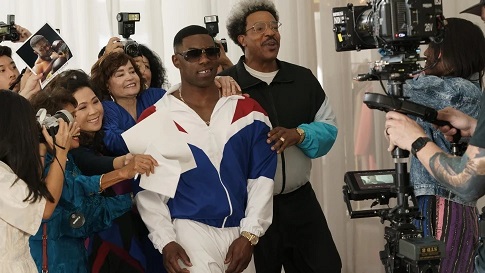
“Who is Mike Tyson?” is question that’s asked by the new Hulu miniseries, Mike.

The answer to that question is that he’s a boring guy who did some interesting things.

For instance, he became a boxer and was briefly the world champion before he was brought down by his own hubris.  That’s interesting, largely because it’s something that seems to happen to quite a few people who suddenly find themselves on top of the world but don’t have the maturity necessary to handle it.  However, that, in itself, does not Mike Tyson an interesting human being.  It just makes him an example of how history repeats itself.

He bit off an opponent’s ear during a boxing match.  That’s interesting because it was such a savage act and it scandalized people who otherwise have no problem watching two men beat each other until one loses consciousness.  Causing brain damage is okay but God forbid you bite off a piece of someone’s ear.  But the fact that Mike bit off the guy’s ear does not, in itself, make Mike Tyson interesting.  It just makes him a jerk.

Mike Tyson has a facial tattoo that doesn’t really mean anything.  A lot of people have stupid tattoos.

Mike Tyson has a distinctive way of speaking.  So do a lot of other people.

Mike Tyson spent three years in prison after being convicted of raping a contestant in a beauty pageant.  Tyson was and is certainly more famous than the typical convict and, somehow, that conviction has not prevented him from becoming a beloved cultural institution in the United States.  The hypocrisy is interesting.  Mike Tyson is not.

At least, that’s the impression that I got from this 8-episode miniseries.  Seven of the episodes feature Tyson (played by Trevante Rhodes) performing a one-man show in front of an audience in Indiana.  Believe it or not, this is based on fact.  Apparently, Mike Tyson did have a one-man show, in which he would discuss his career and his life.  (Jeff even wrote a review of it for this very site!)  We watch flashbacks as the show’s version of Tyson provides a self-serving narration and, to be honest, it seems like it would be the most boring one-man show ever.  Tyson talks about growing up poor and with a mother who alternated between hating and loving him.  He talks about his first trainer (played by Harvey Keitel, who often seems to be channeling Jonathan Banks) and his first marriage.  Mostly he talks about how he feels that almost everyone in his life betrayed him.  The first two episodes, which deal with Tyson’s youth, are effective because they examine how a childhood of mental and physical abuse can set the course of someone’s entire life.  However, once adult Tyson shows up, Mike becomes far less compelling.  It’s hard not to get tired of listening to him blame everyone else for his own increasingly poor decisions.

The one exception to the show’s format is episode 5, which is told from the point of view of Desiree Washington (Li Eubanks), the woman who Tyson was convicted of raping.  This is a powerful stand-alone episode, both because of Eubanks’s performance and because it’s the only episode to not be seen through Tyson’s eyes.  It’s the episode that allows the viewer to see Tyson the way the rest of the world saw Tyson.  And yet it’s difficult to feel that, when viewed in the context of the entire miniseries, this episode is a bit of a cop-out.  It’s the only episode to focus on someone who was hurt by Tyson but it’s surrounded by episodes that once again portray Tyson as being a victim of his managers, his fans, and society at large.  Desiree is given one episode and then disappears from the narrative whereas the show’s version of Tyson is given seven episodes to justify himself.  One gets the feeling that the show’s producers knew that they had to include Desiree but they also knew that revealing Tyson’s version of the events would have also meant revealing that he continues to insist that he was the victim and that would have totally messed up the show’s final redemption arc.  And so, the narrative burden is temporarily placed on Desiree and Tyson only returns once it is time to discuss what it was like being in prison.

Mike was produced by Craig Gillespie, who also directed I, Tonya.  Like I, Tonya, Mike features characters frequently breaking the fourth wall and talking directly to the audience.  In fact, it happens so frequently that it gets to be kind of annoying.  Breaking the fourth wall really wasn’t even that original when it happened in I, Tonya.  In Mike, it becomes a trick that’s used to try to make Mike Tyson into a more interesting character than he is.  But it feels empty, largely because it doesn’t tell us anything that we don’t already know or couldn’t have guessed on our own.

The miniseries itself was made without the participation of the real-life Mike Tyson.  Tyson condemned the show as being an attempt to make money off of his life and he actually does have a point.  Unfortunately, the miniseries itself doesn’t have anything new to add to the story of Tyson.  It’s an 8 episode Wikipedia entry.  At some point, the streaming services may need to realize that not every celeb needs to be the subject of a miniseries.  Simply being famous does not always make for a compelling story.
Music Video of the Day: Couple Days Off by Huey Lewis and the News (1991, directed by Jim Yukich)


Everyone needs a couple of days off, even Huey Lewis and the News!

This song was the final single from Huey to chart in the Billboard Top 20.  For better or worse (I would say “better”), Huey Lewis and the News were the epitome of a mid 80s band.  They worked hard and they made videos that celebrated having a good time.  They were never as obnoxious or openly hedonistic as the hair bands of era but they were also out-of-place in the angst-filled 90s.  But while everyone else continues to pay thousands to see Bruce Springsteen, Huey Lewis and the News will always be the blue collar bar band for me.

This video was directed by Jim Yuckich, who has directed videos for everyone.

Enjoy!

Revolver (1992, directed by Gary Nelson)


In Revolver, Robert Urich plays an FBI agent who, for some reason, is not named Johnny Revolver.  Instead, his name is Nick Suster.  When a drug bust goes wrong and Nick accidentally shoots an innocent bystander in the head, he retires from the FBI and announces that his days of carrying a gun are over.  But then he’s approached by his former boss and asked to take one last special assignment.

Nick goes undercover, offering his services as a bodyguard to the head of Spanish Mafia, Aldo Testi (David Ryall).  Testi agrees to hire Nick and, to celebrate their new arrangement, they go to a strip club where the dancers dress like cowgirls and all the patrons are given small cap guns that they can fire at the stage.  (How could that possibly go wrong?)  Of course, one man has a real gun and uses it to shoot Nick.  The gunman tells Aldo that he’ll be next and then runs off.  Then Aldo runs off, leaving Nick to possibly die.  Eventually, someone calls 9-1-1 and Nick goes to the hospital.

Nick survives being shot but now he’s in a wheelchair.  After spending a month or two feeling bitter, Nick plays one game of wheelchair basketball and decides that it’s time to get on with his life.  Defying the orders of his superiors, Nick flies to Barcelona and tries to learn why he was shot and who was responsible.  After recruiting a broke college student (Jordi Molla) to serve as his legman, Nick sets out to get revenge.

It’s not a bad premise and the film benefits from being filmed on location in Barcelona, which is one of Spain’s more photogenic cities.  Unfortunately, Revolver is a good idea searching for and failing to find a compelling story.  It doesn’t take long for Nick to become not only comfortable with his wheelchair but also combat proficient with it as well.  It also defies credibility that Testi would not be suspicious of Nick still wanting to work for him even after Testi previously left him for dead.  Even when it’s revealed that Testi is dealing in something far more powerful and dangerous than just drugs, the revelation doesn’t carry any weight.  The low budget of this made for television production is obvious when one major cliffhanger is resolved off-screen and dismissed with just two lines of dialogue.

At the time of his death in 2002, Robert Urich held the record for having starred in the most primetime network television shows.  He starred in 15 shows.  Since Revolver was obviously meant to be a pilot, he could have starred in 16 if it had been better received.  In the role of Nick, Urich gives a typically workmanlike performance.  He’s credible but a little boring.  The movie does not help him by having him adopt the phrase “Wherever you go, there you are,” as a philosophy.  Urich gives a sincere reading of the line but it’s impossible to hear it without thinking of Gary Cole in The Brady Bunch Movie.

Revolver would not lead to a series.  Robert Urich would have to wait another four years before he starred in his 13th series, UPN’s Lazarus Man.

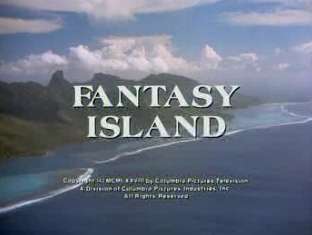
Retro Television Reviews: Fantasy Island 1.3 “The Prince/The Sheriff”


Welcome to Retro Television Reviews, a feature where we review some of our favorite and least favorite shows of the past!  On Tuesdays, I will be reviewing the original Fantasy Island, which ran on ABC from 1977 to 1996.  The entire show is currently streaming on Tubi!

Welcome to Fantasy Island!  Is everyone smiling?

Episode 1.3 “The Prince/The Sheriff”

(Directed by Phil Bontelli, originally aired on February 11th, 1978)

The third episode of Fantasy Island is about two men searching for a simpler way of life.

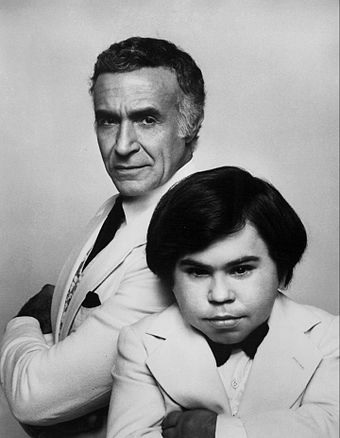
Peter D’Antonoli (Dack Rambo) is the prince of the nation of Andoli.  As Mr. Roarke explains it, Peter is on the verge of becoming one of the last true monarchs, someone who not only wears a crown but who sets governmental policy.  Peter has never known what it’s like to be one of the common people and he feels that he should give it a try before he takes power.

Mr. Roarke arranges for Peter to get a job on a fishing boat.  Apparently, there’s a small fishing village located near the Fantasy Island resort.  I’m just three episodes into the original series and I have to admit that I’m already confused about about how Fantasy Island operates.  The pilot and the first two episodes suggested that Fantasy Island was a magical resort that belonged exclusively to Mr. Roarke.  But, with this episode, it is revealed that there is a fishing village near the resort and that the blue collar fisherman resent all of the people who hang out at the resort.  So, is Fantasy Island actually a nation, one that has many different village and an economic class system?  Is Mr. Roarke the president?  Has Fantasy Island been invited to join the United Nations?  And why is the Fantasy Island fishing village full of people who look like they belong in a second remake of The Fog?  Is Fantasy Island near New England?  Is it off the coast of Maine?  Seriously, this is a confusing place.

Anyway, Mr. Roarke arranges for Peter to get a job on a fishing boat, where he befriends a fisherman named Jamie (Ed Begley, Jr.).  Jamie immediately notes that Peter must be new to the fishing industry because his hands don’t have any callouses.  Jamie explains that he’s been a fisherman his entire life.  (So, did Jamie grow up on the island?)  Peter learns about generosity from Jamie and about rejection from Chris Malone (Lisa Hartman).  Peter falls in love with Chris as soon as he meets her but Chris has lived a tough life and she doesn’t want to marry someone who is just a fisherman.  Peter struggles to explain that he’s actually a prince.  Chris doesn’t believe him.  Peter says that there are things more important than money.  It leads to a big argument but fear not!  Things work out for everyone.  Chis becomes a princess.  Peter learns humility.  And Jamie gets a new boat and remains trapped on the island….well, okay.  Things worked out for almost everyone.

Meanwhile, John Burke (Harry Guardino) is a tough New York cop who wants to go back to a time when there weren’t any liberal DA’s letting criminals out of the street.  He wants to be an old west marshal!  Mr. Roarke mentions that “the old west fantasy” is Fantasy Island’s top seller.  He takes Burke to a western town.  Burke asks about the people who live there.  “They’re not robots, like in that movie, are they?”  No, Mr. Burke, it’s not Westworld!  It’s Fantasy Island!

It turns out that the two men who Burke believes murdered his partner had a similar fantasy and they’re living in the town as well!  Marshal Burke sets out for revenge but, with the help of saloon owner Julie (Sheree North), he learns that upholding the law with mercy is more rewarding than seeking blind vengeance.  Burke and Julie leave the island but fear not.  Mr. Roarke is sure that someone else will show up and request the old west fantasy.  It’s their biggest seller, after all.

(So, Fantasy Island really was just like Westworld….)

The prince storyline was silly.  The old west storyline was also silly but Harry Guardino gave a pretty entertaining performance as John Burke.  This episode also featured a visit to the Fantasy Island disco, which I appreciated.  Why go to the old west when you can dance?

Next week …. more fantasies!

Non Fiction Book Review: The Nashville Chronicles by Jan Stuart


First published in 2000, Jan Stuart’s The Nashville Chronicles is a look at both the making and the legacy of one of the best films of the 70s, Robert Altman’s Nashville.

Starting with Joan Tewksbury’s fateful journey to Nashville to search for ideas for a screenplay for a film that Robert Altman wanted to make about the capitol of country music and ending with the details of a mercifully unrealized sequel, The Nashville Chronicles details just about everything one could want to know about the making of Altman’s film and it does so in an always entertaining fashion.  Jan Stuart’s love of the film is obvious but so is Stuart’s understanding of the film’s satirical take on politics, celebrity, and Americana.

Much like Altman’s film, Stuart’s book is free-wheeling look at a period of American culture, featuring a large and disparate group of characters. Stuart focuses on the collaborative nature of the film, emphasizing that the actors often brought their own ideas and, in some cases, issues to project.  Stuart interviewed almost every member of the cast who was still alive in 2000.  (The only person he couldn’t track down was Dave Peel, who played Bud Hamilton.)  The actors prove to be as interesting as the characters that they played and Stuart does a wonderful job of capturing not only their quirks but also how their own lives often informed their performances.  Ned Beatty emerges as a plain-spoken but intelligent artist while Henry Gibson is as droll as the character he played was calculating.  Keith Carradine talks about how his dislike of the character he was playing actually made his performance more effective.  Karen Black is wonderfully eccentric while Geraldine Chaplin provides an outsider’s view to the uniquely American experience of Nashville, both as a town and a movie.  The enigmatic Michael Murphy expertly straddles the line between the establishment and the counterculture while Thomas Hal Phillips predicts the next 50 years of American political history with the speeches that he wrote for the often heard but always unseen presidential candidate, Hal Phillip Walker.  And, throughout it all, Robert Altman oversees the production, a talented but mercurial director who could be both amazingly supportive and amazingly cold whenever he felt slighted.  Altman emerges as a genius who could be shockingly petty to those who he felt had disappointed him.

The book covers the filming of all the major moments from the film, including the prophetic finale.  The book also explores a proposed Nashville sequel, which would have featured all of the surviving characters ten years after the first film.  Haven Hamilton, for instance, would have followed in Hal Philip Walker’s political footsteps.  Reading about the proposed outline for the sequel, it’s hard not to feel that it’s a good thing that it never moved beyond the idea stage.  As Stuart’s book makes clear, Nashville was a once-in-a-moment success and not something that could be easily duplicated.  Nashville ended with one tragedy, one surprising act of heroism, and the birth of a new star.  It was the perfect ending and any attempt to continue the story would have just cheapened it.

The Nashville Chronicles is a fascinating look at a fascinating film.

Film Review: Vendetta (dir by Jared Cohn)


It’s a dangerous world out there, make no doubt about it.

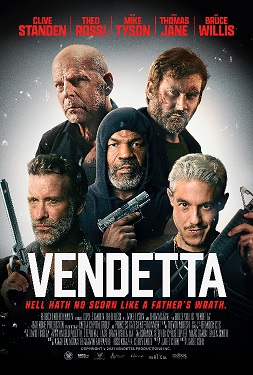
William Duncan (Clive Standen) thought that his days of violence were behind him.  Sure, he did a tour of duty in the military.  And yes, he was trained how to kill a man.  In fact, he was trained how to kill dozens of men and he did just that as a part of his patriotic duty.  But that was the past.  Now, William lives in the suburbs of Atlanta and he’s got a pretty nice life.

Unfortunately, one day, William’s life falls apart, shortly after he picks up his 16 year-old daughter, Kat (Maddie Nichols), from softball practice.  William’s plan is to pick up his daughter, grab some food for dinner, and then head home.  Unfortunately, a gang led by Rory Fetter (Theo Rossi) has a different idea.  The time has come for Rory’s younger brother, Danny (Cabot Badsen), to be initiated into the gang.  At first, it seems like Danny doesn’t even want to join the gang but still, when he’s ordered to murder a random bystander, he does so.  That bystander happens to be Kat.

Danny’s arrested for the murder but he’s released due to the influence of his father, a powerful gangster named Donnie (Bruce Willis).  Having been failed by the legal system, William decides to put his military training to good use and get his vengeance.  At first, he’s armed with only his dead daughter’s softball bat.  Later, he joins up with an arms dealer named Dante (Thomas Jane) and the war truly begins.

It should also be noted that Dante is friends with a shady garage owner named Roach.  Roach is played by Mike Tyson.  Yes, that Mike Tyson.  Tyson doesn’t really get to do much as Roach.  His garage does serve as one of the film’s many battlegrounds but, for the most part, Tyson is something of a bystander.  It’s easy to see that the main reason he was included in the film was because it would inevitably cause at least a few potential viewers to say, “Hey, Mike Tyson’s in this!  Let’s watch!”  That said, even with his limited screen time, Mike Tyson has a surprisingly likable screen presence.  I don’t think that anyone will ever mistake Tyson for being an actor of great range but he does a good enough job here that it would be foolish for someone not to cast him in a bigger role in a future low-budget action flick.

As for Vendetta, it’s about as pulpy as pulp can get.  It’s an action/revenge flick that makes no excuse for being an action/revenge flick and, as a result, it’s difficult not to be entertained by it.  The story moves quickly, there aren’t really any slow spots, and the cast does well with their roles.  That includes Bruce Willis.  This, of course, is one of Willis’s final films.  Watching the films that were released after Willis revealed that he was retiring due to aphasia can feel a bit awkward as it’s obvious that the Willis who appeared in these films was quite a bit different from the Willis who appeared in Die Hard.  That said, Willis is effectively intimidating in Vendetta.  Even if he doesn’t display the wiseguy charm that was his trademark, Willis still has enough of his streetwise, tough guy screen presence that the viewers will be able to buy him as being a feared crime boss.

As far as 2022’s collection of Bruce Willis films go, Vendetta isn’t bad.  It’s maybe a smidgen below Gasoline Alley (which, as of this writing, is the best Willis film of 2022) but it’s a hundred times better than American Siege and A Day To Die.

Music Video of the Day: Dead Ringer For Love by Meat Loaf, featuring Cher (1981, directed by ????)


Today would have been Meat Loaf’s 75th birthday.  Though he may no longer be with us, his music will live forever and so will his music videos.

In Dead Ringer For Love, Meat Loaf plays an amiable lunkhead who realizes that there is more to life than just beer and hanging out with his buddies at the local bar.  There is also love and, in this song and video, the object of his affection is played by Cher.

Interestingly, this song was originally written for a sitcom called Delta House, which was an attempt to spin Animal House into a television series.  If John Belushi had not been available or willing to play Bluto in that classic comedy, Meat Loaf was the second choice for the role.

Enjoy!

Vigilante (1982, directed by William Lustig)


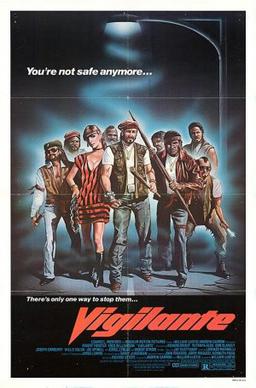
The year is 1982 and New York City has gone to Hell.  While honest, hard-working people try to make a living and take care of their families, the streets are ruled by gangs and drug dealers.  The police and the legal system impotent in the face of intimidation and corruption.  Maybe it’s time for the citizens to take the streets back, by force if necessary.

That’s what Nick (Fred Williamson) and most of his friends believe.  Eddie Marino (Robert Forster) disagrees.  He says that people taking the law into their own hands will just lead to more violence and death.  The vigilantes will become just a bloodthirsty as the criminals.  While Eddie is debating policy with Nick, Eddie’s wife (Rutanya Alda) is threatening to call the police on a Che Guevara look-alike who she spots trying to set a gas station attendant on fire.  Eddie’s wife is stabbed.  His son is killed.  And when the man responsible is allowed to walk by a crooked judge, Eddie’s courtroom outburst leads to him being sent to jail.

Eddie spends 30 days in jail, fighting off predators and befriending a mysterious inmate named Rake (Woody Strode).  When Eddie is finally released, his traumatized wife no longer wants to be married to him but Eddie has found a new purpose in life.  Working with Nick, Eddie tracks down and murders the men who have destroyed his family.

One of the many films to be inspired by the success and enduring popularity of the original Death Wish, Vigilante is a classic of its kind.  Director William Lustig wastes no time in establishing New York City as being a graffiti-decorated war zone where good is fighting a losing war against evil and most of the victims are just innocent bystanders.  The New York of Vigilante looks even worse than it did in Lustig’s previous film, Maniac.  (Maniac’s Joe Spinell plays one a crooked lawyer in Vigilante.)  The action is brutal and bloody.  While Forster fights for his life in prison, the people who killed his son are allowed to run free.  It’s not subtle but, by the time Forster finally walks out of jail, you’ll be more than on his side and ready to see him get his revenge.  With his trademark intensity, Robert Forster is believable as someone who goes from aborhing to violence to being a stone cold killer who doesn’t even flinch when he shoots a defenseless man.  As Nick, Fred Williamson is his usual confident self.  Williamson may not have much range as an actor but he has such a forceful screen presence that he dominates any scene in which he appears.

Vigilante is a grim film, with Eddie ultimately going further than almost any other screen vigilante before him.  It’s also a deeply satisfying film because it appeals to everyone’s desire for revenge.  In the real world, vigilantes are often as dangerous as the people they’re trying to keep off the streets.  In the movies, though, they’re easy to root for.  They present easy and direct solutions to complex problems.  Even a film as dark as Vigilante works as a sort of wish fulfillment.  With crime on the rise and the constant news reports about innocent victims who just happened to be in the wrong place at the wrong time, it’s easy to root for Nick and Eddie as it once was for Paul Kersey.