
By Herman E. Bischoff
There’s a lot of pulp atmosphere to be seen in this wonderful cover from artist Herman E. Bischoff.
By Herman E. Bischoff
There’s a lot of pulp atmosphere to be seen in this wonderful cover from artist Herman E. Bischoff.
Meow!

Remember when William Shatner became the oldest man to go into space?
It’s okay if you’ve forgotten. It happened way back in 2021 and that was like — well, it feels like it was about 30 years ago. Add to that, Shatner went up in space as a part of Jeff Bezos’s space program and Bezos’s attempts to conquer space have pretty much been replaced by Elon Musk’s attempts to conquer space in the national consciousness.
That said, it was a really big deal when it happened. I think there were a lot of people who were concerned that, at the age of 90, Shatner wasn’t really physically fit to go into space and that it would be really depressing if Shatner didn’t make it back to Earth. There were others who pointed out that Jeff Bezos’s Blue Orbit may have gone high up in the sky but that it didn’t quite break through the atmosphere. The people on the ship, including Shatner, experienced weightlessness and got to see what the Earth looked like from space without actually literally going into space. George Takei had to be a whiny little child about it because that’s pretty much the way Takei reacts to anything positive happening to William Shatner. And, of course, many people said that Jeff Bezos should have been spending his money on fixing the Earth instead of trying to escape it. Those were the same people who, later that year, wrote positive reviews of Don’t Look Up.
That said, it was all just really cool. Star Trek may bore me to tears but even I was still moved by the thought of William Shatner going into space, even if it was just for a few minutes. It was a moment to spark the imagination and to inspire optimism. I think those are two things that the professional naysayers are incapable of possessing or understanding. But it’s imagination and optimism that will make the world a better place.
Anyway, there’s a 50-minute documentary about Shatner’s voyage into space, one that I just watched. It’s on Prime and, quite appropriately, it’s called Shatner In Space. In all honesty, Shatner In Space is largely a commercial for Jeff Bezos. There’s not point in denying that. The first half of the documentary features perhaps a bit too much footage of Jeff Bezos, one of the world’s richest men, trying to present himself as just being a humble sci-fi nerd who grew up on a ranch. Brilliant businessman that he is, Bezos is not the most charismatic person in the world and that’s especially obvious when he’s sharing scenes with William Shatner. There’s undoubtedly a lot that you can say about William Shatner but no one can deny that, even at 90, the man knows how to work a scene.
But, fortunately, Shatner himself seems to be so sincerely excited about the prospect of going into space that it even makes Bezos tolerable. The documentary doesn’t include as many scenes as one might hope of William Shatner training for his mission. Personally, I would be curious to know what type of precautions were taken before sending a 90 year-old person into space because, who knows …. I might be 90 before I get the chance to try it for myself! I did notice that, of the crew, Shatner was the only one not to really indulge in the weightless aspect of the trip. While everyone else floated around the capsule, Shatner seemed content to stay in his seat and look at the Earth below. The fact that Shatner, who has pretty much made a late-in-life career out of parodying his reputation for being a bit pompous, seems to be, at that moment, at a loss for words is actually rather touching.
Anyway, as I said, this is basically a commercial for Jeff Bezos but it’s hard not to enjoy watching Shatner go into space.

by R.A. Osborne
This cover is from 1962.
Meow!
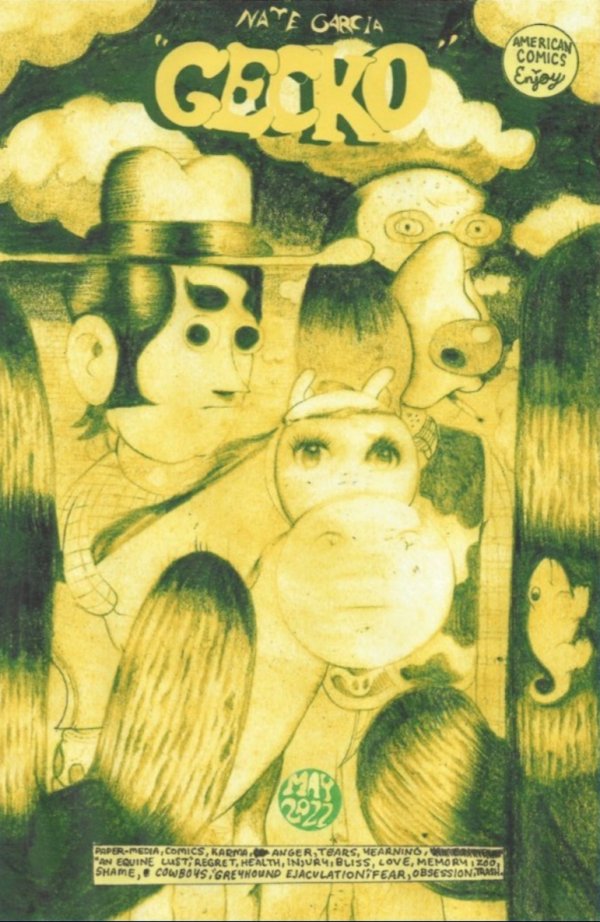
It may not be today, and it may not be tomorrow, but the law of averages dictates that one of these days, Nate Garcia is just gonna take this whole thing too far. His comics about tennis-shoes-wearing cowboy Alanzo Sneak, his horse Sheena for whom he harbors an unhealthy longing and/or obsession, and their anthropomorphic dog pal Huff Deely have consistently straddled the fence between humorously cheesy and downright queasy (with generous side helpings of sleazy and uneasy for good measure), but he’s got this uncanny ability to take you right to the edge and then reel you — and his characters — back in. There’s a frisson of real tension that undercuts these intentionally lame (and, therefore, hilarious) humor strips, but he’s managed to keep the darker impulses of both himself and his coterie of less-than-lovable losers in check. Still, he’s only 21 years old or something — give him time.
And I have to admit, speaking for myself, that I’m curious to see what his iteration of “too far” is going to look like. The overtly “cartoony” nature of his — well, of his cartooning — more or less guarantees that sharp edges are blunted upon delivery, but in a weird way that makes his shit seem even more amoral : like, this is a guy who probably could show a man and a horse making the old beast with two backs (or should that be bestiality with two backs?) and somehow find a way to make the whole thing seem as hysterical as it would be nauseating.
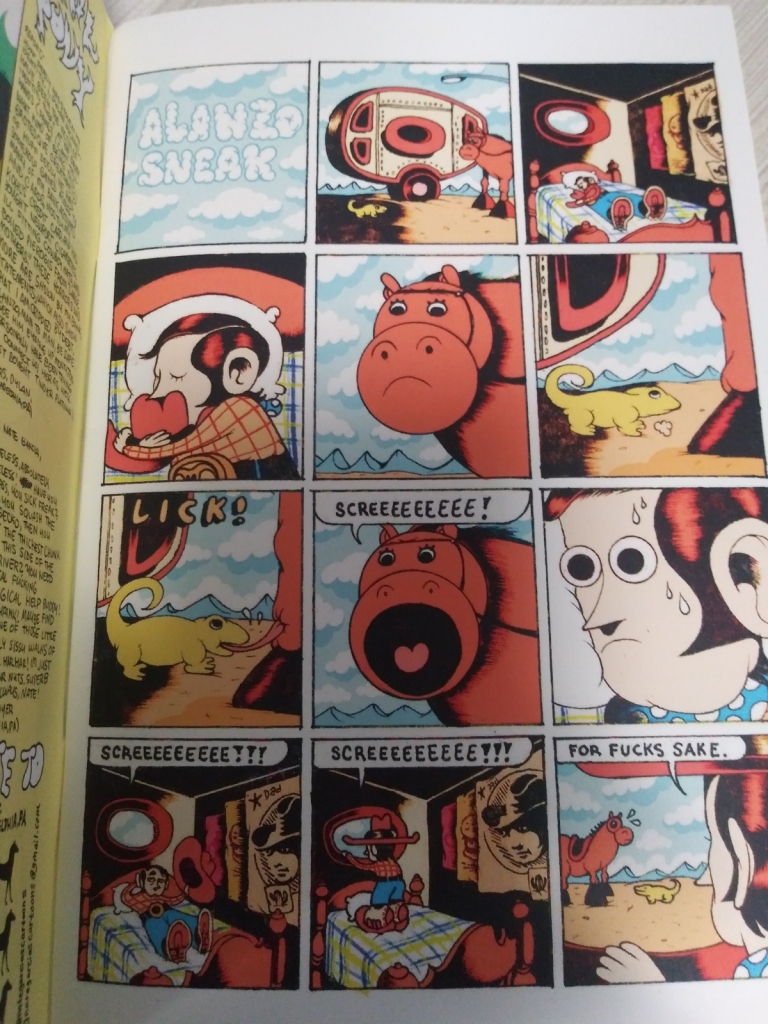
Still, why worry about future eventualities when the present offers such damn good strange fun? And Garcia’s latest, Gecko, certainly is that — not a whole lot happens story-wise, it’s true, but that’s entirely beside the point. Garcia (with a one-page assist at the back of this one from Goiter‘s Josh Pettinger) is more about atmospherics and tonality than narrative ambition, more about the cohesive experience than its reductive elements. The whole has always been greater than the sum of its parts with this Philly-based enfant terrible, and that’s as true as ever here — although those parts deserve special mention.
Specifically, with this new comic Garcia has thrown off the yoke of the magazine format (not that we object to said format around these parts, mind you, but it’s nice to see a self-publishing cartoonist venture out of their comfort zone sometimes) in favor of the old-school A5 (I think, at any rate) ‘zine, and this time he’s opted for a riso-printed cover and full-color interiors. Purely as a physical object, then, this both looks great and feels good to flip through — which rather belies its decidedly modern origins as an Instagram “swipe-though” comic. In fact, petty as it makes me sound, I sorta hope this thing looked like shit on Instagram (I didn’t see it since I don’t have an account on there), because this feels like exactly the right “delivery method” for this material.
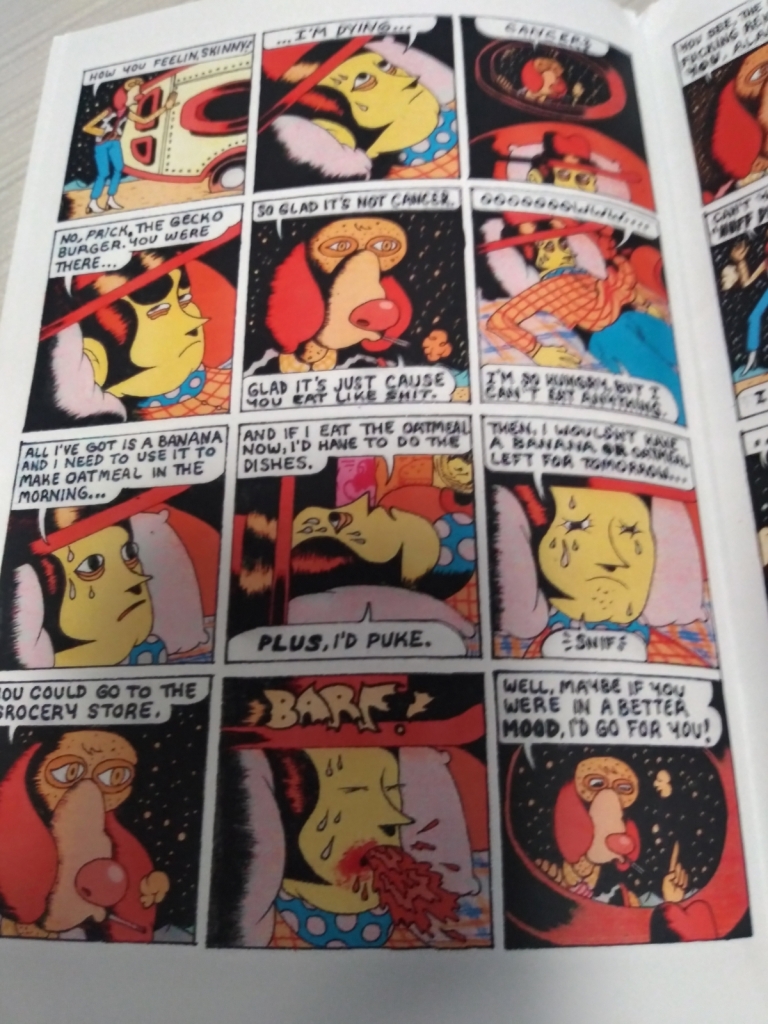
As far as what that material consists of, in short : Alanzo stomps on a Gecko, an anthropomorphic Gecko who works at a hamburger stand takes exception to this act of brutality against one of its brethren and — ya know what, I don’t want to give away the fucked-up “joke” that comes after that, so let’s just say Alanzo ends up sicker than hell and leave it at that. And if all that sounds like flimsy grounds to extrapolate a 20-plus-page story from, well — technically speaking you’re absolutely right, but Garcia’s led an extremely charmed life up to now in his still-nascent cartooning career, and that pattern holds true here. There are a couple of punchy little backup strips, as well, so all in all it’s gotta be said that reading this — and oohing and aahing at the art — is a great time.
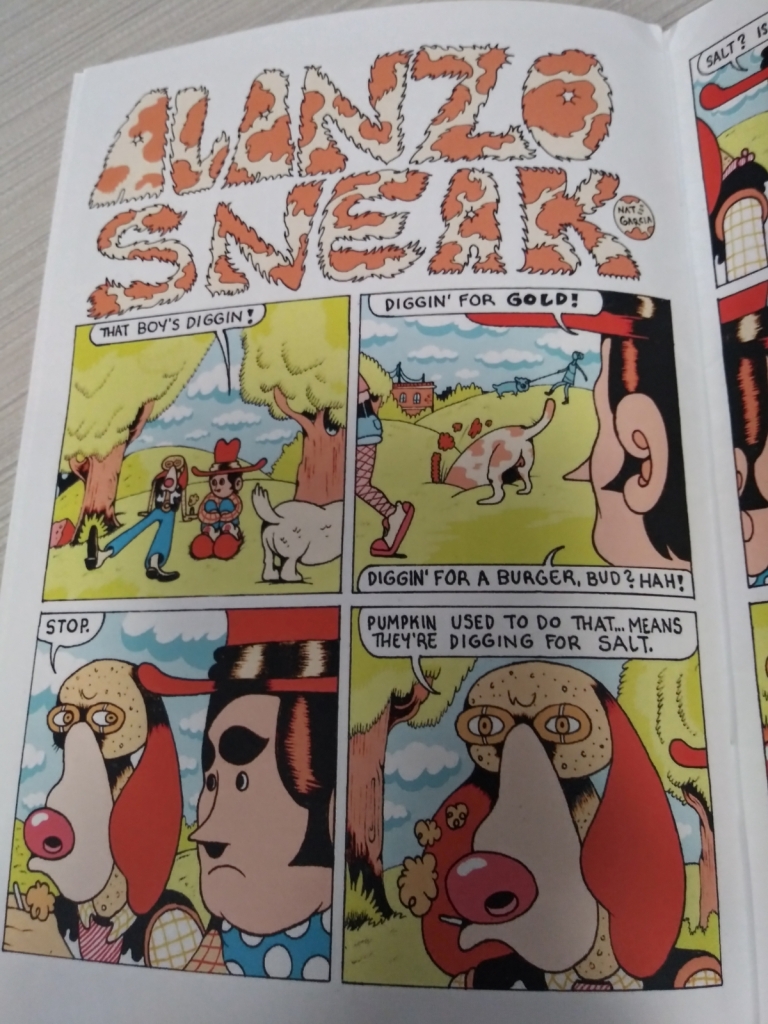
So go on, pick it up and have precisely that. Nate Garcia is one of our weirder and more wonderful comics auteurs of the moment, and there’s no reason to feel the least bit guilty about liking his impeccably-drawn, curiously folksy bizarre surrealist humor. Not yet, at least.
***************************************************************************************
Gecko is available for $10.00 from Nate Garcia’s Bigcartel site at https://nategarcia.bigcartel.com/product/gecko
Also, this review is “brought to you” by my Patreon site, where I serve up exclusive thrice-weekly rants and ramblings on the worlds of comics, films, television, literature, and politics for as little as a dollar a month. Subscribing is the best way to support my continuing work, so I’d be very appreciative if you’d give it a look by directing your kind attention to https://www.patreon.com/fourcolorapocalypse
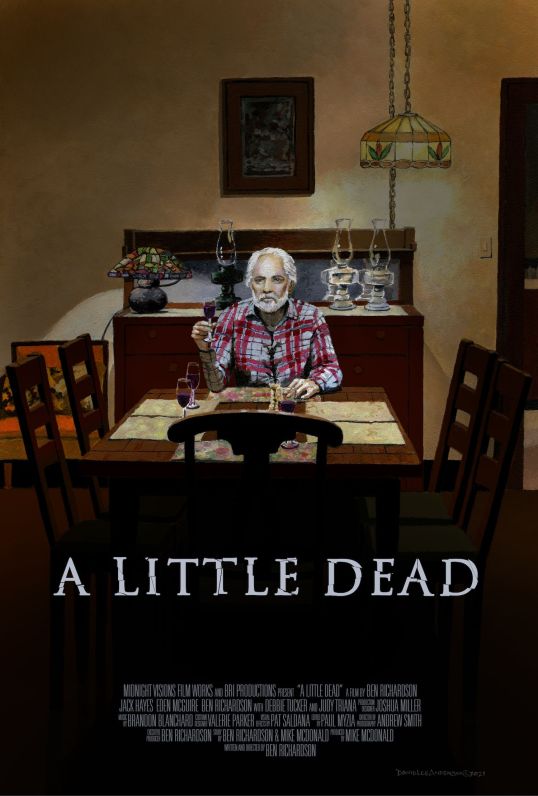 On a farm in Oklahoma, an old man who we get know as being Grandpa (Jack C. Hays) sits at a dinner table. Though he seems to be alone, he’s got three glasses of wine sitting in front of the other chairs, along with with a glass for himself.
Things haven’t been easy for Grandpa since Grandma passed away. His two grandchildren, Hailey (Eden McGuire) and Kevin (Ben Richardson, who also directed the film) arranged for a caretaker to live with him but, when they stop by for a visit, they discover that the caretaker has vanished and Grandpa seems to be convinced that there are people sitting at the table with him. When his grandchildren try to clean up the table, he snaps at them not to touch anyone’s drinks. There’s a ritual going on and his well-meaning grandchildren better not interrupt it. At times, Grandpa seems to be perfectly lucid. At other times, he expresses surprise when Kevin tells him that it’s not a good idea to keep a big box of rat poison with all of the cereal. Is Grandpa losing it or is there something else happening that only he can understand?
Clocking in at a little over 10 minutes (not including the end credits) and deliberately paced without ever being slow, A Little Dead is a nicely atmospheric piece of country gothic. On the one hand, it is a story of a man who may or may not be living with spirits. On the other hand, I think it can be argued that the film is also a metaphor for the mixed emotions that many people have about the feelings of responsibility that they feel towards older relatives and the guilt that comes from feeling that maybe they were not there as much as they should have been. There’s a lot of people like this film’s Grandpa, who are living alone and who are only occasionally visited by younger family members who are, for the most part, checking in to see if they still have their mind and if they’re still capable of taking care of themselves. Is Grandpa talking to actual “people” at the table or is he just talking to the lingering memories of the people who used to be there? And are his grandchildren correct to be concerned about him or are they just dealing with their own feelings of guilt?
A Little Dead is also an enjoyable little horror story. It’s the type of story that you would might expect to find in an old horror comic book, complete with a nice little twist at the end. The film makes good use of that old farmhouse and the desolate country landscape. If you have spent anytime in the rural midwest, you will immediately recognize the film’s milieu. If there were ghosts to be found, that’s definitely where they would probably be living.
This is one to keep an eye out for. Pour yourself a glass and relax with A Little Death.

by Earle Bergey
Giant flies, men with knives, and women in bubbles, it’s definitely the work of Earle Bergey.
Meow!

Speaking as someone who’s been there, done that, and is still doing it, trust me when I say that the existential dread that comes with aging is as serious as a fucking heart attack. Certainly, it has to qualify as a “first world problem” — there are any number of countries in the process of being ground under economically, militarily, or both where simply living to see another day is reason enough to be grateful regardless of how many ticks of the calendar one has endured — but that doesn’t mean those of us who have the privilege of even being able to worry about such things aren’t terrified by our own mortality once we hit the point where logic dictates we likely have more yesterdays than we do tomorrows.
Steven Arnold — or, as he credits himself in the work we’re here to look at, S.R. Arnold — gets it. He knows the slow-burn sense of impending doom that the middle-aged person feels is equal parts well-placed and ridiculous, justifiable and self-indulgent, and in the handsomely-formatted pages of the magazine-sized Perry Midlife (the sixth release from his Philly-based H.O.T. Press Comics imprint, and as far as I know his first “solo” work, in that it was done without the assistance of writing partner Michael Kamison), he regales us with the tale of a typically hapless underachiever having anything but a typical time of things — even if, again, this is a decidedly typical set-up on its face.
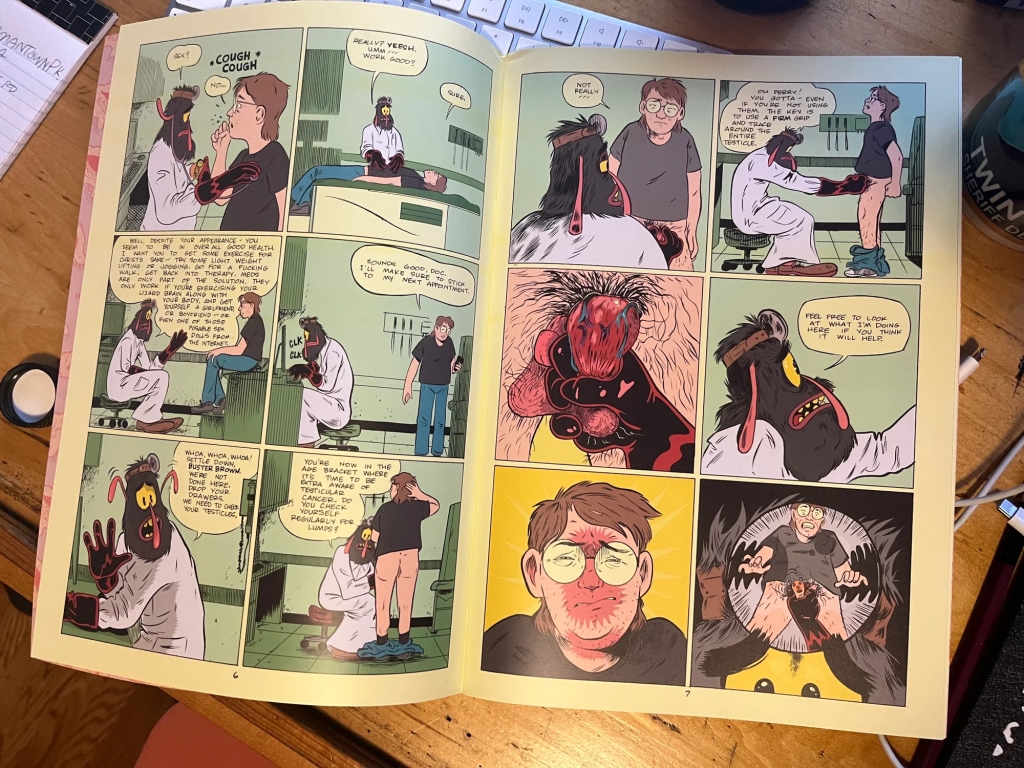
Anyway, how much of what’s happening on the lavishly-colored pages here is “real” or not is beside the point, I suppose, what’s of greater import is the overall relatability of both our titular Perry and his befuddled mindset, and Arnold absolutely nails that. Admittedly, there’s a bit of “high weirdness for its own sake” on offer here — check out our man’s doctor, pictured above, for instance — but if you can’t wrap your head around the concept of a perpetually-annoying fake ornithological species called a cowbird, what can I say? This ain’t the comic for you — but it’s only yourself that you’ll be depriving.
Okay, fair enough, “depriving of what?” is the natural enough follow-up question here, and the answer is a complicated one. Of enjoyment? To a degree, absolutely — I mean, this is a funny comic. But it’s not necessarily an easy one to enjoy, depending on one’s internal wiring. Mine is hopelessly skewed, so I did have a fair amount of fun with this, but there are times when Arnold’s personal flights of fancy can fairly be said to blunt the impact of otherwise-strong narrative “beats” and where he gets the delicate real/surreal balance he’s playing with throughout just a bit wrong — these instances are notable, though, which is as good an indicator as any that most of the time, at any rate, he’s getting things exactly right.
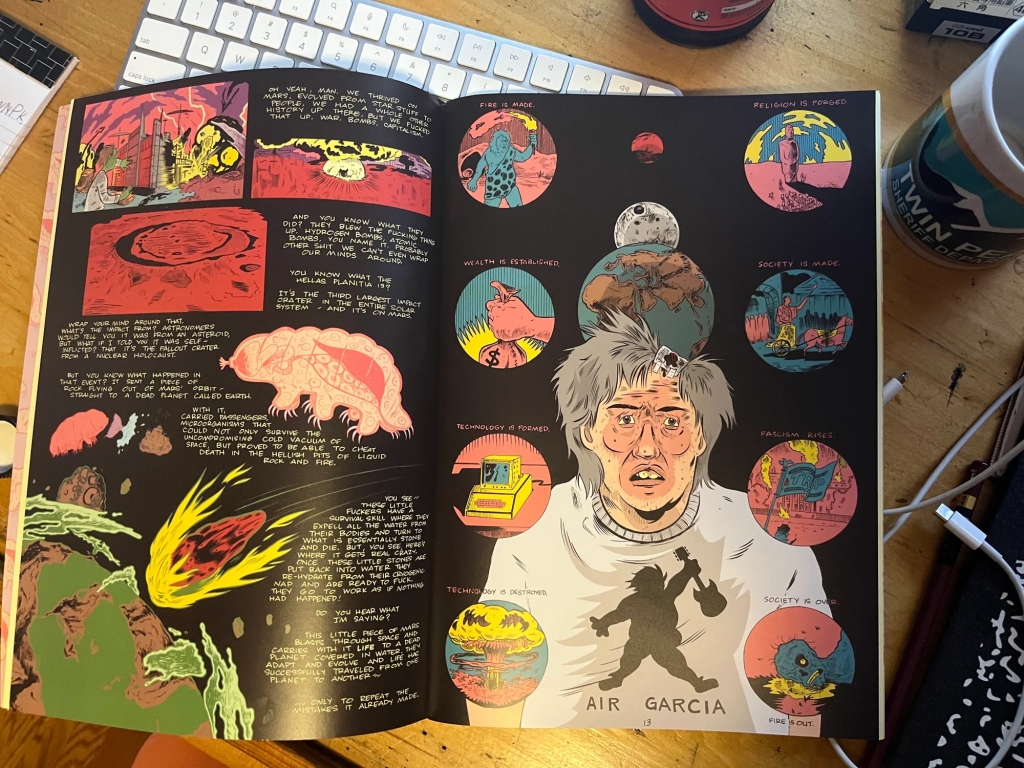
It helps, of course, that Arnold is such a great fucking cartoonist — his compositions are crisp and imaginative, his figure drawing is technically near-flawless, and his layouts run the gamut from standard-issue to pretty damn far-out with gusto and aplomb. He’s not afraid to challenge himself either conceptually or concretely, and the results speak for themselves : the guy is in full command of some fairly considerable creative powers, and stands out as one of the bright lights in what is arguably America’s most vibrant local cartooning scene. You pass on his stuff at your peril.
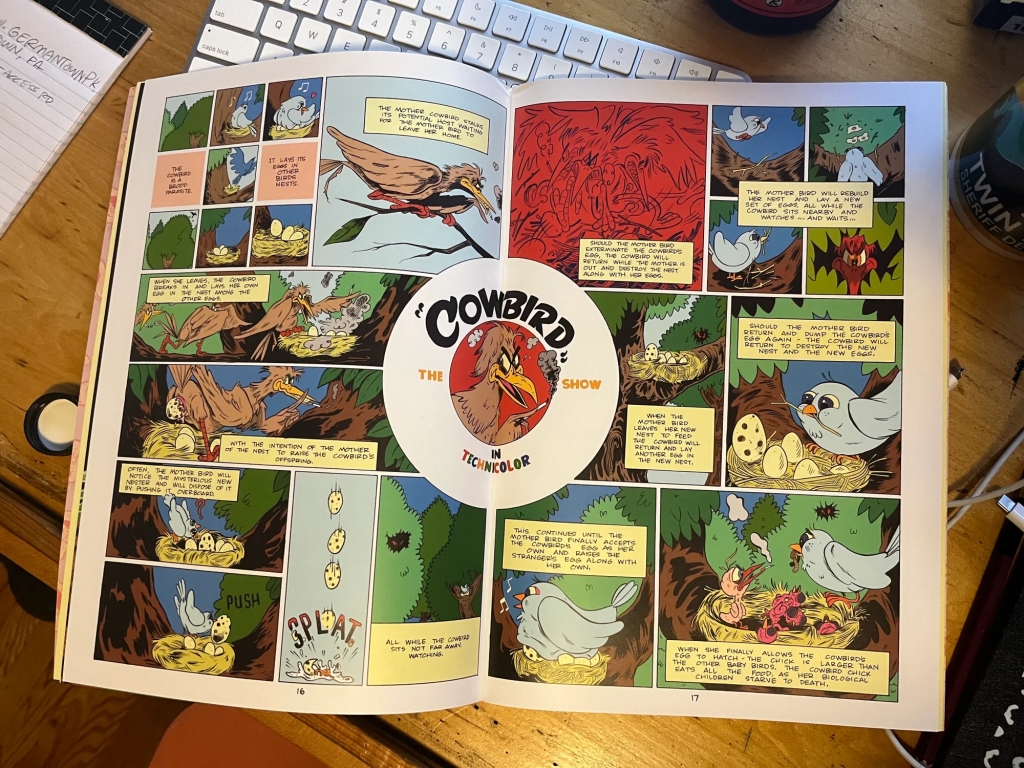
What’s not to like, then? Well, not much, if we’re being totally honest here — and we always are. Tonally, Arnold might be struggling to break free from the Clowes/Ware paradigm, at least to an extent, but his outlook and approach are unique unto himself, even if his overall set of concerns here isn’t. I’m anxious to see where he goes next, absolutely — but for purposes of this review, I’ve gotta say I’m quite impressed with where he is right here and right now.
********************************************************************
Perry Midlife is available for $12.00 from the H.O.T. Press Comics website at https://hotpresscomics.bigcartel.com/product/perry-midlife
Also, this review is “brought to you” by my Patreon site, where I serve up exclusive thrice-weekly rants and ramblings on the worlds of comics, films, television, literature, and politics for as little as a dollar a month. Subscribing is the best way to support my continuing work, so I’d be very appreciative if you’d take a moment to give it a look by directing your kind attention to https://www.patreon.com/fourcolorapocalypse
 Through the Shattered Lens