Film Review: Texas Chainsaw Massacre (dir by David Blue Garcia)


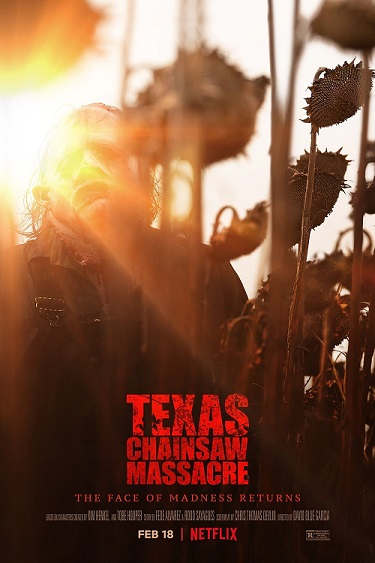
Leatherface is back but don’t worry!  He’s mostly just killing hipsters.

The newest version of Texas Chainsaw Massacre is a direct sequel to the classic 1975 film.  50 years after the murders the shocked the world, Leatherface is still missing.  True crime shows still do specials about the massacre at Harlow, Texas and the mysterious murderer who were a mask made out of human skin.  The only survivor of that massacre, Sally Hardestry (Olwen Fouéré, taking over the role from the late Marilyn Burns), went from being a half-crazed hippie to being a Texas Ranger.  She spent decades searching for Leatherface but she never found him.

I can only assume this means that Sally was terrible at her job because this film reveals that Leatherface is still living in the small rural town of Harlow, Texas.  Harlow has been largely abandoned since the original massacre.  But Mrs. Mc (Alice Krige) still owns the orphanage where Leatherface apparently grew up and Leatherface still lives with her, which is weird since Leatherface had a very tight-knit family in the first film and all of the subsequent sequels.  (As opposed to what David Gordon Green did with his Halloween reboot, the new Texas Chainsaw Massacre does not go out if its way to specifically deny the canonicity of the other Chainsaw films.  I, for one, appreciated that.  Regardless to what the critics may say, there’s always been a rather appalling smugness to the way that Green’s Halloween franchise casually wiped out everything that came after Carpenter’s original film.)  Unfortunately, the bank has foreclosed on most of Harlow and the town has been bought by a bunch of Austin hipsters, who are planning on turning the town into a Marfa-style artist’s colony.  I guess the idea is that artists will be attracted to the town by its cannibalistic history, just as some are attracted to Marfa’s frequent UFO spottings.  Of course, the Marfa Lights have never killed anyone but who knows?  Austin’s weird.

When the main hipster and the sheriff order Mrs. Mc to leave the orphanage, she has a heart attack.  Leatherface accompanies her in the ambulance because, apparently, no one finds it odd that there’s a silent, hulking man wandering around in the same location where a silent, hulking man previously killed a lot of people.  About halfway to the hospital, Mrs. Mc dies and Leatherface decides that it’s time to retrieve his tools and go hipster hunting.

The new Texas Chainsaw Massacre isn’t terrible as much as its just generic.  Everything about it feels like it’s been lifted from other recent horror revivals.  The film opens with some stabs at modern relevance, with scary rednecks glaring at the Yankee invaders and Dante (Jacob Latimore) declaring the Harlow represents the “joys of late stage capitalism.”  Lila (Elsie Fisher, who previously starred in Eighth Grade and who gives a good performance here, despite getting stuck with a poorly written character) is a survivor of a school shooting and she gets upset when she sees that the local mechanic owns an AR-15.  The film then turns, very briefly, into a social satire when the smug hipsters are revealed to be just as greedy and superficial as the people that they’re looking down on.  However, once Leatherface grabs his chainsaw, it turns into just another slasher film.  Sally does eventually show up and calls Leatherface a “motherfucker” while pointing a rifle at him but that moment feels a bit too derivative of the recent Halloween films.  Perhaps if Marilyn Burns were still alive and had returned to play the role, Sally vs. Leatherface would have been the iconic horror moment that it was obviously meant to be but, with a new actress who doesn’t even have a Texas accent, it just feels a bit forced.  The problem with this slasher film being generic is that it’s called Texas Chainsaw Massacre.  That’s quite a legacy to live up to and, for a lot of horror fans, generic simply won’t cut it.

Indeed, as I watched this latest version, I couldn’t help but think about what made the original version a classic.  The original version used its low budget to its advantage.  It had a rough, raw feel to it, one that made you feel as if you were watching real people as opposed to local actors.  It also had very little gore, leaving it to the audience to imagine what horror truly went on inside of Leatherface’s kitchen.  (Needless to say, the imagination can always come up with something far more disturbing than anything that could actually be captured on film.)  This new version takes the opposite approach.  If the original worked because it haunted you after the final frame, the new version is all on the surface. There’s a lack of authenticity to this new version of Texas Chainsaw Massacre.  The first film was made by Texans and it was filmed in Texas.  You could look at any scene in the original and feel the heat and the humidity.  This new version was filmed in Bulgaria.  Texas may be in the title but it’s nowhere in the film.

(Indeed, one of the main reasons why the original film was a success was because it was identified as taking place in Texas, a state that scared a lot of people when the film was originally released and a state that, admittedly, probably still scare scares a lot of people, even though we’re all pretty nice down here.  People would laugh off a Vermont Chainsaw Massacre.)

There’s also no family dynamic in this new version.  There’s no sign of Leatherface’s brothers or their ancient grandpa.  Once Mrs. Mc dies, it’s pretty much just Leatherface and no one, not even Sally, comments on the fact that Leatherface didn’t work alone in the first film.  Without his family around, Leatherface just becomes another silent serial killer.  There were times, in the sequel, where he seemed like he had more in common with Rob Zombie’s version of Michael Myers than with the overwhelmed but hard-working Leatherface of the original film.

That said, on the positive side, I did appreciate the remake’s final scene.  It was a bit predictable but it still managed to be enjoyably chaotic.  What’s more annoying?  Leatherface or a self-driving car?
Music Video of the Day: Find My Baby by Moby (2000, dir by Barnaby & Scott)


You may remember that this song plays over the end credits for American Outlaws. It was a good pick because the song has a real western feel to it. That said, it also has nothing to do with this music video, which interprets the song fairly literally. “Oh my God! They really are finding a baby!”

These babies are all adults now.

Enjoy!

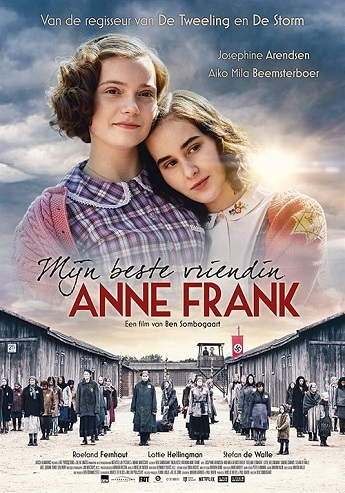
Film Review: My Best Friend Anne Frank (dir by Ben Sombogaart)


The year is 1944 and 16 year-old Hannah Goslar (Josephine Arendsen) and her younger sister, Gabi, are among the many Jews being held at the Bergen-Belsen concentration camp.  Death is all around.  At night, when Hannah is sent to empty out the buckets of waste that have been filled up in her barracks, she sees another prisoner being casually shot by the guards.  Whenever things get to be too much for her, Hannah closes her eyes and asks herself, “What would Anne do?”

As terrible as things are where Hannah is being held, it’s rumored that things are even worse behind the wall that runs through the center of the camp.  The less “privileged” prisoners are kept there.  The wall is thin enough that Hannah can talk to the people on the other side, even if she can’t see them.  Hannah asks them if her best friend, Anne, is among them.  “She has beautiful hair,” Hannah says.  The voice on the other side of the wall explains that no one in the other half of the camp has hair.  Everyone on the other side of the wall is being starved and worked to death.

Occasionally, Hannah remembers what life was like before she and her family were arrested by the Nazis.  Two years earlier, she was a student in Amsterdam and her best friend was Anne Frank (Aiko Beemsterboer).  Hannah was shy but Anne definitely wasn’t.  Hannah was often naïve and fearful but Anne was always intellectually curious and up to try almost anything.  Occasionally, they fought as friends sometimes do.  But Hannah always considered Anne to be her best friend.

The Amsterdam scenes do a good job of contrasting Hannah and Anne acting like ordinary teenagers with the evil that’s always lurking in the background.  Haughty soldiers in German military uniforms stroll the streets of Amsterdam, moving with the arrogance of men who know that no one can defy them.  Because Hannah and Anne wear gold stars on their clothing, they have to sneak into the movies and, when they do, they find themselves watching a propaganda newsreel about how much better life is in the Netherlands now that the Germans are in charge.  Hannah often sees her father having hushed conversations with other nervous-looking adults.

Of course, those of us watching at home know what is going to happen.  We know who Anne Frank was.  Or, I should say, I hope we know who Anne Frank was.  I tend to assume that everyone knows about the horror of the Holocaust and that everyone knows about the anti-Semitism that fueled the rise of Adolf Hitler and the Third Reich.  Unfortunately, over the past year or so, my faith has been shaken.  Anti-Semitism has never gone away but, in recent years, it seems as if it’s become socially acceptable within certain parts of mainstream society and that really should scare the Hell out of anyone who has any knowledge of history.  I have seen reportedly intelligent people either playing down the horrors of the Holocaust or trying to act as if the Holocaust was not about the Third Reich’s obsession with wiping out a race of people.  Whoopi Goldberg may have been the most famous person to have recently gotten the facts of the Holocaust wrong but she’s hardly the only one.

To me, that’s why a film like My Best Friend Anne Frank is important because it reminds us of not only what happened at camps like Bergen-Belsen but also what happened beforehand.  The camps and the ideology that fueled them didn’t just spring up out of nowhere.  Instead, they were built while the rest of the world tried to deny what was happening right before their eyes.  The concentration camp scenes in this film are harrowing but even more disturbing are the Amsterdam scenes where people casually walk by signs that declare that no Jews allowed and almost everyone merely averts their eyes.  When Anne and Hannah walk through Amsterdam, they are insulted not just by the Nazis but also by the Dutch citizens who don’t wear gold stars, many of who seem to take an attitude of, “At least it’s not me being othered.”

My Best Friend Anne Frank is currently on Netflix.  Josephine Arendsen and Aiko Beemsterboer both give good and heart-breaking performances as Hannah and Anne.  The film is not just a story of survival under the worst of circumstances but it’s also a tribute to the power of friendship.  Though Anne did not survive the camps, Hannah was liberated after 14 months at Bergen-Belsen and now lives in Jerusalem.  She is now 93 years old.

Comics As Unresolved Labyrinth : Bruce Zeines’ “Life Out Of Sequence”


Confession time : the title of this review isn’t mine. But it sure is good, so I appropriated it — fortunately, from the very book we’re here to take a look at, so I needn’t feel too terribly guilty. And, in truth, the notion of graphic sequential storytelling as an “unresolved labyrinth” is only one of many that stuck with me long after I closed the covers of cartoonist Bruce Zeines’ 2021 self-published opus on the nature of very medium he’s utilizing, Life Out Of Sequence. Time, spatiality, the unique properties and possibilities that a blank page to be populated by juxtaposed words and images offers — Zeines is equally haunted and fascinated by all these things, and so the subtitle of this, the second volume in his “Musings” series, is very apropos indeed : “A Personal Exploration Of Sequential Art.”

I’m tempted to be glib here and say that Zeines accomplishes more in a standard-format (and standard-length) comic book than Scott McCloud did in a “doorstop” graphic novel, but in truth this is no “primer” on the medium a la Understanding Comics, nor is it a de facto “how-to” guide for aspiring cartoonists to take their cues from. The word “Personal” in that subtitle looms large here, as this is Zeines feeling his own way forward through his creative process, and commenting upon it as he does so — not so much a lecture, then, as it is a mapping out of territory that is ever fresh, ever new, ever confounding, ever expansive. Did I just say it was a map? Maybe more like an atlas — but a decidedly theoretical one.

What’s not at all theoretical but is, rather, concrete reality is the power of Zeines’ intensely-rendered and almost obsessively-detailed illustration : he fills every scintilla of space with imaginatively-conveyed visual information that somehow establishes, and subsequently sustains, an incredible naturalistic fluidity in spite of its admittedly crowded-at-first-glance appearance : it’s a lot to take in, sure, but the act of doing so is thrilling, immersive, and never less than consequential. Zeines doesn’t waste a line or a brush stroke any more than he wastes a conceptual thread or a thematic beat — this is story and art both with a purpose and related for a purpose, and while those may seem like they should always be one and the same thing, a masterfully-articulated work such as this makes you realize how often one or the other is either serving a subservient role or, even worse, absent altogether. Not so here — this is a cartoonist at the absolute height of his powers grappling with how to most effectively use them. And, for the record, succeeding marvelously at doing so.

What’s perhaps most remarkable about all of this, though, is the welcoming, accessible, and downright conversational tone that Zeines maintains throughout — these are some heavy issues he’s tackling for those of us with a personal investment in the comics medium, and he’s approaching them with the near-reverential respect they deserve, without ever crossing the line into pretentious gibberish or faux-erudition. Somebody who’s never picked up a comic could enjoy this quite easily, then, but for those of us who pick up hundreds, if not thousands, of them per year? Well, this is the kind of thing that sends us over the damn moon — a dissertation on the form we love, communicated through the form we love, that deepens our admiration of the form we love.

I realize I’m preaching to the choir here, but there’s nothing a person can’t do with words and pictures — as Zeines himself knows full well. Given that, then, the next thing to figure out is how to use words and pictures to their utmost as a storytelling tool. I think it’s something all comics creators and readers grapple with — sometimes consciously, more often unconsciously — and to see it dealt with from a fresh perspective many actually haven’t considered at all is an unexpected joy. I hope I’m not giving away too much here, but Zines’ central thesis is that life itself — and certainly memory — doesn’t actually have a sequential flow, so arranging a visual story in a way that does? Well, it’s a bigger challenge than it would at first appear.

I’ll tell you what, though : this is an artist who’s more than up to that challenge, and probably any other that you can throw his way. And so I’ll close this review with a challenge to you, the reader : find me a flaw in this comic. Anywhere. Because I sure as hell can’t.

***************************************************************

Life Out Of Sequence is available for $15.00 from Austin English’s Domino Books distro at http://dominobooks.org/lifesequence.html

Also, be sure to check out Bruce Zeines’ website at https://www.theartofbrucezeines.com/

4 Shots From 4 Films: Special Alejandro Jodorowsky Edition


4 Or More Shots From 4 Or More Films is just what it says it is, 4 shots from 4 of our favorite films. As opposed to the reviews and recaps that we usually post, 4 Shots From 4 Films lets the visuals do the talking!

Today, the Shattered Lens wishes a happy birthday to master of surrealism and the man who nearly turned Dune into a film before either David Lynch or Denis Villeneuve, Alejandro Jodorowsky!  It’s time for….

4 Shots From 4 Alejandro Jodorowsky Films

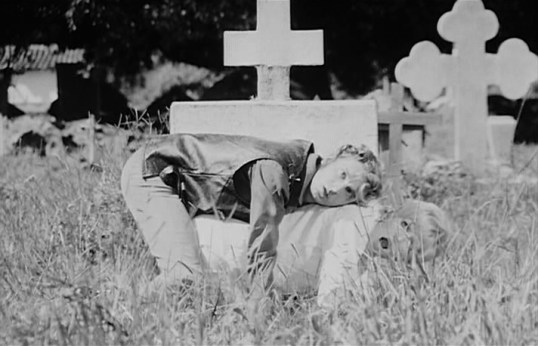
Fando y Lis (1968, dir by Alejandro Jodorowsky, DP: Rafael Corkidi and Antonio Reynoso)

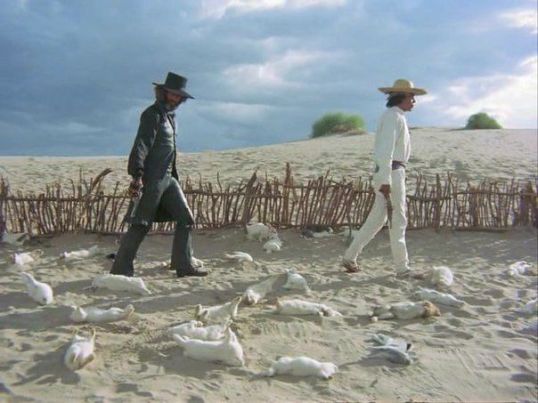
El Topo (1970, dir by Alejandro Jodorowsky, DP: Rafael Corkidi)

The Holy Mountain (1973, dir by Alejandro Jodorowsky, DP: Rafael Corkidi)

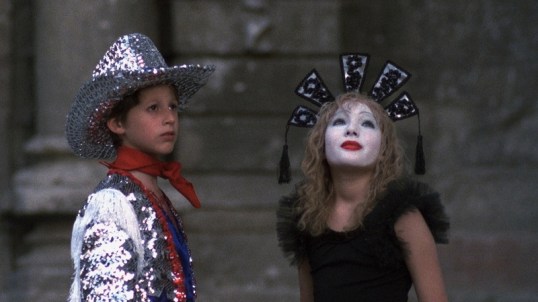
Santa Sangre (1989, dir by Alejandro Jodorwosky, DP: Daniele Nannuzzi)

Music Video of the Day: How Long by Tove Lo (2022, dir by KENTEN)


Today’s music video of the day is another emotional music video from Tove Lo.  This is what I like whenever I watch a move about …. well, a movie about anything.  It’s not that hard to make me cry.

Enjoy!

Try to play it cool
I like you
Have me in your hand
Just like that
Wish I never told ya
It’s killing me to wonder

You give, you give me

Empty promises of love
You’re an honest man when you’re drunk
Wish I never asked ya
But it’s killing me to wonder
How long
How long

How long have you loved another
While I’m dreaming of us together
She got the best of you
Part of me always knew
How long have you tried to end it
While I’m blaming myself to fix it
How long
How long

Listen to my fears
Not my friends
They don’t tell the truth
They like you
Wish I never told ya (but I told ya)
It’s killing me to wonder (I wonder)

You give, you give me

Empty promises of love
You’re an honest man when you’re drunk
Wish I never asked ya
But it’s killing me to wonder
How long
How long

How long have you loved another
While I’m dreaming of us together
She got the best of you
Part of me always knew
How long have you tried to end it
While I’m blaming myself to fix it
How long
How long
I need to know how
How long have you loved another
While I’m dreaming of us together
How long

I know love isn’t fair
I know the heart wants what it wants
There’s no way to prepare
For burning brutal rejection
I know it takes some time
To feel the pain of loosing a lie

How long have you loved another
While I’m dreaming of us together
She got the best of you
Part of me always knew
How long have you tried to end it
While I’m blaming myself to fix it
How long
How long
I need to know how
How long have you loved another
While I’m dreaming of us together
How long
How long

A Rough Kind Of Magic : Frances Cordelia Beaver’s “On A Cute One”


Can earnestness and heart alone carry a 600-plus-page graphic novel?

It’s a question I’d never thought to ask myself before, but was forced to upon completion of Philadelphia-based cartoonist Frances Cordelia Beaver’s new self-published tome On A Cute One, both because of where and how the book shines and where and how it comes up short. To be clear : what it does well, it does really well, and the ways in which it misses the mark aren’t “deal-breakers” by any stretch, so maybe I’ve answered my own introductory question here already, but nevertheless, let’s dig a bit deeper. After all, this is an ambitious work and has earned the right to be examined closely —

It’s clear right from the copyright indicia here that Beaver is straddling a fine line between memoir and fantasy, in a manner referred to in the literary world as “auto-fiction,” so it’s a given that many of protagonist Cordie’s thoughts, feelings, and experiences are rooted firmly in the artist’s own — but then there’s the whole Gorgon thing she’s got going on so, ya know, expect a fair degree of creative license, as well. Essentially, this is a travelogue relating a cross-country-and-back-again journey Cordie takes on a “Superliner” train (I guess a kind of Amtrak on steroids?), but it’s peppered with flashbacks and reminiscences generally related to her coming out and subsequent process of transition, so in that respect it has some thematic resonances and commonalities with celebrated recent works such as Maia Kobabe’s Gender Queer and L. Nichols’ Flocks — but to Beaver’s credit, she largely eschews delivering a “primer” of sorts on issues relating to the non-binary community in favor of speaking to audiences who may or may not be trans themselves, but at least have a degree of social familiarity with trans individuals. Her narrative starting point, then, is not with early-days gender dysphoria but rather is considerably, for lack of a more readily available term, further down the road. That’s refreshing, as are Beaver’s emotively-articulated points of view on various issues trans folks face, particularly her detailed examination of trans women’s quest for acceptance among cis women, which is a recurring theme here that she deals with in an admirably open, honest, and candid fashion.

In fact, candor in general is something this book certainly doesn’t lack — Beaver’s authorial tone is remarkably frank and has no time for pretense, which is something I think we can all appreciate. What I will say, however, is that she probably could have used the services of an editor here. The pacing of the marrative is generally relaxed and fluid, but every once in awhile she’ll insert a jarring page loaded down with far too much exposition for its own good that puts the breaks on the rhythm of her storytelling, and I also found some of her flashback scenes to be handled a bit — -well, perhaps not so much clumsily as confusedly. There are instances where it’s not really clear at first when something is occurring and again, it seems to me that a pair of editorial eyes could have helped with that.

A couple things worth mentioning vis a vis the always-nebulous “style points” category : a LOT of this book is composed of double-page spreads, and they break right in the middle, as you can see above. Beaver is putting this out via the auspices of Lulu, so there’s probably nothing much that can be done about that, but it’s a shame, because her cartooning is well-thought-out, expressive, quite often imaginative and, when she’s drawing landscapes, flat-out gorgeous. It’s a travesty to see it bisected. One thing more firmly within Beaver’s control that I think lets the side down, though, is her decision to use computer-font lettering. I get it, this is a well and truly homemade project and one only has so much time, but Beaver’s hand lettering (utilized primarily, ironically, when she’s showing Cordie’s phone screen) is superb, and mechanical lettering can’t help but feel sterile and cold, which means in this case that it’s working directly against the otherwise-entirely-heartfelt aesthetics of the book as a whole.

All that being said, perhaps because this is so obviously a labor of love, in some ways I can’t help but find its technical and production “flaws,” as well as some of the overall amateurism on display (there are any number of questionable grammar choices, the monster metaphor at the heart of the narrative is sometimes too oblique for its own good, other times too obvious) to be more than a bit endearing in their own way. I do believe in granting “points for trying,” so while it’s never in doubt that Beaver is clearly “learning on the job,” so to speak, in my estimation that almost always makes for an interesting and exciting ride, even if it’s necessarily a bumpy one. There’s a world of difference between putting it all on the page and pouring your all into a page, and given the choice, I’ll opt for the latter every time — on that most crucial score, this is a book that I can say in all honesty absolutely never fails to deliver.

********************************************************************

On A Cute One is available for $45.50 at https://www.lulu.com/en/us/shop/frances-beaver/on-a-cute-one/paperback/product-685m56.html?page=1&pageSize=4

Check out Frances Cordelia Beaver’s website at https://www.francescordeliabeaver.com/

TV Review: Pam & Tommy 1.5 “Uncle Jim & Aunt Susie in Duluth” (dir by Gwyneth Horder-Payton)


This week’s episode of Pam & Tommy was a definite improvement on last week’s, largely because it didn’t feature Seth Rogen wandering around with a “poor me” expression on his face.  Last week, far too much time was devoted to Rogen’s sad sack portrayal of Reed Gauthier, who the show insists on trying to make a sympathetic character even though he was essentially just a thief who tried to make a lot of money by stealing and then selling someone else’s private sex tape.

Reed was nowhere to be found in this week’s episode.  Instead, the narrative focused on how Pam and Tommy’s sex tape became a national story.  Not surprisingly, it all turned out to be Tommy Lee’s fault.  When the show opens, Jay Leno won’t make jokes about the sex tape because it’s not something that Uncle Jim and Aunt Susie in Duluth have heard about.  The LA Times won’t run a story on it because the editor says that it’s not real news.  With Pam preparing for the opening of Barb Wire and Tommy working on his new album (and very much aware that his label no longer views him or the band as being a top priority), it appears that there’s a chance that Pam and Tommy can ride this out.

But then Bob Guccione the publisher of Penthouse, gets his hands on the tape and Tommy and a bunch of lawyers decide to file a lawsuit to keep him for publishing stills.  Pam has her doubts but Tommy and the lawyers do what they want.  Guccione responds by saying that he had a first amendment right to publish pictures from the sex tape.  The L.A. Times discovers, from the court filings, that the sex tape was stolen from Pam and Tommy and that it’s being sold without their permission.  With the story going national, Jay Leno realizes that Duluth now know all about it.  On top of all that, Pam learns how to use a search engine!

It was a busy episode.  And, in contrast to the nearly hour-long episodes that proceeded it, it was only 32 minutes long.  A half hour is the perfect amount of time to spend with Pam & Tommy.  Spending more than half an hour with them means dealing with the fact that Tommy’s a moron and Pam really does seem to think that she’s going to win an Oscar for Barb Wire.  Spending just 30 minute with them means that both characters get a chance to present their cases without wearing out their welcome.  Sebastian Stan and Lily James both gave good performances in this week’s episode, with Stan portraying Tommy as being a manchild who is in deep denial about the fact that the 80s are over while Lily James captured Pam’s need to try to keep everyone happy.  It’s Pam who instinctively knows the right way to deal with Guccione but she’s ignored by Tommy and his team of lawyers.  As Pam’s publicist puts it, women are taught from an early age to always say yes and to agree with men, even when they know that the men doesn’t have the slightest idea what they’re talking about.

That said, Pam & Tommy is still definitely a flawed vehicle.  For every moment that works, there’s a moment or a line of dialogue that just tries too hard.  Particularly in the scenes with Jay Leno, Pam & Tommy felt like it was one Nathan Lane cameo away from turning into a Ryan Murphy production.  Five episodes in and the main problem remains that Pam & Tommy continues to struggle to convince the audience that it’s telling a story that needs to be stretched out of over 8 episodes.  If ever a true story was meant to a 90-minute TBS production, this is it.