
This is from 1948. Unfortunately, the identity of the artist is not known.
This is from 1948. Unfortunately, the identity of the artist is not known.
This is Okean Elzy. They may not be a household name here in the States but in Ukraine, there are one of the country’s oldest and most popular rock bands. Today’s music video of the day is about a lot more than just honoring a band.

Purely as physical objects, Alexander Laird’s self-published comics are things of exquisite beauty : lovingly riso-printed, uniquely formatted, conceptualized to a degree that’s flat-out exacting, they stand as a testament to both dedication and determination in equal measure, their execution representing an inherently harmonious marriage with the singular creative vision behind them. I honestly don’t know of any cartoonist who works as hard at holistically integrating the creative with the technical, whose inner artist is so “in tune” with their outer artisan. Each of Laird’s books has the look and feel of an object carefully made by hand.
That being said, anything that is presented this well needs, by default, to feature content that lives up to its presentation, and that can be tough when you’re pulling out all the stops as far as production values go. Laird’s latest, Burg Land 1 : Sleemore Gank, certainly earned high marks across the board from me, but his earlier effort, Oubliette, leaves perhaps a bit to be desired on that score — but is still plenty fascinating as a prima facie example of a legit autuer finding their footing as they go along and developing the themes that would come to be regarded as central concerns in their work.

Stated less pretentiously, this feels like a “warm-up exercise” for ideas and approaches that would eventually end up becoming fleshed out more fully later. And there’s absolutely nothing wrong with that — in fact, it’s crystal clear that Laird’s been in firm possession of a vision for what he wants to achieve in this medium from the outset, it’s simply that this largely-wordless tale of explorer/academic Jest The Scholar venturing through the ruins of a thought-lost civilization and having to survive a monstrous onslaught of, well, monsters is, all told, a less-thoroughly-realized version of what this same cartoonist would do next.
Which, I admit, makes this review something of an unfair exercise on its face — after all, if I’d read this first, I might very well have been blown away by it, rather than “merely” being mightily impressed. On the plus side, though, there’s no question that I did still find it mightily impressive, so if Laird happens to read this at some point, trust me when I say : a win is a win. I still found this to be a remarkable work in the truest sense. And while I may not recommend it as highly as Burg Land 1: Sleemore Gank, I think its status as a kind of blueprint for that comic means that it could very well especially be of interest to those who, like myself, read the latter first.

Or am I wrong about that? I mean, if you’re a Laird “newbie,” this is certainly a great place to start and it gives you a flavor for his utterly unique methodologies and sensibilities. By turns frightening and fun, and drawn in a style that both reflects and magnifies the ultimately-optimistic outlook of its insatiably curious protagonist, it’s a comic about learning and exploration that learns and explores the medium’s formalities and, more importantly, its possibilities in unison with its narrative. I invoked the term “holistic” earlier, and there’s absolutely no doubt that this is a breathtaking working example of that principle writ — and drawn — large.

Lest there be any misunderstanding, then : this is not a recommendation tempered by any sort of caution — it’s an enthusiastic and unreserved one. Sure, I liked Burg Land 1 : Sleemore Gank a bit more, but so what? I liked that more than just about anything I’ve read recently, and the list of “stuff I didn’t like quite as much” includes a lot of damn fine comics. This is one of them and, furthermore, one of the better ones at that.
************************************************************
Oubliette is available for $12.00 from Alexander Laird’s website at https://sensitiveathletes.bigcartel.com/product/oubliette
Also, this review is “brought to you” by my Patreon site, where I serve up exclusive thrice-weekly rants and ramblings on the worlds of comics , films, television, literature, and politics for as little as a dollar a month. Subscribing is the best way to support my continuing work, so I’ve be very appreciative indeed if you’d take a moment to give it a look by directing your kind attention to https://www.patreon.com/fourcolorapocalypse
 Mike Klein (David Duchovny) is a scriptwriter who suffers from chronic backpain and whose wife (Justine Bateman) is pregnant. Mike has developed an autobiographical TV dramedy about a young man trying to come to terms with the suicide of his brother. He’s sold it to one of the networks but, when he tries to shoot the pilot, he watches as his original concept is continually compromised and diluted by Lenny (Sigourney Weaver), the president of the network. After rejecting Mike’s choice for the lead role because the actor had a beard, Lenny forces him to cast Zack Harper (Fran Kranz), a mugging young actor who lets pre-stardom go to his head. Lenny continues to change Mike’s concept until he can barely even recognize his pilot. Will Mike be able to retain his vision or will network TV continue to be dominated by shows like Slut Wars?
Occasionally, you’ll see a film that was obviously made by a writer/director who was obviously looking to settle some old scores with the studio execs that he had to deal with in the past. Christopher Guest’s first film as a director was The Big Picture, a sharp and clever satire with Kevin Bacon as a film student who discovers there’s little he won’t compromise on to get his film made. Before Guest’s film, Blake Edwards lost a fortune making a film called S.O.B. because he wanted to get back at the people who he blamed for ruining Darling Lili. Continuing the tradition of those films but moving the action to the networks, The TV Set was directed by Jake Kasdan, the son of Lawrence Kasdan. Jake worked on a number of TV shows with Judd Apatow (most famously, Freaks and Geeks) and The TV Set feels like his chance to get revenge on any number of real-life studio execs. It’s an insider’s view of what’s wrong with television but sometimes it becomes such an insider’s view that it becomes hard to relate to Mike and or really care about his show, which sounded pretty bad even before the network suits got involved. Too often, it feels like the movie itself is more about settling personal grudges than saying anything about the state of television.
The TV Set has got a large cast, some of whom manage to create an interesting character despite Kasdan’s overstuffed script. I especially liked Judy Greer, who played Mike’s always-positive agent. I got the feeling that we were supposed to be as annoyed with Greer’s character as Mike often was but Greer gives such an energetic performance that it’s impossible to dislike her, no matter how far she went in her attempts to always put a positive spin on the bad news coming from the set of Mike’s pilot. I also like Fran Kranz and Lindsay Sloane, who played the two actors forced on Mike by the studio. Indeed, probably one of the film’s biggest problems is that all of the characters that we’re supposed to find annoying are played such likable actors that it’s hard to really sympathize with Mike when he starts complaining about them. David Duchovny sleepwalks through the role of Mike but he’s not helped by a script that can never seem to decide if Mike’s supposed to be a visionary or just a hopeless naïve victim of the industry.
The TV Set, which was made a few years before the start of the streaming revolution, ends with a warning that television will soon be full of shows like Slut Wars and there won’t be any room for artists like Mike Klein. The TV Set wasn’t wrong but what it failed to predict was that there would soon be other platforms on which the Mike Kleins of the word could broadcast their shows.

This is from 1930. I especially like the cat.
Rest in Peace, Mark Lanegan.

I’ve seen some wild shit in my time as a comics critic, but for sheer conceptual bravado, few things can match Ukrainian cartoonist Andrew Zakolodny’s new Strangers-published surreal mindfuck Deadnauts, a combustible admixture of high-concept science fiction, drug-addled paranoia, black humor, militaristic uber-violence, and gross-out body horror — among other things. If you’re even remotely squeamish, this is a book you want less than zero to do with. But, hey, if you’re not —
Well, if you’re not, one of the first things you’ll learn is that the curious term “otherside” in this review’s title is no misprint — it’s a place beyond death, or maybe that should be the place beyond death, and serves as the extra-dimensional battlefield which much of Zakolodny’s story takes place in. We’ve all heard of suicide bombers who believe they’ll live eternally after death, but the terrorists in this yarn know it because they actually go there — or part of them does, at any rate. They’re in possession, you see, of some sort of largely-unexplained (probably because it’s flat-out inexplicable) occult technology that allows them to project their consciousness over to this “otherside” in hopes of affecting some kind of takeover of the place, which sounds to me like it’d be a pretty tough thing to organize any kind of opposition or resistance to — unless, ya know, people are willing to die to go over there and stop them. Good luck getting volunteers for that.

Still, this is comics — since when does logic apply? So, yeah — if you’re getting the idea that “death is just the beginning” here, you’re getting the right idea. Because the otherside is so fucked up that it’s actually enough to make a person — or any sort of life form — wish they were alive again. Yes, even the members of the special forces (or whatever) team that goes over to stop the dastardly terrorists — a team full of individuals who are all technically suicidal by definition. I told you this book was effing crazy.
What I’ll also tell you is that it’s crazy in the best possible way — you’ll never know what’s coming next because you can barely figure out what’s going on right now, and even when you do get something resembling a kind of metaphorical footing, you’ll find it’s ripped out from under you pretty quickly. Zakolodny is a master at not just keep you off-balance, but keeping you off your rocker — if he were a prize fighter, his first punch would be a TKO and he’d pummel you repeatedly after the bell just to make good and sure you didn’t get up off the mat. Your job, then, as a reader, is to learn to enjoy the beating.

Which, believe it or not, isn’t actually all that tough a task. The art in this comic is arresting and addictive, all inky blacks and squiggly lines and imaginative forms and even more imaginative locations — it looks and feels like your worst-ever acid trip committed to paper, only cool. There’s a lot to decipher — both narratively and, especially, visually — but doing so doesn’t feel like work by any stretch, even if it is exceptionally goddamn challenging. I know my readers, though (at least, I like to think I do), and so I know that if you’re not up for a challenge, chances are you’re not paying any attention to this blog in the first place. I mean, who are we kidding? Getting through one of my reviews can sometimes be challenging enough in and of itself.

Is this a qualified recommendation, then? You bet it is. Most are. There are a lot of perfectly rational, nice, fair-minded people who will take one look at Zakolodny’s ‘zine and give it a hard pass. But for those who revel in the refined pleasures of the heretical, the extreme, the foreboding and forbidden — for those who consider “beyond the pale” to be the starting line rather than the off-ramp — this isn’t just memorable, visceral, mind-bending stuff : it’s the kind of comic you live for. Or should that be the kind of comic you die for?
***************************************************
Deadnauts is available for $7.00 from Strangers at https://strangerspublishing.com/products/deadnauts-by-andrew-zakolodny
Also, this review is “brought to you” by my Patreon site, where I serve up exclusive thrice-weekly rants and ramblings on the worlds of comics, films, television, literature, and politics for as little as a dollar a month. Subscribing is the best way to support my continuing work, so I’d be very appreciative indeed if you’d take a moment to give it a look by directing your kind attention to https://www.patreon.com/fourcolorapocalypse
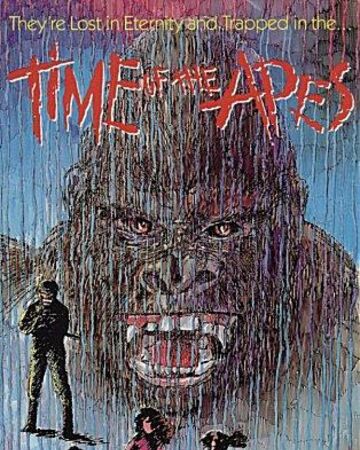 Stop me if you’ve heard this one before.
As a result of a natural disaster, three people are frozen. By the time that they thaw it, several hundreds of years have passed and Earth is now a very different place. Humans are now second-class citizens and the planet is ruled by apes, who speak English, live in their own cities, and have their own militaristic society. The humans go on the run, to avoid being possibly destroyed by the ape leaders who either cannot accept or are trying to cover up the fact that Earth was once dominated by humans. In fact, it’s almost as if the humans have found themselves on a planet of the…
You get the idea.
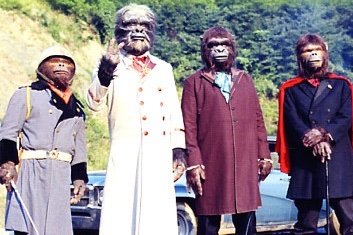
Time of the Apes may sound like a blatant Planet of the Apes rip-off but there are a few differences. First off, instead of Charlton Heston, humanity is represented by Catherine and two children who, for reasons that are not exactly clear, thought it would be a good idea to ride out an earthquake in a cryogenic chamber. (You science teacher right. That’s exactly how you accidentally freeze yourself for several centuries.) Secondly, the apes in Time of the Apes don’t ride horses or wear their leather outfits. Instead, they were suits and police uniforms and they drive Buicks and station wagons. Time of the Apes may take place far in the future but the ape way of life is still trapped in 1974. Catherine and the two brats eventually meet another human named Godo (Tetsuya Ushio). Unlike the nearly-naked future humans in Planet of the Apes, Godo wears a turtleneck.
To understand Time of the Apes, you have to understand that it was originally a 26-episode Japanese television series that aired in 1974, at the height of Planet of the Apes mania. 13 years later, America producer Sandy Frank got the rights to the series and decided to edit it down from 26 hours to 93 minutes so that he could release it as a movie. As a result, Time of the Apes is a disjointed movie in which the action seems to frequently repeat itself but it’s never boring. Between the apes and the sudden appearance of a flying saucer, there’s always something to watch. It’s never really good either, though. The ape makeup is terrible. The dubbing is worse. If you can watch the movie for five minutes without laughing at the ineptitude of it all, you’re a stronger movie watcher than me.
Time of the Apes is pretty much impossible to see unless you’re watching the Mystery Science Theater version. The MST 3K gang liked the film so much that they actually did it twice, once during the show’s later disowned first season (when it was basically just a cable access program in Minnesota) and once more after the show started to air nationally. It’s rightfully considered to be one of MST 3K’s best episodes and it’s probably the best possible way to watch Time of the Apes. You need Joel and the Bots there to assure you that you did actually just see and hear what you think you saw and heard. Sandy Frank was apparently not amused by the show’s lampooning of Time of the Apes but he really should lighten up. MST 3K brought Time of the Apes to an entirely new and appreciative audience.
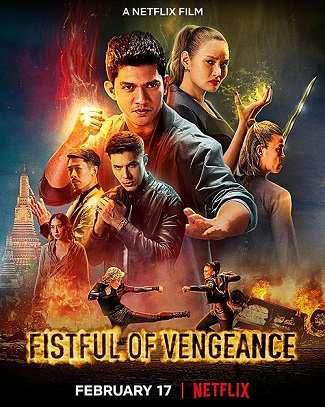
I just finished watching Fistful of Vengeance on Netflix. The film has a running time of 95 minutes and I have to admit that I spent a good deal of the film in a state of confusion. While some of that was undoubtedly due to my ADD, there are two other factors to consider:
First off, Fistful of Vengeance is based on a show called Wu Assassins. (Wu Assassins is also available on Netflix.) The movie takes place immediately after the end of the show’s first season. At this point, I should go ahead and admit that I have never seen the show. The movie does start with a quick recap of who everyone is and why they’re running around the world and fighting supernatural warriors and, from what I’ve read, the film itself is meant to be stand-alone work of entertainment. That said, I’m sure it can be argued that my lack of knowledge of Wu Assassins effected my ability to actually follow the plot of Fistful of Vengeance. If you’re a fan of the show, you should probably just watch the movie and ignore my review.
The second thing to consider about Fistful of Vengeance is that the plot really didn’t matter. Yes, there’s a lot of people conspiring against each other. Yes, there’s a lot of talk of talismans and spirits and monsters and ancient powers. And, yes, there’s international cartels and magical warriors. There’s a mystery to be solved, as Tommy (Lawrence Kao) and his friends try to track down the person or persons responsible for the death of Tommy’s sister. New allies are found and a few surprisingly enthusiastic sex scenes are staged. Enemies are fought and I assume that there’s a reason for it all. However, when watching the film, it soon becomes obvious that all of that plot is just there as an excuse for the action and the glossy images. Fistful of Vengeance is not plot-driven. Instead, Fistful of Vengeance is driven by style.
And you know what?
There’s not a damn thing wrong with that.
Seriously, you don’t watch a film like this because you’re searching for the meaning of life or because you’re hoping for some form of greater enlightenment. You watch a movie like Fistful of Vengeance because you want to see good-looking people wearing nice clothes and kicking ass. One fight follows another and all you really need to know is that you want Kai Jin (played by action specialist Iko Uwais), Tommy, and their team to win. You don’t really need to know who they’re fighting or why they’re fighting. Instead, the appeal is watching the artistry of the kicks and the punches and the tossing of weapons. Add in some monsters and some magical powers and a nice propulsive soundtrack and the movie pretty much has everything that an audience needs to be entertained. It’s a big, glossy, colorful, and rather silly movie. I had no idea what was going on for most of it but I still found myself watching. It’s fun, it’s entertaining, and it really doesn’t demand much. It’s not really a film that’s going to stick with you but watching it is also not terrible way to spend 95 minutes of your day.
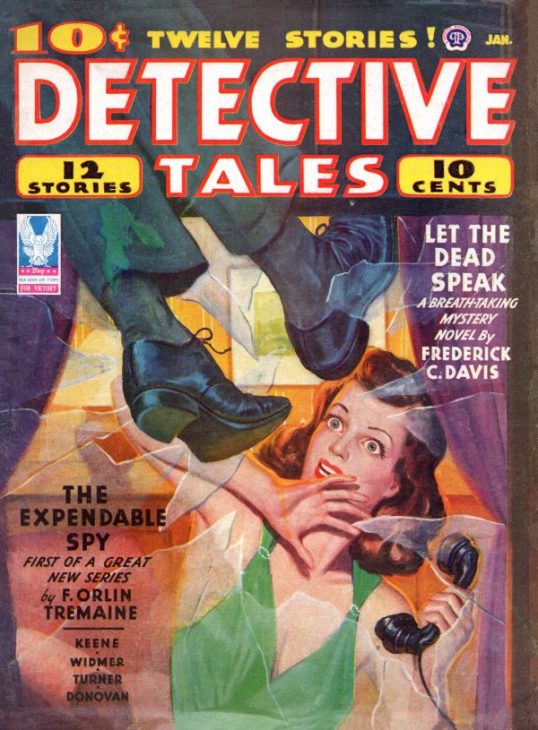
(by Rafael DeSoto)
This is from 1940. Broken glass and a landline phone, it’s everyone’s nightmare come to life.
 Through the Shattered Lens