Film Review: Paterno (dir by Barry Levinson)


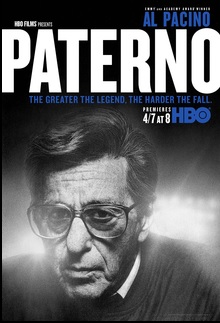
There’s a great scene that occurs about an hour into HBO’s latest original film, Paterno.

Joe Paterno (Al Pacino), the legendary and aging Penn State football coach, has been accused of knowing and failing to report that one of his former assistant coaches, Jerry Sandusky (Jim Johnson), was a pedophile.  With Paterno and his family plotting out strategy behind closed doors, a group of Penn State students gather outside of the Paterno home.  Instead of being angry that children were molested at their college, they’ve come to show their support for Paterno.

“JOE PATERNO!” they chant.

Scott Paterno (Greg Grunberg) hears the chants.  Scott is a lawyer and appears to be the only member of the Paterno family to truly understand the seriousness of the accusations.  Scott steps outside.

“JOE PATERNO!” the crowd continues to chant.

Scott thanks them for their support but then says that they also need to show the same support to all of Sandusky’s victims…

“JOE PATERNO!” the chant continues.

Struggling to be heard, Scott again asks them to remember that the children molested by Sandusky are the ones who need the most support…

Suddenly, the chant changes.  “SCOTT PATERNO!” the crowd starts to chant.  It’s not because they’ve heard anything that Scott’s said.  Instead, it’s because Scott’s a Paterno and, in the eyes of the crowd, that makes him royalty.  As the crowd continues to chant his name, Scott gives up and reenters the house.

Paterno could have used more scenes like that, scenes that explicitly showed the danger of blind hero worship as opposed to just telling us about it.  For the most part, Paterno feels like a well-written Wikipedia article.  You can’t deny the skill with which the film was made but, at the same time, it’s difficult not to get frustrated by Paterno‘s refusal to really dig too far underneath the surface of the story.

Some of the problem is with the film’s structure.  The film primarily takes place over the final six days of Paterno’s career.  Paterno spends the majority of the film locked away in his house, passive aggressively avoiding the question of what he knew and when he knew it.  His wife (Kathy Baker) and his other son, buffoonish Jay (Larry Mitchell), make excuses for him while Scott tries to get everyone to understand that the accusations aren’t just going to go away.  This is the part of the Paterno story that, in most films, would be summed up by an end credits title card.

As a result, Paterno never really deals with why Joe Paterno not only didn’t report Sandusky but also apparently protected him and that, to be honest, is the most important and troubling part of the story.  Since Sandusky is only briefly seen, we never get any insight into his relationship with Paterno and we never understand why Paterno would go to bat for an assistant who he, at one point, refers to as being “a pain in the ass.”  Was Paterno truly clueless about what was happening or did he just think he could sweep it under the rug and nobody would say anything because he was Joe Paterno?  Were Paterno’s actions the result of willful blindness or hubris?  It’s not so much a problem that the film leaves certain questions unanswered as much as it’s a problem that the film itself doesn’t seem to be all that concerned with the answers.

When the film isn’t concentrating on the Paternos, it’s concentrating on the reporter, Sara Ganim (Riley Keough), who originally broke the story.  However, these scenes are never quite as compelling as the film seems to think they are.  Riley Keough, who was so great in American Honey, seems miscast here.  For the most part. Sara seems to be there so that she can witness the Penn State students rioting and chanting, “Fuck the Media” after Paterno loses his job.

The best thing that Paterno has going for it is the lead performance of Al Pacino.  Pacino plays Paterno as a man who is very comfortable with the routine that he’s built up for himself.  His life revolves around Penn State, his team, and finally his own legend.  When the Sandusky story first breaks, Paterno can’t understand why he even has to be concerned about it.  He’s got a game against Nebraska coming up!  Awkward even around his adoring family, Paterno only seems to be truly comfortable when he’s coaching.  Pacino plays Paterno as a fragile and sickly man, a once ferocious lion brought down by a combination of cancer and scandal.  When we first see him, Paterno is coaching his team to a record-setting victory and he seems like a larger-than-life figure.  By the end of the movie, Paterno seems much smaller, a confused man who still can’t seem to bring himself to deal with why everyone is getting so upset.  It’s a great performance in an uneven film.
 

Music Video of the Day: Rock Me by Pills (1997, dir by Mathilde Jouannet)


While visiting with some old friends early on Saturday morning, we decided to watch the 1998 film Run, Lola, Run.

There’s a lot of great things that can be said about Run, Lola, Run but, for now, I just want to say that this song has one of the greatest soundtracks of all time.  This song is one of those that is featured in the film and it’s been stuck in my head ever since.

Maybe it’ll get stuck in your head now, too.

Enjoy!

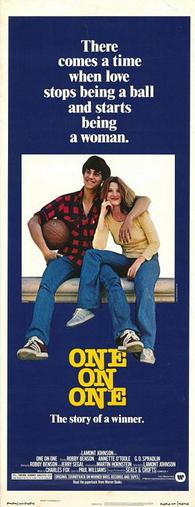
Cleaning Out The DVR: One On One (dir by Lamont Johnson)


Sometimes, I come across things on my DVR that I not only have no memory of recording but which I also cannot, for the life of me, figure out why I decided to record it in the first place.  I recorded the 1977 film One On One off of TCM on January 17th and I’m not really sure why.

It’s not that One On One is a terrible movie or anything like that.  It’s an extremely predictable film and it’s got one of those soundtracks that is extremely 70s but not cool disco-style 70s.  No, instead this film is full of the type of soft rock music that your grandmother listens to while driving to the local CVS Pharmacy.  (The majority of the songs are performed by a group called Seals and Croft and are painfully undanceable.)  But, even with that in mind, it’s not really a bad movie.  If I’m confused about why I recorded it, it’s because One on One is a movie about basketball, which is a sport that holds absolutely zero interest for me.

(My main issue with basketball has to do with the sound of all of those squeaky shoes on the court.)

But, before going any further, let’s watch a commercial:

One on One tells the story of Henry Steele (Robby Benson), a high school basketball star.  Henry is from Colorado, which this film seems to suggest is the equivalent of coming from Siberia.  When Moreland Smith (G.D. Spradlin). the renowned coach of Western University’s basketball team, offers Henry a full athletic scholarship, Henry negotiates a pretty good deal for himself.  Not only is his education going to be paid for but he also wins a guarantee that he’ll never be cut from the team and that his father will get a car.  All Henry has to do is keep his grades up but that shouldn’t be a problem.  Sure, Henry appears to be an idiot but the athletic department will set him up with a tutor and, as long as the coach is happy with him, it’s not like Henry’s actually going to have to go to class.

Upon arriving in Los Angeles, Henry picks up a hitchhiker (a very young Melanie Griffith) who promptly robs him of all of his money.  Once he arrives at the university, he discovers that Coach Smith is not going to be the surrogate father figure that he was expecting.  Instead, Coach Smith is a rather cold and ruthless taskmaster, whose main concern is winning.  When Henry, who is by far the shortest player on the team, struggles, Smith tells Henry that he needs to renounce his scholarship and return home.  When Henry refuses to do so, Smith becomes obsessed with trying to break him.

As Henry’s roommate, Tom (Cory Faucher), points out, Henry’s head is not in the game.  Instead, Henry can’t stop thinking about his tutor, Janet (Annette O’Toole).  At first, Janet assumes that Henry is just a dumb jock, largely because Henry’s a jock and he spends the first half of the movie acting really, really dumb.  Then, out of nowhere, Henry reveals that he’s not only read Moby Dick but he can quote passages from memory.  In fact, Henry even understands that Ahab was — wait for it — obsessed!  Oh my God, Janet realizes, Henry’s literate!  In fact, Janet exclaims that Henry is the first person she’s met who has actually read Moby Dick!  (Really?)  Janet and Henry fall in love but, unfortunately, Janet is already dating her psychology professor.

(The professor has got a beard that looks like it reeks of stale weed and he says stuff like, “Have you seen my sandals?,” so we know better than to take him seriously when he compares the popularity of college athletics to the rise of fascism.  When Henry accuses him of being a hippie, the professor just smirks and says something condescending.  Stupid hippie.)

Will Janet and Henry fall in love?  Will Janet dump her unattractive and unappealing boyfriend so she can date Henry?  Will Henry manage to pass his classes?  Will Henry ever get a chance to prove himself on the court?  Will … oh, why even ask these questions?  You already know what’s going to happen in this movie.  There’s really not a single unexpected moment to be found in One on One.  Everything about the film, from the coach’s ruthlessness to Henry’s transformation from idiot to savvy player, feels pre-ordained.  It’s a predictable movie but, at the same time, it’s a likable movie.  At the start of the film, Benson overplays Henry’s stupidity and O’Toole overplays Janet’s brittleness but, at the film progresses, both performers seem to relax and, by the time the end credits role, they’re actually a fairly likable couple.  Benson even gets a killer final line, one that I imagine made audiences in 1977 applaud.

That said, the film is pretty much stolen by G.D. Spradlin.  Spradlin was a former Oklahoma oilman who reinvented himself as a politician and then as a character actor.  Best known for playing Senator Pat Geary in The Godfather, Part II, Spradlin had a flair for bringing casually corrupt authority figures to life.  In One on One, Spradlin turns Coach Smith into a Mephistophelean figure, offering Henry success at the cost of his soul.  Coach Smith is arrogant, oily, casually racist, and an all-around jerk but, at the same time, it is also obvious that he knows how to lead a team to victory.  The great thing about Spradlin’s performance is to be found in not just how menacing he is but in how charismatic he is.  You never doubt that Coach Smith is both a lousy human being and an absolutely brilliant coach.  If nothing else, he’s good at his job.

As I said at the start of this review, I am not really sure why I recorded One on One but it turned out to be better than I was expecting.  It is a flawed and uneven film but worth watching for Spradlin’s intriguingly villainous turn.


Weekly Reading Round-Up : 04/01/2018 – 04/07/2018


Ryan C. (fourcolorapocalypse)'s avatarRyan C.'s Four Color Apocalypse

This past week’s reading ranged in quality from the sublime to the dire, so let’s take it all in order, from best to worst:

Yellow Negroes And Other Imaginary Creatures presents a triptych of thematically inter-related stories by Parisian (by way of West Africa) cartoonist Yvan Alagbe focused on issues of race, class, the socio-economic divisions rising from/attendant with each, and the risks inherent in attempting to bridge said divides. Deeply rooted in the immigrant experience and illustrated in a breathtaking mix of styles from the intricately hyper-detailed to the amorphous and abstract, Alagbe is a master of utilizing space and shapes to confound expectation and personalize the political — truth be told, I can’t for the life of me recall ever seeing an artist imbue their drawings with so much charged, even combustible, visual information in such an expressive manner, each line a statement in and of itself yet…

View original post 1,048 more words

The Human Orchid: Gorgeous George in ALIAS THE CHAMP (Republic 1949)


gary loggins's avatarcracked rear viewer

WWE’s annual “Wrestlemania” extravaganza is scheduled for Sunday night in New Orleans, so I thought I’d dig up something wrestling related for tonight’s post… 

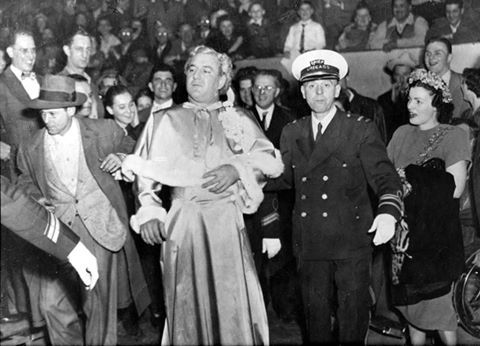
George Raymond Wagner (1915-1963), better known by the nom de guerre Gorgeous George, helped sell more television sets in the late 40’s/early 50’s than anyone this side of ‘Uncle’ Milton Berle . Professional wrestling was on the airwaves six nights a week, on every network, and Americans were clamoring to get a glimpse of the flamboyant antics of the  bleached-blonde, sequin-robed “sissy” who grappled like a wild tiger inside the squared circle. But TV sets were over many an Average Joe’s budget back in those days, so Republic Pictures took the opportunity to strike while the iron was hot, signing “The Toast of the Coast” to star in his own movie, 1949’s ALIAS THE CHAMP.

Gorgeous George in his heyday

The movie itself is nothing…

View original post 531 more words

“Mudbite” : Dave Cooper Is Back, And Ready To Make You Feel Uneasy


Ryan C. (fourcolorapocalypse)'s avatarRyan C.'s Four Color Apocalypse

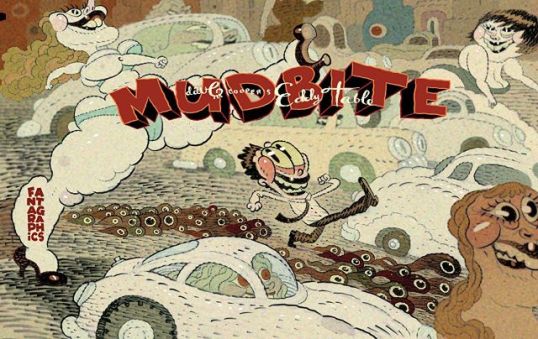
It’s been awhile — 15 years, to be precise — since seminal underground id-baring cartoonist Dave Cooper released a wholly original graphic novel, and while the length of his latest, Fantagraphics-published book, Mudbite, may make it more of a “novella” than anything else, the main thing is that Cooper has, indeed, returned to the fold, his alter-ego protagonist Eddy Table in tow, and that his work as just as singularly unsettling as ever, maybe even moreso. Prepare, then, to feel very disturbed by the things you’re capable of laughing at.

And you will laugh at Mudbite‘s two stories, “Bug Bite” and “Mud River” (now you know where the book’s title comes from), of that there is no doubt — but you’ll just as surely find yourself cringing, scratching your head, even needing to pick your jaw up off the floor on occasion. The biggest question you’ll probably be…

View original post 1,401 more words

Music Video of the Day: HeartBreaker by Steve Aoki featuring Lovefoxxx (2012, dir by BREWER)


How have I not shared more from Steve Aoki on this site?  I have to say that I’m really disappointed with myself.  Oh well, hopefully I can start to rectify that mistake today!

Enjoy!

Here’s The French Trailer For The Man Who Killed Don Quixote!


It took a while but Terry Gilliam has finally made his Don Quixote film.

How long is a while?  Try 19 years.  That’s right.  When pre-production started on The Man Who Killed Don Quixtoe, Bill Clinton was President, George W. Bush was governor of Texas, Barack Obama was starting his first team in the Illinois State House, and Donald Trump was a real estate developer.  Shooting started in 2000 with Jean Rochefort and Johnny Depp in the starring roles but was suspended when the production ran out of money.  In 2002, Lost in La Mancha, a documentary about Gilliam’s then-unfinished film, was released.

Gilliam didn’t give up on the film  Over the next couple of years, production was started and stalled a number of times.  Everyone from Robert Duvall to John Hurt to Ewan McGregor was cast in the film at one time or another.  I think most people assumed that the film would never be finished.

Well, those people were wrong.  Gilliam’s dream project has finally be completed, with Jonathan Pryce and Adam Driver in the leading roles.  It would seem now that the film’s biggest challenge is to live up to all the hype and expectation that comes along with having a 19-year pre-production period.

As for right now, the film does not have an American release date but, yesterday, the first trailer for the French market was released.  And here it is!