Sometimes you just know what a movie’s about before you’ve even seen it.
Take, for instance, the low-budget 2015 Canadian production Man Vs that I checked out on Netflix the other night (I gather that it’s also available on DVD). With a title like that, is there any doubt in your mind that we’re going to have some kind of “reality” TV theme going on here? And that it’s most likely a “found footage” film?
You already know the answers to both those questions, so perhaps the first (and, as it turns out, only) surprise on offer from director Adam Massey and his screenwriter, Thomas Michael (working from a story by Massey himself) is that the “reality” host that their protagonist, Doug (played by Chris Diamantopoulos), is based on has a lot more in common with Bear Grylls than he does with Adam Richman. Nobody’s eating a 20-pound burrito or…
Three Detroit auto workers (played by Harvey Keitel, Yaphet Kotto, and Richard Pryor) are fed up.
It’s not just that management is constantly overworking them and trying to cheat them out of their money. That’s what management does, after all. What really upsets them is that their union is not doing anything to help. While the head of the union is getting rich off of their dues and spending time at the White House, Keitel is struggling to pay for his daughter’s braces, Kotto is in debt to a loan shark, and Pryor is lying to the IRS about the number of children that he has. (When a social worker shows up unexpectedly, Pryor’s wife recruits neighborhood children to pretend to be their’s.) Kotto, Pryor, and Keitel plot to rob the union but instead, they just discover evidence of the union’s ties to the mob. The union bosses will do anything to keep that information from being revealed, from trying to turn the friends against one another to committing murder.
Blue Collar was the directorial debut of screenwriter Paul Schrader. Schrader has said that the three main cast members did not get along during the filming, with Richard Pryor apparently bringing a gun to the set and announcing that there was no way he was going to do more than three takes of any scene. The tension between the lead actors is visible in the film, with all three of them giving edgy and angry performances. That anger is appropriate because Blue Collar is one of the few films to try to honestly tackle what it’s like to be a member of the “working class” in America. While management is presented as being a bunch of clowns, Blue Collar reserves its greatest fury for the corrupt union bosses who claim to represent the workers but who, instead, are just exploiting them. The characters in Blue Collar are pissed off because they know that nobody’s got their back. To both management and the union, the workers are worth less than the cars that they spend all day putting together and the money that can be subtracted from all their already meager pay checks.
Since it’s a Paul Schrader film from 1978, the action in Blue Collar does come to a halt, 40 minutes in, for a cocaine-fueled orgy that feels out of place. While Keitel and especially Kotto give believable performances, Pryor sometimes seems to be struggling to keep up. Still, flaws and all, Blue Collar has a raw and authentic feel to it, something that few other movies about the working class have been able to capture. Perhaps because it never sentimentalizes its characters or their situation, Blue Collar was not a box office success but it has stood the test of time better than many of the other films that were released that same year. Sadly overlooked, Blue Collar is a classic American movie.
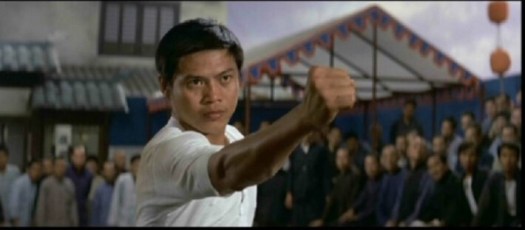
When FIVE FINGERS OF DEATH first hit the local multiplex back in the day, everybody in the neighborhood was kung-fu fighting, throwing chops and roundhouse kicks at each other, trying to be like star Lo Lieh. Bruce Lee’s movies hadn’t yet made it our way, but David Carradine’s KUNG FU was must-see TV for every adolescent boy (and some of the cooler girls). Pretty soon chop-sockey action spread all over the city’s theaters, but it was FIVE FINGERS OF DEATH that reached New Bedford, MA first, and has always held a special place in my heart.
Hong Kong action star Lo Lieh plays Chao Chih-Hao, who’s sent to Shen Chin-Pei’s school by his mentor to train further and defeat Ming Dun-Shun’s “gangsters” in a martial arts tournament. Chih-Hao rescues damsel in distress Yen Chu Hung from some bad guys along the way, and though she comes on to him, his heart belongs to his mentor’s…
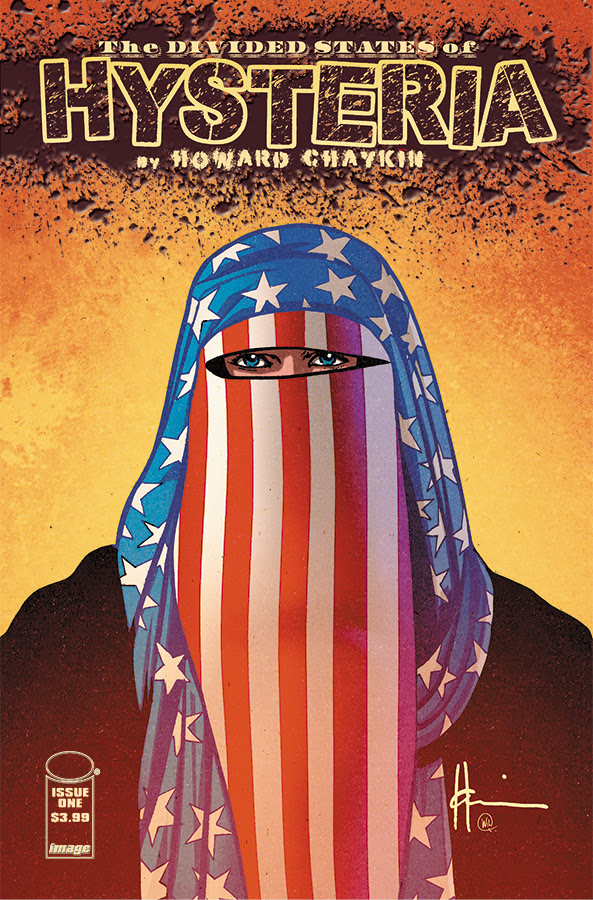
Let’s not kid ourselves — America is fucked. Anyone who follows my ramblings regularly is already more than familiar with my views of our current (and, in my opinion, probably quite temporary) president — and anyone who doesn’t can probably intuit how I feel about the bloated orange mentally ill clown easily enough based on the first couple of lines of this review alone — but one good thing about living in strange and tumultuous times is that the great Howard Chaykin will probably have something to say about them.
After taking us back to the past in his last series, the stylish noir thriller Midnight Of The Soul, Chaykin and his steady collaborators, colorist Jesus Aburtov and letterer Ken Buzenak, are taking aim at the present day (well, three years into the future, as the timeline here would have it) with their new Image Comics six-parter, the…
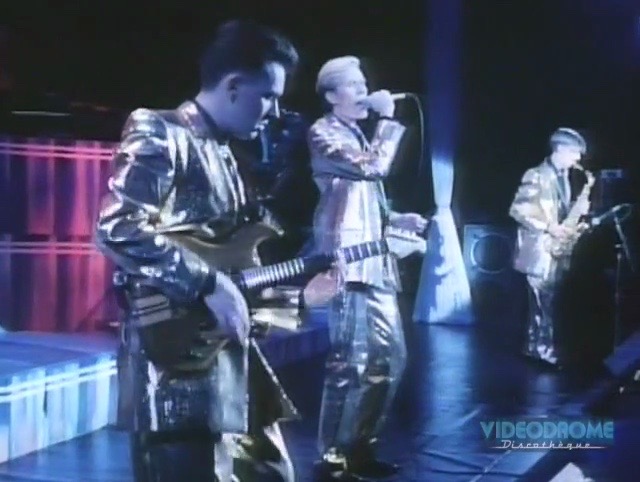
First things first, this is directed by Brian Grant, and not Julien Temple. The other version of this that is listed on mvdbase is from the ABC film Mantrap (1983).
Mantrap (1983, dir. Julien Temple)
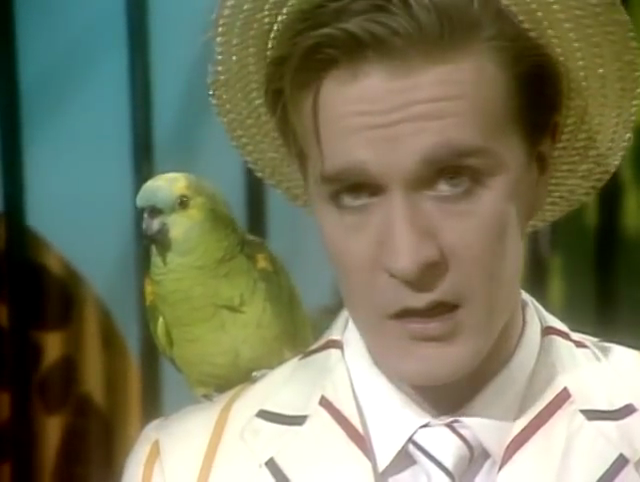
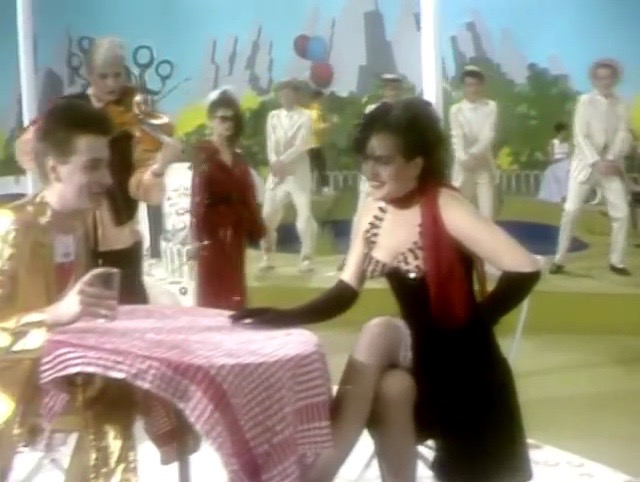
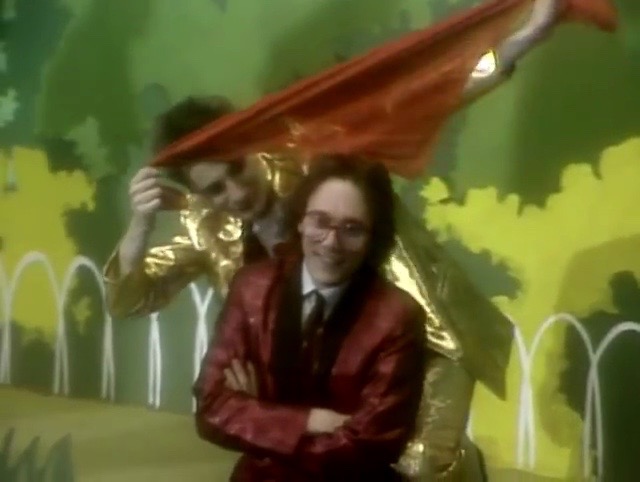
If you enjoy ABC, then I recommend the film. It’s basically an extended music video for the album The Lexicon Of Love that comes complete with Martin Fry fighting his doppelgänger.
From the book I Want My MTV:
Martin Fry: The record companies weren’t pressuring anyone to look a certain way. That came later. For “The Look of Love” we wanted to cross the visual style of Benny Hill, a really crude slapstick comedian, with An American In Paris. I don’t think Kurt Cobain would have ever put on a striped blazer and sung to a wooden crocodile. There’s a parrot on my shoulder at one point. We were pushing it to the limit, seeing how embarrassed we could get. Art is what you get away with.
I wouldn’t have put it past him. Also, you weren’t so much singing to the crocodile as you were trying to beat it to death.
Brian Grant: Martin Fry and I both loved old Hollywood movies. There was no Look at us, we’re a serious rock band. They just wanted to have fun.
I picked up on that from the end of Mantrap.
Mantrap (1983, dir. Julien Temple)
There’s one more quote following the one from Grant, and then we get one from Sir Mix-A-Lot.
Sir Mix-A-Lot, artist: Devo, Gary Numan, the Fixx–I liked all the new wave bands. But I didn’t like any of ’em so much that I tried to style my hair like the guy from A Flock Of Seagulls. And I never tried to hold one key on a synthesizer for as long as he did in “I Ran.”
I’ll never look at Baby Got Back the same way again.
Baby Got Back by Sir Mix-A-Lot (1992)
There are the obvious parts like what I assume is a reference to the beginning of 8½ (1963).
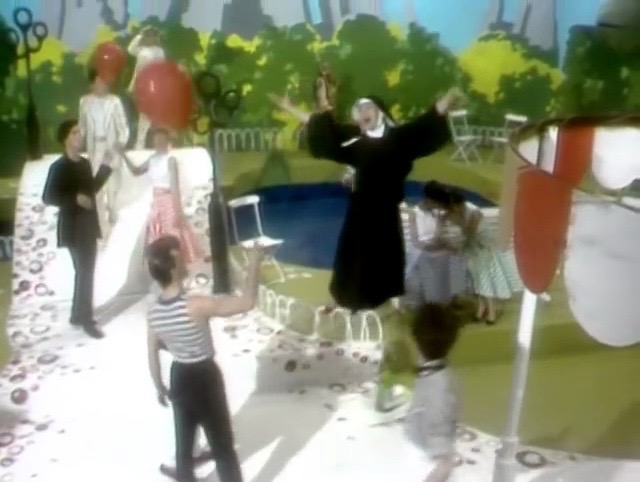
The flying nun.
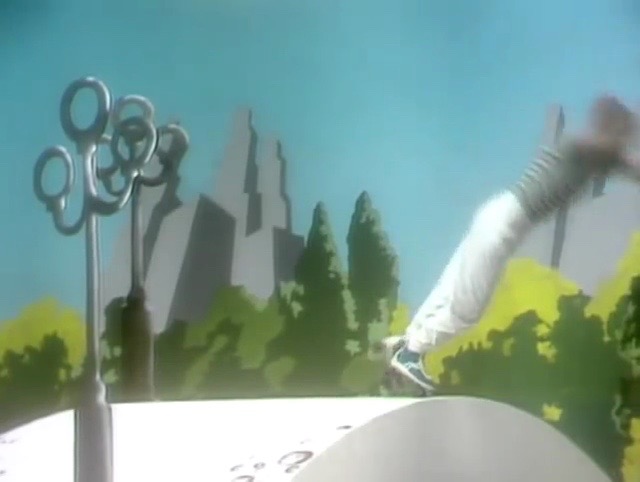
The skater who falls off the bridge.
However, each time I watch this video, I seem to spot something else going on.
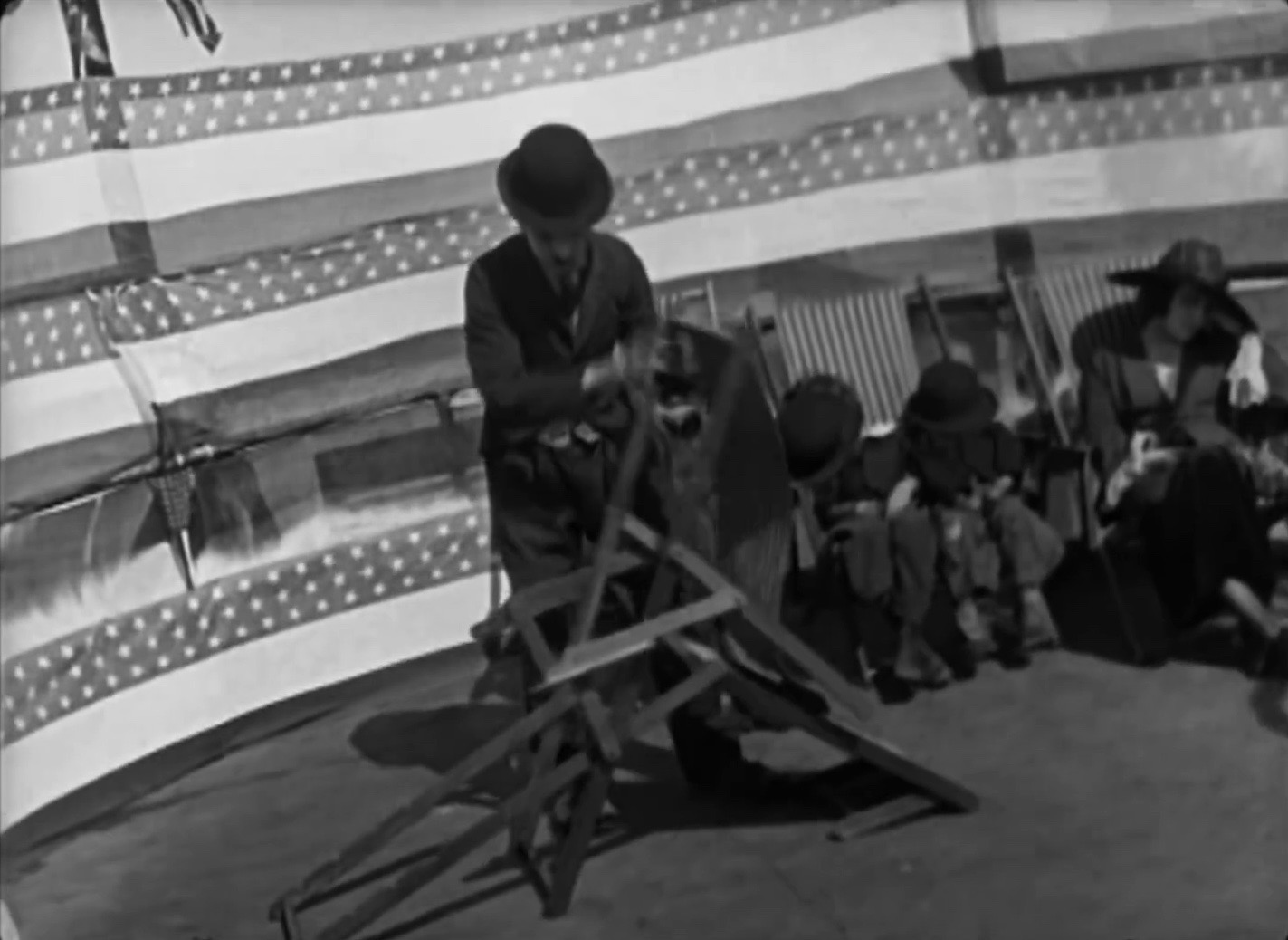
This guy looks like he should be in the background of a Jacques Tati film as he does his routine from A Day’s Pleasure (1919).
A Day’s Pleasure (1919, dir. Charlie Chaplin)
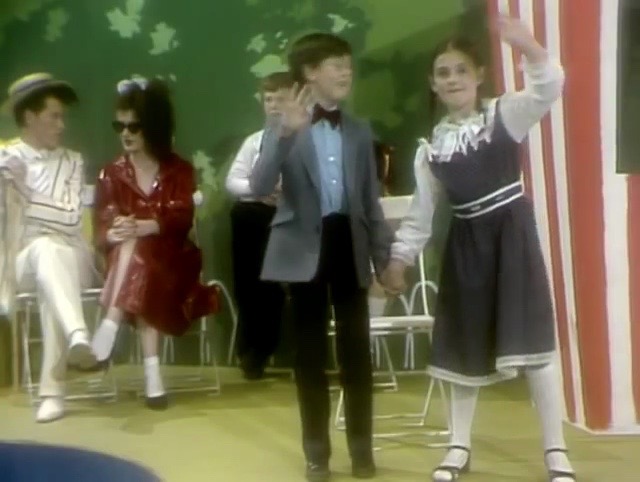
Is that his kid back there?
There’s a lower level on the set way back there. Why?
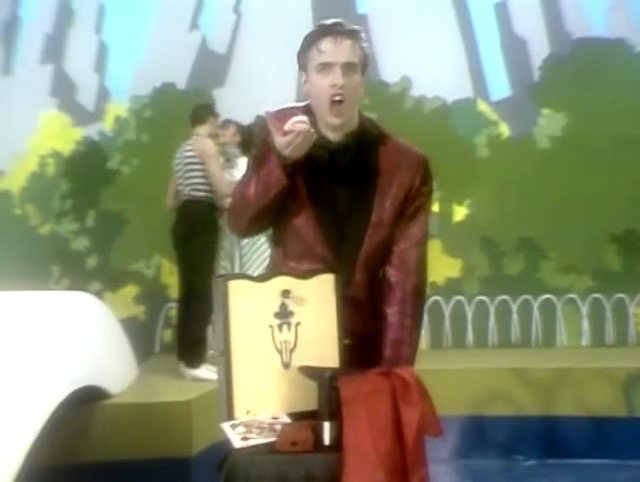
Why does this guy have a giant playing card in addition to everything else?
Who is this man in black that crosses the bridge behind Fry?
I guess we needed at least one eighties person in this video.
Tarzan Boy?
A fire-thrower wearing a leopard print skirt. Sure.
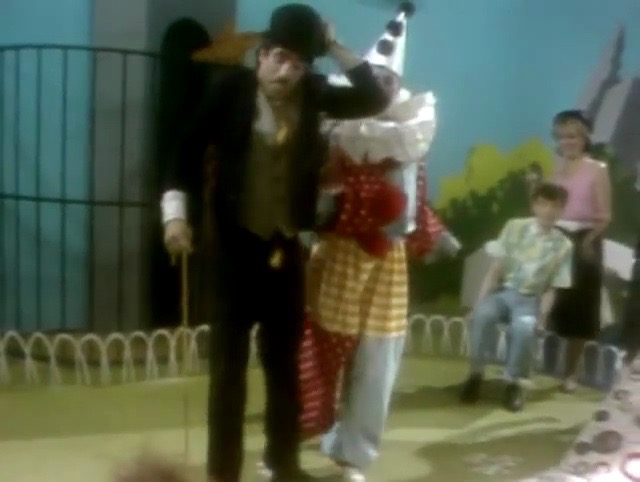
Charlie Chaplin dating a clown. Of course that’s in here.
I don’t know what this guy wearing Martin Fry’s costume from Poison Arrow is doing here or what exactly he’s even doing.
Director Brian Grant has done around 180 music videos.
I love this video. Enjoy! And remember to watch out for plugs in spaghetti.
While Wonder Woman (and, by association, the DCEU) is currently riding high, the MCU has several highly anticipated films coming out later this year and in 2018. One of the most anticipated in Ryan Coogler’s Black Panther. It stars Chadwick Boseman as the title character and it is scheduled to be released on February 16th, 2018.
The first trailer dropped today.
What do you think? Am I the only one who wants to visit Wakanda?
Missouri during the Civil War. All young men are being forcibly constricted into the Union army, leaving those who want to avoid service with only two options: they can either disguise themselves as a woman and hope that the soldiers are fooled or they can head out west. Drew Dixon (Barry Brown) opts for the latter solution but his plans hit a snag when he’s robbed and pistol-whipped by Jake Rumsey (Jeff Bridges). When Drew coincidentally meets Jake for a second time, he immediately attacks him. Jake is so impressed that he insists that Drew join his gang of thieves.
Jake’s gang, which include two brothers (one of whom is played by John Savage) and a ten year-old boy, is hardly the wild bunch. They spend most of their time robbing children and are, themselves, regularly robbed by other gangs, including the one run by Big Joe (David Huddleston). Their attempt to rob a stagecoach goes hilariously wrong. Less hilarious is what happens when they try to steal a pie from a window sill.
Bad Company was the directorial debut of Robert Benton and it has the same combination of comedy and fatalism that distinguished both his script for Bonnie and Clyde and several of the other revisionist westerns of the 1970s. While the interplay between Drew and Jake may remind some of Butch Cassidy and the Sundance Kid, the film’s sudden bursts of violence feel like pure Peckinpah. Fortunately, the combination of Robert Benton’s low-key direction and the excellent performances of Jeff Bridges and Barry Brown allows Bad Company to stand on its own. Brown and Bridges make for an excellent team, with Bridges giving a charismatic, devil-may-care performance and the late Barry Brown holding his own as the more grounded Drew. (Sadly, Brown, who appears to have had the talent to be a huge star, committed suicide six years after the release of Bad Company.) This unjustly forgotten western is one of the best films of the 1970s.
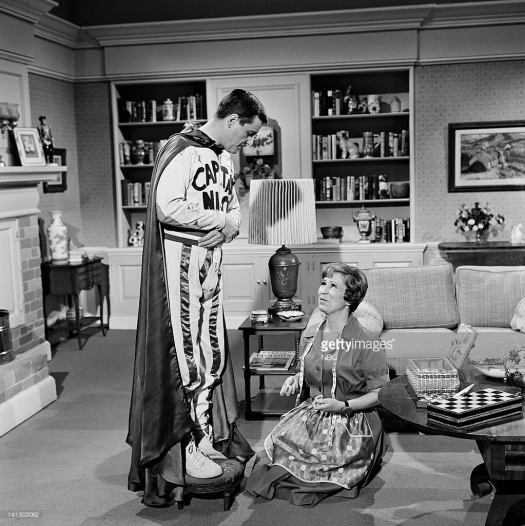
Yes, that’s distinguished actor William Daniels in those long-johns as CAPTAIN NICE, which aired Monday nights on NBC-TV for eight months and fifteen episodes during the height of the superhero camp craze in 1967. Similar in theme to MISTER TERRIFIC on rival CBS, I preferred this one as a kid because of it’s MAD Magazine-level of jokes and gags – which ain’t a bad thing, in my book! The silly superhero series was created by Buck Henry, who also (along with pal Mel Brooks ) was responsible for another campy sitcom, the 60’s spy spoof GET SMART!
Mild -mannered chemist Carter Nash works for the Big Town Police Department, and invents a super-secret super-formula that transforms him into Captain Nice. His domineering mother (Alice Ghostley) sews him up a super-suit and tells him to go out and fight crime like a good boy. Carter’s got all the powers of Superman, except he’s a bit…


 Three Detroit auto workers (played by Harvey Keitel, Yaphet Kotto, and Richard Pryor) are fed up.











 Missouri during the Civil War. All young men are being forcibly constricted into the Union army, leaving those who want to avoid service with only two options: they can either disguise themselves as a woman and hope that the soldiers are fooled or they can head out west. Drew Dixon (Barry Brown) opts for the latter solution but his plans hit a snag when he’s robbed and pistol-whipped by Jake Rumsey (Jeff Bridges). When Drew coincidentally meets Jake for a second time, he immediately attacks him. Jake is so impressed that he insists that Drew join his gang of thieves.
 Through the Shattered Lens