
Artist Unknown
Artist Unknown
This is far from the first time I have heard this song, but it is the first time I have watched the music video. I have to imagine that it is based on the now infamous ending of the TV Show St. Elsewhere. In the last episode of that show, it appears that the entire show was actually taking place in the mind of an autistic guy named Tommy Westphall.
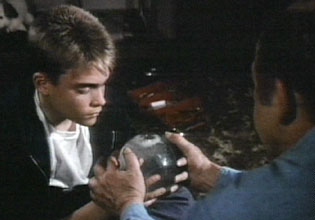
St. Elsewhere
The same scene has been redone several times such as the 1996 episode of NewsRadio where it appears the entire show is taking place in the mind of Stephen Root’s character.
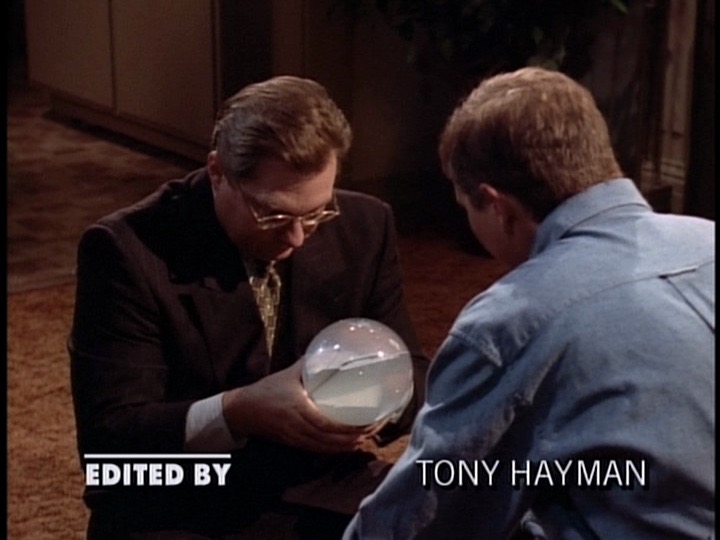
NewsRadio
You might recall Stephen Root’s character as the Alec Baldwin character from 30 Rock since it’s the same show as NewsRadio, but fixed. 30 Rock did a similar episode for it’s series finale.
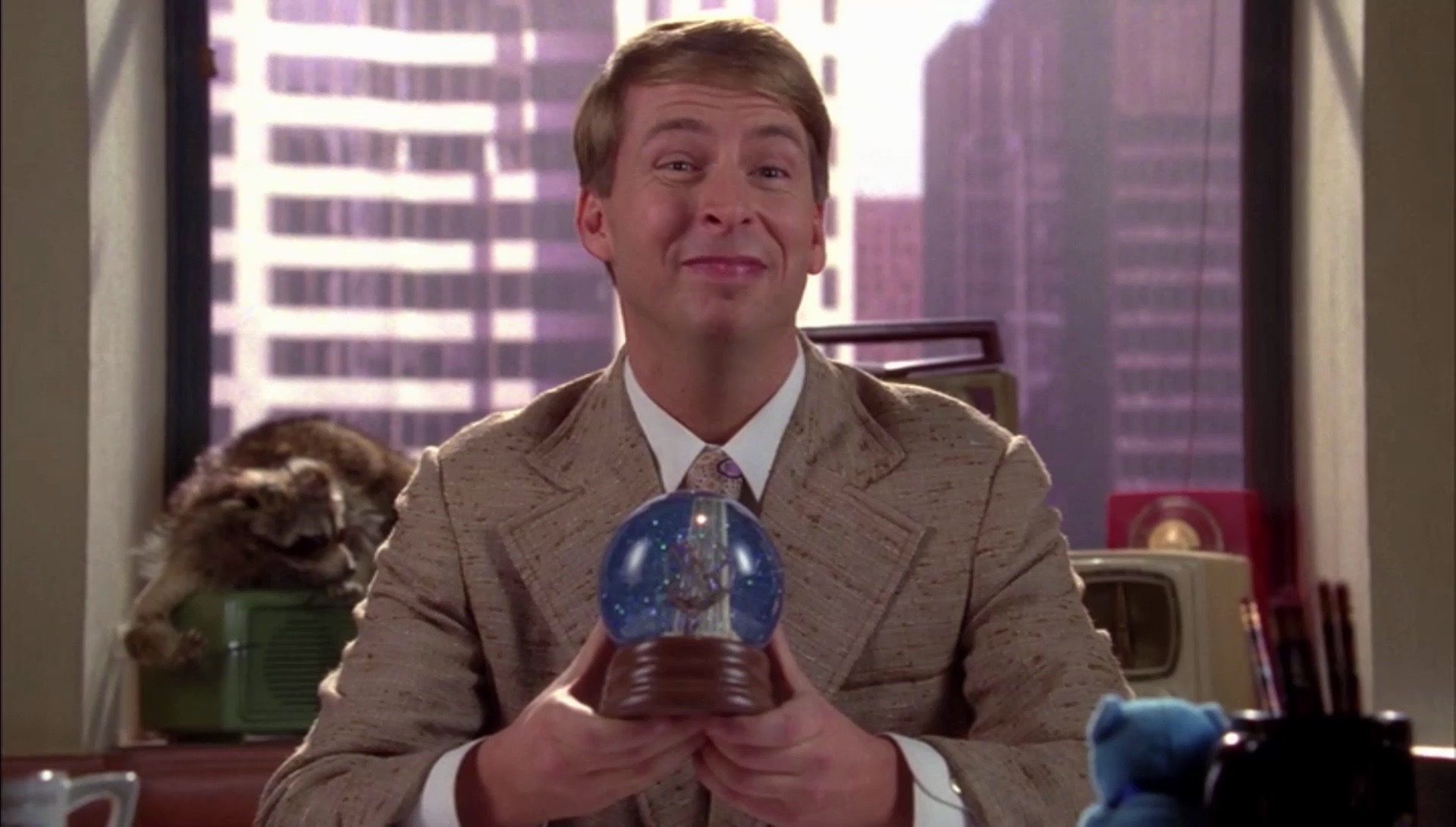
30 Rock
In the case of this music video, it takes place entirely within a small box being carried around by a drifter. This would fit with what Isaac Brock said about why he wrote the song in an interview with The A.V. Club:
“It was a completely conscious thing. I was just kind of fed up with how bad shit had been going, and how dark everything was, with bad news coming from everywhere. Our president George W. Bush is just a fucking daily dose of bad news! Then you’ve got the well-intentioned scientists telling us that everything is fucked. I just want to feel good for a day.”
I guess it could also be a reference to One Magic Christmas (1985) where the central point of hope is the North Pole within a snow globe where the little girl visits Santa Claus.
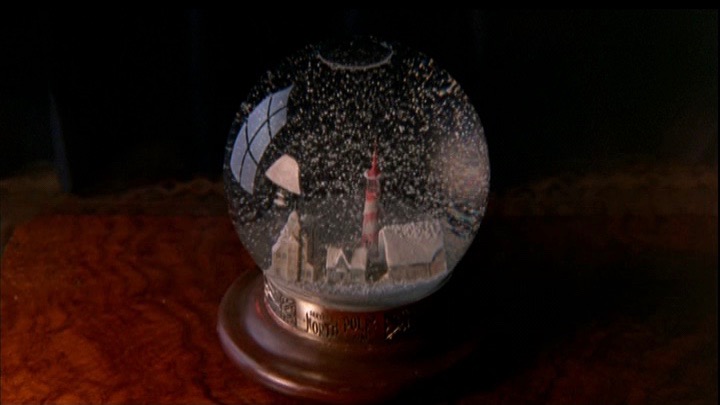
One Magic Christmas (1985)
The rest of the music video reminds me of the comic book styling of The Alan Parsons Project’s Don’t Answer Me in the way it portrays everything as a two-dimensional pop-up book. That music video has a comic book opening that contains the music video inside itself.
The rest is kind of morbid with the sheep being sent to slaughter, which seems to contrast with the intent of the song.
Still, a pretty music video to look at.
Christopher Mills directed the music video. He seems to have worked on somewhere around 70 music videos. He also wrote and worked as an animator on the video.
Kelly Norris worked as an executive producer on the video. It is a little difficult to tell, but she seems to have produced around 100 music videos.
Danny Lockwood’s work on the music video is new to me. He was the video commissioner. I had to look up what that means. A video commissioner is essentially a creative director in that the music company comes to him, and he goes out to find the appropriate director to make the music video. Lockwood seems to have worked in this capacity on around 140 music videos. He has also done some other work such as co-directing Last Friday Night (T.G.I.F.) for Katy Perry.
Enjoy!

Question : you’re a comic book publisher and you’ve got yourself a high-profile “superfan.” What should you do about it?
Answer : if you’re DC, and said fan is Gerard Way of My Chemical Romance fame — who interned at your offices and was planning on pursuing a career as a writer and/or artist on your books before his band went and got famous — you give him not just a series, but an entire fucking line. For developmental guidance you pair him with veteran Vertigo editor Shelly Bond (who has since, sadly, left the building), but by and large you leave him to his own devices and let him come up with whatever it is that he comes up with. The end result? A new imprint semi-mysteriously called DC’s Young Animal. Its first title? A(nother) re-imagined take on the original misfit super-team : the one, the only —
View original post 924 more words
(For the past three weeks, Lisa Marie has been in the process of reviewing 56 back to school films! She’s promised the rest of the TSL staff that this project will finally wrap up by the end of Monday, so that she can devote her time to helping to prepare the site for its annual October horror month! Will she make it or will she fail, lose her administrator privileges, and end up writing listicles for Buzzfeed? Keep reading the site to find out!)
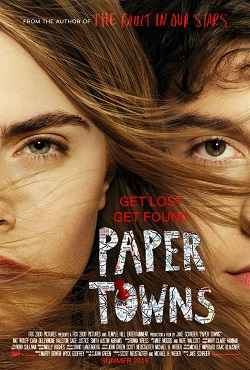
Looking at the film poster above, you could be forgiven for immediately thinking of The Fault In Our Stars. Of course, some of that is because it says, “From the author of The Fault In Our Stars” and because it features half of Nat Wolff’s face. (Wolff had a key supporting role in Fault.) Beyond that, though, the poster feels as if it could have just as easily been used for The Fault In Our Stars. Check out the intensity of the stares. Though we may only see half of their faces, both of the pictured characters appear to be daring the viewer to dismiss their concerns as being mere “teen drama.”
When Paper Towns was released in 2015, it was repeatedly advertised as being the next Fault In Our Stars. Paper Towns does share Fault‘s unapologetic earnestness and, in a few scenes, its sense of inescapable melancholy. (As people get older, they tend to sentimentalize the years that came before and, as a result, they often forget how coming-of-age and intense regret often go hand-in-hand.) But ultimately, though they’re both based on novels by John Green and feature Nat Wolff, Paper Towns tells a very different story from The Fault In Our Stars.
Nat Wolff stars as Quintin, who is better known as Q. Quintin is a student at Jefferson Park High School in Orlando. He’s the epitome of a good kid. He’s shy, he’s polite, and, somewhat inevitably when you consider what is currently valued in American society, he’s not particularly popular at school. He spends most of his time hanging out with his friends, Ben (Austin Abrams) and Radar (Justice Smith). And when he’s not hanging out with them, he’s pining for the most popular girl in school, Margo (Cara Delivingne).
Margo and Quintin have been neighbors since they were children. When Margo’s family first moved in, she and Quintin became close friends but that friendship ended after they came across the body of a man who had committed suicide. Traumatized, Margo drifted away from Quintin. Now, nine years later, they are both seniors in high school. Quintin silently loves Margo. Margo rarely acknowledges his existence…
Or, that is, she doesn’t until the night that she suddenly climbs through Quintin’s bedroom window. She explains that her boyfriend has been cheating on her. She wants revenge on him and all of her friends, none of whom bothered to tell her what was going on. A night of gleeful vandalism follows, ending with a romantic dance.
The next morning, Margo is gone. She’s vanished and no one knows where she has gone. However, Quintin is determined to find her and he is also convinced that she has left him a trail of clues that will lead him to her. When he concludes that she’s gone to upstate New York, he recruits his friends (and one of Margo’s former friends) to go on a road trip with him. Quintin is convinced that Margo will be waiting for him but, as always, the truth is a bit more complex…
While the plot description might make Paper Towns sound like a YA version of Gone Girl, it’s actually an achingly sincere and incredibly likable little film. The entire cast has a good chemistry and their dialogue is clever without sounding artificial. The best thing about Paper Towns is that it serves as a wonderful showcase for Nat Wolff, who is one of the best and most underrated young actors working today. If you watch this film directly after watching Wolff convincingly play a self-destructive sociopath in Palo Alto, you’ll get a hint of Wolff’s range.
Paper Towns won’t make you cry like The Fault In Our Stars did but it’s still a pretty decent film.
(For the past three weeks, Lisa Marie has been in the process of reviewing 56 back to school films! She’s promised the rest of the TSL staff that this project will finally wrap up by the end of Monday, so that she can devote her time to helping to prepare the site for its annual October horror month! Will she make it or will she fail, lose her administrator privileges, and end up writing listicles for Buzzfeed? Keep reading the site to find out!)

Much as in the case of my reviews of School’s Out, Degrassi Goes Hollywood, and Degrassi Takes Manhattan, this review of 2015’s Degrassi: Don’t Look Back is probably not going to make much sense to you if you’re not a huge fan of Degrassi. Then again, it’s possible that it won’t make sense even if you’ve seen every episode of Degrassi.
Among the Degrassi fandom, there’s actually a very passionate debate as to whether or not Don’t Look Back should even be considered canonical. It premiered at the end of season 14, following the graduation episode. Season 14 was also the last season of Degrassi to be broadcast on TeenNick. (The series has subsquently moved to Netflix). Some people don’t consider Netflix Degrassi to be the same as TeenNick Degrassi and since Don’t Look Back is mostly concerned with laying the foundation for Netflix Degrassi, there’s a tendency among some to treat Don’t Look Back as almost being fan fiction.
Admittedly, Don’t Look Back does definitely feel different from the other Degrassi films. It’s much more light-hearted, with a good deal of the film’s 87 minute running time devoted to parodying different horror films. (It’s almost as if Don’t Look Back, which premiered in August, was actually conceived with an October premiere in mind.)
The film, which takes place during the summer, follows five storylines, four of which are pretty typical of what you’d expect to see on Degrassi. Rich girl Frankie Hollingsworth (Sara Waisglass) gets an internship at Toronto’s city hall and has to prove to her coworkers that she’s not just a spoiled brat while, at the same time, resisting the temptation to cheat on her boyfriend, Winston (Andre Kim). Zoe (Ana Golja) attends summer school and finds herself attracted to her classmate, the acerbic Grace (Nikki Gould). (As fans of Netflix Degrassi know, Zoe would eventually accept that she was a lesbian while Grace shocked everyone by revealing that she was both straight and seriously ill.) Tristan Milligan (Lyle Lettau) obsesses over both his dreams of internet stardom and his former boyfriend, Miles. Maya (Olivia Scriven) gets a job as a nanny for a rock star (Sonia Dhillon Tully) and Zig (Ricardo Hoyos) gets mad because he feels neglected.
But then, there’s the fifth subplot and here’s where things get controversial. A minor Degrassi character, Gloria Chin (Nicole Samantha Huff), vanishes and soon, everyone in Canada is searching for her. Fortunately, Grade 10 students of Degrassi Community School are able to use their amazing computer skills and deductive reasoning to figure out where Grace is being held. It’s one of those weird things that you expect to see in an episode of something like CSI or NCIS or some other show with initials for a title. It’s not really something you would expect to see on Degrassi. It feels definitely out-of-place as a part of a franchise that has always prided itself on realistically and honestly exploring teen issues.
But then again, after 14 seasons (and that’s not even including the two series that came before Degrassi: The Next Generation), both the format and tone of Degrassi have changed several times. That’s the way it’s always been. Seasons 1 & 2 of Degrassi have a completely different feel from seasons 3 & 4. And, ultimately, I guess the idea of a bunch of tenners solving a crime is not any stranger than Kevin Smith shooting Jay and Silent Bob Go Canadian, Eh? at the school.
Anyway, if you’re a Degrassi fan, Don’t Look Back is entertaining enough. And yes, it is canonical. Even if they’ve never mentioned since that they solved the Canadian crime of the century (and does seem like something that would occasionally come up in conversation), apparently that’s what the students at Degrassi did during their summer vacation.
Good for them!
(For the past three weeks, Lisa Marie has been in the process of reviewing 56 back to school films! She’s promised the rest of the TSL staff that this project will finally wrap up by the end of Monday, so that she can devote her time to helping to prepare the site for its annual October horror month! Will she make it or will she fail, lose her administrator privileges, and end up writing listicles for Buzzfeed? Keep reading the site to find out!)

I almost hate the idea of criticizing a film like 2015’s A Girl Like Her. This is one of those films that is about a serious subject and it has a great message but the execution just doesn’t work.
A Girl Like Her takes place at an affluent public high school. Everyone at the school is really excited because their school has been named the 10th best school in America and it was literally the only public school to make the list! A documentary crew shows up to shoot a film about the school but, shortly after arriving, they learn that a student named Jessica (Lexi Ainsworth) has just tried to commit suicide. What could have driven the shy but generally well-liked Jessica to swallow a handful of pills!? Don’t worry, Inspector Documentarian is on the case!
The film’s director, Amy S. Weber, plays the director of the fictional documentary. And yes, this is a mockumentary, with everything that suggests. In fact, it’s such a mockumentary that it starts to get annoying. There’s only so many random rack focus shots you can see before you want to scream, “Okay, it’s found footage! I FREAKING GET IT ALREADY!” And then there’s the fact that the camera never stops moving. Weber definitely goes overboard with the whole jerky, hand-held camera thing. The shaky cam didn’t make me physically ill (like Hardcore Henry did) but still, it was all a bit much. I’ve seen enough documentaries to know that occasionally, a camera can be held still.
Anyway, Weber finds out that Jessica’s best friend was Brian (Jimmy Bennett) and Brian reveals that he’s obsessed with filming everything. He knew that Jessica was being bullied so he gave her a hidden camera so that she could record her daily torment. Watching the footage reveals that Jessica was being viciously bullied by Avery (Hunter King), who is one of the most popular girls in school.
When Amy first approaches Avery, it provides a moment of unintentional humor. Weber apparently went to a lot of effort to make the high school and its students come across as being authentic. Let’s just say that a lot of the film’s interviews are conducted with teenagers who are awkward in a very recognizable and believable way. But then the documentary crew goes to Avery’s locker and there’s Avery, wearing an expensive pink dress and looking and sounding totally and complete like an actress and the film’s authenticity just collapses. She might as well just turn to the camera and say, “Hi, I’m the meanest mean girl of all.”
Amy convinces Avery to take a camera and to document her own life. So, to keep track, this film is now made up of Jessica’s footage, Brian’s footage, the documentary crew’s footage, and Avery’s video blog. That’s a lot of found footage to sit through and, unfortunately, very little of it feels authentic. The film is actually probably as its strongest when it focuses on Avery, who has a terrible home life and turns out to be a surprisingly multi-faceted bully. (For the most part, Hunter King gives the film’s best performance.) Jessica remains a cipher, even in the footage that she filmed. Meanwhile, the documentary crew’s footage gave off a definite “worst PBS special ever” vibe.
Don’t get me wrong. Weber’s heart was in the right place but, as with most anti-bullying films, A Girl Like Her is often too much “on the nose” for its own good. For all the effort that was put into making this a convincing mockumentary, the illusion is pretty much destroyed whenever anyone opens their mouth and delivers dialogue that could have come straight from Season 12 of Degrassi.
It would be nice if a movie could end bullying but A Girl Like Her is not the film to do it.
Yep! That is just like I remember. By that I mean, it’s the same music video as Addicted To Love with only minor changes. I recommend watching the two music videos side-by-side because you’ll notice only a couple of things are different:
That’s it. Even the runtimes are only off by one second. This music video is one second longer than Addicted To Love.
Unlike Addicted To Love, where we know who all five girls are, I was only able to track down one of the guys named Bryce Buell. I won’t paraphrase the interview entirely, but the most interesting thing to me was that he noticed that Shania was quite petite, so they kept using some camera tricks to make her look taller than the guys. At about two minutes and fourteen seconds you can see the height difference he’s talking about.
Director Paul Boyd has shot somewhere around 150 music videos. He did several of them for Shania Twain.
I wish I could save the cinematographer of this music video for another day, but he happened to shoot this music video, so I’ll talk about him now.
His name is Daniel Pearl. He has shot at least 430 music videos since around 1982. Not small music videos either. He shot November Rain for Guns N’ Roses, Every Breath You Take for The Police, and Billie Jean for Michael Jackson to name a few. In fact, he’s credited as starting modern music videos back in 1969 when he made an experimental film called Rock ‘n’ Roll Nose using a song by The Byrds as the score. He also has numerous other film credits that are notable. He shot the original Texas Chainsaw Massacre in 1974. He was brought back to shoot the 2003 remake as well. He also did the 2009 Friday the 13th. His credits go on and on. Odds are, you’ve seen something he shot.
If you have only seen the music video for Addicted To Love, then this is well worth watching. For those who have seen this already, then enjoy this time capsule of the late 90’s pop princesses.

Artist Unknown
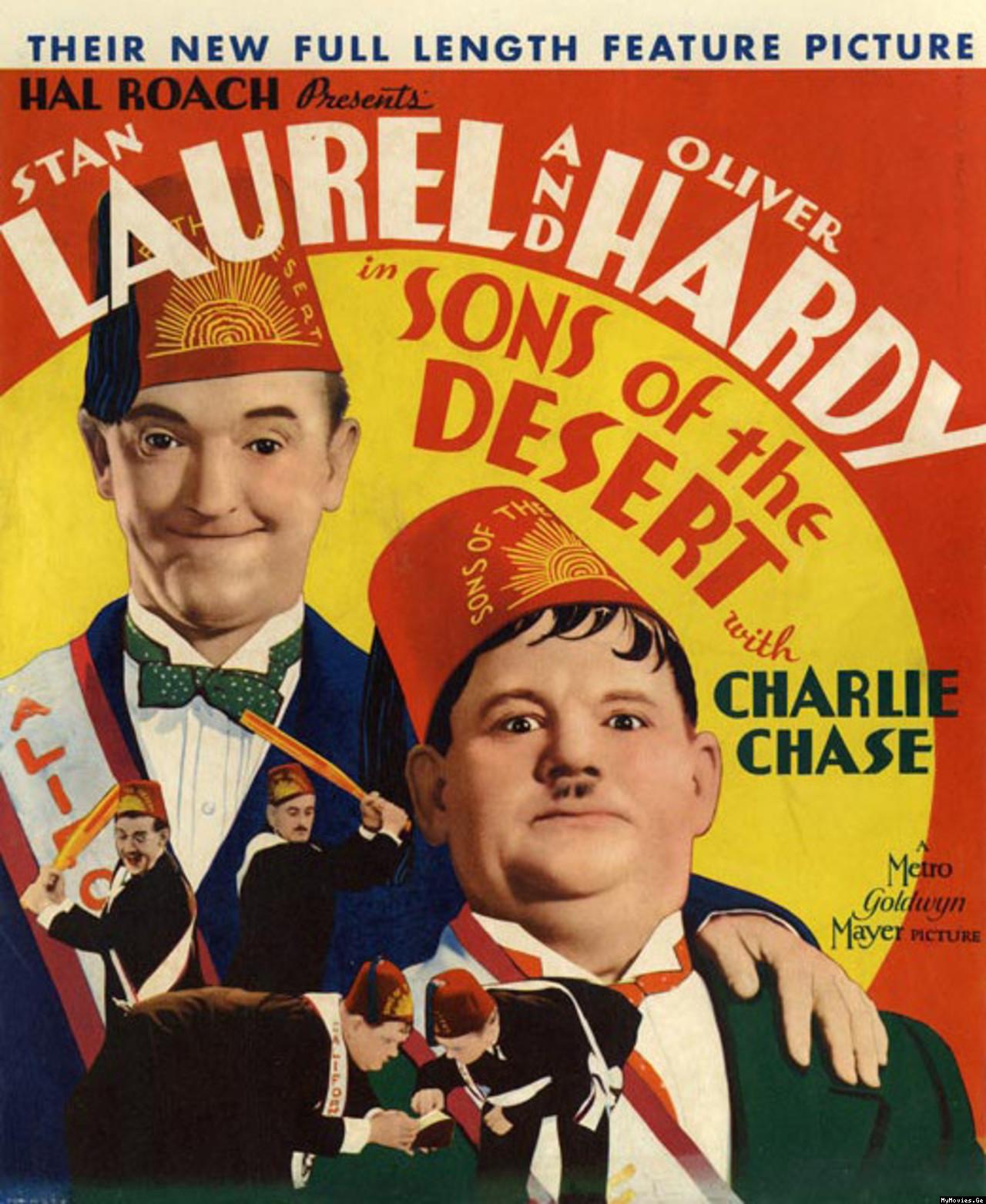
Laurel and Hardy are still beloved by film fans today for their marvelous contributions to movie comedy. Rooted firmly in the knockabout visual style of the silent screen, the team adapted to talking pictures with ease, and won the Best Short Subject Oscar for 1932’s THE MUSIC BOX. The next year the duo made what’s undoubtably their best feature film SONS OF THE DESERT, a perfect blend of slapstick, verbal humor, and situation comedy benefitting from a fine supporting cast and the undeniable chemistry between Stan and Ollie .
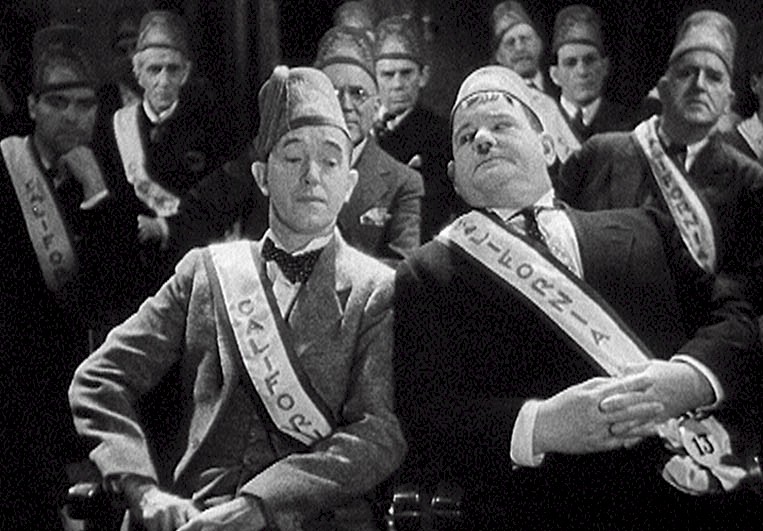
The boys are at a meeting of their lodge The Sons of the Desert when it’s announced all members must swear a sacred oath to attend the annual convention in Chicago. Timid Stanley is afraid his wife won’t let him go, but blustery Ollie insists, boasting about who wears the pants in his family. Of course, Ollie’s just as henpecked as Stan, and his…
View original post 704 more words
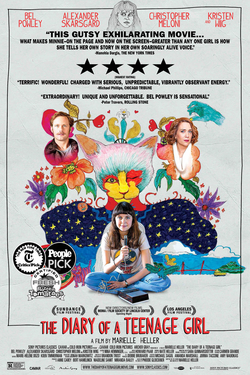
Sometimes, the best way to defend a controversial film is to take a look at some of the people who have criticized it. That’s certainly the case with 2015’s The Diary of a Teenage Girl.
First off, you have so-called critic and professional troll Jeff Wells, who landed in some hot water when he complained that the star of the film, Bel Powley, wasn’t attractive enough for him. Never mind that he thought the rest of the film was intriguing, he simply could not get over the fact that Powley was not conventionally attractive. Never mind, of course, that Powley (who was 23 at the time) was supposed to be playing a 15 year-old and that she gave one of the best and most honest performances of the year or that the film itself was about much more than just sex. Jeff Wells wasn’t turned on and therefore, by his logic, the film failed.
And then you have Sasha Stone, the editor of Awards Daily. Sasha claims to be a feminist and uses her site to regularly scold any actress who she thinks isn’t living up to Sasha’s idea of what a feminist should be. Sasha is the same blogger who announced that her life mission was to “educate” Shailene Woodley and who threatened to never again report on any of Susan Sarandon’s movies because Sarandon was critical of Hillary Clinton. Oddly enough, Sasha is also the online film community’s number one enabler of Jeff Wells, regularly providing cover for him whenever he makes one of his patented misogynistic remarks.
Anyway, Sasha absolutely hated The Diary of a Teenage Girl. In fact, she hated it to such an extent that she’s probably still cursing about it on twitter. Oddly enough, Sasha has never really stated why she hates Diary with such a passion. I mean, here we have an honest film about coming-of-age, one that ends on a note of empowerment. It’s a film that was both written and directed by a woman and it’s based on a graphic novel by Phoebe Gloeckner. This is an important film. As far as I can tell, it appears that Sasha’s hatred was linked to the fact that apparently, she saw the film in a theater that was full of men and she felt that this film was specifically designed to appeal to “dirty old men.”
Which is bullshit.
Don’t get me wrong. I’m sure there are dirty old men who went to see The Diary of a Teenage Girl. That’s just a fact of life. When you have a film about a sexually active 15 year-old, it is going to attract certain people. That, however, is not the film’s fault. In fact, the film’s straight-forward approach to sexuality was probably the exact opposite of what most of those pervs were looking for.
The film’s protagonist is Minnie Goetze (played, as previously stated, by Bel Powley). In 1976, she is 15 years old and living in San Francisco with her irresponsible (and, as becomes apparent as the film plays out, rather unstable) mother (Kristin Wiig). Minnie is an aspiring cartoonist, an independent and intelligent teenager who often feels as if she’s separated from the rest of the world. (The film makes good use of animation to visualize Minnie’s isolation.) After losing her virginity to him, Minnie ends up having an affair with her mother’s handsome loser of a boyfriend (played by Alexander Skarsgard)….
When The Diary of a Teenage Girl was first released, so much attention was paid to the fact that 15 year-old Minnie was sexually active and frequently seen using drugs that many reviewers missed the fact that the film ultimately celebrates Minnie’s intelligence, independence, and her imagination. Speaking for myself, after sitting through a countless number of teen films which either idealized virginity or insisted on punishing any sexually active teen with either pregnancy or an STD, The Diary of a Teenage Girl was actually a welcome change of pace.
Unfortunately, many critics have made the mistake of assuming that just because The Diary of a Teenage Girl does not judge, it therefore supports all of Minnie’s decisions. Despite what some critics claim, Diary of a Teenage Girl does not glamorize anything that Minnie does. (Many of the film’s sex scenes are deliberately filmed to be as unerotic as possible.) At the same time, the film doesn’t feel the need to dispense out any sort of karmic punishment, either. Instead, it’s a film that suggests that Minnie, like everyone else, is exploring and trying to discover what’s right for her. In the end, the message of this film is that the most important thing is to love yourself and to find your own happiness. And there’s absolutely nothing wrong with that.
The Diary of a Teenage Girl is an engrossing and well-made coming-of-age story. I can’t wait to see what director Marielle Heller does next.


 Through the Shattered Lens